




~1 min
Average Reply Time
~1 hour
To Be Matched With A Tutor
30 Min Trial
75% Find Their Tutor On The 1st Trial
$20-35+/hr
Premium Yet Affordable Learning
You’ve been stuck on the same Swift error for three days. Stack Overflow isn’t cutting it. You need a live iOS tutor who can see your Xcode project and fix it with you.
iOS Tutor Online
iOS is Apple’s mobile operating system and native development platform, taught through Swift and Xcode. It equips developers to build, test, and deploy apps for iPhone and iPad using UIKit, SwiftUI, and Apple’s SDK frameworks.
Finding a reliable iOS tutor near me is hard when most tutors stop at introductory Swift. MEB’s software engineering tutoring network includes iOS specialists who know the full stack — from UIKit layout constraints to App Store submission. Whether you’re a computer science student building your first app or a working developer stuck on a Core Data migration, a 1:1 online iOS tutor gets you unstuck fast. One clear outcome: you leave each session able to do something you couldn’t do before.
- 1:1 online sessions tailored to your course syllabus or project spec
- Expert-verified tutors with hands-on iOS and Swift development experience
- Flexible time zones — US, UK, Canada, Australia, Gulf
- Structured learning plan built after a diagnostic session
- Guided project support — we explain, you build and submit
52,000+ students across the US, UK, Canada, Australia, and the Gulf have used MEB since 2008 — including students in Software Engineering subjects like iOS development, Android tutoring, and Swift-based mobile app coursework.
Source: My Engineering Buddy, 2008–2025.
How Much Does an iOS Tutor Cost?
Most iOS tutoring sessions run $20–$40/hr for undergraduate-level coursework and foundational Swift projects. Advanced topics — Core ML, ARKit, App Store optimisation — sit toward $60–$100/hr depending on tutor depth. New students can start with the $1 trial before committing to a package.
| Level / Need | Typical Rate | What’s Included |
|---|---|---|
| Standard (intro to intermediate Swift) | $20–$35/hr | 1:1 sessions, project guidance, code walkthroughs |
| Advanced / Specialist (ARKit, Core ML, SwiftUI) | $35–$100/hr | Expert tutor, niche framework depth |
| $1 Trial | $1 flat | 30 min live session or one project question explained |
Tutor availability tightens sharply around university project deadlines and semester-end assessments. Book early if you’re working to a hard submission date.
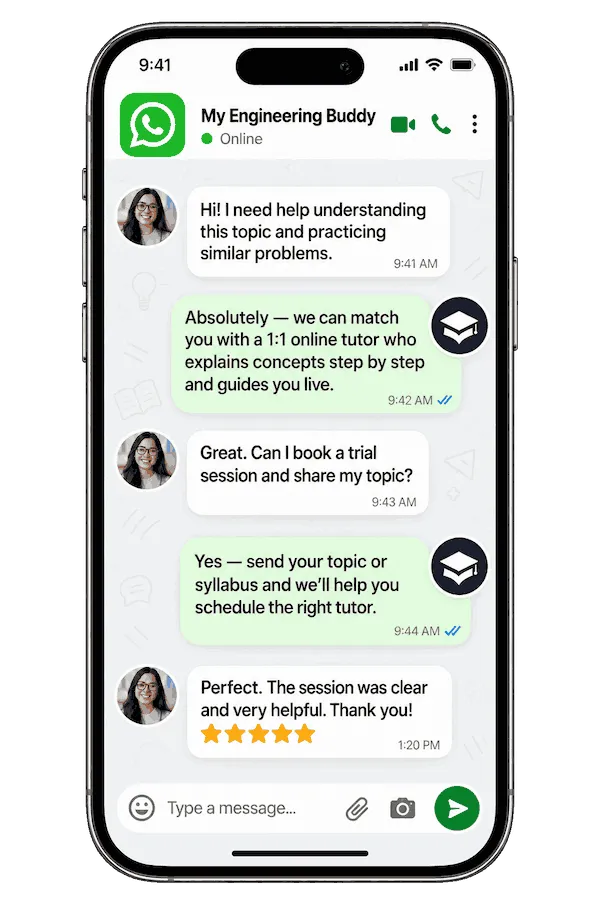
WhatsApp MEB for a quick quote — average response time under 1 minute.
Who This iOS Tutoring Is For
iOS tutoring at MEB covers a wider range than most people expect. Students arrive with everything from a broken ViewController stack to a half-built Core Data model they can’t debug. If your progress has stalled, a tutor cuts through it quickly.
- Undergraduate computer science students with an iOS development module or capstone project
- Graduate students building research apps using HealthKit, ARKit, or custom ML models
- Self-taught developers who learned from tutorials but hit a wall on real app architecture
- Students with a university conditional offer depending on this project grade — this is the session that protects it
- Parents supporting a student whose app project grade has slipped alongside their confidence
- Working developers needing targeted help with Swift concurrency, memory management, or Xcode Instruments
Students at institutions including MIT, Stanford, University of Toronto, Imperial College London, ETH Zurich, University of Melbourne, NYU, and Carnegie Mellon have used MEB for mobile app development help during intensive project periods.
Start with the $1 trial — a 30-minute diagnostic that immediately tells both you and the tutor where the real gaps are.
1:1 Tutoring vs Self-Study vs AI vs YouTube vs Online Courses
Self-study works if you’re building simple apps, but stalls when architecture decisions get real. AI tools like ChatGPT explain Swift syntax quickly but can’t debug your specific Xcode project or explain why your Auto Layout is breaking on a specific device. YouTube covers concepts well until you’re stuck on your own codebase — then it stops helping. Online courses (Udemy, Coursera) give structure but move at a fixed pace with no feedback on your code quality. A 1:1 iOS tutor from MEB sees your actual project, corrects your SwiftUI state management in real time, and calibrates every session to your exact module or submission brief.
Outcomes: What You’ll Be Able To Do in iOS
After working with an MEB iOS tutor, you’ll be able to build and debug SwiftUI views without hitting layout constraint errors you can’t explain. You’ll be able to model and persist data using Core Data or SwiftData with a clear understanding of fetch requests and relationships. You’ll be able to apply the MVC and MVVM patterns correctly in a real Xcode project — not just describe them. You’ll be able to integrate APIs using URLSession or Combine, handle JSON decoding, and manage asynchronous calls cleanly. You’ll be able to submit a working app to TestFlight or the App Store with confidence in its build settings and provisioning profiles.
Based on feedback from 40,000+ sessions collected by MEB from 2022 to 2025, 58% of students improved by one full grade after approximately 20 hours of 1:1 tutoring in subjects like iOS. A further 23% achieved at least a half-grade improvement.
Source: MEB session feedback data, 2022–2025.
At MEB, we’ve found that iOS students who share their Xcode project before the first session save at least 20 minutes of setup time. Send your project folder or GitHub link via WhatsApp before you start — the tutor arrives already oriented to your architecture.
What We Cover in iOS (Syllabus / Topics)

Swift Language Fundamentals & Xcode
- Swift syntax: optionals, closures, protocols, generics, and error handling
- Value types vs reference types — structs, classes, enums
- Swift concurrency: async/await, actors, Task groups
- Xcode project structure, build targets, schemes, and simulators
- Instruments: profiling memory leaks, CPU usage, and time profiler
- Unit testing with XCTest and UI testing with XCUITest
Core textbooks: Swift Programming: The Big Nerd Ranch Guide (Mathias & Gallagher); iOS Programming: The Big Nerd Ranch Guide (Conway et al.).
UIKit & SwiftUI Interface Development
- UIKit fundamentals: ViewControllers, Auto Layout, storyboards vs programmatic UI
- SwiftUI views, modifiers, state management (@State, @Binding, @ObservedObject, @EnvironmentObject)
- Navigation: NavigationStack, TabView, modal presentation
- Table views, collection views, diffable data sources
- Animations: UIView animation, SwiftUI transitions, and Core Animation layers
- Accessibility: VoiceOver support, dynamic type, and colour contrast
Core textbooks: SwiftUI for Masterminds (Gauchat); Programming iOS 17 (Neuburg). Apple’s developer documentation is the definitive reference for framework APIs.
Data, Networking & App Architecture
- Core Data: entities, relationships, fetch requests, migrations
- SwiftData (iOS 17+): model macros, persistence container, query descriptors
- Networking with URLSession: GET/POST, Codable JSON decoding, error handling
- Combine framework: publishers, subscribers, operators for reactive pipelines
- Architecture patterns: MVC, MVVM, and coordinator pattern in practice
- Firebase and REST API integration in real app projects
- App Store preparation: provisioning profiles, TestFlight, App Store Connect
Core textbooks: Combine: Asynchronous Programming with Swift (raywenderlich.com team); Advanced iOS App Architecture (raywenderlich.com team). For Firebase integration help, MEB tutors cover both iOS and backend configuration.
What a Typical iOS Session Looks Like
The tutor opens by checking what you worked on since last time — specifically the Auto Layout issue or the Core Data fetch predicate you were stuck on. You share your Xcode project over screen share on Google Meet. The tutor uses a digital pen-pad to annotate the view hierarchy or draw out the data model while you watch. You then take over — implementing the fix or writing the next function while the tutor watches and corrects in real time. If you’re working through SwiftUI state propagation or async/await cancellation patterns, you’ll write it, break it, and fix it in the same session. The session closes with a specific task: finish the networking layer for one endpoint, or get the Core Data migration running without crashes. Next topic is noted and shared before you disconnect.
Students consistently tell us that seeing their own Xcode project debugged live — not a textbook example — is the moment iOS clicks. Generic tutorials show clean code. Tutors show you why your code isn’t working and what the fix actually looks like in context.
How MEB Tutors Help You with iOS (The Learning Loop)
Diagnose: In the first session, the tutor reviews your project or course brief, runs your code, and identifies the three or four specific gaps causing the most damage — whether that’s weak understanding of Swift memory management, confusion about MVVM bindings, or an inability to read Xcode’s crash logs.
Explain: The tutor works through live examples on your actual codebase using a digital pen-pad, not a whiteboard full of abstract diagrams. If you’re struggling with async/await, you’ll see it solved in your project’s networking layer before the theory is discussed.
Practice: You take over. You write the function, configure the fetch request, or implement the protocol conformance while the tutor watches. No passive watching — you do the work in session.
Feedback: Errors get caught immediately. The tutor explains not just what went wrong but why — which matters when you’re writing a project report or sitting a viva on your code choices.
Plan: Each session ends with a clear task and a note of what the next session covers. Accountability is built in — you arrive with something done, and the tutor checks it first.
Sessions run on Google Meet with screen sharing. The tutor uses a digital pen-pad or iPad with Apple Pencil to annotate your code and diagrams. Before your first session, share your Xcode project link or GitHub repo, your course brief or project spec, and your submission deadline. The first session covers a diagnostic pass through your project, identifies the two or three highest-priority fixes, and sets a session sequence from there. Whether you need a quick catch-up before a deadline, structured 4–8 week revision, or ongoing weekly support through the semester, the tutor maps the plan after that first diagnostic.
Start with the $1 trial — 30 minutes of live iOS tutoring that also serves as your first diagnostic.
The most common pattern MEB iOS tutors see: students who understand Swift syntax from tutorials but have never built a real app with proper architecture. That gap shows up fast in graded projects — and it’s fixable in 3–4 focused sessions.
Source: My Engineering Buddy tutor observations, 2022–2025.
Try your first session for $1 — 30 minutes of live 1:1 tutoring or one project question explained in full. No registration. No commitment. WhatsApp MEB now and get matched within the hour.
Tutor Match Criteria (How We Pick Your Tutor)
Not every Swift developer makes a good tutor. MEB vets on subject depth and teaching clarity — separately.
Subject depth: Tutors are matched to your specific level — whether that’s a first-year university iOS module, a graduate research app, or a professional project using Core ML or ARKit. The tutor must have shipped real apps or taught iOS at the relevant level.
Tools: All sessions run on Google Meet with screen sharing. Tutors use a digital pen-pad or iPad with Apple Pencil to annotate your code directly — essential for explaining layout constraints and data flow visually.
Time zone: Matched to your region — US, UK, Gulf, Canada, or Australia — so evening and weekend slots are available without a 3am session.
Goals: Tutor selection accounts for whether you need project completion support, conceptual depth for a viva or exam, or weekly app development help through a full semester.
Unlike platforms where you fill out a form and wait, MEB responds in under a minute, 24/7. Tutor match takes under an hour. The $1 trial means you test before you commit. Everything runs over WhatsApp — no logins, no intake forms.
Pricing Guide
iOS tutoring starts at $20/hr for standard undergraduate-level coursework. Graduate-level topics — Core ML model integration, custom Swift Package Manager libraries, ARKit scene reconstruction — sit at $60–$100/hr depending on tutor background and subject complexity.
Rate factors: your course level, the complexity of your current project, how close your deadline is, and tutor availability in your time zone. Availability drops sharply in the two weeks before major submission windows at US and UK universities.
For students targeting roles at Apple, Google, or top-tier iOS consultancies, tutors with professional iOS engineering backgrounds are available at higher rates — share your specific goal and MEB will match the tier to your ambition.
Start with the $1 trial — 30 minutes, no registration, no commitment. WhatsApp MEB for a quick quote.
FAQ
Is iOS development hard to learn?
The Swift language itself is learnable in weeks. The difficulty is in Xcode’s complexity, Apple’s framework architecture, and understanding how UIKit or SwiftUI actually manages state and layout at scale. Most students struggle at the architecture layer, not the syntax layer.
How many sessions do I need?
Students fixing a specific project bug or submission gap typically need 3–5 sessions. Students building understanding of iOS architecture from scratch — MVVM, data persistence, networking — usually need 10–20 hours spread over a semester to reach consistent competency.
Can you help with my iOS project and portfolio work?
Yes. MEB tutors guide you through planning, architecture decisions, debugging, and code quality. The project is yours — you write and submit it. MEB tutoring is guided learning. See our Academic Integrity policy and Why MEB page for full details on what we help with and what we don’t.
Will the tutor match my exact syllabus or exam board?
Yes. Share your course outline, university module descriptor, or project brief before the first session. The tutor reviews it in advance and targets sessions to your specific deliverables — not a generic iOS curriculum.
What happens in the first session?
The tutor reviews your project or course brief, runs your code, and identifies the three or four most critical gaps. By the end of the first session, you have a prioritised fix list and a session sequence. Nothing generic — the diagnostic is built around your actual submission.
Is online iOS tutoring as effective as in-person?
For code-based subjects, online is often better. Screen sharing lets the tutor see your exact Xcode setup, your real error messages, and your actual project structure — something a whiteboard session can’t replicate. The digital pen-pad annotation layer adds the visual explanation in-person tutors use.
Can I get iOS help at midnight?
Yes. MEB operates across US, UK, Gulf, Australia, and Asian time zones. WhatsApp MEB at any hour — average response time is under a minute. Tutors in compatible time zones are available for late-night sessions during crunch periods.
What if I don’t like my assigned tutor?
Tell MEB via WhatsApp after your first session. Tutor swaps happen within the hour. The $1 trial is specifically designed so you test fit before committing to a package — no awkward conversations, no lost money.
SwiftUI or UIKit — which should I learn first?
Most university courses and Apple’s own developer documentation now lead with SwiftUI for new learners. UIKit is still essential for maintaining existing apps and for roles at companies with large legacy codebases. MEB tutors can guide you through either or both — tell the tutor your course requirements and target role.
Do you support Xcode debugging and Instruments profiling specifically?
Yes. MEB iOS tutors work through Xcode’s debugger, breakpoint strategies, and Instruments tools — memory graph debugger, time profiler, and network link conditioner — directly in your session. This is one of the areas where live 1:1 Xcode tutoring has a clear advantage over video tutorials.
How do I get started?
Three steps: WhatsApp MEB, describe your project or module, get matched to a verified iOS tutor — usually within the hour. Your first session is the $1 trial: 30 minutes of live tutoring or one project question walked through in full. No registration required.
Trust & Quality at My Engineering Buddy
Every MEB tutor goes through subject-specific vetting — not a general platform screen. iOS tutors are evaluated on their Swift and Xcode depth, their ability to explain architecture decisions clearly, and their familiarity with the frameworks your course actually uses. Tutors complete a live demo evaluation before being matched to students. Ongoing session feedback is reviewed and tutors with declining ratings are removed. Rated 4.8/5 across 40,000+ verified reviews on Google.
MEB tutoring is guided learning — you understand the work, then submit it yourself. For full details on what we help with and what we don’t, read our Academic Integrity policy and Why MEB.
MEB has served 52,000+ students across the US, UK, Canada, Australia, the Gulf, and Europe since 2008 in 2,800+ subjects. In Software Engineering and adjacent fields — including Flutter tutoring, React help, and iOS — MEB’s tutor pool covers both academic coursework and professional project support. The platform was built for advanced technical subjects where a generic tutor simply doesn’t work.
MEB has operated since 2008 with a clear model: expert-matched, 1:1, live sessions for technical subjects where generic help fails. iOS is one of the most requested subjects in the Software Engineering category — and one of the most under-served by general tutoring platforms.
Source: My Engineering Buddy, 2008–2025.
Explore Related Subjects
Students studying iOS often also need support in:
Next Steps
To get matched with the right iOS tutor, share three things via WhatsApp: your course module or project brief, your current Xcode issue or learning gap, and your submission deadline or exam date. MEB matches you with a verified tutor — usually within an hour.
Before your first session, have ready:
- Your course outline or project spec (a PDF or link is fine)
- Your Xcode project or GitHub repo link — even if it’s broken
- Your submission or exam date
The tutor handles the rest. The first session starts with a diagnostic pass through your project so every minute is used on what actually matters.
Visit www.myengineeringbuddy.com for more on how MEB works.
WhatsApp to get started or email [email protected].
Reviewed by Subject Expert
This page has been carefully reviewed and validated by our subject expert to ensure accuracy and relevance.




