
3 Ways You’re Using Science Past Papers Wrong

Past papers are the gold standard for science exam preparation. You’ve probably heard teachers say it a hundred times: “Do more past papers.” But here’s the problem. Most students practice past papers the wrong way, and their scores don’t improve.
You’re putting in hours of work, but you’re not getting the results you deserve. The issue isn’t the past papers themselves. It’s how you’re using them.
This article reveals three common mistakes students make with science past papers and shows you exactly how to fix them. These strategies come straight from examiner reports and educational research, so they work.
Need expert learning support? Check out our online tutoring
What Students Are Asking About Past Papers
On forums and in tutoring sessions, the same questions keep appearing. Students ask why they’re not improving despite completing dozens of past papers. They wonder why their mock exam scores stay the same. They want to know what they’re missing.
The answer is simple but not obvious. Practice alone doesn’t create improvement. Strategic practice does.
Students who score top marks don’t just complete more past papers. They use them differently. They extract maximum value from every question. They learn from their mistakes in a systematic way.
To understand what top students do differently, let’s look at the strategic cycle that replaces the typical ‘do paper, check score’ routine.
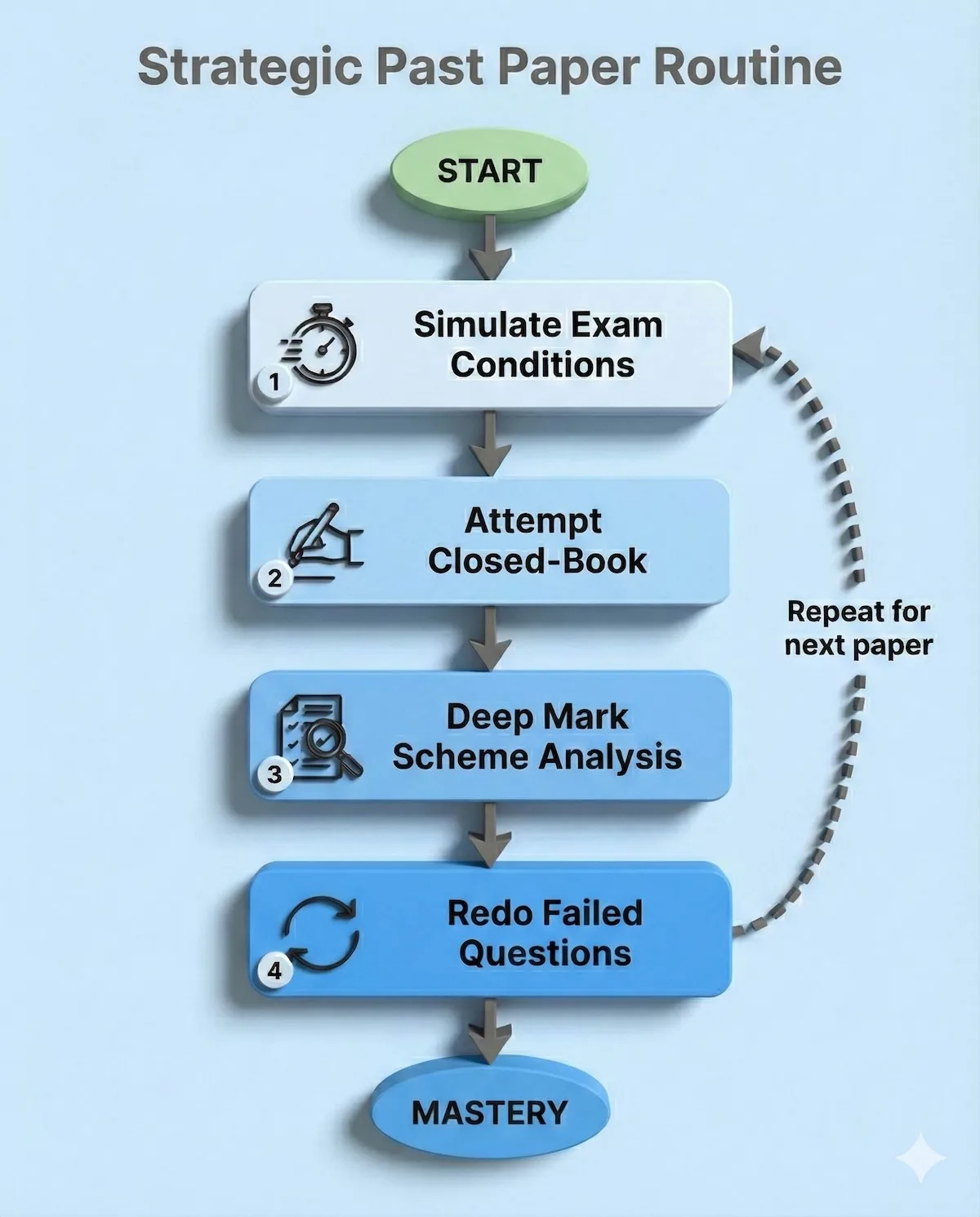
Move beyond passive practice by following this 4-step strategic routine for every past paper you attempt.
By following this cyclical approach, you turn every past paper into a comprehensive diagnostic tool rather than just a practice run.
Let’s look at the three biggest mistakes and how to avoid them.
Mistake 1: You’re Doing Past Papers Without Using Mark Schemes Properly
This is the most common and most damaging mistake. You complete a past paper, check your answers against the mark scheme, count up your score, and move on. That’s passive practice, and it wastes your time.
Mark schemes aren’t just answer keys. They’re instruction manuals that show exactly what examiners want. When you ignore them, you miss the entire point of practice.
What Mark Schemes Actually Tell You
Cambridge, AQA, Edexcel, and other exam boards publish detailed mark schemes for good reason. They show the specific keywords, phrases, and structure that earn marks.
Look at this example from a biology question: “Explain how water is transported through a plant.”
A student might write: “Water moves up through the plant from the roots to the leaves.”
That answer is correct but incomplete. The mark scheme shows what’s really needed: cohesion between water molecules, transpiration pull, xylem vessels as the pathway, and root pressure. Each of these is a separate marking point.
Without studying the mark scheme, you’d think your answer was fine. With the mark scheme, you learn exactly what you’re missing.
How to Use Mark Schemes Correctly
After completing each question, don’t just check if you got it right or wrong. Do this instead:
- Compare your answer word by word with the mark scheme. Circle the keywords in the mark scheme that you missed. These are usually scientific terms or specific phrases.
- Identify patterns in what you’re missing. Are you always forgetting to include units? Do you miss cause-and-effect explanations? Do you give vague answers when the mark scheme wants specifics?
- Rewrite wrong answers using the mark scheme as a guide. Don’t just read the correct answer. Write it out yourself using the proper keywords and structure. This builds muscle memory for exam day.
- Create a keyword list. Keep a running list of terms that appear repeatedly in mark schemes. Terms like “concentration gradient,” “partially permeable membrane,” or “rate of reaction” appear constantly. Learn them.
- Pay attention to command words. Mark schemes show the difference between “state,” “describe,” and “explain.” A “state” question needs a simple fact. An “explain” question requires cause and effect with scientific reasoning.
Examiner reports from 2024 show that students lose marks not because they don’t understand concepts, but because they don’t use the precise language examiners expect. Mark schemes teach you that language.
This process might sound abstract, so here is the exact 5-step ‘Deep Dive’ workflow you should follow after every question.
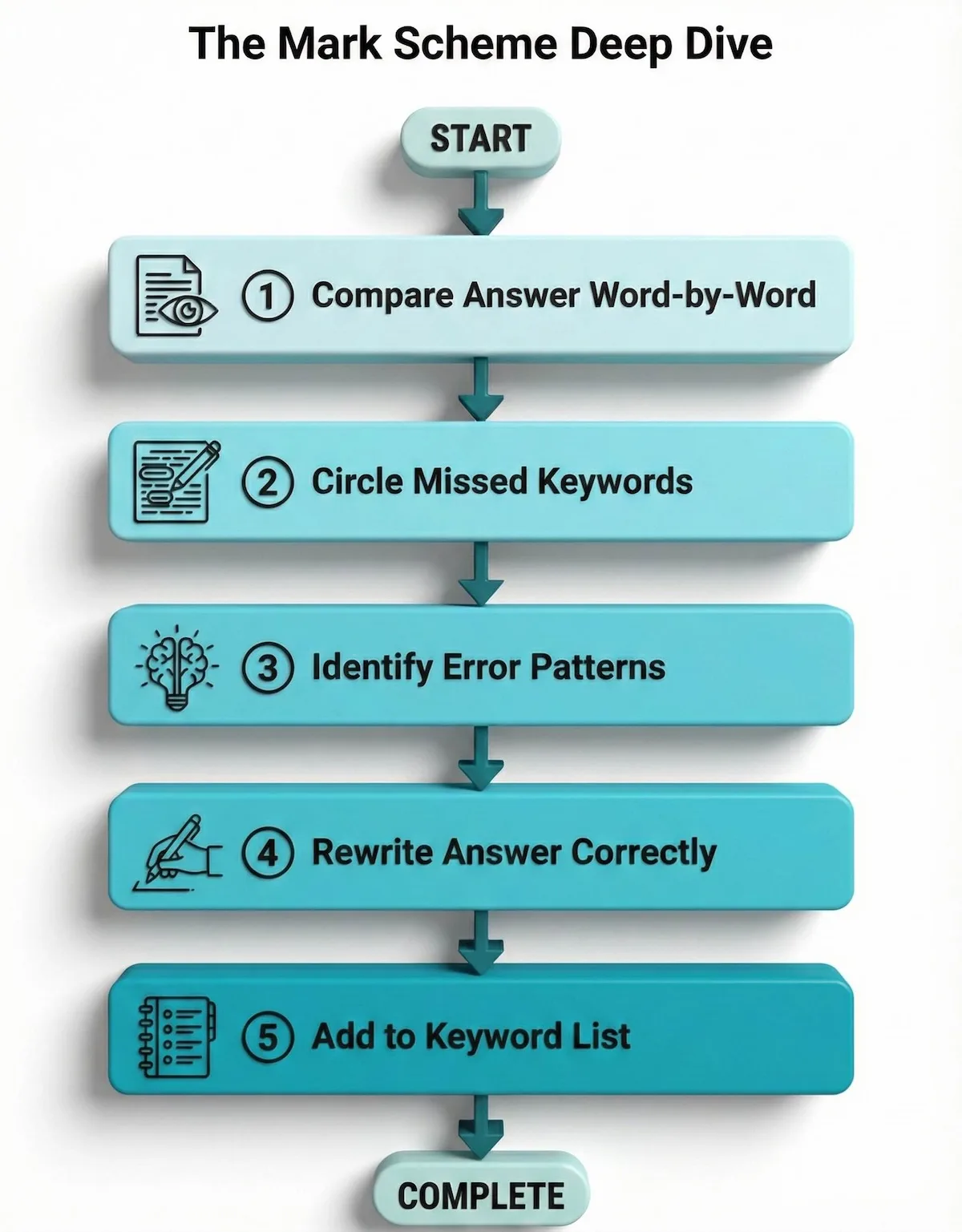
Don’t just check your score—use this 5-step “Deep Dive” method to extract every mark from the mark scheme.
Adding step 5—creating a keyword list—is the ‘secret weapon’ that prevents you from making the same terminology mistakes twice.
Mistake 2: You’re Practicing Passively Instead of Actively
Most students treat past papers like reading exercises. They do the paper, mark it, note their score, and think they’ve practiced. This is passive learning, and it barely helps.
Active practice means engaging with the material, testing yourself, and forcing your brain to work hard. The difference in results is dramatic.
Check out smart test prep solutions to score higher
The Active vs. Passive Problem
The difference between these two approaches is night and day. Use this comparison table to audit your current study habits.
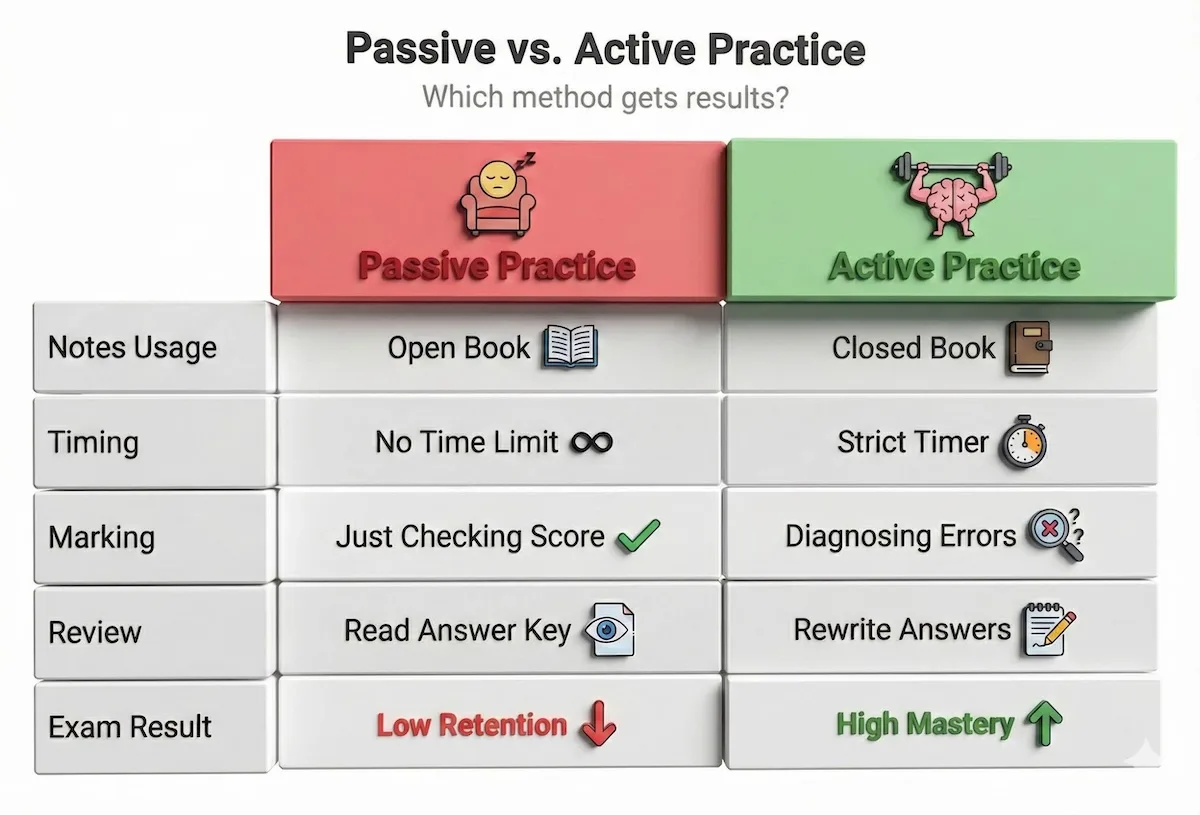
Research shows active practice significantly outperforms passive review. Are you using the methods in the green column?
If your routine looks more like the red column, you are likely wasting 50% of your study time on methods that don’t improve retention.
Research from the University of Georgia found that students using active revision strategies significantly outperformed those using passive strategies. The passive group reread notes, highlighted information, and copied out answers. The active group tested themselves, created questions, and explained concepts out loud.
For past papers, passive practice looks like this: complete the paper with your notes open, check answers immediately, circle wrong ones, move to the next paper.
Active practice looks different. You treat each past paper like a real exam. You test yourself under timed conditions. You identify why you made mistakes, not just what the right answer is.
How to Practice Actively
- Start with timed conditions, even if you’re not ready. Use a timer for every past paper. Cambridge GCSE science papers give you 1 hour 45 minutes. Set your timer and stick to it. You’ll learn time management and identify which questions slow you down.
- Complete papers closed-book first. Don’t look at notes or textbooks while working. This simulates exam conditions and shows you what you actually know versus what you think you know.
- Self-mark critically. When marking, don’t give yourself half marks for “kind of right” answers. Be harsh. If the mark scheme wants three points and you gave two, mark it wrong. This shows your real gaps.
- Diagnose your mistakes. For every wrong answer, write down why you got it wrong. Did you misread the question? Forget a key concept? Run out of time? Use vague language? Each error type needs a different fix.
- Track patterns over multiple papers. Keep a spreadsheet or notebook tracking question types. If you always struggle with graph interpretation or calculation questions, that’s where to focus your study.
- Redo questions you got wrong after a few days. Don’t just move on after checking answers. Come back to failed questions later and try them again without looking at the mark scheme. This tests whether you actually learned from the mistake.
Active practice is harder than passive practice. It takes more mental effort. But it’s the only type of practice that creates real improvement.
Mistake 3: You’re Not Learning from Examiner Reports
Most students don’t even know examiner reports exist. This is like preparing for a sports match without watching footage of the opposing team.
Examiner reports are documents published by exam boards after each exam session. They explain what students did well and what went wrong. They highlight common mistakes, clarify what examiners expected, and show which topics students struggle with most.
These reports are free, available online, and completely underused.
What Examiner Reports Reveal
Examiner reports from 2024 show consistent patterns across all science subjects:
Students lose marks on terminology. Reports repeatedly note that students use everyday language instead of scientific terms. Saying “the liquid got hotter” instead of “temperature increased” costs marks. Saying “the reaction went faster” instead of “the rate of reaction increased” does too.
Students skip steps in calculations. Examiners want to see working, even if the final answer is correct. Reports show that students lose marks by jumping to answers without showing formulas, substitutions, or unit conversions.
Students misread questions. Reports highlight that students answer what they think the question asks, not what it actually asks. A question asking for “differences between X and Y” gets answers describing X or Y separately, not comparing them.
Students give incomplete explanations. For “explain” questions, students often describe what happens without explaining why it happens. Reports emphasize that explanations need cause-and-effect chains using scientific principles.
How to Use Examiner Reports
Many students are intimidated by these official documents, but they are easy to use if you follow this simple loop.
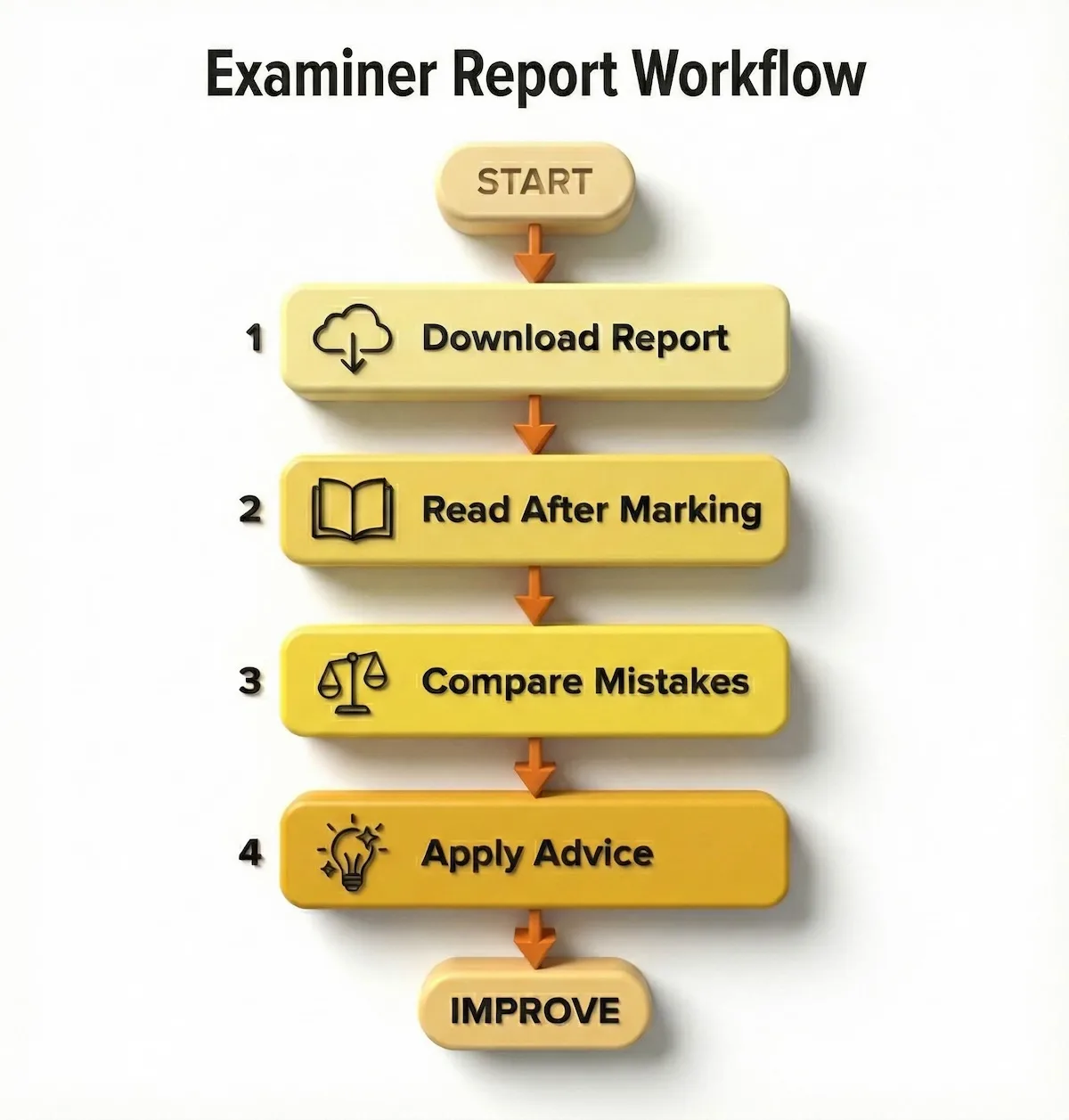
Examiner reports are hidden gems. Use this simple 4-step cycle to unlock their insights for every past paper.
By comparing your specific errors to the ‘common mistakes’ listed in the report, you can instantly see if you are falling into the same traps as thousands of other students.
- Download reports for your exam board and specification. Search “[exam board] [subject] examiner report [year]” to find them. For example, “AQA GCSE Biology examiner report 2024.”
- Read the reports for past papers you’ve completed. After finishing a past paper, read the examiner report for that specific paper. See which questions students found hardest and what mistakes were common.
- Compare your mistakes to common mistakes. If you made the same errors that examiners highlight, you know exactly what to fix. If your mistakes are different, you’ve identified a personal weak area.
- Note the examiner’s advice. Reports often include tips like “students should show all working” or “answers need to include specific keywords from the question.” Apply this advice to future papers.
- Look for patterns across multiple reports. If examiners complain about the same issue in three consecutive years, it’s definitely something you need to master. Common repeats include poor graph interpretation, missing units, and vague explanations.
Examiner reports give you insider knowledge about what goes wrong and how to avoid it. Not using them is like studying for a test without knowing what’s on it.
Common Mistakes That Cost Marks
Based on 2024 examiner reports and mark scheme analysis, here are specific errors that cost students marks repeatedly:
Not reading the question carefully. Students see a familiar topic and write everything they know instead of answering the specific question asked. A question about photosynthesis products gets an answer describing the entire photosynthesis process.
Missing the mark allocation clue. A 4-mark question needs four distinct points. Students give two detailed points and wonder why they lost marks. The mark value tells you how many separate things to include.
Forgetting units. Calculation answers without units automatically lose marks, even if the number is correct. Write “25 cm³” not “25.” Write “3.2 mol/dm³” not “3.2.”
Using imprecise language. “It increases” needs to specify what increases. “The temperature increases” or “the concentration increases” is better. “There’s more of it” loses marks compared to “the mass increases.”
Not showing working for calculations. Even if you can do the math in your head, write it down. Show the formula, substitution, and rearrangement. Method marks can save you even if your final answer is wrong.
Giving definitions instead of explanations. An “explain” question wants cause and effect. Defining terms isn’t enough. For example, “Explain why reaction rate increases with temperature” needs more than “temperature is a measure of thermal energy.”
Read more to get instant, accurate homework help
To summarize these pitfalls, here is a ‘Cheat Sheet’ of corrections. Memorize the green column to instantly upgrade your answers.
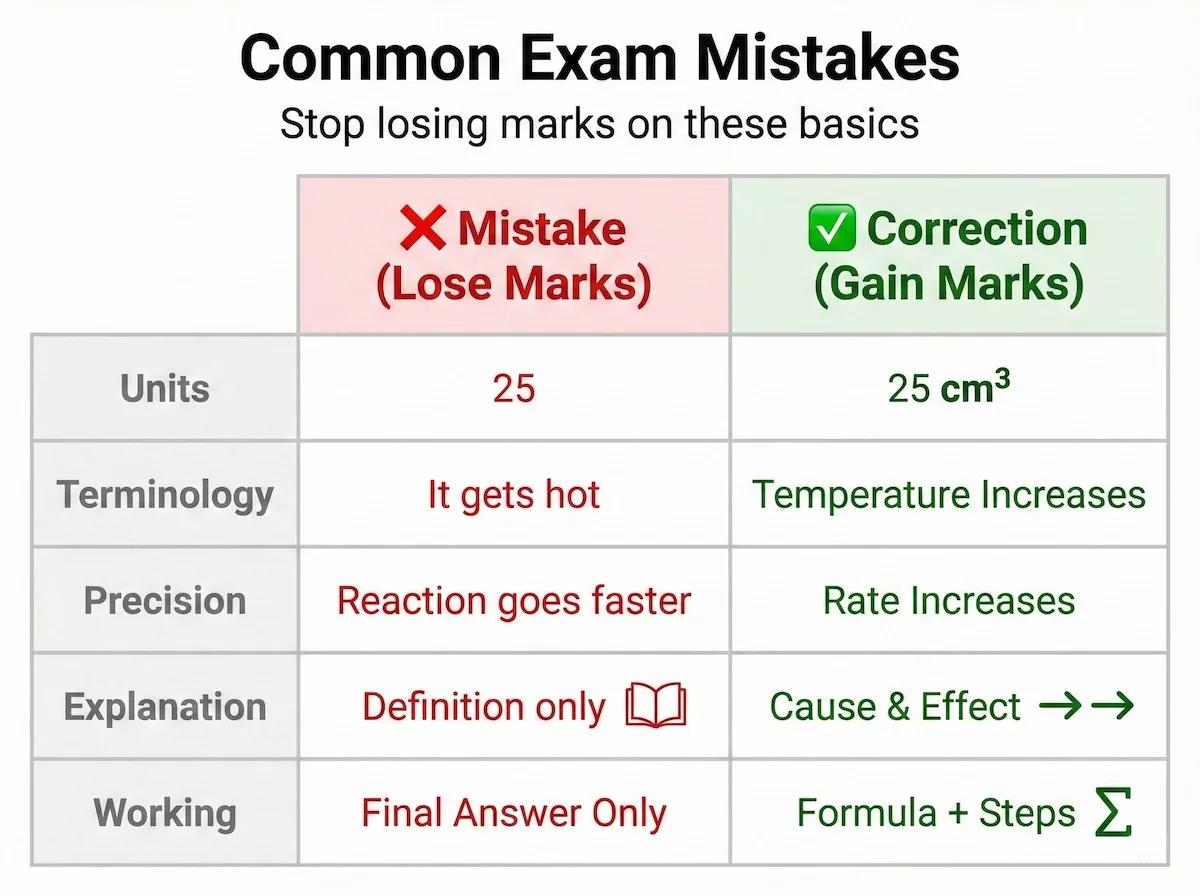
Are you making these 5 common errors? Check the “Correction” column to ensure you don’t throw away easy marks.
Notice how the correct answers always include specific units, precise direction (increases/decreases), or cause-and-effect logic.
How to Apply This to Your Next Past Paper
Start with your next practice session. Pick one past paper and use all three strategies:
Use the mark scheme properly. Don’t just check answers. Study why each answer earns marks. Identify the keywords you missed. Rewrite wrong answers.
Practice actively. Time yourself. Work closed-book. Mark harshly. Diagnose why you made mistakes. Track patterns.
Use examiner reports. Download the report for the paper you’re doing. Read it after marking. See if your mistakes match common mistakes. Apply the examiner’s advice.
This approach takes longer than just grinding through papers. But it works. Students who use these strategies improve faster than students who complete twice as many papers without strategy.
The Verification Factor
Every strategy in this article comes from verified sources: official mark schemes, examiner reports from 2024, and educational research on active versus passive learning. These aren’t theory or guesswork. They’re proven methods that work.
Mark schemes from Cambridge, AQA, and other exam boards show exactly what earns marks. Examiner reports from 2024 identify the specific mistakes students make. Research from institutions like the University of Georgia confirms that active practice beats passive practice consistently.
When you use past papers correctly, you’re not just practicing. You’re training your brain to think like an examiner. You’re learning the language of mark schemes. You’re fixing the exact errors that cost marks.
Key Takeaways
Past papers work when you use them strategically. Most students don’t, which is why their scores plateau.
Fix these three mistakes and your practice becomes effective:
- Use mark schemes as learning tools, not just answer keys. Study keywords, structure, and command words.
- Practice actively with timed conditions, closed-book attempts, and critical self-marking. Diagnose why you made mistakes.
- Read examiner reports to learn what goes wrong and how to avoid it. Apply examiner advice to every paper.
Strategic practice beats mindless repetition every time. Use these methods, and past papers become your most powerful exam preparation tool.
******************************
This article provides general educational guidance only. It is NOT official exam policy, professional academic advice, or guaranteed results. Always verify information with your school, official exam boards (College Board, Cambridge, IB), or qualified professionals before making decisions. Read Full Policies & Disclaimer , Contact Us To Report An Error