The Cambridge International A Level English Language (9093) Paper 1 Commentary (Section A) requires more than identifying literary devices. It demands a sophisticated linguistic analysis that explains how language functions to achieve a specific purpose for a target audience. Many students stall at feature spotting, which caps their score well below the top bands.
This article provides five high-impact, verified strategies that shift your approach from passive description to penetrating linguistic analysis. These techniques focus on the analytical depth required to master this core component of the 9093 syllabus.
Need expert learning support? Check out our online tutoring
Student Pulse
The core challenge for 9093 students, as evidenced on student forums, is the analytical depth required. Common student struggles include:
- Vague Analysis: Commenting that a technique “engages the reader” without explaining how or why that engagement serves the text’s specific purpose (Snippet 2.2).
- Ignoring Development: Spending too much time on the beginning of the text and missing significant tonal or structural shifts later in the passage (Snippet 1.1).
- The “List of Devices”: Submitting a commentary that reads like a categorized list of techniques (metaphor, alliteration, tricolon) without linking them into a cohesive argument about the text’s overall function.
The following tips directly solve these practical academic challenges.
Concept/Strategy Breakdown: 5 High-Impact Tips
Tip 1: Master the “Point and Push” Analysis
The single most critical step is moving beyond technique identification. Every analytical point must follow the Point $\rightarrow$ Quote $\rightarrow$ Push structure.
- Point (P): Identify the linguistic feature or pattern (e.g., hyperbole, active voice, semantic field of conflict).
- Quote (Q): Embed a short, precise example from the text.
- Push (P): This is the analysis. Do not stop at saying “This makes the reader interested.” Instead, explain how the choice (the P) serves the text’s overall purpose and audience (A/P/C).
Example Push: “The sustained use of the imperative mood, such as ‘Invest Now’ and ‘Take Control,’ functions to create a direct, authoritative register which positions the intended audience (investors seeking immediate action) into a receptive, compliant mindset, thereby serving the explicit purpose of persuasion.”
To ensure you never miss a mark, visualize your paragraph structure using this simple flow.
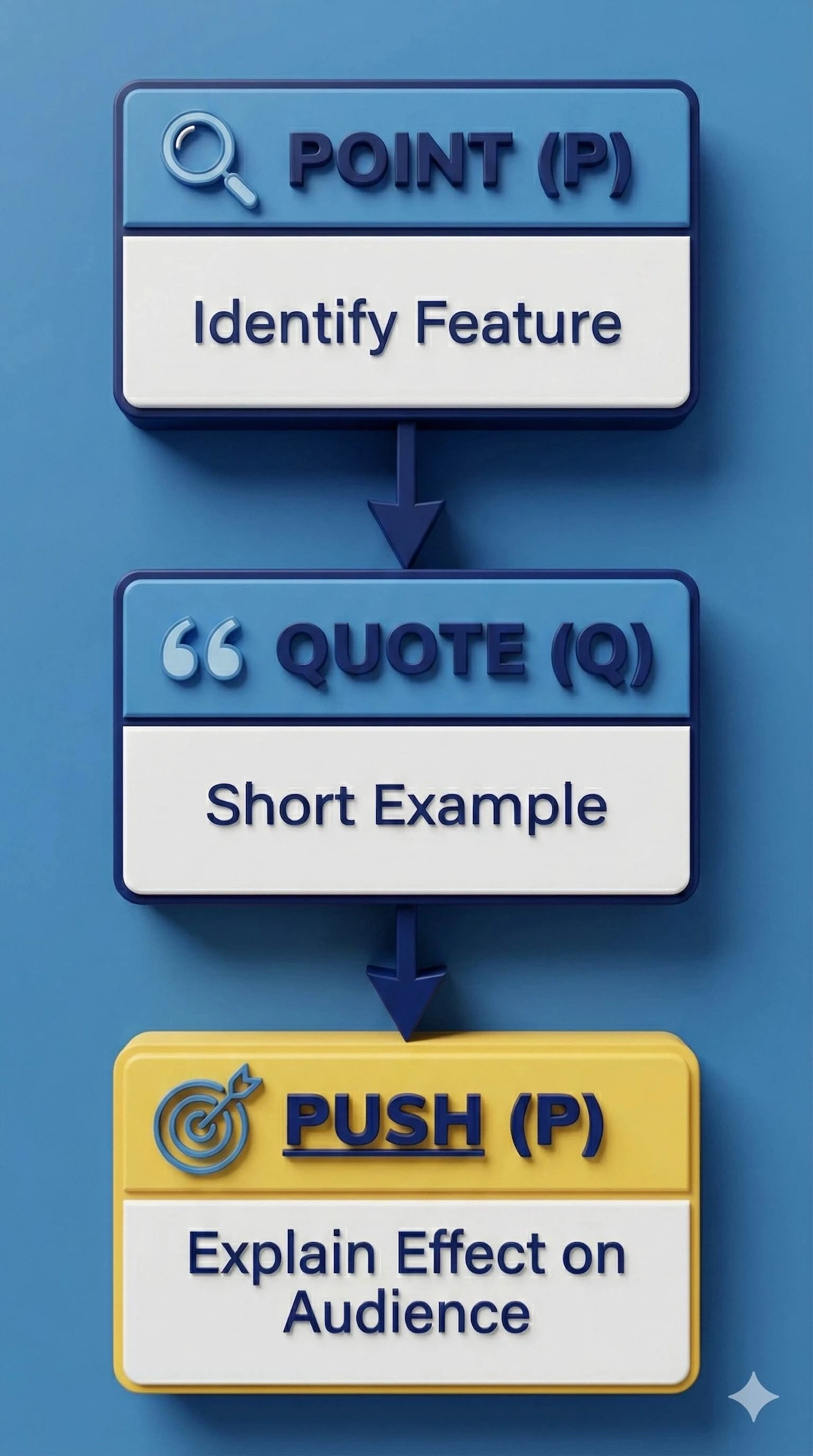
Master the “Point and Push” method to ensure every analytical paragraph scores high marks.
Following this strict vertical sequence prevents you from rambling and keeps your analysis focused.
Read more to get instant, accurate homework help
Tip 2: Implement the 3-Layer Analysis Model
Instead of organizing by device (one paragraph for imagery, one for syntax), structure your commentary to reflect layers of language, which naturally promotes deeper analysis.
- Micro Layer (Lexis and Syntax): Focus on word choice (lexis), sentence structure (syntax), and basic punctuation. These form the building blocks of tone.
- Meso Layer (Structure and Tone): Analyze paragraph development, introduction/conclusion effectiveness, and the overall tone (e.g., formal, condescending, reflective). Pay attention to where the tone shifts (Snippet 1.2).
- Macro Layer (Audience, Purpose, Context – A/P/C): Dedicate the introduction and conclusion, and the ‘Push’ of every paragraph, to connecting the language choices back to the ultimate function of the text.
Think of your analysis as a pyramid. You must build a solid foundation before reaching the peak.
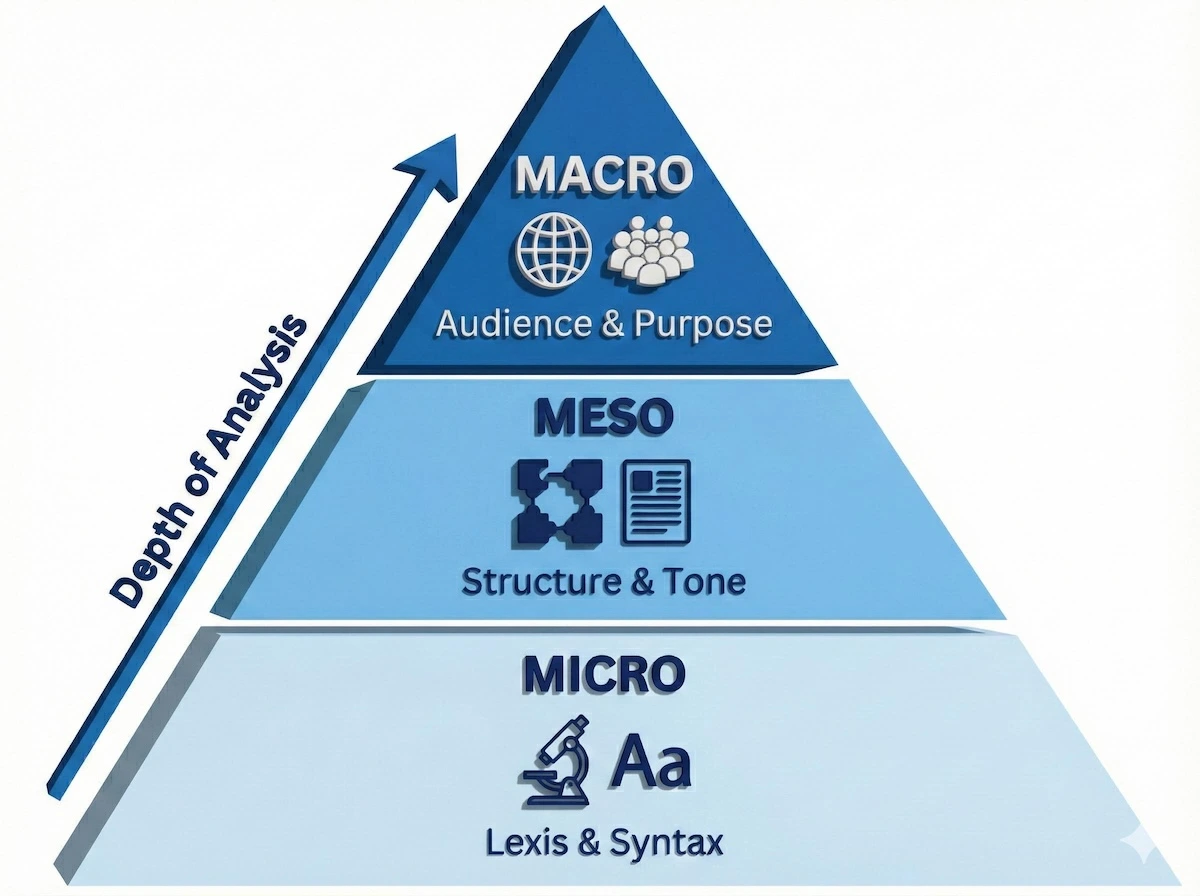
Build your analysis from the ground up using the Micro, Meso, and Macro layers.
By moving from the bottom up—from words to structure to purpose—you ensure comprehensive coverage of the text.
Tip 3: Prioritize Structural and Tonal Development
Examiners frequently reward candidates who recognize the passage is not static. Look for changes in structure, tone, or perspective between the beginning, middle, and end (Snippet 1.1).
Action: Before writing, divide the text into three sections. In your plan, note down the primary tone and primary focus for each section. If a narrative begins in despair and ends with optimism, dedicate a paragraph to analyzing the linguistic choices that signal this tonal shift (e.g., a move from negatively charged lexis to positively charged lexis).
Tip 4: Link Every Feature to Audience and Purpose (A/P/C)
In 9093, the purpose of a language choice is inseparable from its effect on the target audience. Do not treat A/P/C as a separate box to tick.
| Feature |
Linkage Question |
Resulting Analysis |
| Use of Jargon |
Why was this specific lexicon chosen? |
Purpose: To establish credibility and Audience: To filter out non-experts, confirming the professional context of the journal. |
| Short, Simple Sentences |
Why is the flow disrupted? |
Purpose: To create a sense of urgency, mimicking a checklist or manifesto (Snippet 1.2), reflecting the seriousness of the context. |
Check out smart test prep solutions to score higher
This formula helps you remember that a linguistic feature is meaningless without its context.
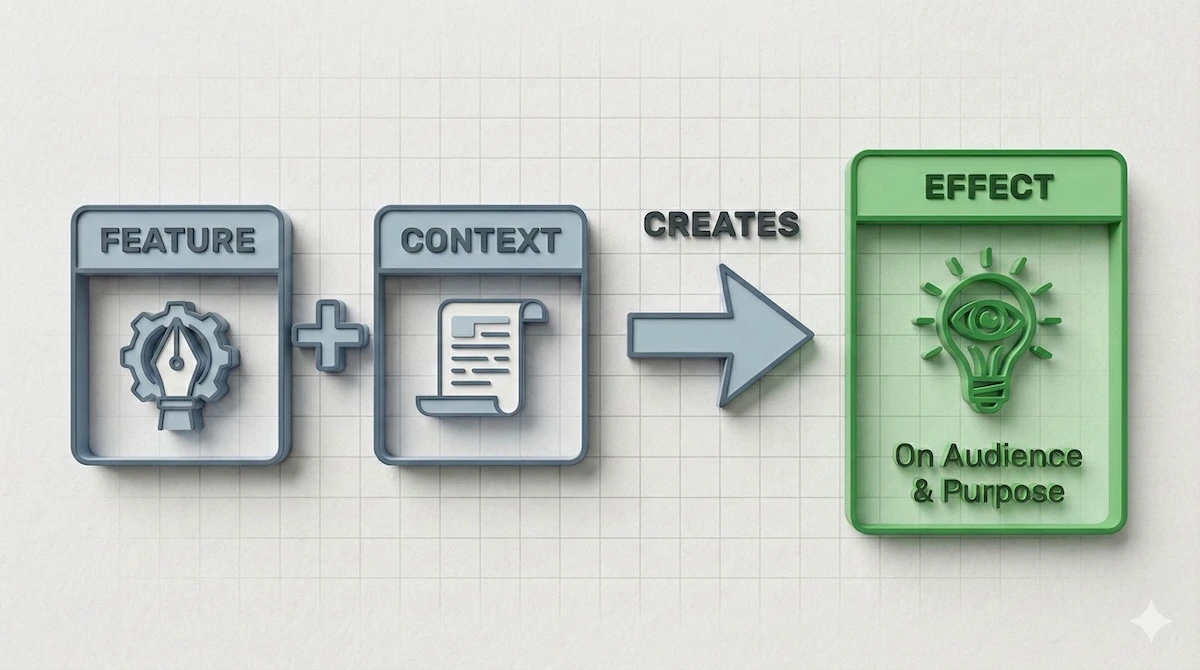
Never list a feature without connecting it to the context and its effect on the audience.
Memorize this equation: Feature + Context = Effect on Audience.
Tip 5: Plan First, Write Fluently, and Use Formal Register
Allocate approximately 15 minutes for planning (Snippet 1.1). This prevents getting “stuck” mid-commentary.
- Planning: Choose 9-12 of the most powerful and relevant linguistic features across the text. Select the features that best demonstrate the overall purpose. Do not feel obligated to discuss every device (Snippet 2.2).
- Writing: Write the commentary in a formal, objective register. Use precise, high-frequency linguistic terminology (e.g., deictic language, hypotaxis, semantic field). Avoid overly casual language.
- Embedding: Embed all quotations smoothly within your analytical sentences. Do not introduce quotes with a colon or a separate line.
Many students panic and start writing immediately. Here is the time split used by top-scoring candidates.
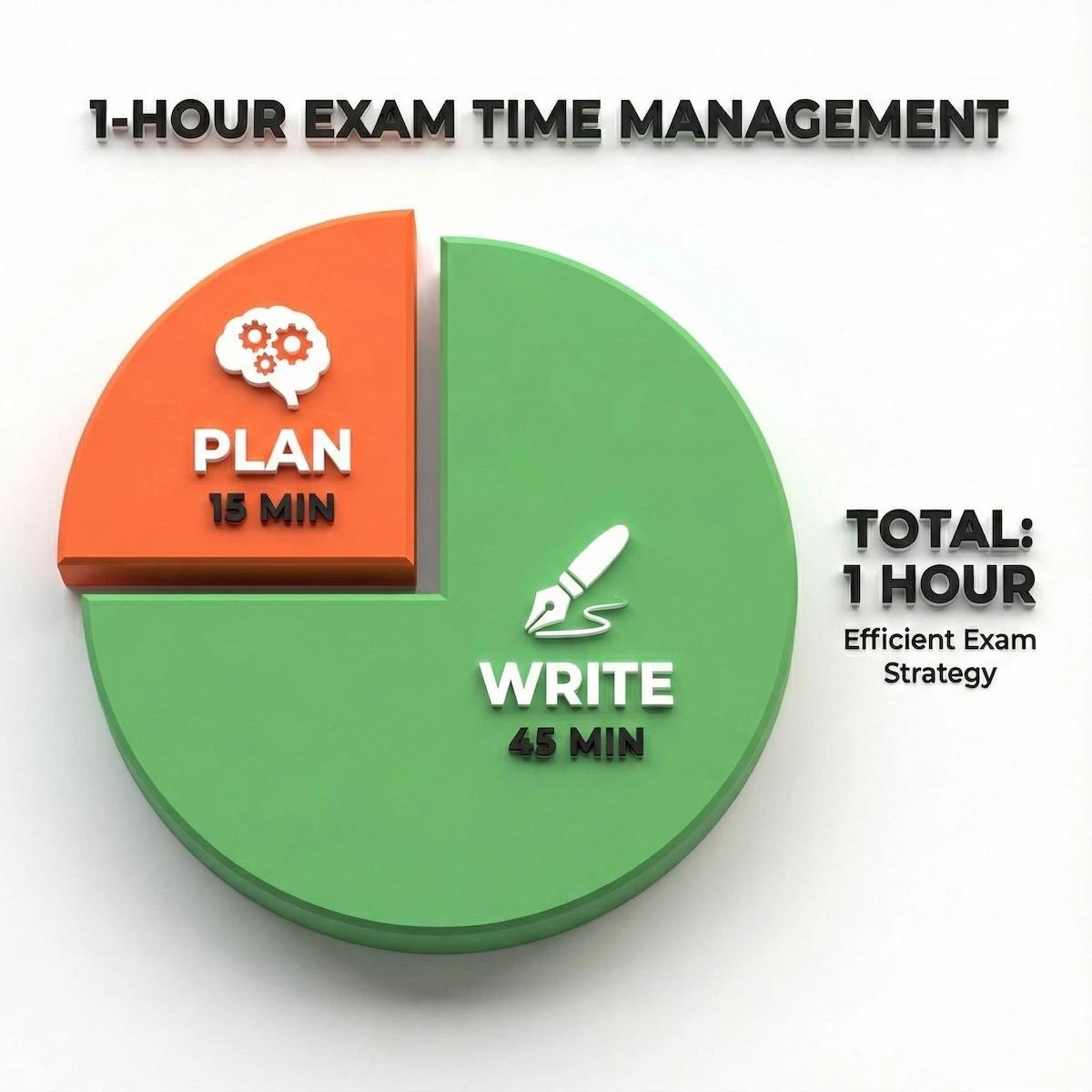
Don’t rush to write! Investing 15 minutes in planning ensures a cohesive and high-scoring essay.
That 15-minute investment in planning saves you from running out of ideas halfway through the hour.
Common Mistakes
- Vague Terminology: Using blanket terms like “literary device” instead of precise terms like tricolon, anaphora, or complex-subordinate clauses.
- The Content Summary: Re-telling the story or explaining the subject matter instead of analyzing the language choices used to convey it (Snippet 1.2).
- Focusing on Effect Alone: Stating a simile is used “to create an image” without explaining what kind of image is created and why that image serves the writer’s purpose.
Practical Application
For your next practice text, apply the 3-Layer Analysis Model.
- Highlight all Micro Layer features (words/phrases).
- Circle all Meso Layer features (sentence length/structure/tone shifts).
- Spend the first five minutes writing out three complex analytical sentences, each proving the text’s purpose by linking one feature from each layer to the A/P/C. This forces the deep integration required for a Band 5 score.
Quick Example (What Good Looks Like)
Let’s look at the difference between a Band 2 response and a Band 5 response side-by-side.
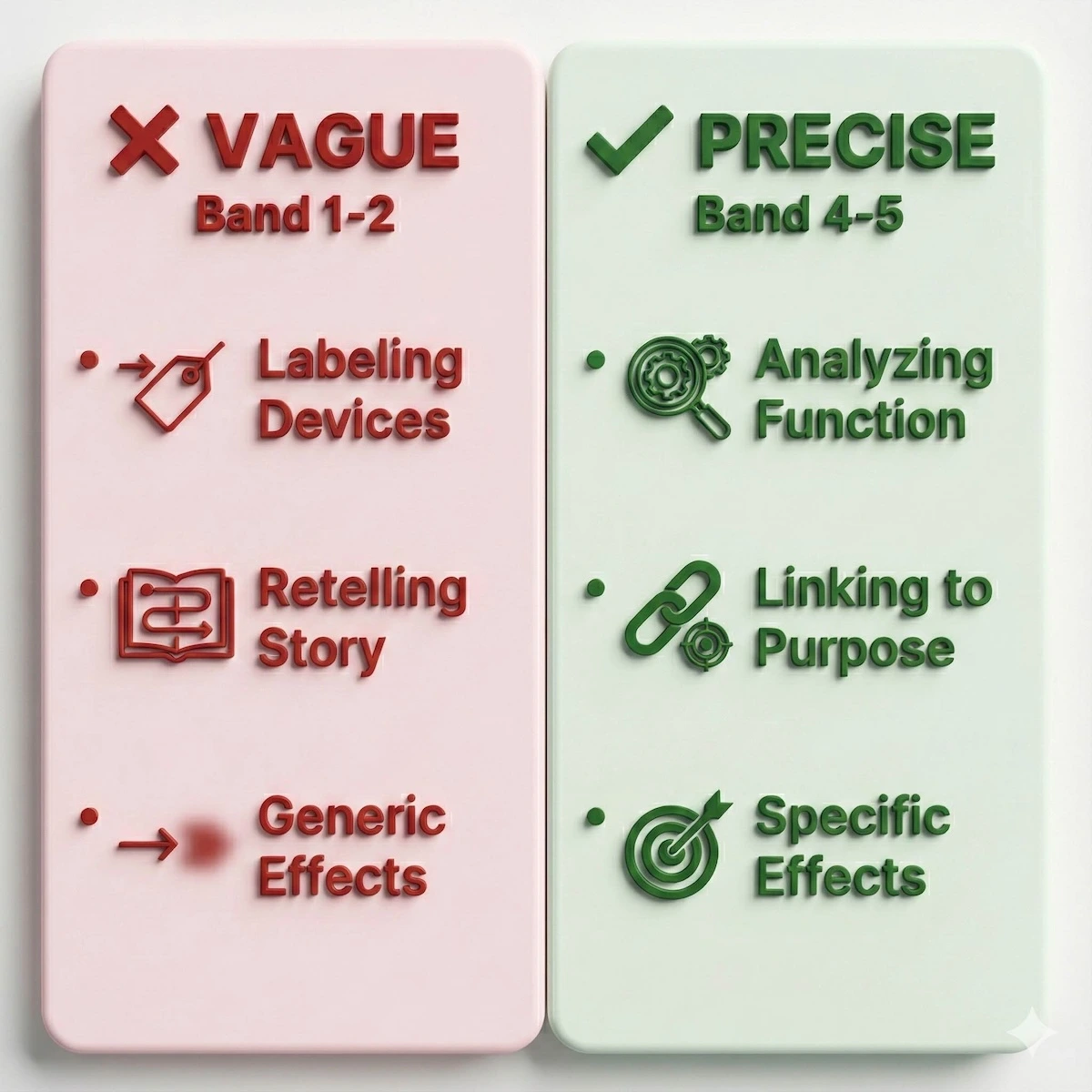
Shift your focus from simply labeling devices to analyzing their specific function and effect.
Notice how the column on the right focuses on why the writer made those choices, not just what they are.
Instead of writing:
“I used emotive language to make it interesting.”
Try:
“I used emotive adjectives such as ‘heartbreaking’ and ‘shattered’ to evoke sympathy in readers, reinforcing my purpose to persuade the audience of the urgency of community action.”
This shows purpose + example + effect exactly what examiners want.
Summary Box
- P.Q.P. is Non-Negotiable: Point $\rightarrow$ Quote $\rightarrow$ Push the analysis to its function.
- Analyze Layers: Move from Micro (words/syntax) to Meso (structure/tone) to Macro (A/P/C).
- Follow the Development: Organize your commentary sequentially or thematically to track changes in tone, style, or argument.
- Be Precise: Use high-frequency linguistic terminology and embed quotations seamlessly.
******************************
This article provides general educational guidance only. It is NOT official exam policy, professional academic advice, or guaranteed results. Always verify information with your school, official exam boards (College Board, Cambridge, IB), or qualified professionals before making decisions. Read Full Policies & Disclaimer , Contact Us To Report An Error


5 High-Impact Tips to Ace the 9093 Commentary Task
Contents
The Cambridge International A Level English Language (9093) Paper 1 Commentary (Section A) requires more than identifying literary devices. It demands a sophisticated linguistic analysis that explains how language functions to achieve a specific purpose for a target audience. Many students stall at feature spotting, which caps their score well below the top bands.
This article provides five high-impact, verified strategies that shift your approach from passive description to penetrating linguistic analysis. These techniques focus on the analytical depth required to master this core component of the 9093 syllabus.
Need expert learning support? Check out our online tutoring
Student Pulse
The core challenge for 9093 students, as evidenced on student forums, is the analytical depth required. Common student struggles include:
The following tips directly solve these practical academic challenges.
Concept/Strategy Breakdown: 5 High-Impact Tips
Tip 1: Master the “Point and Push” Analysis
The single most critical step is moving beyond technique identification. Every analytical point must follow the Point $\rightarrow$ Quote $\rightarrow$ Push structure.
Example Push: “The sustained use of the imperative mood, such as ‘Invest Now’ and ‘Take Control,’ functions to create a direct, authoritative register which positions the intended audience (investors seeking immediate action) into a receptive, compliant mindset, thereby serving the explicit purpose of persuasion.”
To ensure you never miss a mark, visualize your paragraph structure using this simple flow.
Master the “Point and Push” method to ensure every analytical paragraph scores high marks.
Following this strict vertical sequence prevents you from rambling and keeps your analysis focused.
Read more to get instant, accurate homework help
Tip 2: Implement the 3-Layer Analysis Model
Instead of organizing by device (one paragraph for imagery, one for syntax), structure your commentary to reflect layers of language, which naturally promotes deeper analysis.
Think of your analysis as a pyramid. You must build a solid foundation before reaching the peak.
Build your analysis from the ground up using the Micro, Meso, and Macro layers.
By moving from the bottom up—from words to structure to purpose—you ensure comprehensive coverage of the text.
Tip 3: Prioritize Structural and Tonal Development
Examiners frequently reward candidates who recognize the passage is not static. Look for changes in structure, tone, or perspective between the beginning, middle, and end (Snippet 1.1).
Action: Before writing, divide the text into three sections. In your plan, note down the primary tone and primary focus for each section. If a narrative begins in despair and ends with optimism, dedicate a paragraph to analyzing the linguistic choices that signal this tonal shift (e.g., a move from negatively charged lexis to positively charged lexis).
Tip 4: Link Every Feature to Audience and Purpose (A/P/C)
In 9093, the purpose of a language choice is inseparable from its effect on the target audience. Do not treat A/P/C as a separate box to tick.
Check out smart test prep solutions to score higher
This formula helps you remember that a linguistic feature is meaningless without its context.
Never list a feature without connecting it to the context and its effect on the audience.
Memorize this equation: Feature + Context = Effect on Audience.
Tip 5: Plan First, Write Fluently, and Use Formal Register
Allocate approximately 15 minutes for planning (Snippet 1.1). This prevents getting “stuck” mid-commentary.
Many students panic and start writing immediately. Here is the time split used by top-scoring candidates.
Don’t rush to write! Investing 15 minutes in planning ensures a cohesive and high-scoring essay.
That 15-minute investment in planning saves you from running out of ideas halfway through the hour.
Common Mistakes
Practical Application
For your next practice text, apply the 3-Layer Analysis Model.
Quick Example (What Good Looks Like)
Let’s look at the difference between a Band 2 response and a Band 5 response side-by-side.
Shift your focus from simply labeling devices to analyzing their specific function and effect.
Notice how the column on the right focuses on why the writer made those choices, not just what they are.
Instead of writing:
“I used emotive language to make it interesting.”
Try:
“I used emotive adjectives such as ‘heartbreaking’ and ‘shattered’ to evoke sympathy in readers, reinforcing my purpose to persuade the audience of the urgency of community action.”
This shows purpose + example + effect exactly what examiners want.
Summary Box
******************************
This article provides general educational guidance only. It is NOT official exam policy, professional academic advice, or guaranteed results. Always verify information with your school, official exam boards (College Board, Cambridge, IB), or qualified professionals before making decisions. Read Full Policies & Disclaimer , Contact Us To Report An Error
Kumar Hemendra
Editor in chief at MEB. With 16 years of experience in this field, I myself have written 500+ articles for several educational platforms, including MEB. I am an expert in essay writing and the US and UK education systems. I oversee the online tutoring and homework help businesses of MEB. I am a big fan of language, literature, art, and culture. I love reading and writing, and whenever I am not working, you may find me reading some piece of literature. I love animals and am an animal rights activist.I am a big fan of language, literature, art, and culture.
I am a versatile expert with a strong blend of technical, managerial, and communication skills. With a BTech in Marine Engineering from MERI Kolkata and an MBA, brings over seven years of experience in building lasting client relationships and mentoring students. At My Engineering Buddy, plays a pivotal role in guiding learners towards academic and professional excellence. specializes in English, Management, and Essay Writing, and is also recognized for expertise in Statistics. understands the challenges of formal education and is dedicated to connecting students with top tutors in a personalized, trustworthy environment. passion for helping others extends beyond academics, as also advocates for a balanced lifestyle and continuous self-improvement. Whether you’re looking to master language skills, excel in management, or sharpen your statistical prowess, is your go-to mentor for success.
Top Tutors, Top Grades! Only At My Engineering Buddy.
Get Homework Help & Online Tutoring
15 Years Of Trust, 18000+ Students Served
24/7 Instant Help In 100+ Advanced Subjects
Getting help is simple! Just Share Your Requirements > Make Payment > Get Help!