
7 Smart Ways To Use Predicted Papers Without Risking Your A-Level Physics Grade

Predicted papers dominate A-Level physics revision landscapes. YouTube channels, educational sites, and revision platforms push “predicted” papers with conviction, implying they forecast what examiners will ask. This creates a dangerous assumption: if you focus exclusively on predicted papers, you will succeed.
The reality is sharper. Predicted papers identify probability patterns, not certainties. Students who treat predictions as gospel often feel blindsided in actual exams when questions deviate from the pattern. Meanwhile, students who use predicted papers strategically as one layer in a structured four-step system consistently jump grades.
This article reveals exactly how to use predicted papers to identify gaps, build exam confidence, and secure higher marks without betting your grade on what might appear.
Hire Verified & Experienced Online Tutoring
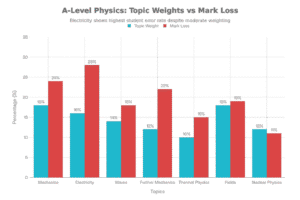
A-Level Physics Topic Weighting & Common Mark-Loss Areas
Understanding Predicted Papers: What They Actually Are
Predicted papers are educated guesses created by experienced educators who analyze historical exam patterns. They identify high-probability topics and question structures based on:
- Recurring topic cycles: Mechanics, electricity, and waves rotate with higher frequency than specialist topics.youtube
- Curriculum coverage patterns: Exam boards aim to test all specification areas within 3-4 exam cycles.savemyexams
- Mark scheme consistency: Similar marking rubrics appear across years for identical question types.pmt.physicsandmathstutor
However, predicted papers are not prophetic. They represent probability, not certainty. In 2025, YouTube predictions focused on exponential decay, potential dividers, and data processing. But actual May exams may shift emphasis based on what was tested in January, or pivot to underexamined areas.youtube
Why students fail with predictions alone:
Students practicing only 2023 and 2024 predicted sets risk gaps in less-commonly-tested but examinable topics. Overconfidence in a predicted pattern leads to panic when exams deviate. Predictions also breed false security—students complete a “predicted” paper in 90 minutes, score 85%, and assume they are exam-ready. They overlook that timed, pressured exam conditions differ from practice.
7 Smart Strategies To Integrate Predicted Papers Safely
Strategy 1: Use Predicted Papers As Exam-Condition Sprints, Not Learning Tools
The mistake: Treating predicted papers as your primary learning resource.
Predicted papers should never be your first contact with new topics. By the time you do a predicted paper, you should already understand the core concepts. Predicted papers serve a single purpose: to test your ability to apply knowledge under time pressure and exam conditions.
The smart approach:
- Master core notes and topic questions first (Weeks 1-6 of revision)
- Solve predicted papers under strict exam conditions (Weeks 6-8)
- Mark using official mark schemes
- Log errors in a dedicated “wrong answers” notebook
A student’s revision arc should look like this:
- Weeks 1-3: Concept mastery (textbook, videos, teacher notes)
- Weeks 4-6: Topic-specific questions (single-topic problem sets)
- Weeks 6-7: Real past papers (mixed difficulty, mixed topics)
- Weeks 7-8: Predicted papers (final exam-condition practice)
This sequence ensures you build understanding before exposing gaps through predictions.
Strategy 2: Cross-Reference Predicted Papers Against Official Specifications
Predicted papers sometimes drift from the official exam specification. A prediction might emphasize a sub-topic that counts for only 2-3% of the exam, wasting your time.
Before treating a predicted paper seriously:
- Open the official specification for your exam board (AQA, OCR, Edexcel, or CAIE)
- Scan the predicted paper questions
- Verify each question maps to a stated specification point
- Flag questions that seem to invent content not in the spec
Example: A predicted paper asks about “the internal structure of graphene.” Check the AQA specification materials is not a core focus for all boards. If your board doesn’t emphasize materials, this question is a distraction.
Strategy 3: Build A 4-Layer Revision System; Predicted Papers Are Layer 3
Position predicted papers within a complete revision framework:
Layer 1: Core Concept Mastery (Weeks 1-4)
- Textbook chapters
- Teacher notes
- Concept videos
- Formula derivations
Layer 2: Topic-Focused Problem Sets (Weeks 4-6)
- Single-topic questions (all mechanics questions, then all electricity)
- Build procedural fluency
- Identify concept gaps early
Layer 3: Real Past Papers (Weeks 6-7)
- Actual exam papers from 2018-2024
- Mixed topics, authentic difficulty
- Use past papers to benchmark your level
- Past papers reveal examiner priorities better than predictions
Layer 4: Predicted Papers + Final Revision (Weeks 7-8)
- Use predictions to stress-test under exam conditions
- Identify remaining weak spots
- Build exam-day confidence
This four-layer structure ensures you do not spend excessive time on any single resource type.
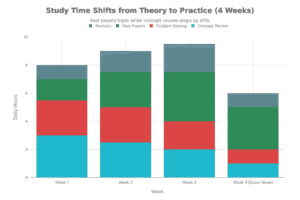
Final 4-Week Physics Revision Schedule: Daily Time Allocation by Activity
Strategy 4: Create A “Predicted Paper Risk Matrix”
Not all predicted papers are equally useful. Some are excellent. Others are oversimplified or contain errors. Before investing three hours in a predicted paper, qualify it.
Evaluate using this checklist:
| Criterion | High Quality | Medium Quality | Low Quality |
| Source credibility | Exam board staff or senior examiners | Experienced tutors with track record | Anonymous online creators |
| Question variety | Mix of recall, calculation, explanation, analysis | Mostly calculations | Repetitive formats |
| Mark scheme detail | Full working shown, method marks identified | Basic answers only | Missing explanations |
| Topic coverage | Touches 8+ specification areas | Focuses on 4-5 areas | Narrow topic focus |
| Difficulty calibration | Aligns with 2023-2024 papers | Slightly easier or harder | Notably mismatch |
| Errors or ambiguity | None detected | Minor typos, one unclear question | Significant errors |
If a predicted paper scores 3/5 or lower on this matrix, skip it. Use real past papers instead.
Strategy 5: Track Predicted Paper Performance vs. Past Paper Performance
Students often outscore themselves on predicted papers because predictions sometimes underestimate difficulty or overestimate common question types.
Create a simple tracker:
| Paper Type | Average Score | Questions Missed | Common Error Type |
| Predicted (2025 AQA) | 78% | Waves Q2, Circuits Q5 | Sign convention, unit errors |
| Past Paper (June 2023) | 72% | Mechanics Q3, Fields Q6 | Conceptual misunderstanding |
| Predicted (OCR) | 81% | Nuclear Q1 | Definition precision |
| Past Paper (Nov 2022) | 68% | Projectile motion, SHM | Mathematical execution |
The insight: If your predicted paper average is significantly higher than your past paper average, you are overrelying on predictions. Use this gap to guide your study focus back toward past papers and real exam difficulty.
Strategy 6: Focus On Predicted Paper Errors, Not Repetition
Completing ten predicted papers without analyzing errors is futile. Completion does not equal learning.
After each predicted paper:
- Mark thoroughly
- For every wrong or partially correct answer, complete a one-page error analysis:
- What was asked?
- What did you do?
- What should you have done?
- Why did you make the mistake? (conceptual gap, calculation error, misread question, time pressure?)
- What will you do differently next time?
- Group errors by type:
- Conceptual errors (you misunderstood the physics)
- Procedural errors (you knew the approach but executed poorly)
- Reading errors (you misunderstood what the question asked)
- Timing errors (you ran out of time)
- For conceptual errors, return to core notes. Do not repeat the predicted paper.
A single predicted paper with deep error analysis is worth ten papers completed mindlessly.
Strategy 7: Balance Predicted Papers With Examiner Reports And Mark Scheme Analysis
Official examiner reports, published by exam boards after each session, reveal exactly where students lost marks. These reports are far more reliable than predictions.
After each predicted paper, also:
- Find the corresponding examiner report for a real past paper (2023 or 2024) on the same topic
- Read what the examiner says about common mistakes
- Cross-reference those mistakes against your predicted paper errors
- If your errors align with documented examiner comments, your revision is well-targeted
Example: An OCR examiner report notes that “many candidates failed to distinguish between e.m.f. and potential difference in terms of energy considerations, confusing terminal voltage with e.m.f.” If you made this same error on a predicted paper, you have identified a high-priority concept gap.
Check out smart test prep solutions to score higher
Why Predicted Papers Matter: Real Student Examples
Example 1: Building Confidence After Struggling
Student A scored 55% on a mechanics topic test in January. Worried, they spent two weeks on mechanics core notes, then completed one predicted mechanics paper and scored 71%. The predicted paper confirmed their understanding had improved. They gained exam confidence not overconfidence, but justified belief in their progress.
Example 2: Identifying Blind Spots Early
Student B completed all AQA predicted papers for waves and optics, averaging 76%. When they tackled real past papers from 2023, they scored only 62% on waves. Why? The real papers tested more advanced interference and diffraction problems than the predictions emphasized. Early exposure via predicted papers would have been useless; real past papers caught the gap early enough to revise.
Example 3: Timing Pressure and Exam Nerves
Student C practiced predictions in isolation, scoring 80% with unlimited time. In actual exams, pressure and fatigue caused them to miss marks on calculation steps. Had they practiced predictions under strict 90-minute exam conditions (reading the question once, no second-guessing, moving on after 2 minutes per mark), they would have discovered their timing weakness before the real exam.
Common Traps In Mechanics: Predicted Papers Often Miss These
Mechanics accounts for 16-18% of A-Level marks and is consistently a high-error zone. Predicted papers often oversimplify mechanics, leading students to miss the subtleties examiners test.
Trap 1: Projectile Motion Sign Conventions
What predicted papers often test:
Simple horizontal projection (object thrown horizontally off a cliff, land on flat ground).
What real exams add:
Objects launched at an angle, landing at a different height, or motion in both upward and downward phases. Students forget that when resolving vertically upward, gravity is negative acceleration throughout.
Correct approach:
- Establish a clear sign convention (upward = positive or downward = positive; stick to it)
- When the projectile rises, a = -9.81 m/s² (gravity acts downward, opposing motion)
- When the projectile falls, a = -9.81 m/s² (gravity acts downward, assisting motion)
- Many students incorrectly switch the sign of acceleration, creating wrong answers
Why predicted papers miss this: They often test simple cases where sign errors do not show up until the final phase.
Trap 2: Energy Conservation With Multiple Heights
What predicted papers test:
A ball dropped from height h. Find speed at ground.
What real exams test:
An object with initial velocity, launched from height h1, passes through height h2, lands at height h3. Find speed at h2 or h3.
Predicted papers often treat energy as a single-state problem. Real exams demand students track energy across multiple reference points.
Correct approach:
- Define the zero potential energy level clearly (usually ground or starting position)
- Write the total mechanical energy at each key point
- Set them equal (conservation of energy)
- Solve for unknown
Why predicted papers miss this: Tracking multiple heights requires deeper understanding than predicted papers usually demand.
Trap 3: Momentum And Impulse Sign Errors
Predicted papers test momentum in straight-line collisions. Real exams test momentum with vector components, collisions at angles, and multi-object systems.
Students often lose marks by:
- Not assigning consistent directions (one object moving right is positive, left is negative)
- Forgetting to include all momentum contributors
- Confusing momentum (kg m/s) with impulse (N s) or force
Electricity And Circuits Mastery: High-Probability Exam Content
Electricity accounts for 14-16% of marks and is the second-highest error zone. Predicted papers often gloss over the precision required in circuit analysis.savemyexams
Common Errors In Circuit Questions
The mark scheme for circuit problems is unforgiving. Students lose marks for:
- Kirchhoff’s First Law Mistakes
- Forgetting to include all currents at a junction
- Using the wrong sign convention for current direction
Example: At a junction, current I (from battery) splits into I₁ and I₂ (into two branches). Correct: I = I₁ + I₂. Common error: I = I₁ – I₂ (wrong sign).
- Parallel Circuit Assumptions
- Assuming current is the same through all parallel branches (it’s not; voltage is the same)
- Calculating total resistance incorrectly when parallel and series components mix
- Power of Ten Errors
- Converting cross-sectional area: 1 mm² = 10⁻⁶ m² (not 10⁻³)
- Loses 1-2 marks easily if final resistance is off by factor of 1000
- E.M.F. vs. Potential Difference
- E.m.f. is the energy per unit charge supplied by a source
- P.d. is the energy per unit charge dissipated by a component
- Terminal voltage = E.m.f. – (Internal resistance × Current)
Why students fail: Predicted papers often test simple circuits; real exams include internal resistance, making this distinction critical.studymind+2
Kirchhoff’s Laws Application: Step-By-Step
Kirchhoff’s First Law (Current Law): At any junction, the sum of currents entering equals the sum leaving.
ΣI_in = ΣI_out
Kirchhoff’s Second Law (Voltage Law): Around any closed loop, the sum of e.m.f.s equals the sum of potential differences.
ΣE.m.f. = ΣV_drop
Worked Example (Circuit with Two Loops):
Given: Battery (12 V), resistor R₁ (6 Ω), resistor R₂ (3 Ω) in parallel.
Find: Current through each resistor.
Step 1: Assign current directions (I_total from battery, I₁ through R₁, I₂ through R₂).
Step 2: Apply Kirchhoff’s First Law at the junction:
I_total = I₁ + I₂
Step 3: Apply Kirchhoff’s Second Law around each loop:
Loop 1: 12 V = I₁ × 6 Ω → I₁ = 2 A
Loop 2: 12 V = I₂ × 3 Ω → I₂ = 4 A
Step 4: Verify Kirchhoff’s First Law:
I_total = 2 + 4 = 6 A ✓
Why this matters: Exams test more complex circuit variations (multiple e.m.f.s, mixed series-parallel, non-ohmic components). Predicted papers rarely include such complexity.
Read more to get instant, accurate homework help
Waves And Optics Tips: Exam Command Words Decoded
Waves and optics questions often test explanation and reasoning, not just calculation. Students lose marks by misunderstanding what the examiner is asking.
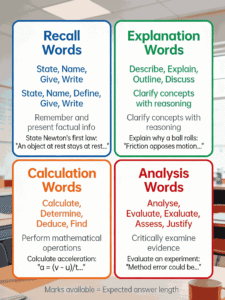
A-Level Physics Command Words Reference Guide
Key Command Words In Waves Questions
| Command | Meaning | Example Marks Loss |
| Describe | Say what happens; no reasoning needed | Saying “wavelength increases” without explaining why |
| Explain | Give the physics reason; must include mechanism | Saying “wavelength increases because frequency is constant” (uses wave equation v = fλ) |
| Outline | Brief account of the steps | Omitting one step in the double-slit setup |
| Discuss | Analyze pros and cons; consider multiple perspectives | Mentioning coherence but not coherent sources |
| State and Explain | Recall the statement, then reason | Stating “constructive interference when path difference = nλ” but not explaining why |
Interference: High-Probability Exam Content
Why it appears in exams: Interference tests understanding of wave superposition, a fundamental principle.
What students get wrong:
- Confusing path difference and phase difference
- Forgetting that for visible interference, sources must be coherent (same frequency, constant phase difference)vedantu
- Not recognizing that intensity depends on the square of amplitude, not amplitude itself
Exam-standard answer for interference questions:
Two coherent light sources produce an interference pattern. At a point where the path difference is exactly one wavelength (λ), the waves arrive in phase. Constructive interference occurs, and the intensity is maximum (bright fringe). At points where the path difference is (n + 0.5)λ, destructive interference occurs, and the intensity is minimum (dark fringe).
Diffraction: Often Confused With Interference
Key distinction:
- Interference: two or more coherent waves overlap
- Diffraction: light bends around an obstacle or slit
Diffraction grating formula (high-probability exam content):
d × sin(θ) = n × λ
Where:
- d = slit separation
- θ = angle to central maximum
- n = order of maximum (1, 2, 3…)
- λ = wavelength
Why students lose marks:
- Confusing θ with the angle from the slit (not the normal)
- Using degrees instead of radians (or vice versa)
- Forgetting that n starts from 0 (central max) or 1 (first order)
Final Revision Checklist: Formula Retention And Timing Practice
Formula Retention Tactics
Memorizing formulas without understanding is useless. However, understanding without retaining formulas is equally useless in a timed exam.
Effective formula memorization combines understanding with repetition:conceptfirst+2
- Understand the derivation. Know where the formula comes from. For kinetic energy (EK = ½mv²), understand that it is derived from work done against motion.
- Connect to physical meaning. EK = ½mv² means kinetic energy depends on mass (more mass = more energy) and velocity squared (doubling speed quadruples energy).
- Write formulas by hand 5-10 times. Physical writing creates muscle memory and stronger neural connections than typing.
- Create visual associations. Draw a diagram (e.g., falling object) next to the formula. When you recall the diagram, the formula follows.
- Use mnemonics. For Snell’s law (n₁ sin θ₁ = n₂ sin θ₂), remember “No Sine Equals New Sine.”
- Apply in problems immediately. After learning a formula, solve 5-10 problems using it within the day. Repetition locks it in memory.
- Consolidate formulas on one sheet. One A4 page with all key equations. Review it daily for the final two weeks before the exam.
Past Paper Timing Practice
Predicted papers are useless if you cannot finish under exam conditions. Timing failures are among the top reasons high-performing students underperform in real exams.
Timing guidelines (based on mark allocation):
- 1 mark: 1.5-2 minutes (short answer or simple calculation)
- 2 marks: 3-4 minutes (calculation or brief explanation)
- 3 marks: 5-6 minutes (multi-step calculation or detailed explanation)
- 4-5 marks: 7-10 minutes (complex problem or extended explanation)
- 6+ marks: 10+ minutes (synoptic question or detailed analysis)
Practice routine:
- Complete one full past paper under strict exam conditions (no breaks, no time extensions, no looking at answers)
- Mark it immediately; do not leave a gap
- Log the time spent per question and per section
- Identify which sections caused time pressure
- Repeat weekly until you finish with 5-10 minutes to spare for review
Formula Sheet Guide: Quick Reference With Annotations
Below is a consolidated formula sheet for A-Level Physics. Annotations explain when and why to use each formula.
Mechanics Formulas
| Formula | Variables | When To Use | Common Pitfall |
| v = u + at | v = final velocity, u = initial, a = acceleration, t = time | Finding velocity after time OR time when reaching a velocity | Sign errors if changing direction |
| s = ut + ½at² | s = displacement | Finding distance traveled with constant acceleration | Confusing displacement (net distance) with distance (total path) |
| v² = u² + 2as | v, u, a, s as above | Finding final velocity when you don’t know time | Forgetting to square the velocities |
| F = ma | F = force (N), m = mass (kg), a = acceleration (m/s²) | Finding force from mass and acceleration OR acceleration from force and mass | Forgetting to convert all units to SI |
| p = mv | p = momentum (kg m/s) | Finding momentum OR verifying conservation in collisions | Confusing momentum with impulse (F·t) |
| W = Fs cos θ | W = work (J), F = force, s = displacement, θ = angle between them | Finding work done by a force | Forgetting that only the component of force in the direction of motion counts |
| EK = ½mv² | EK = kinetic energy (J) | Finding kinetic energy from mass and velocity | Forgetting that velocity is squared |
| EP = mgh | EP = gravitational potential energy, h = height above reference point | Finding potential energy OR applying conservation of energy | Forgetting to define the zero potential energy level |
| P = W/t | P = power (W), W = work (J), t = time (s) | Finding power OR work OR time | Confusing power with force |
Electricity Formulas
| Formula | Variables | When To Use | Common Pitfall |
| I = Q/t | I = current (A), Q = charge (C), t = time (s) | Defining or calculating current | Forgetting that charge and time must be in SI units |
| V = W/Q | V = voltage (potential difference, V), W = work (J), Q = charge (C) | Defining voltage OR calculating work OR charge | Confusing voltage with e.m.f. (especially with internal resistance) |
| R = V/I | R = resistance (Ω) | Calculating resistance from voltage and current | Assuming resistance is constant (some components are non-ohmic) |
| E = εI t | E = energy dissipated (J), ε = e.m.f. (V), I = current, t = time | Calculating energy supplied by a battery | Forgetting that energy can also be calculated as W = VIt |
| P = VI | P = power (W) | Calculating power dissipated in a component | Forgetting that P = I²R OR P = V²/R are equivalent |
| R_total (series) = R₁ + R₂ + R₃ | R_total = total resistance when in series | Adding resistors in series (voltage divides) | Using this formula for parallel circuits (it’s wrong) |
| 1/R_total (parallel) = 1/R₁ + 1/R₂ + 1/R₃ | For parallel resistors | Adding resistors in parallel (current divides, voltage is same) | Forgetting to invert the final result to get R_total |
| ε = E/Q | ε = e.m.f. (V), E = energy supplied (J) | Defining e.m.f. OR calculating energy from e.m.f. | Confusing e.m.f. with terminal voltage when internal resistance exists |
| V_terminal = ε – Ir | V_terminal = voltage across the external circuit, r = internal resistance | Analyzing circuits with internal resistance | Forgetting that the internal resistance is in series with the e.m.f. |
Waves Formulas
| Formula | Variables | When To Use | Common Pitfall |
| v = fλ | v = wave velocity (m/s), f = frequency (Hz), λ = wavelength (m) | Finding any one variable if you have the other two | Confusing wavelength with frequency |
| T = 1/f | T = period (s), f = frequency (Hz) | Converting between period and frequency | Remembering this is the inverse relationship (not T = f) |
| I ∝ A² | I = intensity (W/m²), A = amplitude | Understanding that intensity depends on amplitude squared | Thinking intensity is proportional to amplitude (it’s not) |
| λ = a sin θ / n | λ = wavelength, a = slit width, θ = angle to minima, n = order | Single-slit diffraction minima | Confusing this with double-slit OR forgetting that n = 1, 2, 3… |
| d sin θ = nλ | d = slit separation (double slit), θ = angle to maxima | Double-slit interference (maxima) | Using this for single-slit OR forgetting that constructive interference is nλ, not (n+0.5)λ |
| Fringe width: β = λD/d | β = fringe spacing, D = distance to screen, d = slit separation | Calculating the spacing between bright (or dark) fringes | Confusing fringe width with wavelength OR slit separation |
Exam-Ready Summary
Before the exam, memorize these:
- Equations of motion (v = u + at, v² = u² + 2as, s = ut + ½at²)
- Kirchhoff’s Laws (verbal statement + symbolic form)
- Diffraction grating equation (d sin θ = nλ)
- Wave equation (v = fλ)
- Energy formulas (EK = ½mv², W = Fs, P = W/t)
- Resistance combinations (series and parallel)
You can derive or look up (if given):
- Some material properties (Young’s modulus derivations)
- Specific phenomena (black body radiation, photoelectric effect)
******************************
This article provides general educational guidance only. It is NOT official exam policy, professional academic advice, or guaranteed results. Always verify information with your school, official exam boards (College Board, Cambridge, IB), or qualified professionals before making decisions. Read Full Policies & Disclaimer , Contact Us To Report An Error