Humanities Study Skills: A Guide to History, Literature, and Philosophy

- History, literature, and philosophy each require a distinct tutoring approach — generic support is less effective.
- PEEL and three-part argument structures work only when students understand the logic, not just the sequence.
- Process-level feedback on reasoning produces transferable gains; task-level correction does not.
- AI tools improve expression but cannot evaluate argument quality against examiner expectations.
- Strong humanities grades remain a real filter in law, consulting, civil service, and finance recruitment.
What Does Humanities Tutoring for History, Literature, and Philosophy Each Actually Require?
Humanities tutoring is not a single service with interchangeable content. History, literature, and philosophy each test a distinct set of skills, and the most common tutoring mistake is applying the same approach across all three. Understanding what each discipline demands is the starting point for effective support.Humanities tutoring is not one-size-fits-all. This quick comparison shows what each subject actually demands from a tutor.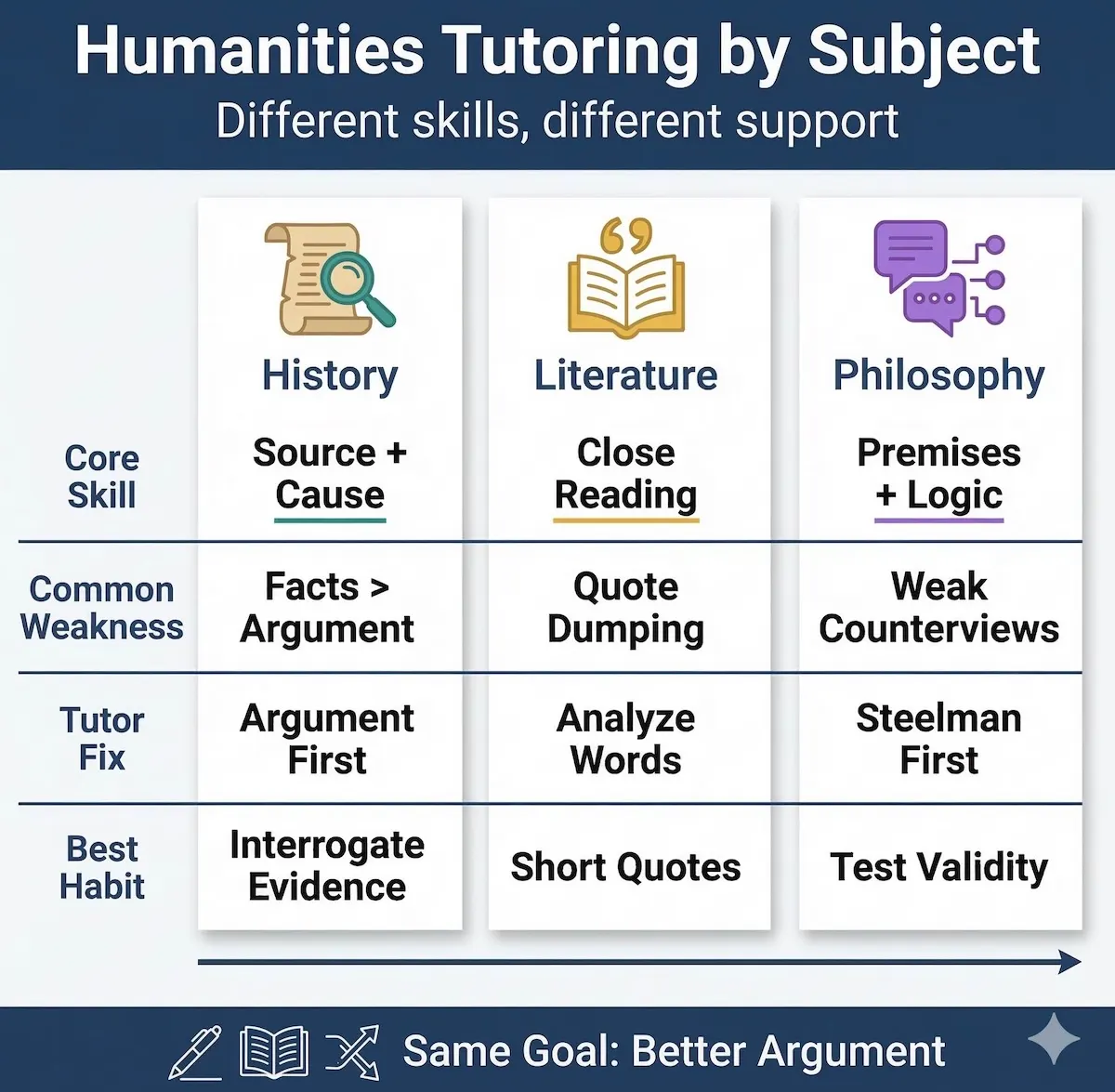
This humanities tutoring comparison shows how history, literature, and philosophy each require different academic support strategies.
History Tutoring
Centres on source evaluation, causation, and essay structure. A history tutor’s primary job is teaching the student to interrogate evidence not to state what happened but to explain why it happened, how different factors interacted, and what the historiographical debate looks like.The highest-scoring history essays at A-Level, IB, and undergraduate level are not the ones with the most factual content; they are the ones where argument drives the selection and deployment of evidence, not the other way around.Tutors working in history spend most of their time on this inversion: moving students from content-first to argument-first thinking.Literature Tutoring
Focuses on close textual analysis, contextualisation, and voice. The specific skill that separates good from excellent literature students is the ability to build an interpretive argument from textual evidence a quote is not an answer, it is the start of an analytical response.Tutors in literature work heavily on the structure of a point: claim evidence analysis contextualisation significance. Students who can embed short quotations fluently and then unpack them at the word or image level consistently outperform those who rely on longer quotations with superficial commentary.Philosophy Tutoring
Requires a different orientation again. The primary skill is constructing and attacking arguments formally: identifying premises, testing for logical validity, recognising informal fallacies, and engaging with counterarguments systematically.A philosophy tutor’s most common task is teaching students to steelman opposing positions before critiquing them a habit that produces the evaluative depth that examiners mark highly.Students who dismiss counterarguments without genuine engagement score in a lower band regardless of how sophisticated their own position is.| Discipline | Core skill assessed | Most common student weakness | What a tutor primarily fixes |
| History | Causation, source evaluation, historiographical awareness | Content-first essays with weak or absent argument | Argument-first essay structure; source interrogation method |
| Literature | Close textual analysis, contextualisation, interpretive argument | Long quotations with surface-level commentary | Point–evidence–analysis–significance technique |
| Philosophy | Logical argument construction, counterargument engagement | Dismissing opposing views without engagement | Steelmanning; premise–conclusion structure |
| English Language | Linguistic analysis, discourse features, audience/purpose | Feature spotting without effect analysis | Effect-first analysis: “this creates…” not “this is…” |
| Media/Cultural Studies | Theoretical application, case study integration | Theory mentioned but not applied to text | Theory as lens: apply to specific textual moments |
Which Essay Writing Frameworks Do Humanities Students Actually Need?
Essay frameworks give students a repeatable structure for turning knowledge into argument. The two most widely taught at secondary and undergraduate level are PEEL and the three-part argument structure. Both are useful; both are also misunderstood in ways that limit their effectiveness.Students often know framework names without knowing when to use them. This visual makes the choice much simpler.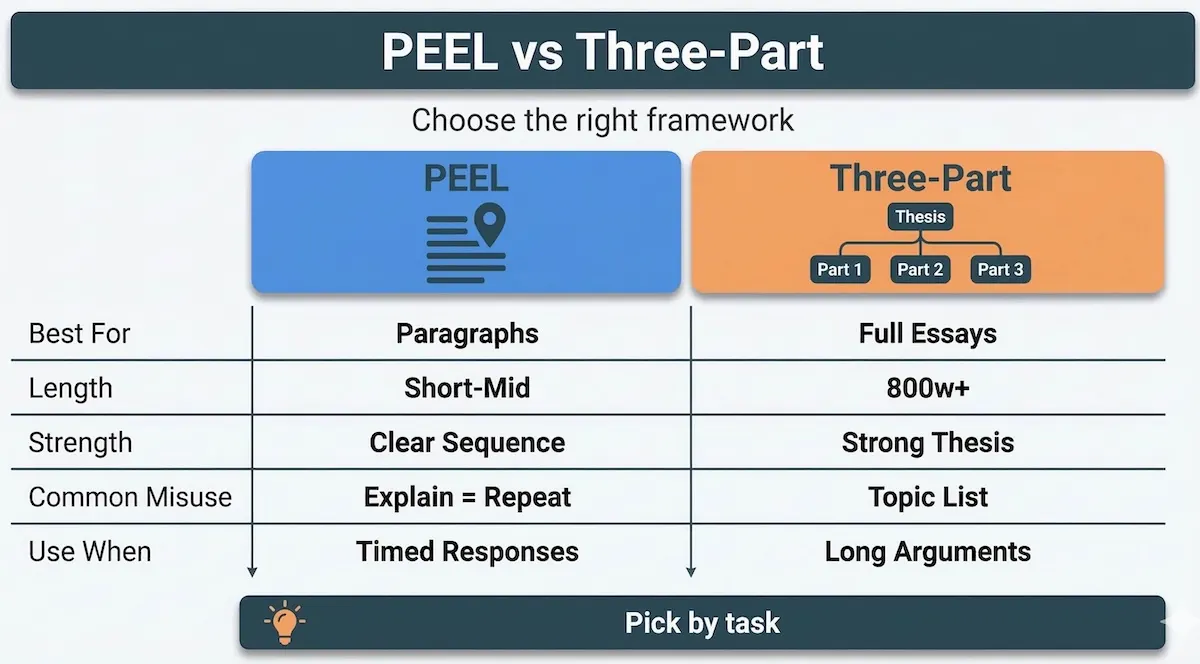
This essay framework comparison helps humanities students choose between PEEL paragraphs and a three-part argument structure.
PEEL (Point, Evidence, Explain, Link)
PEEL is the most commonly taught paragraph framework at GCSE and A-Level. Its value is in enforcing the sequence: you begin with your analytical point (not a fact, not a description), you support it with specific evidence, you explain what the evidence demonstrates about the point, and you link back to the overall essay argument. The most common failure is treating “Explain” as repetition of the point rather than as development: the explanation should add analytical depth, not restate what has just been said.A worked PEEL paragraph for a history essay on the causes of World War One:Point: The alliance system amplified rather than caused the war, acting as a transmission mechanism for a crisis that originated in Austro-Hungarian domestic concerns.Evidence: The blank cheque issued by Germany to Austria-Hungary on 5–6 July 1914 demonstrates that the alliance was activated deliberately, not automatically.Explain: This indicates that political agency not mechanical alliance obligation—drove escalation, supporting Fischer’s argument that German leadership saw the crisis as an opportunity rather than a constraint.Link: The alliance system therefore matters less as a cause than as the infrastructure through which calculated risk-taking produced a general war.The worked example is useful, but the sequence matters even more. This flowchart turns PEEL into a repeatable writing routine.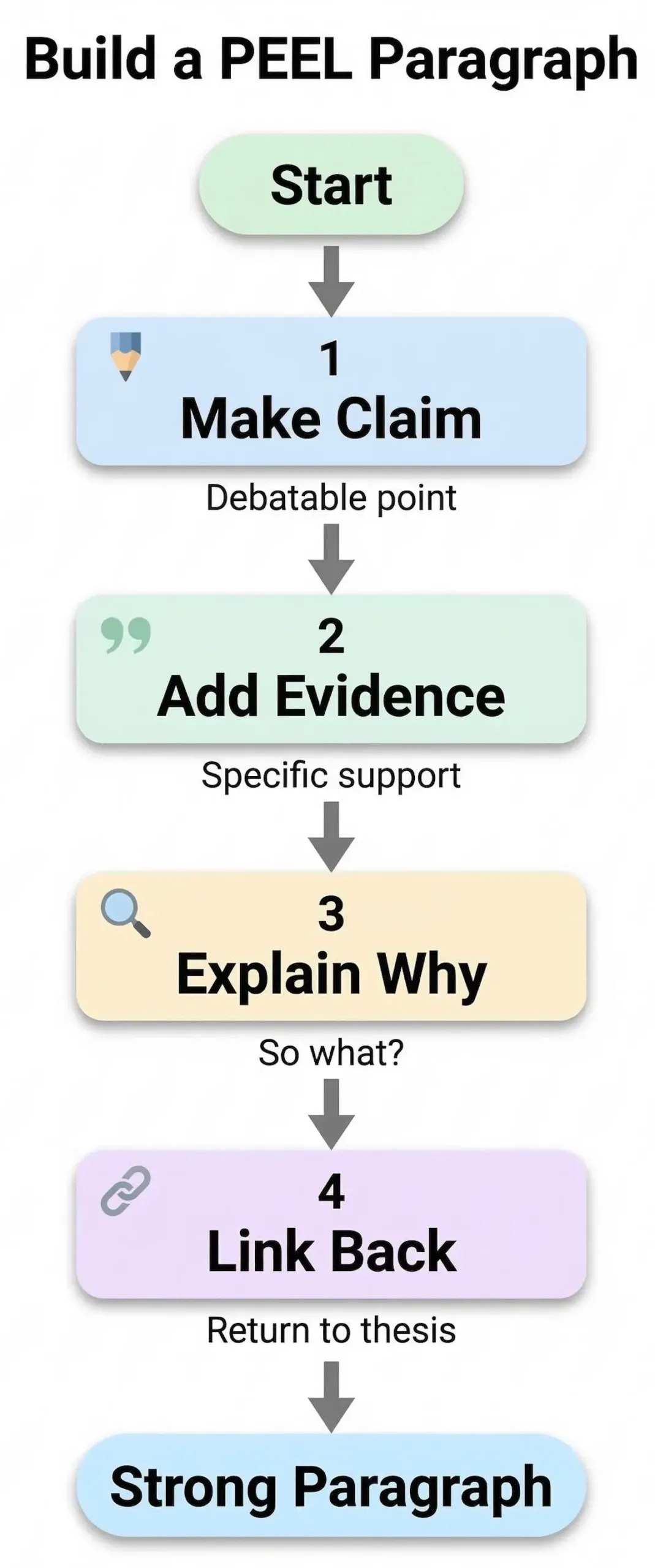
This PEEL paragraph flowchart shows the exact writing sequence humanities students can use to build stronger analysis.
The Three-Part Argument Structure
The three-part argument structure is more appropriate for longer undergraduate essays and structured exam answers of 800 words or more. It organises the essay as:(1) a thesis statement that takes a specific, debatable position;(2) a body that develops the argument through sections, each advancing the thesis rather than presenting separate topics; and(3) a conclusion that synthesises the argument and acknowledges its limitations or the strongest opposing view.The critical difference from a list-of-topics essay is that every paragraph in the body serves the thesis students who write thematic paragraphs that could be rearranged without affecting the argument have not yet built a genuine analytical structure.The most common framework error across all disciplines: students treat the framework as a checklist rather than as a logic structure. PEEL works because the sequence reflects how an analytical argument is built.When students go through the motions writing four labelled sentences with no real analytical connection between them the framework produces structured mediocrity rather than analytical strength.A tutor’s job is to develop the student’s judgment about what constitutes a genuine analytical move at each stage, not just whether a stage is present.| Framework | Best suited for | Core discipline | Most common misuse |
| PEEL | GCSE, A-Level paragraph structure | History, Literature, English | “Explain” becomes restatement of “Point” |
| PEEL-E (+ Evaluate) | A-Level and IB essays | History, Philosophy | Evaluation added mechanically without genuine weighing |
| Three-part argument | Undergraduate essays, 800w+ exam answers | All humanities | Body paragraphs as topic list, not argument development |
| PEA (Point, Evidence, Analysis) | Shorter exam paragraphs | Literature, English Language | Analysis absent — ends at evidence quotation |
| Thesis-antithesis-synthesis | Philosophy and higher-level debate essays | Philosophy, Politics | Synthesis treated as summary, not resolution |
Does Humanities Tutoring Actually Improve Critical Thinking? What Does the Research Show?
The research evidence on tutoring and critical thinking development is meaningful, though it requires careful interpretation. The strongest findings come from studies examining structured one-to-one and small-group tutoring with explicit feedback on reasoning quality the model most relevant to humanities tutoring contexts.A series of studies reviewed in the Educational Psychology Review (Hattie & Timperley, 2007) established that feedback addressing the reasoning process not just the correctness of answers produces substantially larger learning gains than feedback on task completion alone.This distinction matters directly for humanities tutoring: a tutor who marks an essay and comments only on what was missing is providing task-level feedback.A tutor who identifies the specific point at which the student’s argument became circular, or where evidence was asserted rather than analysed, is providing process-level feedback the type associated with transferable skill development.Research on argumentation instruction specifically reviewed in the Review of Educational Research (Graff, 2003; Nussbaum & Sinatra, 2003) shows consistent improvement in students’ ability to consider counterarguments and acknowledge complexity following structured practice in argument construction and refutation.These are precisely the skills humanities tutors develop through essay feedback and Socratic questioning. The gains are not confined to the subject being studied: students who develop argumentative reasoning in history apply it in philosophy and legal studies contexts.For critical thinking more broadly, a meta-analysis published in Thinking Skills and Creativity (Abrami et al., 2015, covering 341 studies) found that explicit instruction in critical thinking teaching the skills directly rather than hoping they emerge from content exposure produced effect sizes approximately three times larger than embedded instruction alone.The research section is one of the article’s strongest trust signals. A visual summary makes the evidence easier to remember.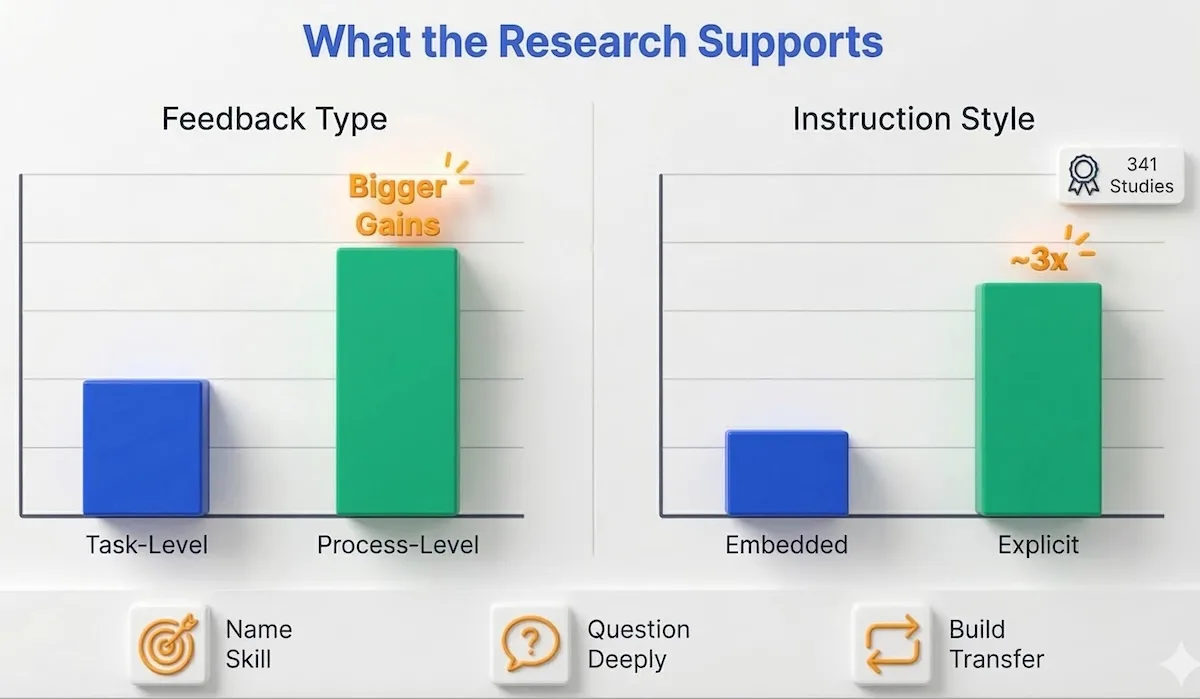
This humanities tutoring research chart highlights why process-level feedback and explicit instruction improve critical thinking faster.
What Mistakes Do Students Commonly Make in Humanities Exams and How Does a Tutor Fix Them?
Many humanities students repeat the same avoidable errors in exams. This table works as a fast pre-exam checklist.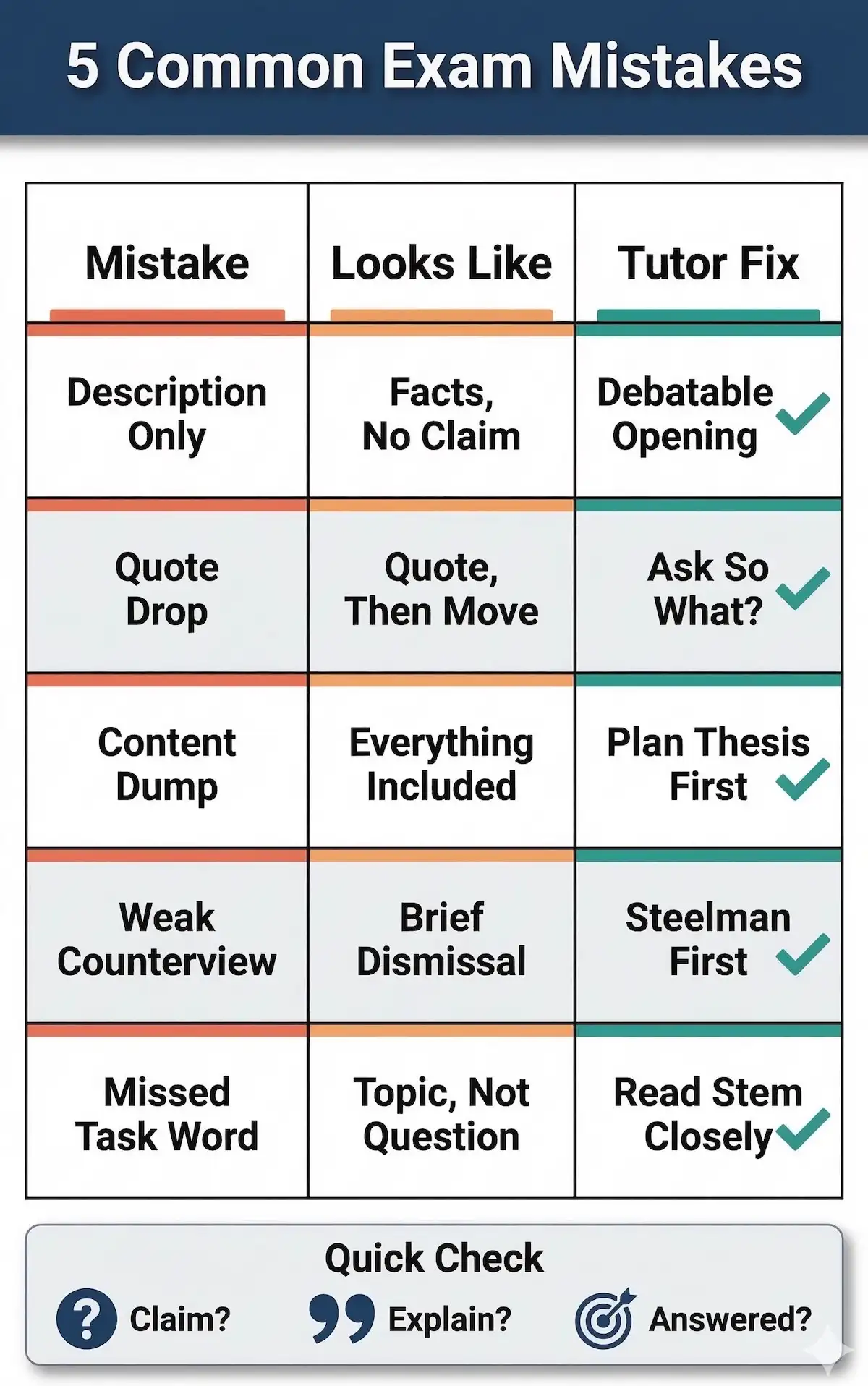
This humanities exam mistakes table helps students spot weak habits and match each one to a practical tutor fix.
Mistake 1: Describing Rather Than Analysing
The student writes what happened, what the text says, or what the philosopher argued, without making an analytical point about why it matters or what it demonstrates.Tutors fix this by requiring every paragraph to begin with a claim that could be argued with not a statement of fact. The test: could someone reasonably disagree with your opening sentence? If not, it is probably description, not analysis.Mistake 2: Quotation Without Analysis (the “Hit and Run” Quote)
In literature and philosophy exams, students cite evidence and then move on without unpacking it. The quote is used as a full stop rather than as a starting point.Tutors address this through the “so what?” discipline: after every piece of evidence, the student must explain what specifically that evidence demonstrates about the point being made, at a level of specificity that could not be achieved without that particular quotation.Mistake 3: Writing Everything Known Rather Than Selecting Evidence for Argument
Under exam pressure, students default to content-display mode: writing as much relevant knowledge as possible in the available time. This produces essays that read as notes rather than arguments.Tutors develop the habit of planning the argument before writing any content spending five minutes on a thesis and three or four analytical points before the first sentence is written.Mistake 4: Generic Counterargument Engagement
Students acknowledge opposing views with phrases like “however, some argue that…” followed by a brief dismissal. Examiners at A-Level and above reward genuine engagement with the strongest version of the opposing argument.Tutors work on this by requiring students to articulate the counterargument at its most compelling before responding to it the steelmanning technique from philosophy applied across all humanities disciplines.Mistake 5: Ignoring the Question’s Specific Wording
A student who answers the topic but not the question loses marks regardless of knowledge quality. Tutors teach close reading of question stems: words like “assess,” “evaluate,” “to what extent,” and “examine” require different responses, and students who treat them as interchangeable consistently underperform.Students looking for support in technical subjects alongside their humanities work can find online Python tutoring and related resources available as well.| Exam mistake | What it looks like | Tutor’s remediation technique |
| Description instead of analysis | “The Battle of the Somme resulted in heavy casualties” no analytical claim | Require every paragraph to open with a debatable claim |
| Hit-and-run quotation | Quote cited, then next point begins immediately | “So what?” discipline: explain what the quote demonstrates, specifically |
| Content-display mode | Essay lists facts chronologically or thematically | Thesis-first planning: argument before any writing begins |
| Generic counterargument | “However, others disagree…” with brief dismissal | Steelman technique: present the opposing view at its strongest |
| Ignoring question wording | Answers the topic, not the specific question | Question stem analysis: define the task word before planning |
AI Essay Tools vs Human Tutoring for Humanities: Which Actually Improves Your Grade?
AI writing tools and human humanities tutors address different problems. Understanding this distinction prevents students from using either tool in ways that produce diminishing returns or, in the case of AI tools, academic integrity risks.AI tools such as ChatGPT, Grammarly, and Turnitin’s writing feedback features are most effective at surface-level improvements: grammar and sentence structure correction, vocabulary suggestions, identification of unclear phrasing, and basic structural feedback. For students whose primary challenge is written expression rather than analytical depth, these tools provide useful and immediate feedback at no cost.Their limitations for humanities specifically are significant. AI tools evaluate the coherence of written argument but cannot evaluate the quality of the argument itself relative to the disciplinary standards of the subject.A history essay that argues clearly but misuses sources, ignores historiographical context, or fails to engage with the specific question wording will receive positive feedback from an AI tool and poor marks from an examiner. The tool assesses the writing; the examiner assesses the thinking.Human tutors who specialise in a humanities discipline bring precisely what AI tools cannot: subject-specific judgment about what constitutes a strong argument in this context, familiarity with the specific mark scheme and examiner expectations for the relevant qualification, and the ability to ask follow-up questions that develop the student’s reasoning rather than correcting their output.The most productive approach is not either/or. Students who use AI tools to improve the clarity of their written expression and then work with a human tutor on argument structure and disciplinary quality typically improve faster than those relying on either resource alone.Students often treat AI and tutoring as substitutes. This comparison shows why the smarter strategy is role-based use.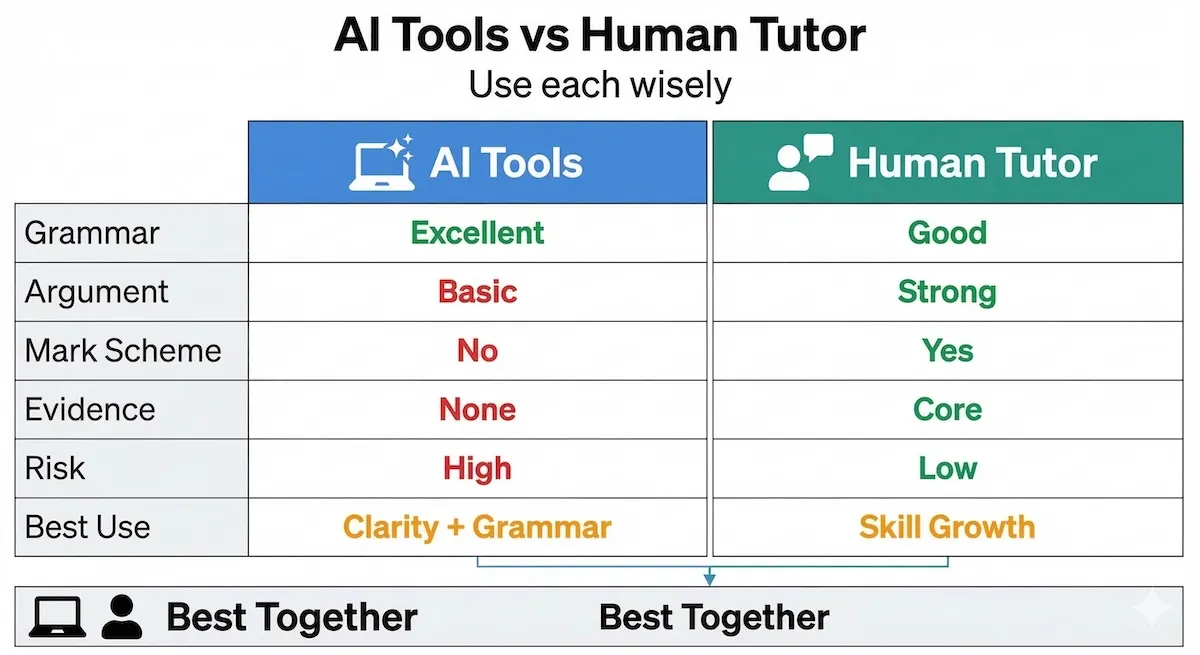
This AI essay tools comparison shows why humanities students should use AI for clarity and tutors for argument quality.
| Feature | AI essay tools | Human humanities tutor |
| Grammar and expression feedback | Excellent | Good (secondary focus) |
| Argument structure feedback | Basic (generic) | Strong (discipline-specific) |
| Mark scheme alignment | No | Yes key differentiator |
| Source and evidence evaluation | None | Core competency |
| Examiner expectation knowledge | No | Yes for known qualifications |
| Counterargument development | Weak | Strong |
| Availability | 24/7, instant | Scheduled sessions |
| Academic integrity risk | High if used to generate submitted work | None |
| Cost | Free–low (basic tools) | Variable (£25–£80/hr UK typical) |
| Best use case | Expression clarity, grammar | Analytical skill development, exam preparation |
What Career Paths Open Up With a Strong Humanities Degree and Why Do Grades Still Matter?
The “what can you do with a humanities degree?” question is asked so frequently because the answer is genuinely broader than most students expect at the point of choosing their subject.Strong humanities graduates are in demand across a wider range of graduate-entry careers than the degree title implies, and grade performance remains a meaningful filter in competitive application processes.The analytical and communication skills developed through humanities study constructing evidence-based arguments, evaluating source reliability, synthesising complex information, writing clearly under pressure map directly onto the competencies that graduate employers in law, consulting, finance, public policy, media, and technology assess at application stage.The Confederation of British Industry’s annual education and skills survey consistently identifies critical thinking, written communication, and analytical reasoning as among the most sought-after graduate skills all core outcomes of a well-developed humanities degree.Law
Law remains the most direct pathway for humanities graduates, particularly those with strong essay writing and argumentation skills from history, philosophy, or English.The Solicitors Qualifying Exam (SQE) route in England and Wales, fully in operation since 2021, has increased the accessibility of legal qualification for non-law graduates. Strong A-Levels or undergraduate grades remain a significant filter for vacation scheme and training contract applications at commercial law firms.Management Consulting
Management consulting recruits heavily from humanities backgrounds. McKinsey, BCG, and Bain specifically target candidates who can structure complex problems and communicate clearly to non-specialist audiences skills humanities graduates develop directly.The case interview process tests structured reasoning, not domain knowledge. Students who also need support in quantitative or technical subjects can find a Java tutor online alongside humanities resources.Civil Service and Public Policy
Civil service and public policy careers in the UK, US, and EU value humanities degrees highly. The UK Civil Service Fast Stream, for example, does not weight degree subject in its assessment process it assesses the analytical and communication competencies that humanities study develops.Journalism and Media
Journalism and media remain natural pathways, with strong writing ability and the capacity to synthesise and communicate complex information being the primary technical requirements. Those interested in how tutoring platforms serve students in adjacent fields may find this review of Bartleby’s reviews, alternatives, and pricing a useful comparison.| Career path | Relevance of humanities skills | Grade significance | Key qualification or entry route |
| Law | Very high argumentation, source analysis | High training contract applications filter on grades | SQE (England/Wales); LLB conversion; Bar course |
| Management consulting | High structured reasoning, communication | High at top firms GPA/degree classification used as screen | Graduate scheme application; case interview |
| Civil service (UK Fast Stream) | Very high analytical writing, policy reasoning | Moderate competency-based; degree class matters less than assessment | Fast Stream assessment centre |
| Journalism/media | High writing, research, synthesis | Moderate portfolio and experience weigh heavily alongside grades | Trainee schemes; NCTJ qualification (journalism) |
| Finance (banking, asset management) | Moderate quantitative skills needed additionally | High graduate scheme screening uses degree classification | Graduate scheme; CFA for asset management |
| Academia/postgraduate research | Very high | Very high PhD funding and placement depend heavily on undergraduate class | First or 2:1 typically required for funded PhD places |
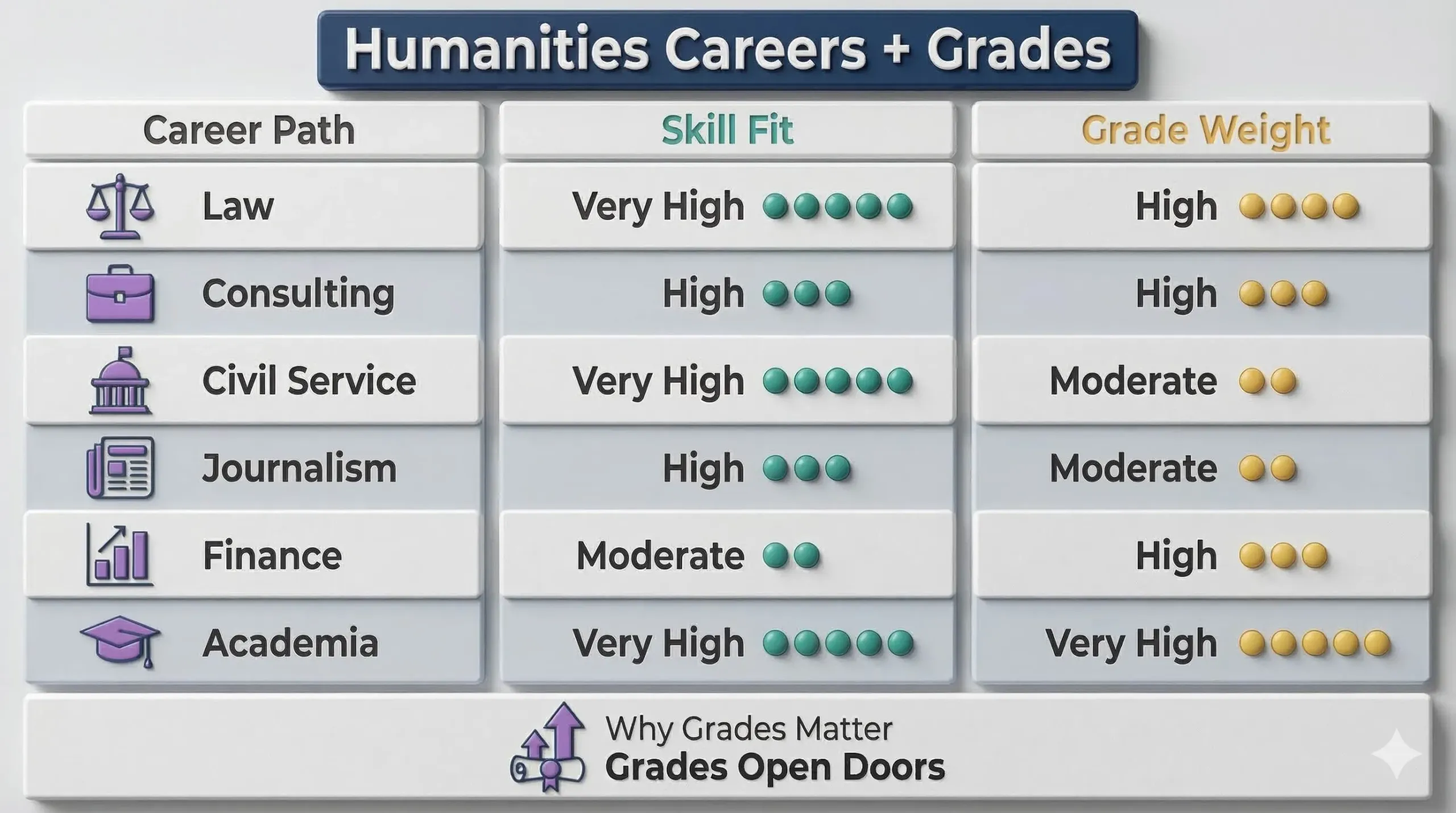
This humanities career infographic shows which career paths value humanities skills most and where grades matter most.
Related Reading
******************************
This article provides general educational guidance only. It is NOT official exam policy, professional academic advice, or guaranteed results. Always verify information with your school, official exam boards (College Board, Cambridge, IB), or qualified professionals before making decisions. Read Full Policies & Disclaimer , Contact Us To Report An Error