GRE Tutoring: How Personalized Help Boosts Exam Scores

Most students who stall on the GRE aren’t struggling because they haven’t studied enough they’re struggling because they keep re-practicing what they’re already decent at. The GRE tests patterns of reasoning across verbal, quantitative, and analytical writing, and without a trained eye identifying exactly where your errors originate, more hours alone won’t close the gap. That’s the core problem a qualified GRE tutor solves: not delivering more content, but diagnosing precisely what’s holding your score back.
The 2024–25 ETS GRE Snapshot reports 206,004 test takers worldwide, down from over 580,000 at peak which means the applicant pool is increasingly composed of ambitious, research-focused candidates targeting competitive graduate programs. In engineering and physical sciences programs, average admitted Quant scores routinely sit in the mid-160s.
The global Quant mean of 157.58 (ETS, 2021–2024 cohort data) leaves most self-studying applicants measurably below par for top STEM programs. Personalized GRE tutoring online or in person targets that gap through diagnostic feedback, strategy calibration, and structured practice that translates directly into score improvement.
This article answers the five questions graduate school applicants most commonly ask about GRE tutoring: what the score stakes actually are for your specific field, why self-study produces diminishing returns past a certain point, what tutoring specifically does that studying alone cannot, how to evaluate tutor quality before you pay, and how to structure your sessions for maximum score gain.
Check Out: Get Personalized Online Tutoring
What GRE Score Do You Actually Need and How Is It Measured?
The GRE General Test measures verbal reasoning (130–170), quantitative reasoning (130–170), and analytical writing (0–6 in half-point increments). According to ETS data covering July 2021 through June 2024 the current authoritative interpretive dataset the mean Verbal score is 151.21 and the mean Quantitative score is 157.58. Understanding where you stand relative to your target program’s admitted class profile, not the global average, is the only number that matters for your preparation.
The GRE underwent a major structural change in September 2023, reducing total test time to 1 hour 58 minutes across five sections, down from over three hours.
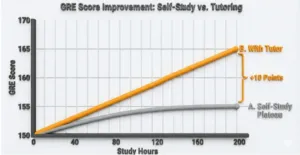
The gap at the right edge of this chart represents the points that separate competitive from average applications to top programs.
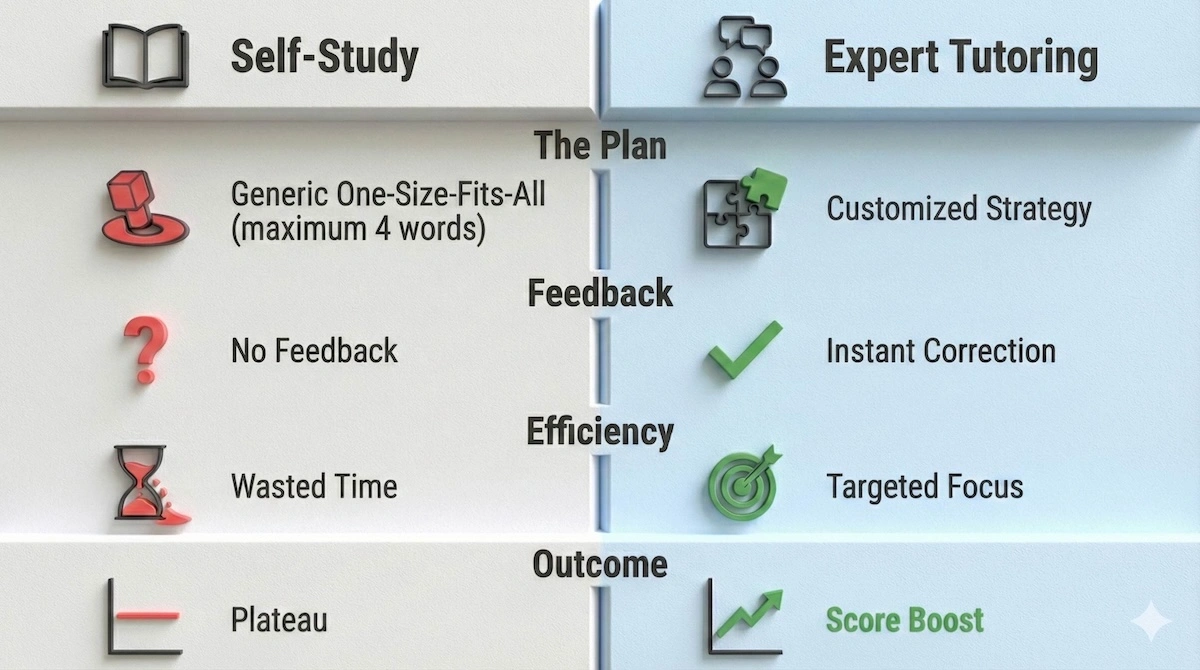
The comparison table below shows why unguided practice produces plateau effects while personalized tutoring sustains improvement.
The Ultimate Guide to Online Tutoring 2026: Expert Tips, Pricing & Platform Reviews
What Are the Most Common GRE Self-Study Mistakes That Tutors Fix?
Three errors account for the majority of self-study plateaus:
First, practicing on question types already mastered rather than attacking genuine weak areas. Students gravitate toward problems where they feel competent because it feels productive but this provides no score uplift. A tutor’s diagnostic work prevents this by forcing focus onto the actual error categories in your practice test data.
Second, studying content rather than reasoning structure. The GRE does not primarily test factual recall; it tests the ability to reason analytically under constraints.
Students who memorize vocabulary lists without building reading comprehension strategies, or who drill algebra formulas without building quantitative reasoning frameworks, improve on the questions they practiced but not on novel phrasings of the same concepts. Experienced tutors teach the underlying reasoning pattern, not the surface solution.
Third, poor pacing calibration. The shortened GRE format 1 hour 58 minutes for five sections rewards students who know when to skip, when to estimate, and when to commit.
Most self-studying students either rush and make careless errors or invest too long on hard questions and run out of time. Pacing strategy requires practice under realistic test conditions with feedback from someone who can see exactly where you are losing time.
How Much Can a GRE Tutor Actually Improve Your Score?
[NLR-SENTENCE: The industry benchmark for tutored GRE improvement is 4–8 points per section; the most effective tutors consistently deliver 9–20 points, and the difference is almost entirely attributable to diagnostic precision.]
The honest answer is that score improvement from tutoring exists on a spectrum directly tied to starting score, hours invested, and tutor diagnostic quality. According to data compiled by Leland from top-rated GRE coaches, the industry standard for tutored improvement is 4–8 points per section, while the most diagnostically skilled tutors report average gains of 9–20 points per student.
Princeton Review’s 32-hour premium package guarantees a 5-point sectional improvement (or a 165+ score for those starting above 159) a meaningful commitment that reflects how measurable this outcome is when the right structure is in place.
For context: a 10-point Quant improvement from 157 to 167 moves a student from roughly the 62nd percentile to approximately the 96th percentile, a difference that can be decisive for competitive STEM doctoral programs.
Even a 5-point improvement in either section shifts your application profile in ways that matter. This is why one-to-one tutoring despite its higher cost relative to self-paced courses produces returns that scale with your program ambitions.
The GRE tutoring process works through a specific feedback loop that self-study cannot replicate:
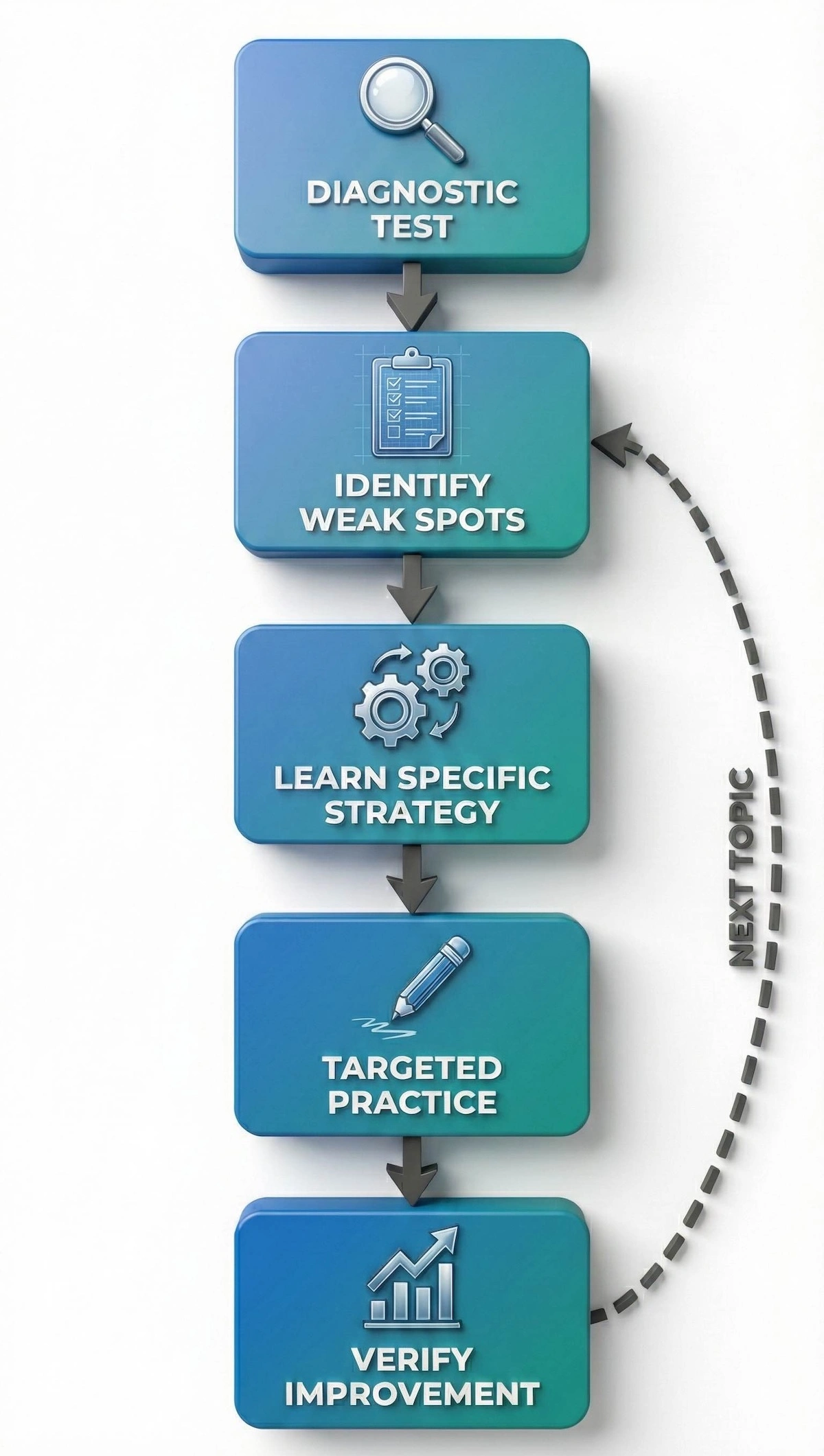
Each cycle of this loop eliminates a category of error from your practice results. Over a 6–12 week tutored preparation period averaging 1.5 hours of tutoring per week alongside self-study between sessions students who execute this process consistently can expect to reach or exceed the industry benchmark improvement range.
One counterintuitive finding from experienced tutors: students starting near the top of the scoring scale (165+) often need more tutoring hours per marginal point than students starting at 150–160. The higher you climb, the harder each additional point becomes not because the content is different, but because the scoring algorithm requires near-perfect accuracy on the hardest question types.
Students in this high-score bracket specifically benefit from tutors with 99th-percentile scores in the target section, who can teach the exact reasoning patterns required for elite-level performance.
How Online Tutoring Enhances Test Prep for Standardized Exams
What Does a GRE Tutoring Session Actually Look Like?
A well-structured GRE tutoring session follows a three-phase format. The first 10–15 minutes reviews homework problems completed between sessions not to mark answers right or wrong, but to reconstruct the reasoning the student used on each question. This is where the tutor identifies error patterns that are not visible from a wrong answer alone.
The middle 30–40 minutes applies targeted instruction: working through new problem types in the category where diagnosis identified the weakest reasoning, with the student working problems aloud while the tutor observes the decision process in real time. The final 10 minutes sets specific practice assignments for the week, calibrated to the exact question types and difficulty levels that will produce the most measurable improvement by the next session.
Students who approach sessions passively waiting to be taught rather than actively attempting problems in front of the tutor see significantly smaller gains. The diagnostic value of a session depends entirely on the tutor observing your live reasoning.
Read More: StudyX Online Tutoring Review: Features, Pricing, and Alternatives
Online or In-Person GRE Tutoring: Which Format Actually Delivers Better Results?
[NLR-SENTENCE: For most GRE test takers in 2025, online tutoring matches or exceeds in-person outcomes the decision should be made on tutor quality and fit, not format.]
The evidence increasingly supports online tutoring as the primary format for GRE preparation. The global online tutoring market reached approximately rel=”noopener
“>$10.4 billion in 2024, with a projected growth rate of 14.5% annually through 2030</a> (Grand View Research), driven in part by documented equivalence in learning outcomes between virtual and in-person instruction for test prep subjects.
The GRE itself is computer-delivered, which means preparing on a screen with digital tools is actually closer to real test conditions than working from paper in a physical space.
The practical advantages of online tutoring are significant: access to tutors with 99th-percentile scores regardless of your geographic location, scheduling flexibility across time zones (particularly important for international applicants in India, China, and the Middle East collectively representing the majority of GRE test takers outside the US), and the ability to record sessions for later review. Most quality platforms use interactive whiteboards that replicate on-paper working just as effectively as in-person sessions for math problem-solving.
The case for in-person tutoring remains valid under specific conditions: younger students or those with significant test anxiety who benefit from physical presence and direct human rapport, and situations where a highly qualified local tutor is available at a comparable rate. Some students find that the social accountability of a face-to-face appointment produces better between-session study behavior.
The table below summarizes the key decision factors:
| Factor | Online Tutoring | In-Person Tutoring |
| Tutor quality ceiling | Very high global tutor pool | Limited to local availability |
| Cost | Generally lower (~$20–$80/hr range) | Often higher due to travel and local rates |
| GRE-aligned format | Higher screen-based practice | Lower paper-based default |
| Scheduling flexibility | High | Lower |
| Recording for review | Standard on most platforms | Rarely available |
| Best for | Most GRE test takers | Students with significant anxiety or young test-takers |
The bottom line: format matters far less than tutor quality, diagnostic skill, and your commitment to executing the work between sessions.
Also Read: 24/7 Premium 1:1 Tutoring For Standardized Tests
How Do You Choose a Qualified GRE Tutor?
[NLR-SENTENCE: A qualified GRE tutor is distinguished not by credentials alone but by their ability to watch you work a problem and identify exactly why you got it wrong ask for a diagnostic session before committing to any package.]
Most students hire a GRE tutor based on advertised scores or price. Both are poor proxies for diagnostic skill, which is the capability that actually determines your improvement. The right question to ask before hiring any tutor is not “what did you score on the GRE?” but “how do you identify exactly where my reasoning fails on a problem I get wrong?”
A tutor who cannot answer this clearly who describes their approach in terms of content delivery, strategy lists, or study plans rather than error analysis is likely to produce results at the low end of the improvement range.
Practical criteria for evaluating GRE tutors:
Score credentials matter, but conditionally. A tutor with a 99th-percentile Quant score is valuable for a student targeting 165+ in Quant. The same tutor may be less useful for a student primarily struggling with Verbal reasoning. Match the tutor’s strongest section to your weakest area.
Ask for a diagnostic session first. Reputable tutors and platforms offer a first session or trial session before package commitment. Use this session to work through 5–8 real GRE practice questions in front of the tutor and observe the depth of their feedback. If they primarily confirm your answer was wrong and explain the correct approach, they are delivering content. If they reconstruct your reasoning process and identify the specific cognitive step where you went off-track, they are delivering diagnosis.
Verify experience with your specific target score range. Tutoring a student from 145 to 155 requires different techniques than taking a student from 160 to 168. Ask tutors directly about their experience at your starting score and target score range.
Red flags to avoid: tutors who offer guaranteed improvement without a diagnostic baseline, platforms that cannot tell you who your specific tutor will be before payment, and tutors who have never taken the GRE themselves. Well-regarded platforms such as <a href=”https://www.myengineeringbuddy.com/test-prep/
“>MEB’s test preparation services</a> vet tutors on subject expertise and provide transparent matching processes.
GRE tutors can be found through dedicated test prep companies (Manhattan Prep, Target Test Prep, Princeton Review), specialist coaching platforms (Leland, Menlo Coaching), and flexible tutoring marketplaces likehttps://www.myengineeringbuddy.com/subject/gre/ MEB’s GRE tutoring service</a>, which offers one-to-one sessions starting around $20–$40 per hour significantly below large test-prep company rates with tutors available across the full range of GRE sections including Quantitative Reasoning
How Do You Get the Most Out of Each GRE Tutoring Session?
Tutoring is only as effective as the student’s engagement between and during sessions. Students who see the largest score gains treat their tutor not as a teacher delivering content but as a diagnostic partner helping them understand their own reasoning patterns and then do the work themselves to correct those patterns through between-session practice.
Before each session: Complete all assigned practice problems independently, without looking up answers mid-problem. When you reach an answer right or wrong write a brief note on your reasoning: what approach you used and why. Bring these notes to the session. A tutor reviewing your reasoning process is ten times more valuable than a tutor reviewing your answers.
During each session: Work problems aloud. Narrate your reasoning as you solve rather than presenting a finished answer. This is uncomfortable at first, but it is the only way your tutor can observe the exact point where your thinking diverges from correct reasoning.
After each session: Execute assigned practice within 24 hours while the session’s corrective feedback is still fresh. Students who delay practice by 3–5 days lose most of the session’s diagnostic value before they have applied it.
Tracking progress: Keep a running error log a record of every incorrect answer categorized by question type, error type (content gap, misread question, pacing error, careless arithmetic), and difficulty level. Review this log before each tutoring session. After 3–4 sessions, patterns will emerge that allow both you and your tutor to prioritize exactly where remaining prep time should go.
The confidence benefit of structured tutoring compounds with competence. As you eliminate specific error categories through targeted practice, the anxiety associated with those question types drops replacing test-day hesitation with procedural confidence

For students preparing while managing coursework, research commitments, or full-time work: the between-session investment does not need to be large in volume. Two hours of diagnostic, error-focused practice three times per week executed consistently outperforms five hours of passive content review over the same period.
For GRE homework help on specific practice problem sets, or for on-demand assistance between scheduled sessions, many students supplement weekly tutoring with targeted homework support on individual questions or sections where progress has stalled.
<h2>Is Investing in GRE Tutoring Worth the Cost?</h2>
GRE tutoring is not worth the cost as an abstract proposition — it is worth the cost when specific conditions are met. Understanding those conditions helps you avoid both underinvesting (relying on self-study after you have already plateaued) and overinvesting (buying premium packages when free or low-cost resources would suffice for your situation).
Tutoring is clearly worth it when:
- You have attempted self-study for 60+ hours and your practice test scores have not moved by more than 3–4 points in the last 4 weeks
- Your target program’s 75th-percentile admitted score is 10 or more points above your current practice test performance
- Your application timeline is under 12 weeks, which means efficient, diagnostic improvement matters more than raw study hours
- You are targeting 165+ in either section, where marginal gains require expert-level diagnostic feedback
Tutoring may not be the priority when:
- Your practice scores are already at or above your target program’s 50th-percentile admitted score
- You have 6+ months of preparation time and the discipline to execute a structured self-study plan with regular self-testing
- Your score gap is primarily attributable to content knowledge (not reasoning), in which case structured self-study with Khan Academy or ETS official materials may close the gap cost-effectively
On cost: independent GRE tutors charge widely varying rates. Specialist platforms with 99th-percentile tutors range from $80–$200/hour. More flexible platforms offering vetted subject tutors including MEB’s GRE tutoring start from $20–$40/hour, providing diagnostic support at a fraction of large-company rates. A typical tutored prep program of 12–15 hours over 8 weeks costs between $240 and $3,000 depending on platform and tutor level a range that warrants careful matching between your score gap, timeline, and budget before committing.

Key Takeaways
- GRE score improvement is primarily a diagnostic problem: students stall because unguided practice cannot identify which reasoning step is failing, not because they haven’t studied enough.
- The 2024–25 ETS snapshot recorded 206,004 GRE test takers a consolidating, ambitious pool. In engineering and physical science programs, the competitive Quant benchmark is typically 162–166, well above the global mean of 157.58.
- Industry data places average tutored improvement at 4–8 points per section; highly diagnostic tutors consistently achieve 9–20 points. The gap is tutor skill, not student effort.
- Every 40–50 hours of focused prep produces approximately 5 points of improvement. Tutoring’s value is compressing this by eliminating unfocused hours through error diagnosis.
- Online tutoring matches or exceeds in-person outcomes for most GRE test takers in 2025. Choose based on tutor quality and diagnostic fit not format.
- Before hiring any tutor, ask for a diagnostic session and watch how they analyze a wrong answer. Content explanation is not diagnosis. Identifying the exact reasoning step that failed is.
- Tutoring ROI is highest when your score plateau is real (60+ hours, <4 points gain), your target program’s 75th-percentile score is 10+ points above your current performance, or your timeline is under 12 weeks.
Frequently Asked Questions
Q1: What is GRE tutoring?
Personalized one-to-one exam preparation in which an expert tutor diagnoses your specific error patterns, designs targeted practice, and teaches test-taking strategy moving well beyond generic content delivery to produce measurable score improvement.
Q2: How effective is online GRE tutoring compared to in-person?
For most test takers, online tutoring matches in-person effectiveness and offers meaningful advantages: access to higher-quality tutors regardless of location, scheduling flexibility, and a screen-based format that mirrors the actual GRE’s computer-delivered structure. The 2024 global online tutoring market reached $10.4 billion, reflecting documented equivalence in outcomes for test prep subjects.
Q3: How many hours of tutoring do I need to improve my GRE score?
A useful benchmark: every 40–50 hours of diagnostic, feedback-driven study produces approximately a 5-point score improvement. For a 10-point target improvement, plan for 8–12 weeks of preparation involving weekly tutoring sessions (1–1.5 hours each) plus dedicated between-session practice. Students targeting 165+ in either section often require more tutor-hours per marginal point.
Q4: How do I know if a GRE tutor is actually qualified?
Request a diagnostic session before committing to any package. A qualified tutor does not just explain why an answer is correct they reconstruct your reasoning process to identify exactly which cognitive step produced the error. Ask directly: “How do you diagnose where my reasoning goes wrong on a problem I get right for the wrong reason?” If the answer is vague, continue searching.
Q5: When should I hire a GRE tutor instead of self-studying?
Key signals: you have self-studied for 60+ hours with fewer than 4 points of improvement in the last month, your target program’s 75th-percentile score is 10+ points above your current performance, or your test date is within 12 weeks. Students close to their target score with ample time may not need tutoring.
Q6: What does GRE homework help cover?
GRE homework help refers to tutor-guided review of practice problem sets math reasoning questions, verbal reasoning items, and analytical writing prompts with targeted feedback on both the answer and the reasoning process. This can supplement scheduled tutoring sessions or provide on-demand support on specific question types that continue to challenge you. MEB’s homework help service covers all GRE sections.
Q7: Which GRE section benefits most from tutoring?
Both sections benefit, but the nature of the benefit differs. Quantitative Reasoning tutoring is most valuable for identifying specific algebra, number properties, or data interpretation reasoning gaps discrete, diagnosable skill deficiencies. Verbal Reasoning tutoring is most valuable for students whose reading comprehension strategies are underdeveloped a harder problem to self-diagnose because errors feel like vocabulary gaps when they are often reading strategy failures.
Related Subjects
GRE Analytical Writing GRE Mathematics GRE Physics GRE Psychology GRE Quantitative Reasoning GRE Verbal Reasoning
******************************
This article provides general educational guidance only. It is NOT official exam policy, professional academic advice, or guaranteed results. Always verify information with your school, official exam boards (College Board, Cambridge, IB), or qualified professionals before making decisions. Read Full Policies & Disclaimer , Contact Us To Report An Error