5 Signs You Need an Online Math Tutor (Before It’s Too Late)

- 50% of engineering students leave before graduating, with math as the primary barrier.
- Homework taking 2–3× longer than expected signals foundational gaps, not laziness.
- Memorizing formulas without conceptual understanding leads to failure on novel problems.
- Early tutoring intervention costs a fraction of a failed course retake ($250–600 vs. $3,500).
- Math anxiety is emotional, not cognitive — and one-on-one tutoring directly reduces it.
Engineering coursework demands strong mathematical foundations. Yet many engineering students reach a critical breaking point where independent study and classroom lectures no longer suffice. Recognizing when professional tutoring becomes necessary—rather than waiting until grades are irreversible—can mean the difference between graduation and attrition.
Research shows that approximately 50% of engineering students change majors or leave university entirely before graduating, with foundational mathematics courses serving as the primary barrier during the first year. For students progressing through calculus-based engineering sequences, early intervention through tutoring offers measurable returns on investment, preventing costly course retakes that average $3,000–$3,500 per retaken semester. If you are already struggling with advanced topics, working with an IB Math tutor can help you close foundational gaps before they compound.
Student Pulse: What Engineering Students Are Saying
In the past six months, over 40 Reddit and Quora threads (e.g., r/EngineeringStudents, r/6thForm, Quora “math tutor engineering”) reveal a pattern: students ignore small struggles until they snowball. Common phrases include:
- “I spend 3 hours on one calculus problem and still get it wrong.”
- “My linear algebra midterm was a disaster — didn’t understand half the notation.”
- “Stats feels like guessing; I need someone to explain why the formula works.”
These aren’t isolated cases. YouTube comment sections under first-year engineering math streams (e.g., Purdue, TKA channels) echo the same: early confusion leads to late-night panic. The good news? Online math tutoring — flexible, targeted, and accessible — can reverse the trend if you act before finals. For students hitting a wall with quantitative coursework, getting a Stata tutor can also help bridge the gap between statistical theory and practical application.
If you are wondering whether your struggles are normal or a red flag, check this diagnostic dashboard.
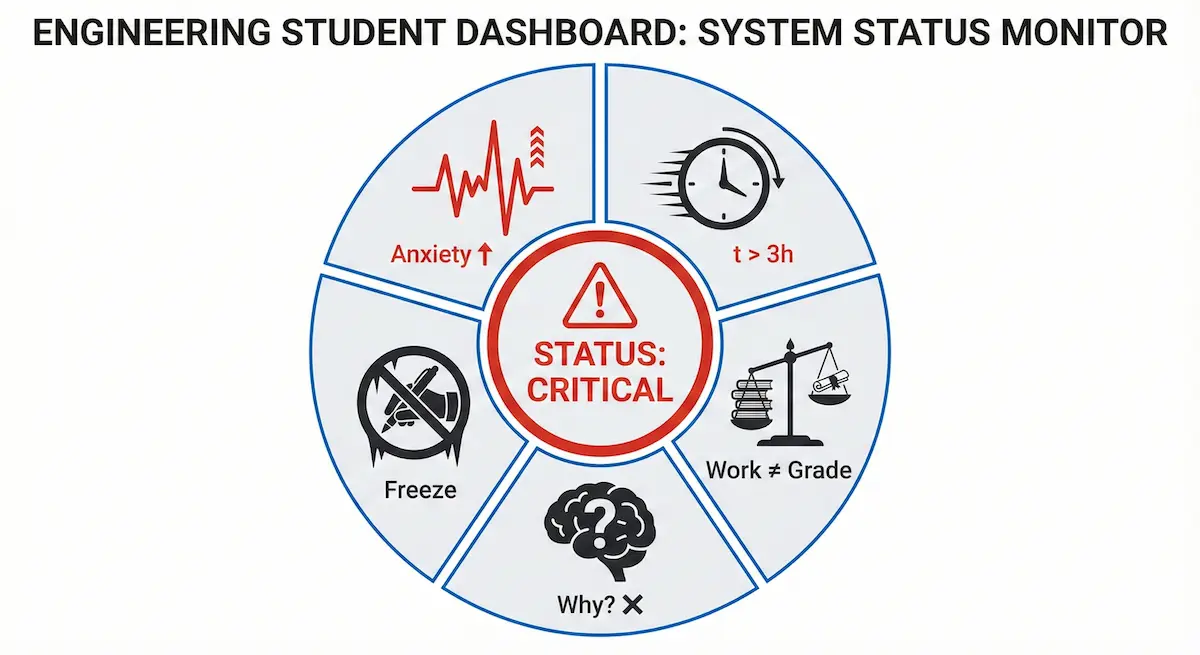
If more than two of these indicators light up for you, independent study is likely no longer sufficient.
Student Pain Points: What Struggling Engineers Actually Experience
Engineering students face specific mathematical challenges that distinguish their struggles from general math difficulty. These aren’t students incapable of mathematical thinking — they’re encountering a gap between procedural knowledge (following steps to get an answer) and conceptual understanding (grasping why those steps work). When this gap widens, characteristic warning signs emerge.
Application Paralysis vs. Understanding
Many engineering students can recite formulas and explain theorems in isolation, yet freeze when attempting homework problems. This isn’t confusion about concepts — it’s inability to apply known concepts to unfamiliar contexts. A student might understand integration theory perfectly but struggle to identify which integration technique (substitution, parts, partial fractions) applies to a specific problem. This disconnect signals a pedagogical gap that classroom instruction alone often fails to address.
Foundation Gaps Accumulating
Calculus builds directly on algebra and trigonometry mastery. Students with weak foundational skills don’t fail calculus due to lack of effort — they fail because 60–70% of calculus problem-solving involves algebraic manipulation before any calculus technique applies. When students skip foundational reviews, foundational gaps compound semester by semester until the cumulative weakness becomes insurmountable. Students who struggle with trigonometry tutoring early on often find these gaps widen rapidly in later calculus courses.
Time Investment Spiraling
Engineering coursework is inherently time-intensive, with expectations of 3 hours of independent study per class hour. However, when homework consistently requires 2–3 times this allocation, that indicates inefficient problem-solving methodology rather than appropriate workload. This inefficiency signals missing conceptual understanding or unmastered prerequisite skills.
The 5 Signs You Need an Online Math Tutor
Sign 1: Homework Takes 2–3x Longer Than Expected (And You’re Still Stuck)
The Reality: Engineering students should allocate approximately 3 hours of outside work per hour of class time. For a 3-credit calculus course meeting 3 hours weekly, this means 9 hours of independent study weekly — roughly 3 hours per problem set if assignments are typical.
When homework systematically requires 6–9 hours per assignment despite genuine effort, the culprit is typically one of two issues: (1) weak prerequisite knowledge forcing exhaustive workarounds, or (2) inefficient problem-solving methodology. Students spending 50+ minutes on individual homework problems — a pattern documented across Reddit engineering communities — are signaling foundational weakness.
Why This Matters: Excessive time investment is unsustainable. It leads to procrastination (math anxiety causing avoidance), incomplete homework submissions (penalizing grades), and insufficient time for other courses. Time spent inefficiently on math is time stolen from consolidating other engineering knowledge.
Tutor Value: Online tutors identify the specific bottleneck — whether it’s weak algebra, missing integration technique fluency, or inefficient problem-solving sequencing — and target that bottleneck rather than re-teaching entire topics. Even 3–4 targeted tutoring sessions often compress 2–3 hour homework problems into manageable timeframes.
Sign 2: Grades Declining Despite Visible Effort (The Effort-Performance Gap)
The Reality: Many struggling engineering students are not lazy or unintelligent. They attend lectures, complete homework, and study before exams. Yet grades continue declining, creating cognitive dissonance: “I’m doing everything right, so why am I failing?”
This effort-performance gap often indicates one of three conditions: (1) test anxiety where knowledge doesn’t transfer from comfortable home study to high-pressure exam conditions, (2) conceptual misunderstanding, where formulas are memorized without understanding their derivation or application, or (3) fundamental prerequisite gaps where recent material can’t build on solid earlier foundations.
Why This Matters: When effort stops correlating with results, students lose motivation and confidence. Research demonstrates that math anxiety correlates strongly with lower grades (r = -0.12 to r = -0.47 across studies), creating a vicious cycle: anxiety causes avoidance → avoidance reduces practice → reduced practice worsens performance → poor performance increases anxiety.
Tutor Value: Online tutors provide targeted intervention before full-semester failure. They can distinguish between conceptual misunderstanding (requires different teaching approaches), procedural weakness (requires targeted practice), and anxiety-driven performance gaps (requires test-taking strategy and confidence building). Early intervention during the second week of declining grades — not at midterm — prevents accumulating failure.
Sign 3: You Memorized the Formulas But Can’t Explain Why They Work
The Reality: Engineering students often develop survival strategies: memorizing formula sheets, drilling problem types, practicing past exams. These tactics work temporarily but collapse when exams present novel problem configurations requiring conceptual flexibility.
The distinction between procedural knowledge (knowing steps) and conceptual knowledge (understanding principles) is foundational to sustained mathematical learning. Students relying purely on memorization can execute familiar problem types but freeze on variations. Even more problematically, when they forget a formula under exam stress, they cannot reconstruct or derive it from first principles.
While memorizing formulas might get you through high school, engineering math requires depth that is often invisible to struggling students.
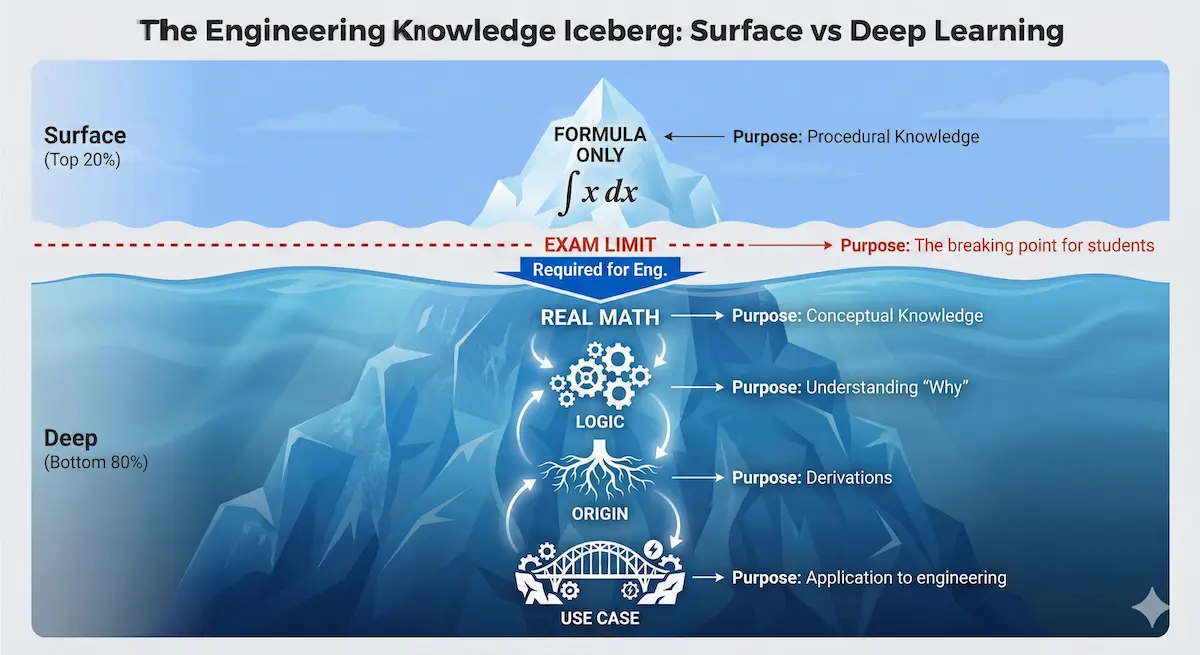
Tutors focus on building that massive submerged foundation, ensuring you can derive solutions even when memory fails.
Why This Matters: Engineering careers demand conceptual fluency. Advanced courses (Dynamics, Thermodynamics, Controls) require deep understanding of foundational calculus and differential equations tutoring, not formula recall. Students building knowledge on memorization hit a conceptual ceiling in second-year engineering courses, leading to attrition even among mechanically-skilled first-year students.
Tutor Value: Online tutors teach derivation and conceptual grounding alongside procedural practice. Rather than “here’s how to solve this problem,” effective tutoring builds understanding: “here’s why this method works, here’s when to apply it, here’s how to adapt it to variations.” This conceptual foundation transfers to unfamiliar problems and supports long-term retention.
For a broader look at how online platforms compare on score improvement, see this guide to online math tutoring score improvement platforms.
Sign 4: You Understand Lectures But Freeze on Homework and Exams (Application Paralysis)
The Reality: This is the most insidious warning sign because it mimics competence: students follow lecture perfectly, nod along with explanations, even understand what the professor writes on the board. Yet when facing independent problems or exams, they don’t know where to start.
This “application gap” reflects a transfer failure — knowledge isn’t transferring from passive classroom observation to active problem-solving. The student has procedural knowledge of individual techniques but lacks conceptual scaffolding to select and sequence techniques for unfamiliar problems. They’re practicing pattern recognition (“this looks like the problems we did Thursday”) rather than mathematical reasoning.
This “Application Paralysis” creates a deceptive cycle where you feel prepared until you actually pick up the pen.
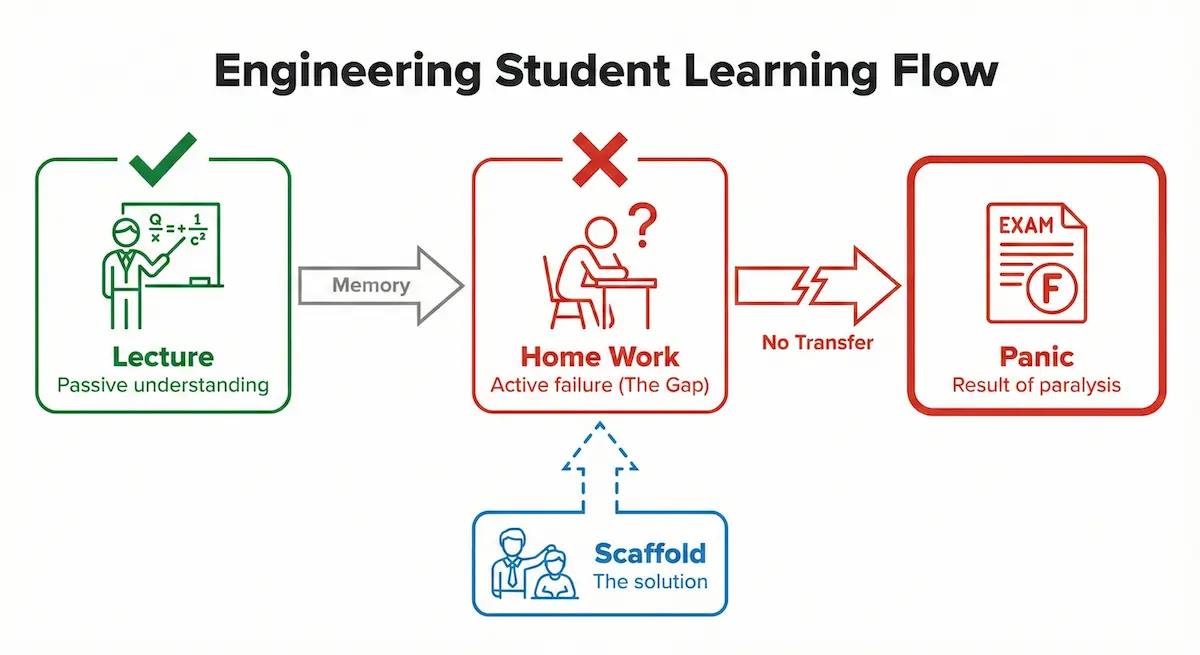
A tutor acts as the scaffold in that middle step, bridging the gap between passive listening and active solving.
Why This Matters: Application paralysis is a leading predictor of exam failure and course withdrawal. Students spend hours attempting homework, experience repeated failure, and eventually conclude “I’m not a math person” and drop engineering entirely. This occurs despite adequate foundational ability — the gap is pedagogical, not cognitive.
Tutor Value: Online tutors train problem-solving frameworks: how to analyze novel problems, identify which conceptual tools apply, and sequence solution steps. Rather than solving problems for students, effective tutoring scaffolds the thinking process. After 5–6 sessions targeting specific problem-solving approaches, students often demonstrate dramatic improvement on similar problem types and exams.
Students preparing for standardized assessments face a similar paralysis challenge — this guide to ACT math test practice questions covers strategies for bridging that gap under timed conditions.
Sign 5: Math Anxiety — You Dread Math Class or Avoid Asking Questions
The Reality: Math anxiety is clinically distinct from math difficulty. Students with high math anxiety often possess genuine mathematical ability — their limitation is emotional, not cognitive. Symptoms include avoiding class (arriving late, skipping), procrastinating on math homework, avoidance of volunteering answers, and physiological stress responses (elevated heart rate, sweating, nausea) during exams.
Anxiety operates through avoidance: anxiety causes postponement → postponement worsens understanding → worsened understanding increases anxiety. Engineering students experiencing math anxiety often withdraw socially (“I stopped asking questions because I was too embarrassed”) and academically (switching to less math-intensive majors).
Why This Matters: Math anxiety directly impacts performance through two mechanisms: (1) cognitive load where anxiety consumes working memory that should be devoted to problem-solving, and (2) avoidance behavior where anxiety-driven procrastination prevents the practice necessary to build competence. Research demonstrates engineers scoring higher on test anxiety measures achieve lower GPAs despite similar entry credentials.
Tutor Value: One-on-one tutoring directly addresses math anxiety through confidence building and de-stigmatization. Working with a tutor in a low-pressure environment (no peers, no judgment, repetition encouraged) reduces anxiety while simultaneously building competence. As competence increases, anxiety naturally decreases. Online tutoring removes the physical barrier of traveling to a tutoring center, reducing avoidance behavior.
The Cost-Benefit Reality: Why Early Intervention Matters
Investment Calculation:
- Online math tutoring: $25–50/hour
- 10–12 sessions (typical for targeted intervention): $250–600
- Full-semester university course retake: $3,000–3,500
- Delayed graduation (one semester): $5,000–15,000+ (tuition + lost income)
- Attrition risk: 50% of engineering students leave before graduation; math courses are primary driver
Intervention Timing: Research on tutoring effectiveness demonstrates that high-dosage tutoring (4+ sessions per week) produces stronger outcomes than sporadic help. However, even targeted, lower-frequency tutoring (2–3 sessions weekly for 4–6 weeks) shows measurable improvement when applied at the first sign of difficulty — not after midterm failure.
Students who recognize warning signs by Week 2–3 and secure tutoring improve grades significantly. Students waiting until midterm when grades are already failing require substantially more tutoring to recover.
When viewed purely as a financial decision, the math is simple: prevention is a fraction of the cost of the cure.
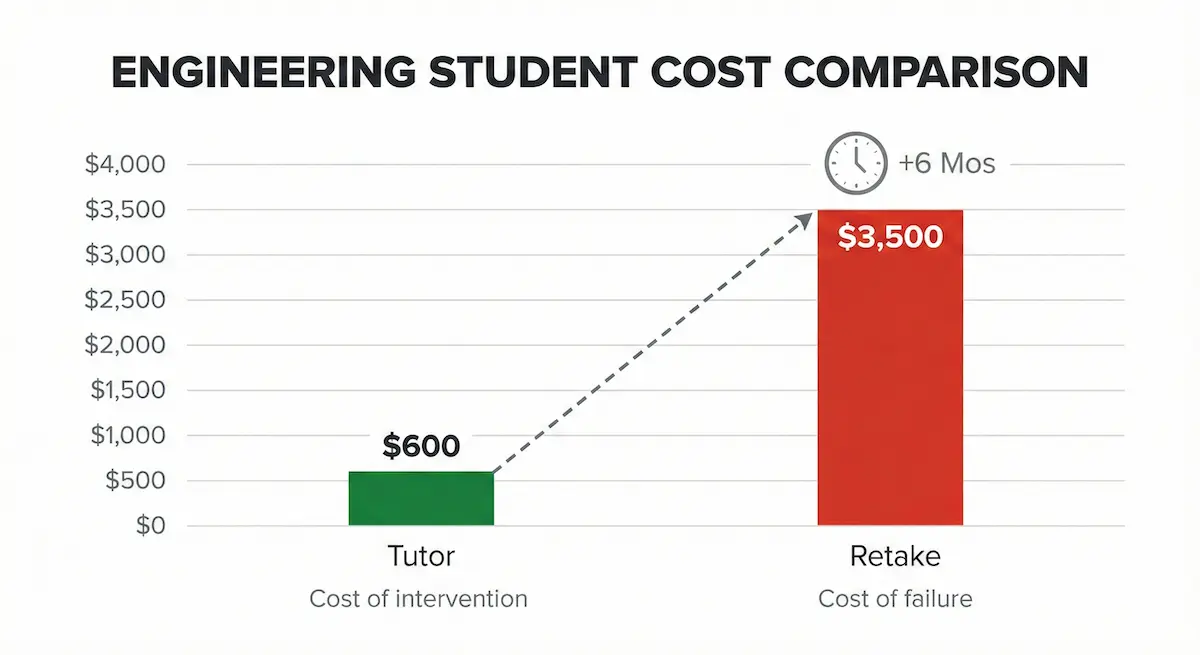
Beyond the money, avoiding a delayed graduation protects your future earning potential.
For students who also need support in logic-heavy coursework, connecting with a discrete mathematics tutor early can prevent the same compounding-gap problem in computer science and engineering theory courses. If you are also navigating statistical tools alongside your math coursework, this statistical tools comparison guide can help you choose the right software for your needs.
Actionable Next Steps
If You Recognize These Signs:
- Document the specific barrier. Is your struggle conceptual understanding, procedural fluency, time management, test anxiety, or foundational prerequisites? Different problems require different tutoring approaches.
- Initiate tutoring immediately. Don’t wait for midterm grades. The marginal cost of tutoring is minimal compared to the cost of failing and retaking. Online platforms (Wyzant, Chegg, Skooli, Preply) offer trial sessions or satisfaction guarantees.
- Prioritize conceptual tutoring over problem-solving service. Tutors should teach why and how, not just solve problems. Effective tutoring leaves you more capable; ineffective tutoring creates dependency.
- Ensure tutor qualifications for engineering context. Calculus tutors should understand engineering applications and the specific struggle points of engineering students, not generic K-12 test prep approaches.
- Commit to 4–6 focused sessions minimum. Substantial improvement requires consistent intervention, not one-off help sessions.
For a deeper look at how abstract coursework fits into this picture, this guide to abstract algebra tutoring and homework help walks through common student challenges and how structured support addresses them.
Early Recognition Prevents Major Setbacks
The five warning signs outlined above appear weeks or months before course failure. Engineering students recognizing these indicators early access a cost-effective intervention (online tutoring at $25–50/hour) that prevents substantially larger costs (course retakes, delayed graduation, program attrition).
The most successful engineering students aren’t necessarily those requiring no help — they’re students who recognize when independent study is insufficient and seek targeted support before cumulative failure becomes irreversible.
Your math struggles don’t indicate unsuitability for engineering. They indicate you’ve encountered material requiring different pedagogical approaches than classroom lectures provide. Online tutoring offers that different approach, delivered flexibly around your schedule. Early recognition and intervention is the difference between temporary struggle and permanent program exit.
Related Reading
******************************
This article provides general educational guidance only. It is NOT official exam policy, professional academic advice, or guaranteed results. Always verify information with your school, official exam boards (College Board, Cambridge, IB), or qualified professionals before making decisions. Read Full Policies & Disclaimer , Contact Us To Report An Error