7 Examiner Secrets to Boost Your A Level Economics 9708 Grade

- Command words determine whether evaluation is required — misreading them costs 4–6 marks per essay.
- Diagrams must show labeled axes, curves, equilibria, and shift arrows to earn full marks.
- Allocate 60% of essay time to evaluation, not analysis, for 12-mark questions.
- Always integrate specific extract data; failing to do so caps scores at 4–6 out of 10.
- Level 3 requires balanced, two-sided evaluation with a supported final judgment.
Scoring an A* in Cambridge 9708 Economics requires more than knowing the content. Examiners follow specific marking criteria, and understanding what they look for can add 10–15 marks to your papers. Based on November 2024 examiner reports and mark schemes, here are seven insider strategies that separate A* students from the rest. If you want structured support working through these techniques, a dedicated economics tutor can help you apply them to past papers.
What Students Are Asking
Recent forum discussions show students struggling with the same issues. “Why did I lose marks when I explained everything?” and “How is evaluation different from analysis?” appear in over 20 Reddit threads from the past three months. Students also ask about diagram requirements, time management in Paper 2, and using extract data effectively. These concerns reflect consistent mark-loss areas identified in examiner reports.
Secret 1: Master the Command Word Hierarchy
Command words determine what examiners expect. Misunderstanding them costs students 4–6 marks per essay question.
To ensure you never misinterpret a question again, use this visual hierarchy to distinguish strictly between analysis and evaluation tasks.
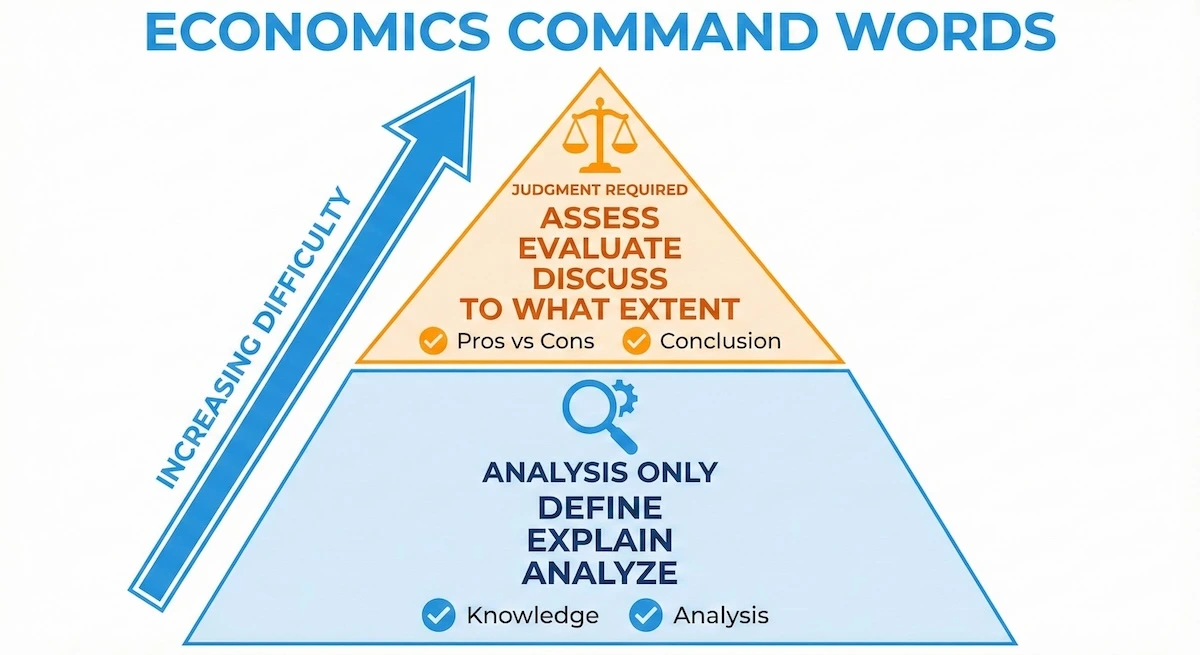
Memorize this hierarchy: words in orange require a final judgment, while words in blue only require logical explanation.
Keep this pyramid in mind: if the command word falls in the orange ‘Judgment’ zone, you cannot achieve top marks without weighing arguments and concluding.
Command Words Requiring No Evaluation
- Define: Give precise meanings
- Explain: Show how/why something works with logical reasoning
- Analyze: Break down relationships using economic theory
Command Words Requiring Evaluation
- Assess: Weigh up both sides, reach a supported judgment
- Evaluate: Make judgments based on evidence, consider strengths and weaknesses
- Discuss: Examine multiple viewpoints, provide balanced analysis with conclusion
- To what extent: Create an argument showing degrees of agreement/disagreement
How This Works in Practice
A question asking “Explain how fiscal policy affects economic growth” needs analysis only. Show the chain of reasoning: government spending increases, aggregate demand rises, real GDP grows. Include an AD/AS diagram. Stop there.
A question asking “Assess whether fiscal policy is the best way to achieve economic growth” needs both analysis and evaluation. After explaining how fiscal policy works, evaluate its limitations (time lags, crowding out, debt concerns) and compare it to alternatives (monetary policy, supply-side policies). Conclude with a supported judgment.
November 2024 examiner reports note students often provide evaluation when only explanation is needed, wasting time. Conversely, students lose 30–40% of marks on “assess” questions by only analyzing without evaluating trade-offs.
Application strategy: Read the question twice. Underline the command word. If it requires evaluation, allocate 40% of your writing time to weighing up arguments and reaching conclusions. If it doesn’t, focus entirely on clear analysis.
Understanding the difference between microeconomics tutoring concepts and macroeconomic ones also sharpens how you apply command words across different question types.
Secret 2: Diagram Technique That Gains Full Marks
Diagrams can earn or lose 3 marks in seconds. Examiners follow strict criteria based on March 2024 and November 2024 mark schemes.
Essential Diagram Requirements
- Both axes clearly labeled (not just P and Q, write “Price” and “Quantity”)
- Curves labeled (D for demand, S for supply, AD for aggregate demand)
- Original equilibrium marked (label it E1 or use clear notation)
- New equilibrium marked if showing a shift (label it E2)
- Show direction of shifts with arrows on curves
Common Mistakes from Examiner Reports
- Unlabeled axes lose 1 mark immediately
- Missing equilibrium points lose 1–2 marks
- Confusing shifts with movements along curves loses marks
- Drawing curves that don’t intersect or intersect at wrong angles
Visualizing these requirements can prevent simple errors. Here is the 4-point checklist every diagram must pass to earn full credit.
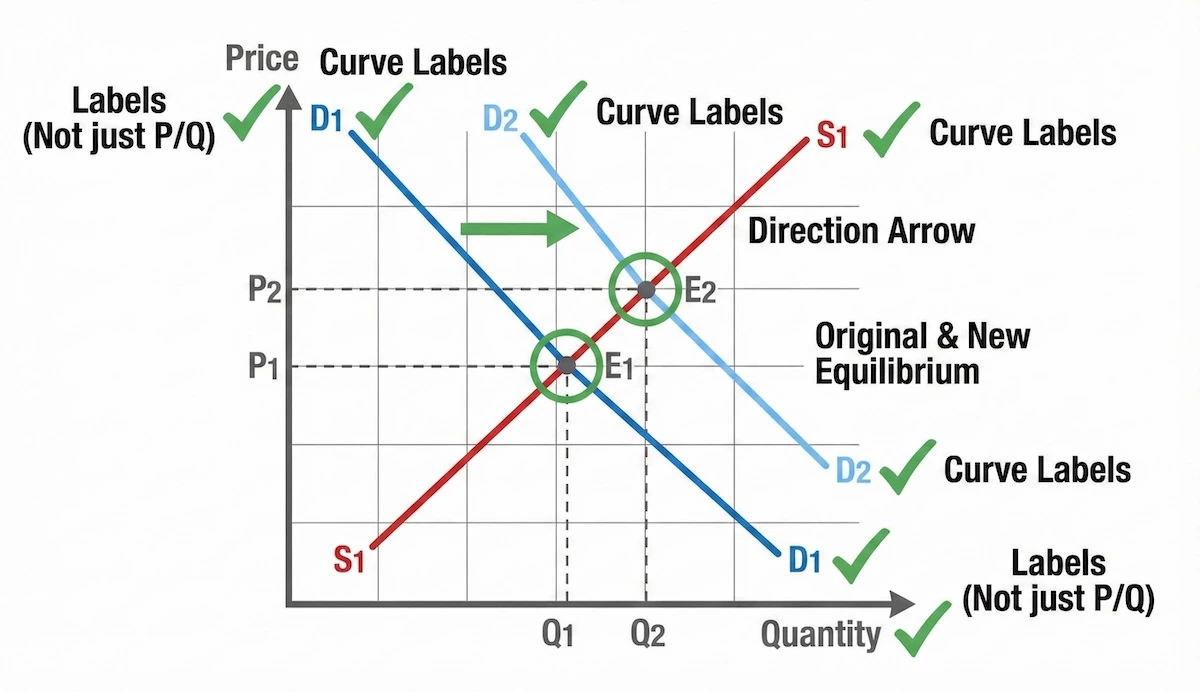
Every diagram must pass this 4-point checklist to secure the full 3 marks available.
Get in the habit of mentally ticking off these four green checkmarks — especially the equilibrium labels — before you move on to the next question.
Correct Approach for Demand-Supply Diagrams
Start with labeled axes: Price (vertical), Quantity (horizontal). Draw downward-sloping demand curve D1 and upward-sloping supply curve S1. Mark their intersection as E1, showing initial price P1 and quantity Q1.
If showing an increase in demand, draw a new demand curve D2 to the right of D1 with an arrow. Mark new equilibrium E2 with higher price P2 and quantity Q2. Reference both equilibria in your written explanation.
For AD/AS Diagrams
Vertical axis: Price Level. Horizontal axis: Real GDP (or Real National Output). Draw downward-sloping AD curve and upward-sloping SRAS curve (short-run) or vertical LRAS curve (long-run). Mark equilibrium clearly.
Mark schemes award 1 mark for correct axes and curves, 1 mark for original equilibrium, 1 mark for showing the change correctly. Missing any element costs you marks.
Time-saving tip: Practice drawing 10 standard diagrams until you can produce them in under 60 seconds. Use a ruler for axes if needed for clarity.
When personal liabilities become overwhelming due to fluctuating market conditions, consulting the best debt settlement companies allows you to settle accounts and find a sustainable path toward financial recovery.
Secret 3: The Two-Sided Evaluation Framework
Evaluation separates B-grade students from A*/A students. November 2024 examiner reports state: “Candidates who achieved Level 3 provided balanced evaluation considering both sides.”
Students preparing for related qualifications may also find it useful to work with an IB Economics tutor, since the evaluation frameworks overlap significantly.
The Evaluation Framework Examiners Want
For any “assess” or “evaluate” question, structure your evaluation using this approach:
- Present the main argument with analysis (Argument A)
- Present the counter-argument or limitation (Argument B)
- Compare the relative strength of both sides
- State which side is stronger under what conditions
- Conclude with a clear judgment
Worked example:
Question: “Assess whether raising interest rates is the best way to reduce inflation.”
Analysis: Explain how higher interest rates reduce aggregate demand through reduced consumption and investment, leading to lower demand-pull inflation. Include AD/AS diagram showing leftward AD shift.
Evaluation structure:
Strengths of interest rate policy:
- Works relatively quickly (6–12 month transmission lag)
- Targets demand-pull inflation directly
- Central bank has clear control mechanism
Limitations and counter-arguments:
- Ineffective against cost-push inflation
- May cause recession and unemployment
- Exchange rate effects may offset benefits
- Alternative: supply-side policies address root causes but take years
- Time lags mean policy may overshoot target
Weighing up: Interest rate effectiveness depends on inflation type. For demand-pull inflation exceeding 5%, interest rates work well. For cost-push inflation from oil shocks, supply-side responses are better. If growth is already weak, interest rate rises cause excessive unemployment costs.
Judgment: Interest rates are best for demand-driven inflation in a growing economy, but supply-side policies are better for long-term price stability without growth sacrifice.
This structure earns 3–4 evaluation marks. One-sided analysis earns 0–1 evaluation marks.
Constructing a balanced argument can be difficult to visualize in the heat of an exam. The flowchart below maps out the exact thought process needed for a Level 3 evaluation.
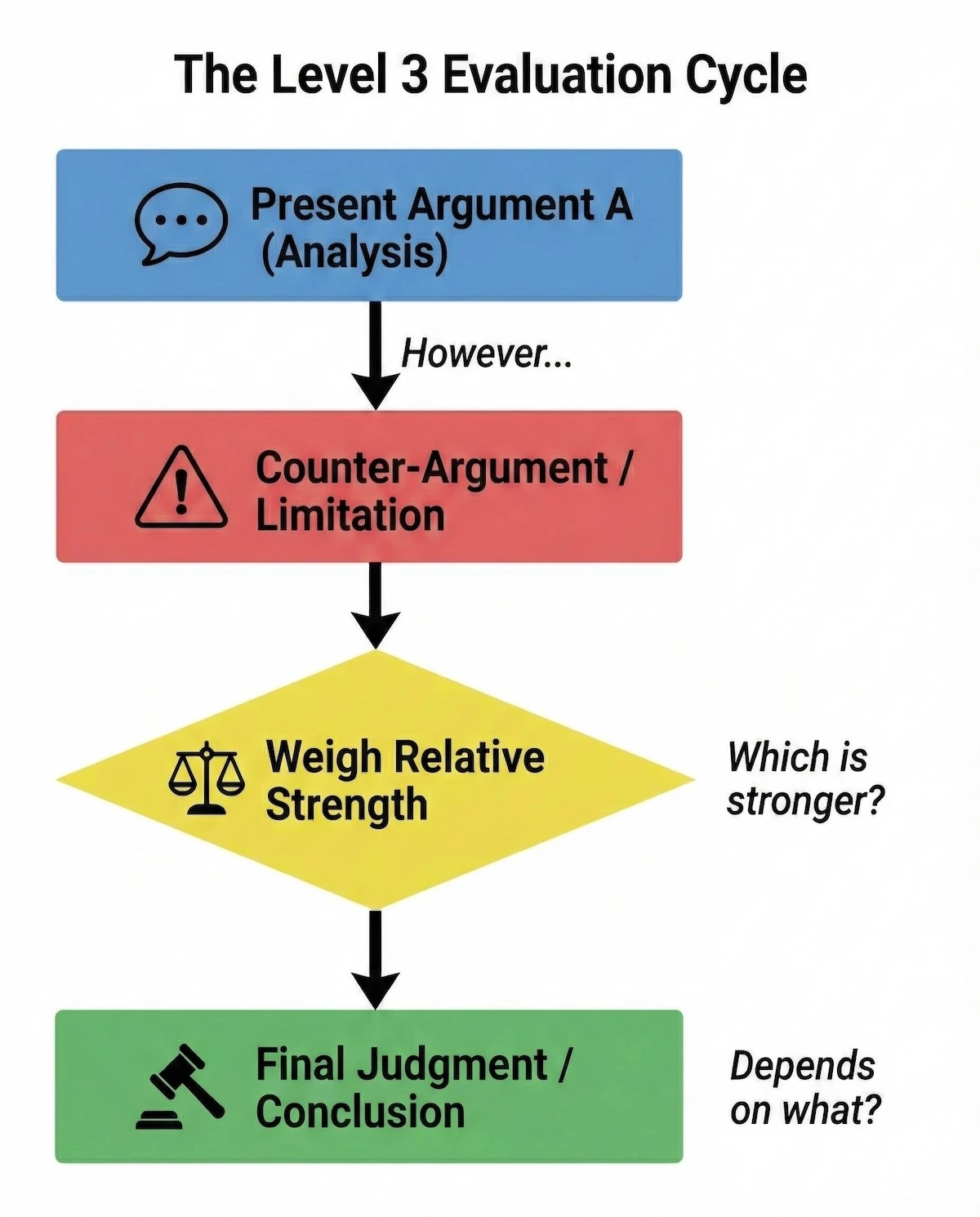
Move beyond one-sided arguments by following this cycle: Argument → Counter → Weighing → Judgment.
By following this loop, you ensure that every argument is weighed against a counter-argument before you attempt to reach a final judgment.
Secret 4: Extract Integration Formula for Paper 2
Paper 2 Section A data response questions explicitly test extract usage. November 2024 examiner reports highlight: “Candidates who failed to reference extract data scored maximum 4–6 marks out of 10.”
The Integration Formula
Every data response answer should follow this pattern:
- Make your economic point
- Support it with extract evidence
- Explain why the evidence supports your point
Think of your data response answers as a mathematical equation. You need all three components — Point, Evidence, and Explanation — to get the result.
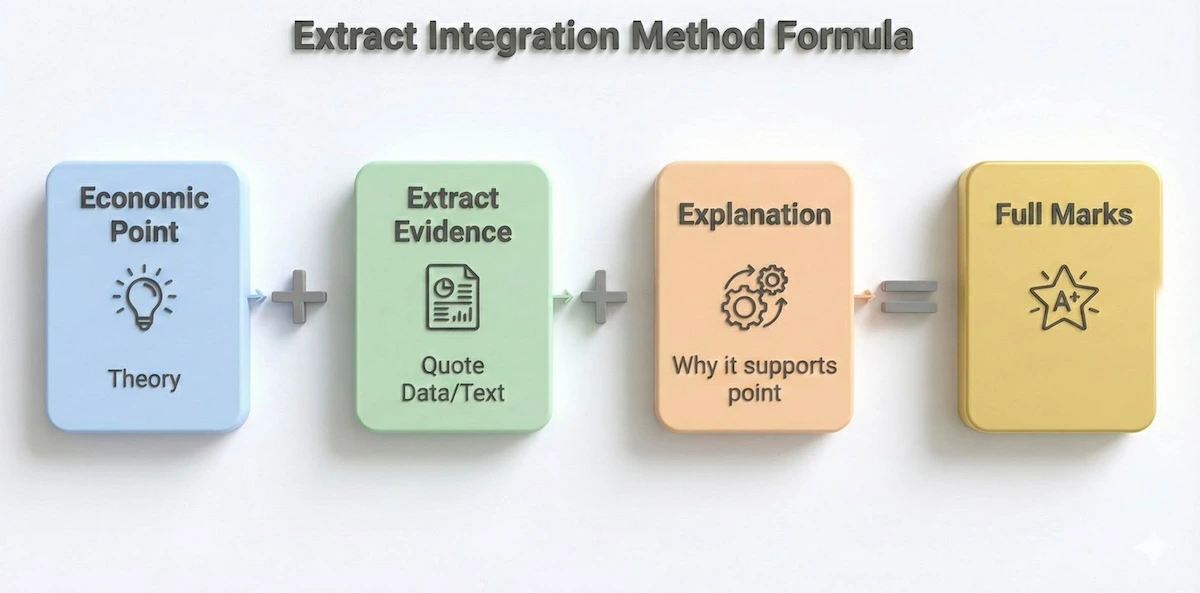
Treat data response questions like a formula: you must combine Theory, Evidence, and Explanation to get the mark.
If you miss the middle variable (Extract Evidence), you lose the application mark instantly. Always quote the specific data.
Example:
Question: “Using Extract A, explain two factors that might increase demand for tourism in Country X.”
Weak answer (loses marks): “Rising incomes increase demand for tourism because people have more money to spend.”
Strong answer (full marks): “Rising incomes increase demand for tourism. Extract A shows real wages in Country X grew by 8.5% from 2022 to 2024. This income growth raises purchasing power, allowing households to afford international holidays previously beyond their budget. Tourism is a normal good with positive income elasticity, so demand rises as incomes increase.”
Second Integration Technique
When extracts contain data tables or graphs, reference specific numbers. Mark schemes award marks for “use of data” separately from analysis marks.
Example: “Extract B indicates unemployment fell from 7.2% to 4.1% between 2020 and 2023, suggesting effective labor market policies.”
This explicit data reference earns you the application mark even if your analysis is weak.
How Much to Integrate
For 8-mark questions: Reference extract 3–4 times. For 12-mark questions: Reference extract 5–6 times.
Underline key data in extracts before writing. This ensures you don’t forget to use it.
Platforms like Verbling are sometimes used by students seeking language and subject tutors online — worth knowing if you are exploring your options.
Secret 5: The 40/60 Time Split for Essays
Time management directly affects grades. November 2024 grade thresholds show you need approximately 70% of available marks for an A*. Poor time management leaves 12-mark questions half-finished, losing 6–8 marks.
The Strategic Split
Paper 2 (90 minutes total):
- Section A (20 marks): 35 minutes
- Section B essay (8 marks): 15 minutes
- Section B essay (12 marks): 25 minutes
- Review: 15 minutes
Paper 4 (105 minutes total):
- Section A (20 marks): 35 minutes
- Section B/C essay (8 marks): 15 minutes each
- Section B/C essay (12 marks): 25 minutes each
- Review: 10 minutes
Within each essay, use the 40/60 rule:
For 12-mark questions requiring evaluation:
- 40% of time (10 minutes): Analysis and explanation
- 60% of time (15 minutes): Evaluation, comparison, judgment
Students typically reverse this, spending 20 minutes on analysis and 5 minutes rushing evaluation. This earns 5–6 marks for strong analysis but only 1–2 marks for weak evaluation, totaling 6–8/12. Reversing the split earns 4–5 for decent analysis and 4–5 for strong evaluation, totaling 8–10/12.
Most students struggle with time management because they prioritize the wrong tasks. This chart shows how your 25 minutes for a 12-mark essay should actually be divided.
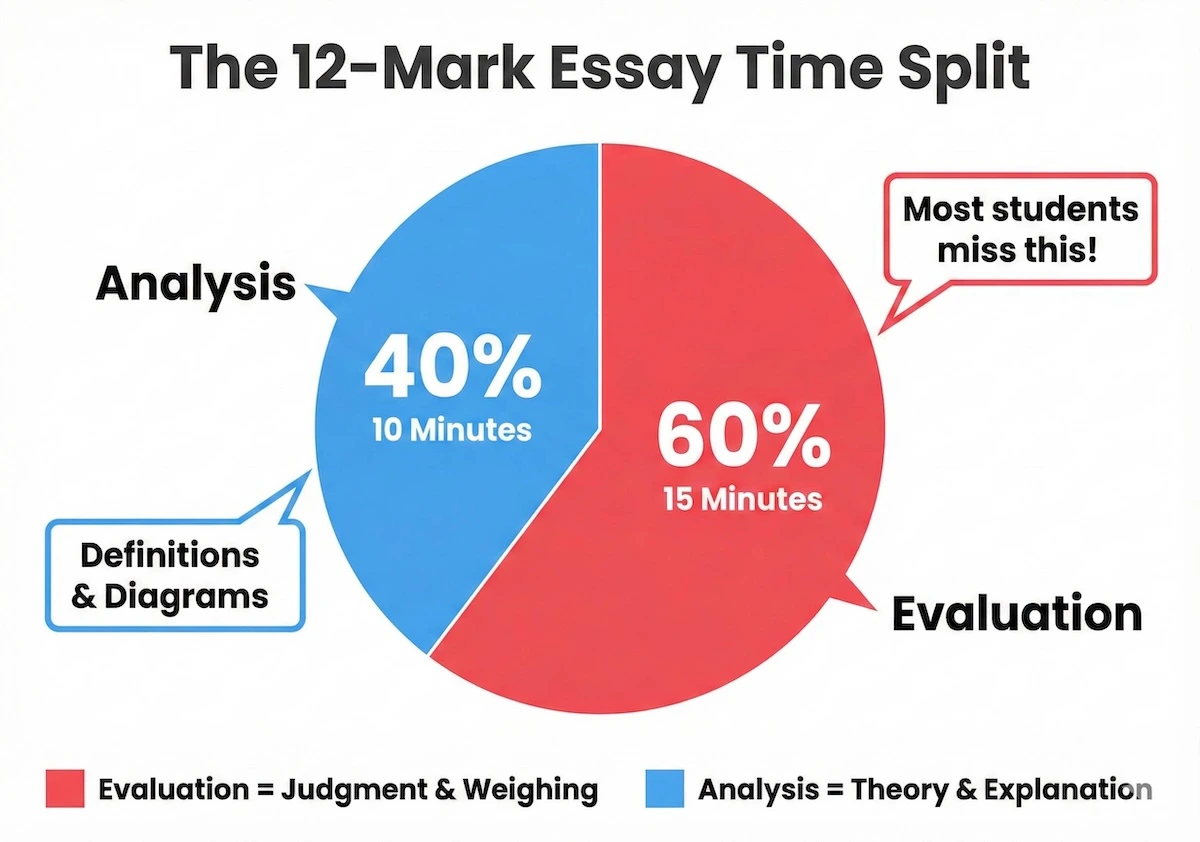
Most students analyze for 20 minutes and evaluate for 5. Reverse this habit to match the 40/60 rule shown above.
Shifting your focus to the red section (Evaluation) is the single fastest way to improve your essay grade without learning new content.
Practical timing technique: Wear a watch. When you start a 12-mark question at minute 40, set mental checkpoint at minute 50. If you’re still writing analysis at minute 50, stop immediately and shift to evaluation. Incomplete strong evaluation outscores complete weak evaluation.
For students who also study business topics, working with an online marketing teacher can reinforce the applied economic reasoning skills that transfer directly to exam technique.
Secret 6: Level Descriptors Decoded
Mark schemes use level descriptors for essays. Understanding these levels shows exactly what examiners want.
Level 1 (1–3 marks for 12-mark questions):
- Limited economic knowledge
- Little or no analysis
- One-sided or no evaluation
- Poorly organized ideas
Level 2 (4–6 marks for 12-mark questions):
- Some economic knowledge
- Analysis present but may be incomplete
- One-sided or limited evaluation
- Some organization but gaps in logic
Level 3 (7–12 marks for 12-mark questions):
- Good economic knowledge
- Developed analysis with clear chains of reasoning
- Balanced evaluation considering alternatives
- Well-organized with logical structure
How to reach Level 3:
The difference between Level 2 and Level 3 is consistency. Level 2 answers do some things well. Level 3 answers do everything well.
What does ‘consistency’ actually look like on paper? This table compares the specific attributes of an average answer versus a top-tier response.
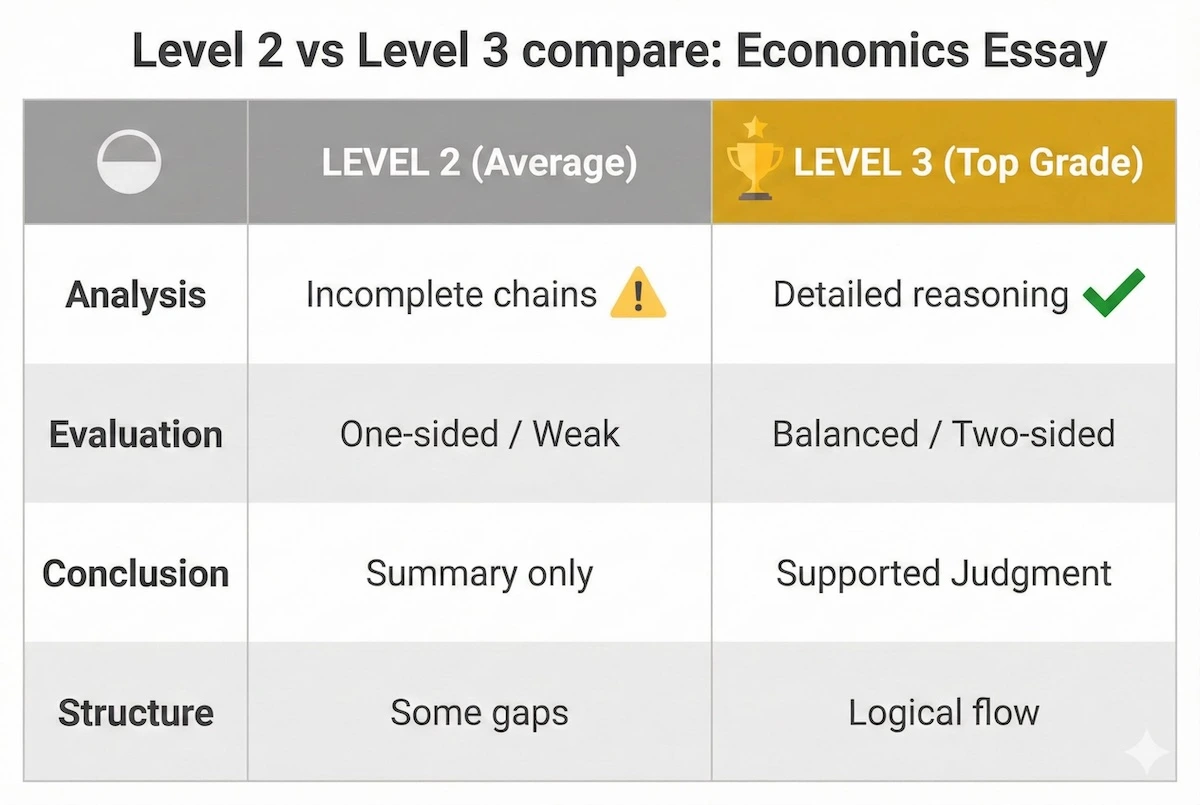
The difference isn’t just knowledge — it’s structure. Aim for the ‘Balanced’ and ‘Detailed’ features in the right-hand column.
Aim for the attributes in the right-hand column to ensure you are consistently hitting the Level 3 descriptors regarding balance and depth.
Checklist for Level 3 essays:
- Define key terms accurately
- Use relevant economic theory (not just common sense)
- Include appropriate diagram if applicable
- Analyze at least two sides/policies/arguments
- Evaluate trade-offs explicitly
- Reach a clear, supported conclusion
- Logical paragraph structure
Students often achieve Level 2 by doing good analysis but weak evaluation, or vice versa. To reach Level 3, both must be strong.
Mark scheme insight:
February 2024 mark schemes state: “Level 3 responses will consider alternative policies/concepts and will be balanced. Explanations will be offered and will be accurate.”
The word “balanced” appears in every Level 3 descriptor. Balance means presenting multiple viewpoints, not just agreeing with the question statement.
Reviews of study platforms such as BookNook and Quizlet can help you decide which tools best support structured revision for level-descriptor targets.
Secret 7: The 3-Mark Evaluation Technique
Most Paper 2 part (a) questions worth 8 marks allocate 2–3 marks for evaluation. Students often ignore this, losing easy marks.
The quick evaluation structure for 8-mark questions:
After your analysis (5–6 minutes), add one evaluation paragraph (2–3 minutes) using this formula:
“However, this depends on…” or “This may not always apply because…”
Example:
Question: “Explain how a maximum price affects equilibrium in a market and consider whether consumers always benefit.”
Analysis (5 marks): Define maximum price. Draw diagram showing price ceiling below equilibrium. Explain shortage occurs as quantity demanded exceeds quantity supplied at the lower price.
Evaluation (2 marks): “However, consumers do not always benefit. While those who purchase the good pay less, many consumers cannot obtain the product due to excess demand. If a black market develops, consumers may pay higher prices than the original equilibrium. Consumer benefit depends on whether they can access the good and whether rationing systems distribute it fairly.”
This evaluation earns 2 marks by considering limitations and conditions. Without it, maximum score is 5–6/8.
The three evaluation approaches that always work:
- Depends on assumptions: “This assumes ceteris paribus, but in reality other factors may change…”
- Depends on time period: “In the short run X occurs, but in the long run Y may happen…”
- Depends on context: “Effectiveness depends on the economic situation (recession vs growth, open vs closed economy)…”
Use these phrases to trigger evaluation thinking, then explain why the dependency matters.
For a broader look at how study tools compare, the IvyPanda review covers features relevant to economics essay writing and research support.
Key Takeaways
Based on Cambridge 9708 examiner insights, these strategies directly improve grades:
- Match your response structure to command words (evaluation only when required)
- Draw diagrams with full labeling (axes, curves, equilibria, arrows)
- Use two-sided evaluation with explicit judgments for all “assess/evaluate” questions
- Integrate extract data with economic analysis in every data response answer
- Allocate 60% of essay time to evaluation, not just analysis
- Target Level 3 descriptors by providing balanced, well-organized responses
- Add quick evaluation to 8-mark questions using dependency statements
November 2024 grade thresholds show you need approximately 127 marks out of 180 for an A* in most A Level combinations. These seven techniques can gain you 15–20 marks across papers by aligning your answers with examiner expectations. The difference between B and A* is not more content knowledge but better exam technique.
For students who want to go deeper on macroeconomic topics covered in the exam, working with an online macroeconomics tutor can help consolidate the analytical frameworks these secrets depend on.
Related Reading
******************************
This article provides general educational guidance only. It is NOT official exam policy, professional academic advice, or guaranteed results. Always verify information with your school, official exam boards (College Board, Cambridge, IB), or qualified professionals before making decisions. Read Full Policies & Disclaimer , Contact Us To Report An Error