AI for STEM Learning: How Generative Tools Simplify Math and Engineering

- Over 60% of students using AI tools scored higher on math and physics tests.
- Adaptive AI platforms adjust difficulty in real time based on individual progress.
- AI visualization tools boost comprehension rates by up to 50% in engineering courses.
- Generative AI improves STEM engagement by up to 40% through personalized study paths.
- AI supports learning but does not replace teachers, who guide and mentor students.
When you sit down for a physics lab, the difficulty hits. Math equations can feel vague, engineering sketches seem tangled, and a lot of students find it hard to link theory to everyday practice. The picture of STEM education is being redrawn, thanks to AI. A student who works with a generative writing tool can turn a dense article into a brief summary, while an adaptive math platform reshapes problems in real time, and a voice‑activated assistant answers quick questions, all of which trim the obstacles that slow learning. Students looking for structured support alongside these tools can work with an engineering tutor to reinforce what AI explains.
If you’ve ever wondered whether AI tutors help, a 2024 analysis shows they do. More than 60% of students who used such tools scored higher on math and physics tests. This shift is not temporary; it is structural. Modern classrooms now mix traditional instruction with smart digital tools that respond to individual learning needs.
The numbers speak for themselves. Recent studies highlight a significant jump in performance when smart tools are introduced to the study routine:
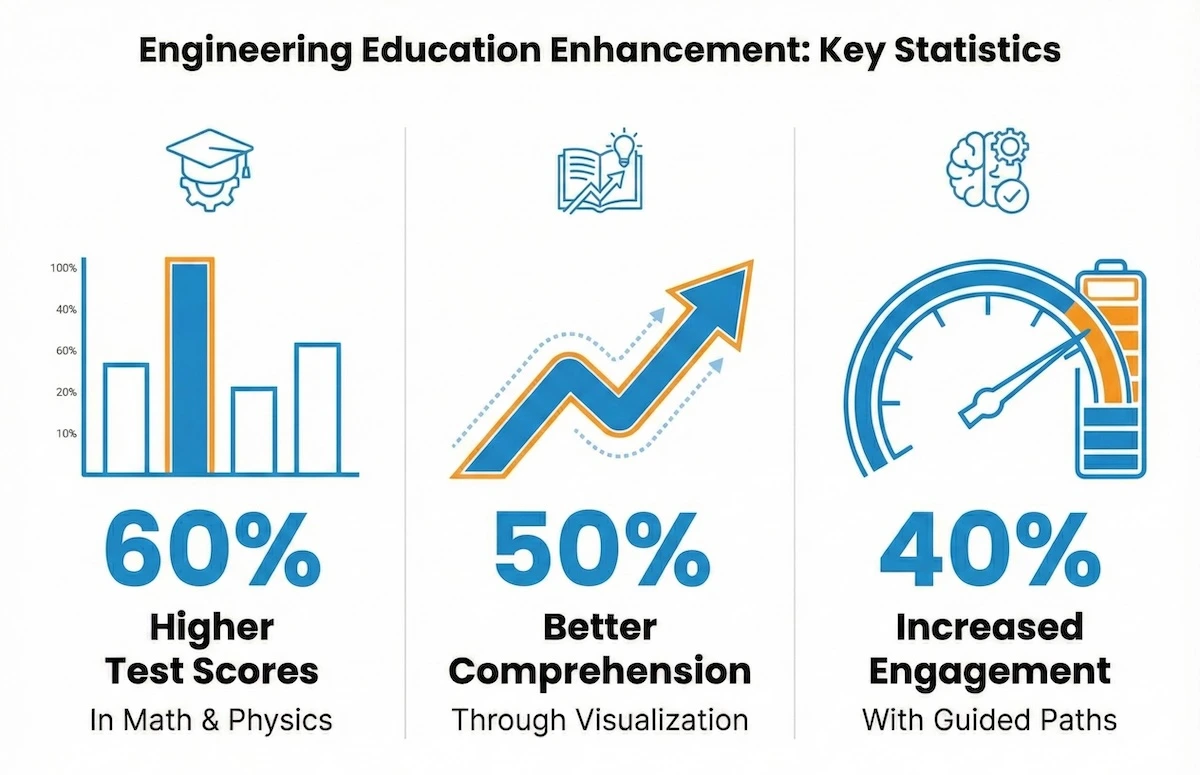
These gains aren’t just about better grades; they reflect a deeper, more intuitive grasp of complex subjects.
How Generative AI in Education Supports Understanding
Generative AI in education offers something earlier tools never had: the ability to create explanations on the spot. Learners who want to understand these
technologies more deeply can also explore a generative ai course. These systems look at a question, identify gaps in the student’s knowledge, and develop explanations that feel natural and easy to follow. A student struggling with quadratic equations or vector transformations can receive tailored responses instead of generic textbook definitions. Students working through IB Math HL/SL often find this kind of on-demand explanation especially valuable.
Some tools also provide interactive explanations. Instead of passively reading a chapter, the student can ask follow-up questions, change variables, or check how a formula behaves under different conditions. This active engagement boosts retention and helps learners internalize relationships between numbers, shapes, forces, and functions.
Personalized Learning Paths for Every Student
Classroom rhythm differs; one student may sprint, another stroll. They zip through calculus, only to stumble over trigonometry’s quirks. Many adore the mechanics side, but the wiring part throws them off. With smart, adaptive software, AI watches a learner’s growth, highlights where they’re slipping, and instantly adjusts the next exercises.
You’ll see a simple pattern guiding the whole process.
- It checks prior responses to see what was already said.
- It tracks the regular slip‑ups we make.
- It offers activities that plug knowledge holes.
- It tracks improvement and recalibrates difficulty.
It might sound complicated, but the AI process follows a predictable, helpful cycle. Here is how it adapts to your personal learning speed:
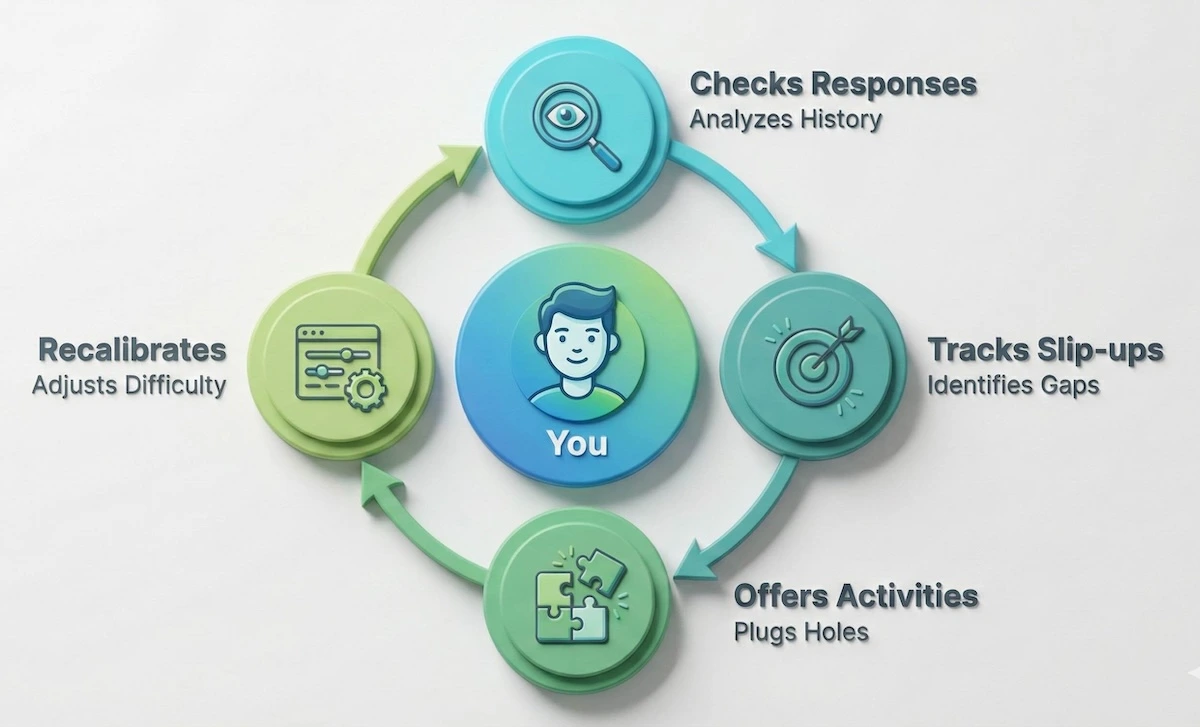
This continuous loop ensures you are never bored with easy tasks or overwhelmed by impossible ones.
A recent survey of e‑learning sites finds that AI guided study paths lift engagement by close to 40%, largely because students sense real support and don’t feel buried in material. For a deeper look at how these strategies apply to advanced math, the engineering mathematics survival kit on AI-assisted learning strategies covers practical approaches in detail.
AI Tools for Math and Engineering: Practical Classroom Benefits
The biggest advantage of modern systems is the ability to generate step-by-step solutions. For example, the math solver for Chrome not only displays the result but also explains how it arrived at it. Thanks to AI, the Chrome math solver doesn’t require manual formula entry; it can even scan a problem from a photo. The math solver for Chrome is available in free mode and is known for its accurate calculations.
Examples include:
- breaking down differential equations
- visualizing 3D mechanical structures
- checking logic in engineering proofs
- modeling electrical circuits
- transforming statistics problems into simple sequences of actions
Modern AI solvers do more than just crunch numbers. They replicate the logic of a human tutor to guide you through the solution:
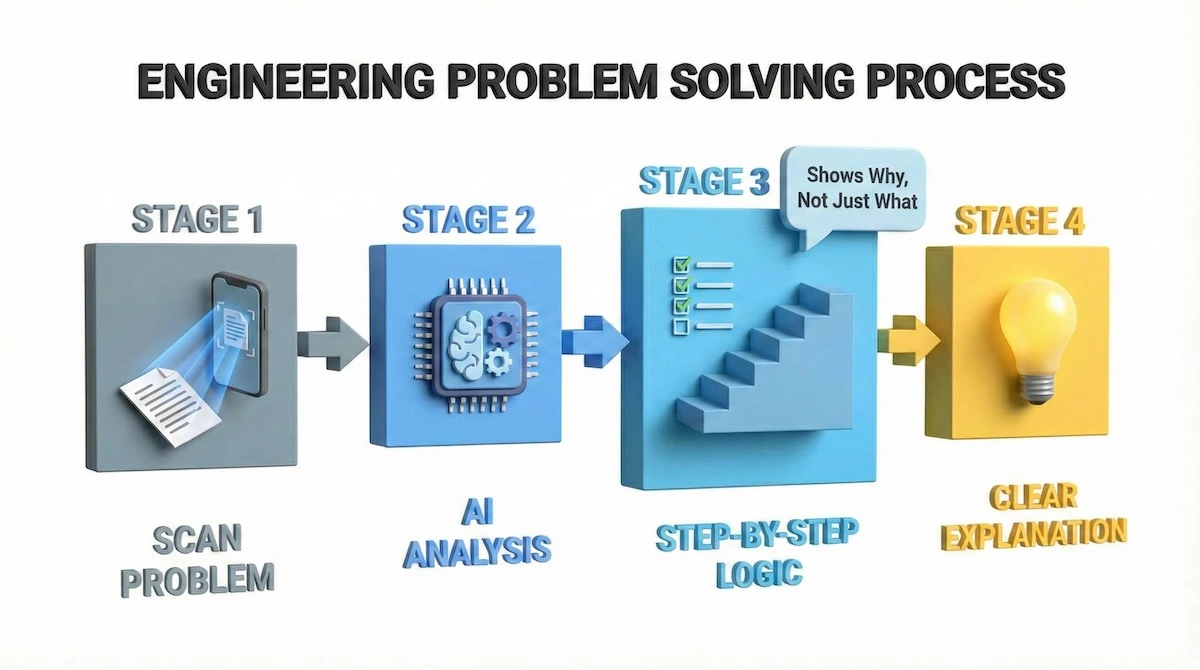
By visualizing the ‘Why’ behind every step, these tools help you build a mental map for solving similar problems in exams.
By showing every step, AI tools for math and engineering give students a clear map of what to do and why. This strengthens skills and reduces frustration, especially for learners who feel lost when facing long, complex tasks. Students who also want structured practice with linear algebra can pair these tools with one-to-one sessions for faster progress.
Engineering Visualization Made Easier
Engineering education often requires strong spatial reasoning. Students must imagine forces, flows, rotations, deformations, and interactions between components. Not everyone finds this intuitive. That is why AI systems now support engineering visualization with automatically generated diagrams, sketches, transition animations, and simplified models.
For example, when studying load distribution on a beam, students can watch how stress moves across the structure. When reviewing signal flow in circuits, AI can show the path of current step by step. These visual aids make difficult ideas more accessible. Research in technical universities suggests that visualization increases comprehension rates by up to 50% for students in early engineering courses.
Imagine seeing the invisible forces at work. The diagram below illustrates how AI can visualize stress distribution on a cantilever beam:
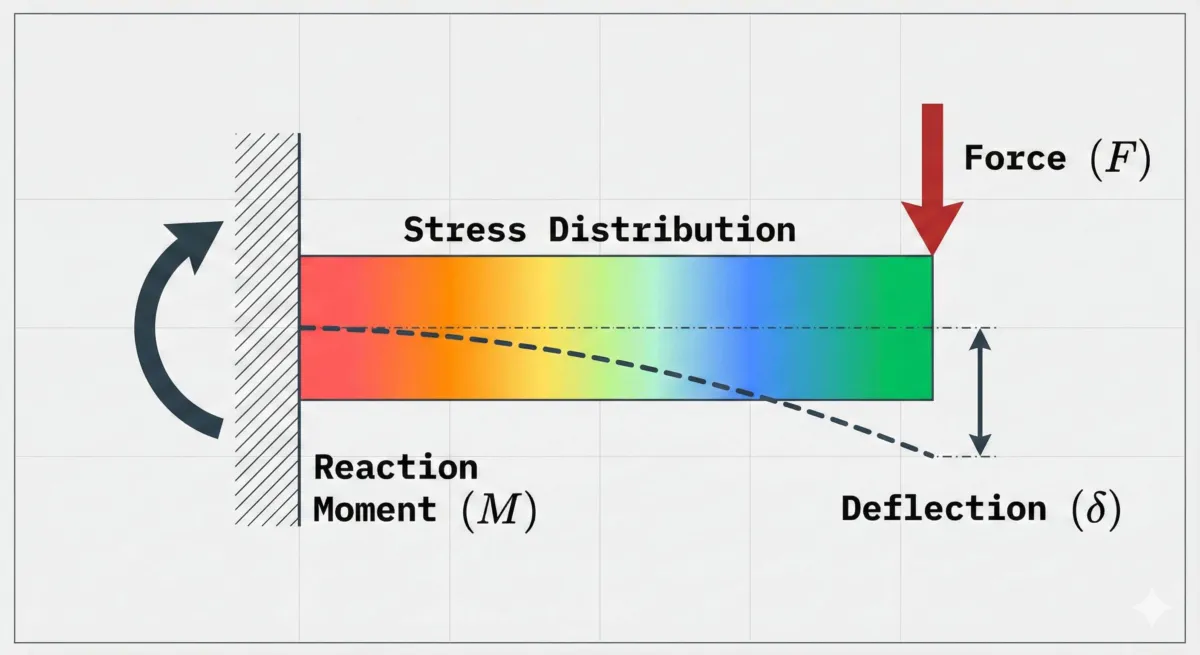
Visual aids like these increase comprehension rates by up to 50%, making abstract engineering physics much easier to digest.
Improving Problem-Solving Skills and Strengthening Analytical Thinking
Effective STEM education means applying ideas, not just memorizing facts. We aim to grow your ability to think logically. Students need to learn to tackle fresh problems, see how variables relate, and test their assumptions. These AI‑driven assistants sharpen your reasoning by providing step‑by‑step clues instead of the answer itself. They highlight errors, ask the student to reconsider steps, and encourage exploration.
With each lesson the learner starts to trust their own judgment. Soon they act on their own. By working through this method, students sharpen their analytical skills as they spot patterns in tough assignments. They learn how to break problems down, how to select methods, and how to check if a solution makes sense.
Understanding how to choose the right analytical method is equally important in statistics. The guide on choosing the right probability distribution for engineers extends these problem-solving principles into statistical reasoning. For students working through inferential methods, the walkthrough on how to solve hypothesis testing step by step is a practical companion.
Boosting STEM Engagement Through Interaction
Many students say math and engineering feel boring or too theoretical. Generative systems challenge this stereotype. They boost STEM engagement through interactive exercises, real-world examples, scenario simulations, and conversational explanations. A task that once felt abstract suddenly becomes vivid.
The difference between the old methods and the new AI-enhanced approach is stark. See how the learning experience shifts:
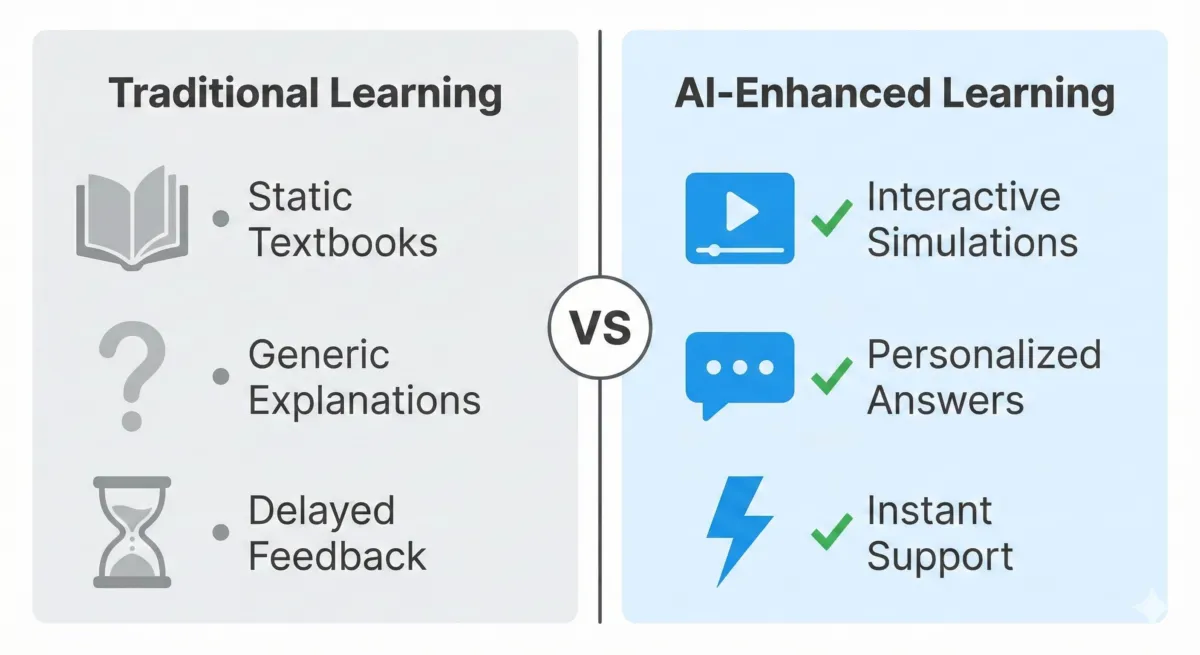
Embracing these interactive elements turns study sessions from a chore into an engaging exploration.
Examples include:
- simulating planetary motion
- calculating real-world bridge loads
- modeling temperature changes in materials
- generating dynamic graphs
- exploring optimization problems through sliders and buttons
The more dynamic the learning experience, the more willing students are to continue. Students who want to extend this engagement into data-driven subjects will find the complete guide to mastering statistical thinking a useful next step.
Reducing Learning Barriers With Simple Language
When you need a tricky topic demystified, AI steps in, spelling it out in language that feels familiar and easy. The instant drop in difficulty opens the door for beginners and for anyone tackling a new language. Turning a heavy thermodynamics section into everyday speech is totally doable. A heavy algebraic expression can be turned into a simple story. Obstacles fade. Confidence follows naturally.
Teachers report that the same learners who once sidestepped difficult assignments now show interest, because the subject matter is written in a way they can easily follow. Clear goals light a fire under us.
The Future of AI-Enhanced STEM Learning
Future classes will see generative programs woven directly into the teaching flow. They will build smarter exercises, detect emotional frustration, adjust teaching tone, and offer real-time support. Students pick up material quicker and stress drops. By having additional time, teachers can devote themselves to advising, inventing lessons, and mentoring pupils.
AI won’t take teachers’ jobs; it broadens how far they can go. For STEM subjects where precision, visualization, and reasoning matter this combination can transform outcomes for millions of learners. Students who want to go deeper into advanced quantitative topics can also explore sessions with a Calculus 3 tutor or get structured support through engineering mathematics tutoring alongside their AI tools.
FAQs on AI STEM Learning
How does AI help students understand math and engineering concepts better?
AI explains complex topics step by step, adapts explanations to the student’s level, and connects theory with practical examples, making abstract ideas easier to grasp.
Is generative AI useful for beginners in STEM subjects?
Yes. Generative AI simplifies language, breaks down problems, and builds concepts gradually, which is especially helpful for beginners and first-time learners.
Can AI tools replace traditional teachers in STEM education?
No. AI supports learning by providing additional explanations and practice, while teachers guide, mentor, and design meaningful learning experiences.
How do AI math solvers improve problem-solving skills?
AI math solvers show complete solution steps, explain reasoning, highlight mistakes, and encourage students to think through each stage instead of just giving final answers.
Do AI tools work for both math and engineering subjects?
Yes. AI supports algebra, calculus, statistics, physics, mechanical systems, electrical circuits, and engineering design through calculations and visualizations.
How does AI personalize learning for different students?
AI tracks progress, identifies weak areas, adjusts difficulty levels, and suggests targeted exercises based on individual learning patterns.
Can AI improve visualization in engineering education?
Yes. AI generates diagrams, 3D models, animations, and simulations that help students understand forces, structures, circuits, and spatial relationships.
Are AI tools effective for exam preparation in STEM fields?
AI tools are highly effective for practice, concept revision, and error correction, helping students gain confidence before exams.
Do students actually perform better when using AI learning tools?
Studies show higher test scores, better engagement, and improved concept retention among students who use AI-assisted learning tools regularly.
What role will AI play in the future of STEM education?
AI will become a core learning companion, offering real-time support, adaptive exercises, and interactive explanations while allowing teachers to focus more on guidance and creativity.
Related Reading
******************************
This article provides general educational guidance only. It is NOT official exam policy, professional academic advice, or guaranteed results. Always verify information with your school, official exam boards (College Board, Cambridge, IB), or qualified professionals before making decisions. Read Full Policies & Disclaimer , Contact Us To Report An Error