Math Tutors Charging $150/hr Aren’t Always Worth It — Here’s Why

- Math tutoring rates range from $25 to $150/hr depending on five key factors.
- Five red flags reveal when a tutor is overpriced for what they deliver.
- Advanced subjects like calculus and differential equations command $50–$125/hr.
- Online tutoring typically costs 20–30% less than in-person for equal qualifications.
- Package deals and group sessions can cut semester tutoring costs by up to 40%.
When you search for math tutoring, the price range seems impossibly wide. Some tutors charge $20 per hour. Others charge $150. One tutor’s profile looks impressive at $120 per hour but are you paying for expertise, or getting overcharged?
This is the challenge engineering and STEM students face constantly. The national average for math tutoring sits around $40 per hour, but most students pay anywhere from $25 to $150 depending on several key factors. Unlike textbooks with fixed prices, tutoring costs vary wildly based on location, subject complexity, tutor qualifications, and session format. If you are working through advanced coursework such as differential equations tutoring, understanding what drives pricing helps you avoid overpaying.
Here’s what students are asking on Reddit:
- “I found a tutor charging $80/hour for calculus. Is that reasonable?” [r/EngineeringStudents, 47+ upvotes]
- “Is my tutor worth $100/hour if they just solve homework problems with me?” [r/Calculus, 200+ upvotes]
- “Why do some tutors cost 3x more than others when they seem similar?” [r/Mathematics]
This guide eliminates the confusion. You’ll learn the five factors that determine what tutors actually charge, how to identify overpriced tutors through five clear red flags, and a framework for evaluating whether any tutor’s rate matches their real value. Students navigating programmes such as IB Math HL/SL tutoring will find the advanced-subject benchmarks especially useful.
Current Math Tutoring Rates: 2025 Benchmarks
First, establish what tutoring actually costs in today’s market.
Online Tutoring
- K-12 core subjects (general math, English): $27–$55/hour
- Advanced/specialized subjects (AP Calculus, Physics, Chemistry): $50–$100/hour
- Test-prep specialists (SAT, ACT, GRE): $80–$110+/hour
In-Person Tutoring
- K-12 core subjects: $35–$68/hour (regional variation significant)
- Advanced subjects: $60–$100+/hour
- Specialists with advanced degrees: $70–$150/hour
By Region (US Math Tutors, 2025)
- Seattle/Hartford: $52–$65/hour
- Dallas/Sacramento: $45–$58/hour
- Colorado Springs/Akron: $38–$50/hour
- Kansas City: $40–$48/hour
By Tutor Type
- Junior tutors (college student, recent grad, <2 years experience): $20–$70/hour
- Professional tutors (3–10 years experience, solid credentials): $70–$110/hour
- Boutique specialists (advanced degrees, proven track record, high demand): $100–$150+/hour
Now you have a baseline. If a tutor falls significantly above these ranges without specialized credentials, that’s your first red flag.
To give you a clear baseline before you start your search, here is a breakdown of the current market rates for 2025 across different tutoring types.
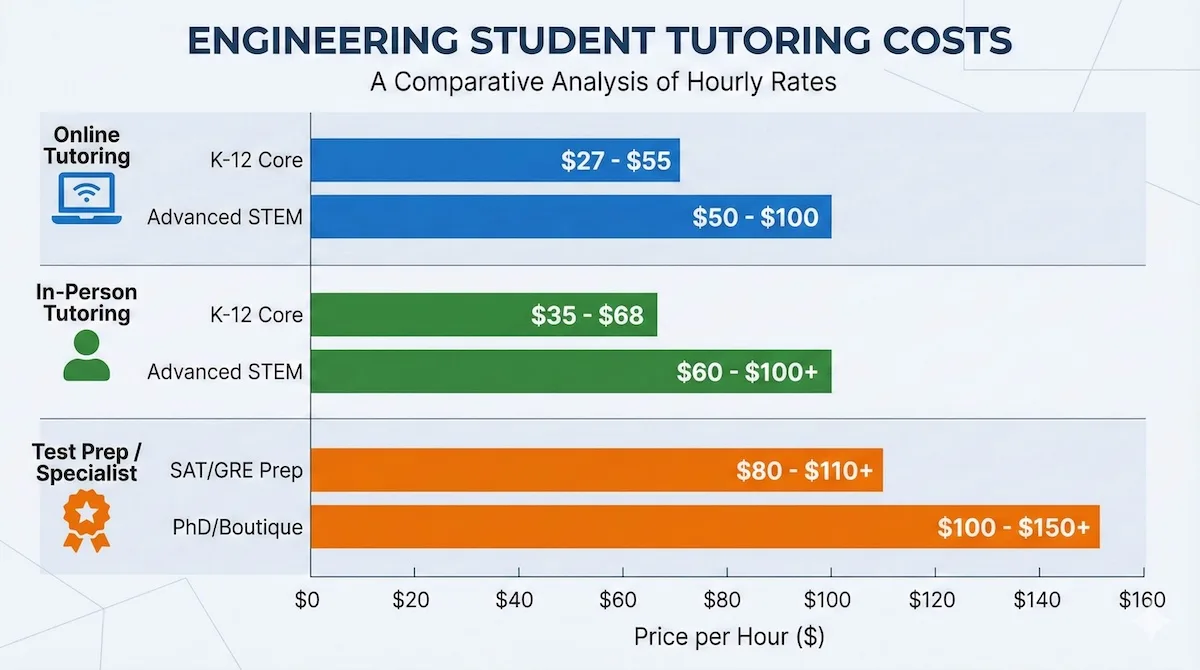
Compare current market rates for online, in-person, and specialist math tutoring to ensure you aren’t overpaying.
Keep these benchmarks in mind as you evaluate quotes; paying significantly more than the top end of these ranges usually isn’t necessary.
Part 1: The 5 Factors That Determine What You’ll Actually Pay
Why do prices vary so wildly? It comes down to the interaction of five distinct variables that drive the final hourly rate.
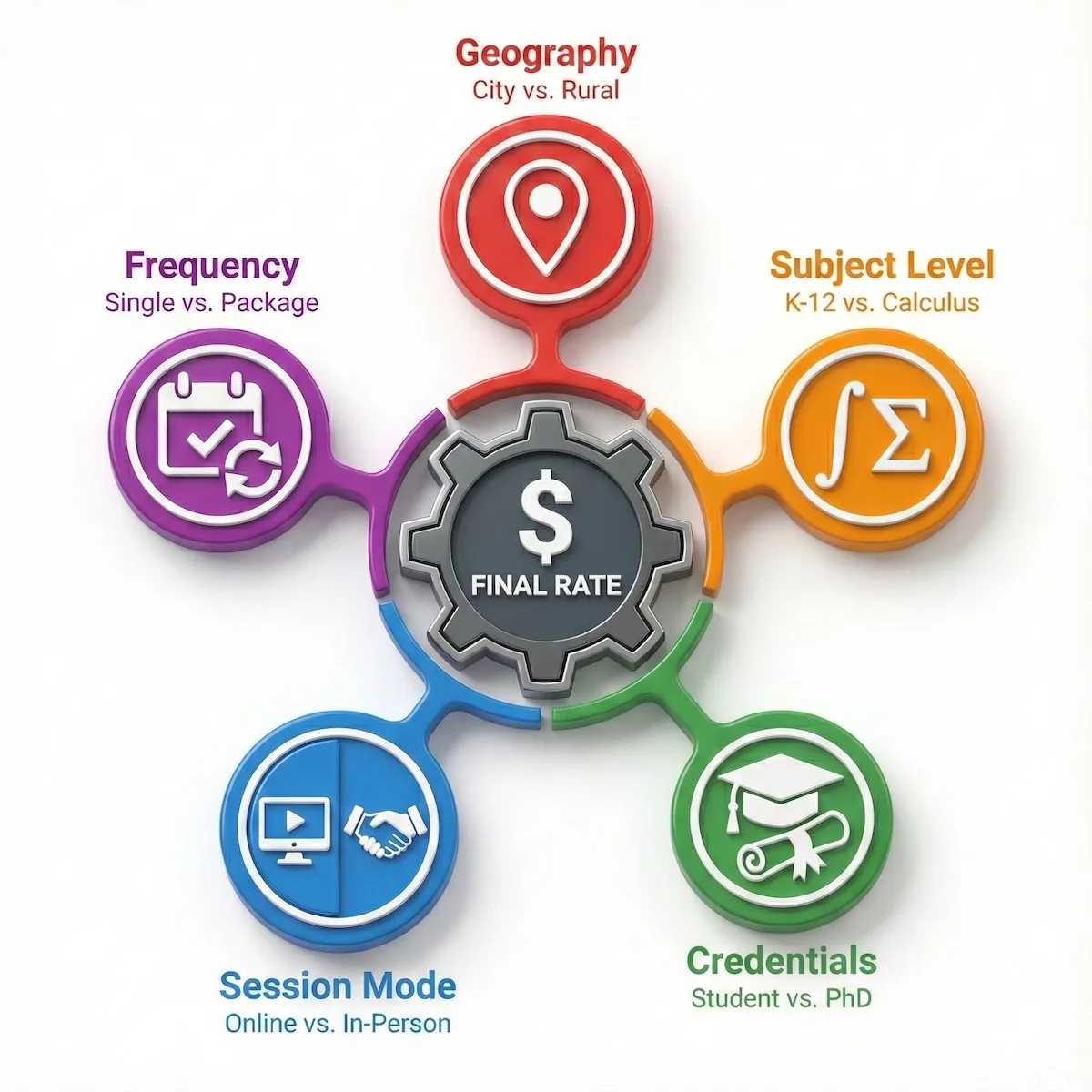
Understanding these five variables helps you identify why one tutor charges $30 and another charges $100.
Let’s examine each of these five factors in detail to understand where you can save money without sacrificing quality.
Factor 1: Geographic Location
Where you live significantly impacts what you pay. Tutors in major metropolitan areas charge 30-50% more than those in smaller cities or rural areas.
Urban Premium Rates:
- New York City: $55-$150 per hour
- San Francisco: $60-$125 per hour
- Los Angeles: $50-$100 per hour
- Chicago: $45-$80 per hour
Suburban and Rural Rates:
- Mid-sized cities: $30-$60 per hour
- Rural areas: $25-$50 per hour
The higher cost of living in cities directly affects tutor pricing. Manhattan tutors can charge 20% more than tutors in other NYC boroughs simply due to rent and transportation costs.
Cost-saving insight: Online tutoring partially eliminates geographic pricing differences. A student in San Francisco can hire a qualified tutor from a lower-cost region and save 20-40% compared to local rates.
Factor 2: Subject Complexity and Grade Level
Not all math tutoring costs the same. Elementary addition requires different expertise than multivariable calculus.
Math Subject Pricing Tiers:
Elementary Math (Grades K-6):
- Basic arithmetic, fractions, word problems
- Typical rate: $20-$40 per hour
- Lower rates reflect simpler content
Middle School Math (Grades 7-8):
- Pre-algebra, basic algebra, geometry introduction
- Typical rate: $30-$50 per hour
High School Math (Grades 9-12):
- Algebra I/II, Geometry, Trigonometry, Pre-Calculus
- Typical rate: $40-$70 per hour
Advanced High School/College Math:
- AP Calculus AB/BC, Calculus I/II/III, Differential Equations, Linear Algebra
- Typical rate: $50-$125 per hour
- Specialized knowledge commands premium pricing
Test Preparation:
- SAT Math, ACT Math, GRE Quantitative
- Typical rate: $75-$200 per hour
- Combines subject expertise with test-taking strategies
The jump in pricing for advanced subjects makes sense. A tutor helping with Calculus III typically holds a degree in mathematics, engineering, or physics. They understand not just how to solve problems but why methods work.
Factor 3: Tutor Qualifications and Experience
Who teaches you matters as much as what they teach.
Tutor Qualification Tiers:
College Student Tutors:
- Currently enrolled undergraduates or recent graduates
- Rate range: $20-$50 per hour
- Best for homework help and review of recently learned material
Professional Tutors (Non-Certified):
- Degree holders actively tutoring full-time
- Rate range: $40-$80 per hour
- Solid subject knowledge and tutoring experience
Certified Teachers:
- State-certified educators with teaching credentials
- Rate range: $60-$100 per hour
- Deep curriculum knowledge and pedagogical training
Specialized Experts:
- Advanced degrees (Master’s or PhD in mathematics/engineering)
- Rate range: $80-$150+ per hour
- Tackle the most challenging topics
The credential premium exists for good reasons. Certified teachers understand how concepts build throughout the curriculum. They spot knowledge gaps quickly and know multiple ways to explain difficult ideas.
However, student tutors offer real value for the right situations. If you need someone to review homework or check your work, a strong undergraduate math major can deliver excellent results at half the cost.
For a broader look at what to ask before committing to any tutor, see these key questions to ask when choosing online math tutoring.
Factor 4: Session Format and Structure
How tutoring happens affects total cost as much as who provides it.
Private One-on-One Tutoring:
- Cost: $30-$80 per hour (standard subjects)
- Cost: $50-$125 per hour (advanced subjects)
- Benefits: Complete personalization, flexible pacing, targeted help
- Drawbacks: Highest per-hour cost
Private tutoring delivers maximum value per minute. Every second focuses on your specific questions.
Group Tutoring:
- Cost: $15-$30 per hour per student
- Typical group size: 3-5 students
- Benefits: Lower cost, learn from peer questions
- Drawbacks: Less individual attention
The cost savings are significant. Ten hours of group tutoring at $20 per hour costs $200 compared to $600-$800 for private sessions.
Online Tutoring:
- Cost: 20-30% less than in-person for same qualifications
- Typical range: $25-$60 per hour
- Benefits: No travel time, broader tutor selection, recorded sessions
- Drawbacks: Requires reliable internet
In-Person Tutoring:
- Cost: $40-$100+ per hour
- Benefits: Face-to-face interaction, physical workspace
- Drawbacks: Travel time, scheduling constraints, potential travel fees
The 20-30% cost difference comes from eliminated travel expenses. A tutor who previously spent 15 minutes driving each way can now schedule back-to-back sessions from home.
Deciding between these two formats is often the biggest factor in your budget. The table below compares the key trade-offs at a glance.
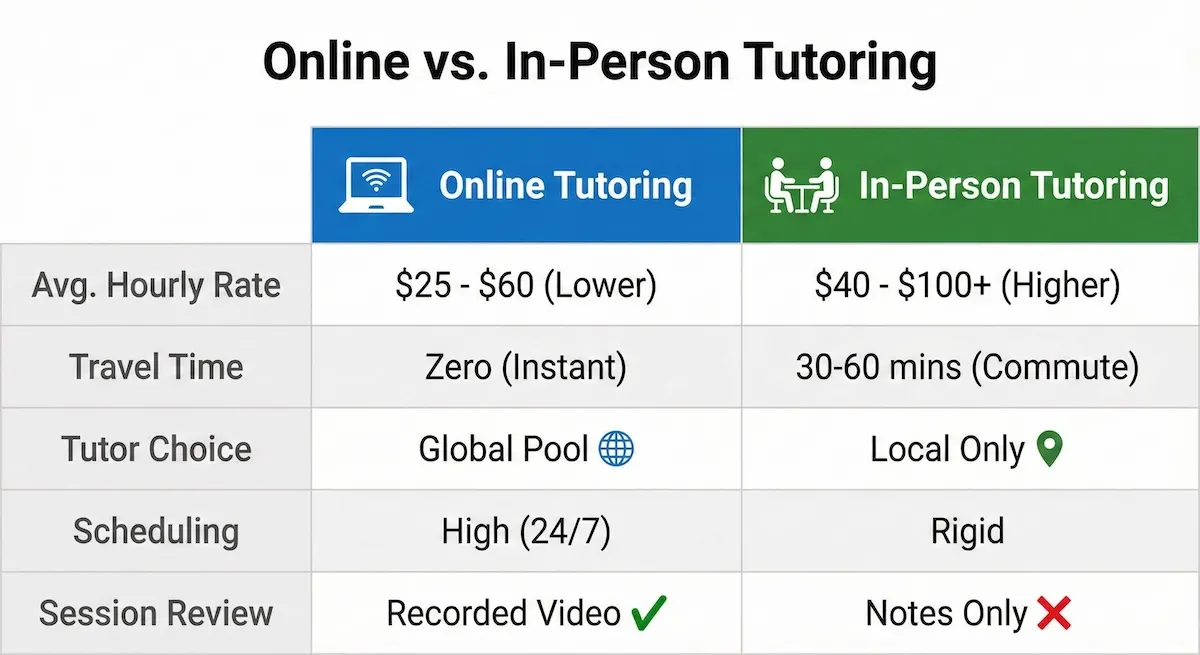
Compare the costs and benefits of online versus in-person tutoring to decide which fits your budget and learning style.
While in-person offers face-to-face interaction, online tutoring typically provides better value and flexibility for engineering students. Engineering majors dealing with calculus-heavy coursework may also find this guide on calculus help for engineering majors a useful companion read.
Factor 5: Session Frequency and Package Deals
How often you meet impacts the effective hourly rate.
Package Discounts:
- 5-session package: 5-10% discount
- 10-session package: 10-15% discount
- Monthly unlimited: Variable pricing
Example pricing:
- Single session: $60 per hour
- 10-session package: $540 ($54 per hour, 10% savings)
- Monthly package (8 sessions): $400 ($50 per hour, 17% savings)
If you need help twice weekly for 12 weeks (24 sessions), a 15% package discount saves $216 on a $60-per-hour tutor.
Hidden Costs to Consider:
- Assessment fees: $50-$150 for initial diagnostic testing
- Material costs: Workbooks, practice tests, software subscriptions
- Cancellation fees: 50-100% for cancellations within 24 hours
- Travel fees: $10-$25 for in-home sessions
- Platform fees: 10-20% service fees on online platforms
These extras can increase your total cost by 15-30%.
Part 2: 5 Red Flags Your Tutor Is Overpriced
Now that you understand fair market rates, here are five clear warning signs you’re paying too much for what you’re getting.
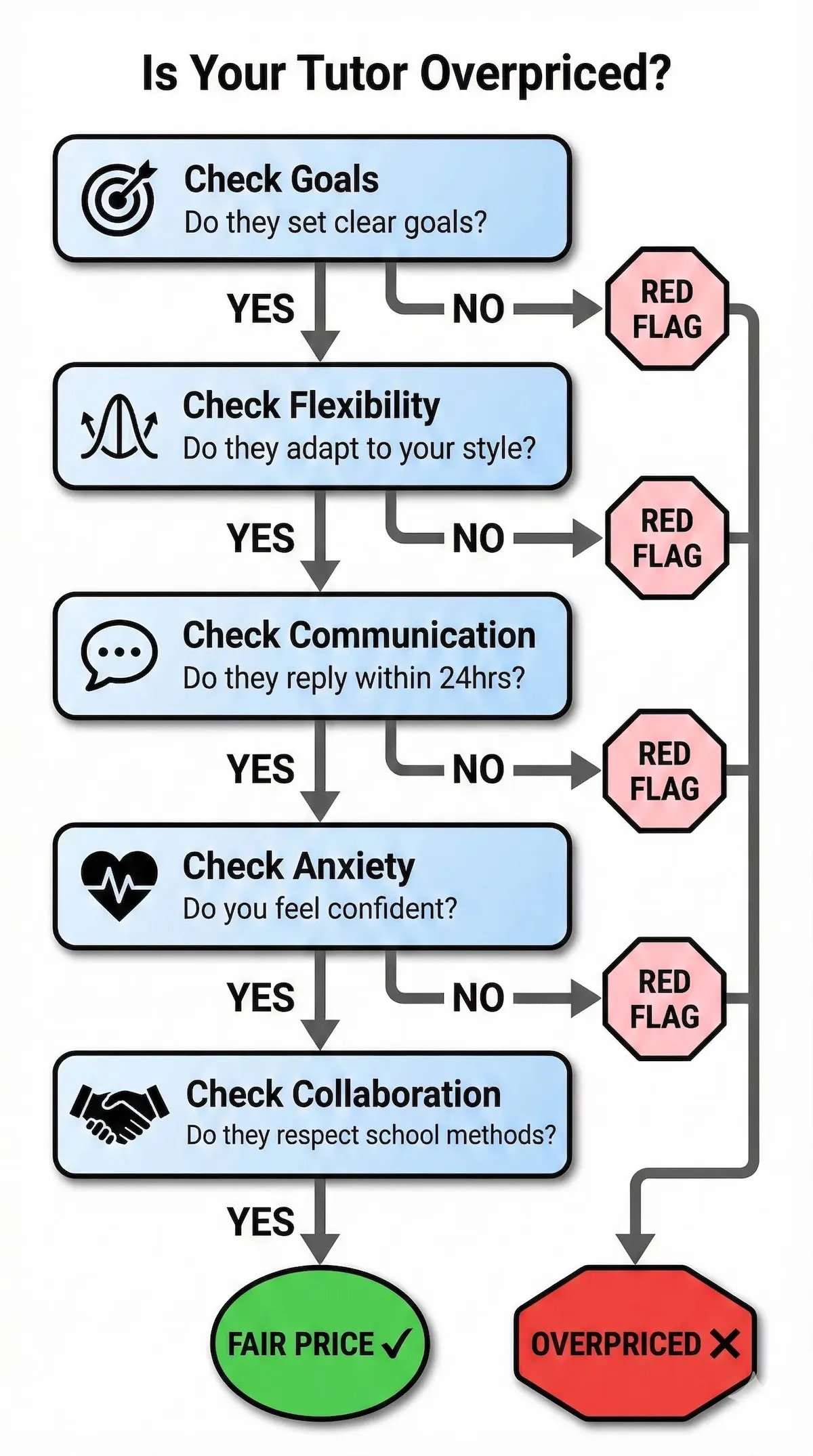
Use this simple checklist to determine if a potential tutor is worth their asking price.
Red Flag #1: No Clear Goals or Progress Tracking
What bad tutoring looks like: You have a session. The tutor helps with homework problems. The session ends. You don’t know what you learned, what comes next, or whether you’re improving.
What good tutoring looks like: The tutor has identified weak concepts through assessment. Sessions target those concepts explicitly. The tutor checks progress regularly and gives feedback like “Your algebra skills have improved; now we need to focus on word problem setup.”
Why this matters for price: If a tutor can’t articulate what you’re working toward or how success is measured, they’re not doing the cognitive work that justifies premium pricing. They’re reactive, not strategic.
- Reactive tutoring (just solving homework): $30-$50/hour maximum
- Strategic tutoring (goal-setting, diagnostics, progress tracking): $70-$100/hour justified
Questions to ask:
- “What specific concepts are we targeting this month?”
- “How will we measure whether I’ve improved?”
- “Can you show me progress from the first session to now?”
If the tutor can’t answer these clearly, they may be overpriced.
Red Flag #2: Inflexibility and One-Size-Fits-All Methods
Good tutors adapt. Your learning style might be visual. Another student might learn better through practice problems. A third might need conceptual discussion before calculations.
Overpriced tutors often rely on a standardized approach. They’ve developed one method and apply it regardless of how the student learns best.
Why this matters for price: Customization requires cognitive work. The tutor must assess your learning style, adapt explanations, and develop personalized problem sets. This justifies higher rates ($70-$100+/hour). If a tutor uses the same playbook with every student, they should charge less ($30-$60/hour).
Red flags:
- The tutor immediately launches into their standard method without asking about your learning style
- They resist adjusting their approach after feedback (“That’s how I teach everyone”)
- They dismiss learning differences or accommodations
What to do: In the first session, ask: “How do you adapt your teaching style to different learners?” Listen for specific examples, not generic answers.
Red Flag #3: Poor Communication and Lack of Student Input
A tutor who doesn’t communicate is effectively invisible. You don’t know what’s happening, whether progress is being made, or whether the fit is right.
Professional tutors provide regular updates. They answer questions promptly (within 24 hours). They involve you in goal-setting and respect feedback.
Overpriced tutors often:
- Respond days later to emails or messages
- Reschedule sessions without confirming a new time
- Skip introductory conversations and launch straight into tutoring
- Treat feedback as criticism
Why this matters for price: Communication is part of the service. If a tutor doesn’t update you, you’re not getting value. This should cost $20-$40/hour, not $80-$120/hour.
Red flags to watch for:
- No reply within 24 hours to initial inquiry
- Rescheduling without confirming with you first
- Starting immediately without background conversation
- Expressing complaints about workload early in the relationship
What to do: Use the trial session to assess communication. Do they ask about your background? Do they seem engaged? After the first paid session, do they follow up?
Red Flag #4: Teaching Without Emotional Support (Creating Anxiety, Not Confidence)
Some tutors are technically sound but emotionally tone-deaf. They might:
- Criticize mistakes instead of treating them as learning moments
- Create a high-pressure atmosphere
- Make disparaging remarks about your abilities
- Dismiss concerns or learning anxieties
Reality check: If a student leaves tutoring more anxious than before, something is wrong. Good tutoring builds confidence alongside competence.
Why this matters for price: Emotional support is harder to deliver than problem-solving. It requires patience, active listening, and genuine care. Tutors who provide this deserve higher rates ($80-$110/hour). Tutors who treat tutoring as transactional problem-solving shouldn’t charge premium rates.
Red flags:
- Your child dreads sessions or feels more anxious afterward
- The tutor talks down or uses condescending language
- Mistakes are met with frustration, not curiosity
What to do: After a few sessions, ask: “Do you feel more confident about [subject]?” If the answer is no, the tutor may be overpriced for your needs.
Red Flag #5: No Collaboration with Teachers or Classroom Context
A good tutor understands your classroom context. They know what your teacher expects. They coordinate strategies so you’re not getting conflicting advice. They might even reach out to your teacher (with permission) to understand gaps.
An overpriced tutor often works in isolation they’ve convinced themselves their method is universally superior, so classroom context doesn’t matter.
Why this matters for price: A tutor who collaborates with classroom teachers is doing more work. They’re integrating their tutoring into a broader educational ecosystem. This justifies higher rates ($80-$110/hour). A tutor who ignores classroom context is optimizing their efficiency, not your learning. They should charge less.
Red flags:
- The tutor never asks what your teacher emphasizes
- They resist integrating classroom materials (“I have my own approach”)
- They don’t follow IEPs, 504 Plans, or accommodations your school provides
Students who have already hit a wall in a course — such as failing a midterm — may benefit from reading about how to fix your study strategy after a failed statics midterm, which covers the kind of structured intervention a good tutor should provide.
Part 3: What You Should Actually Pay: Framework by Scenario
Now that you understand both fair market rates and overpricing red flags, here’s what to pay in specific situations.
Your fair price depends entirely on your specific needs. Identify your scenario in the menu below to see the appropriate price range.
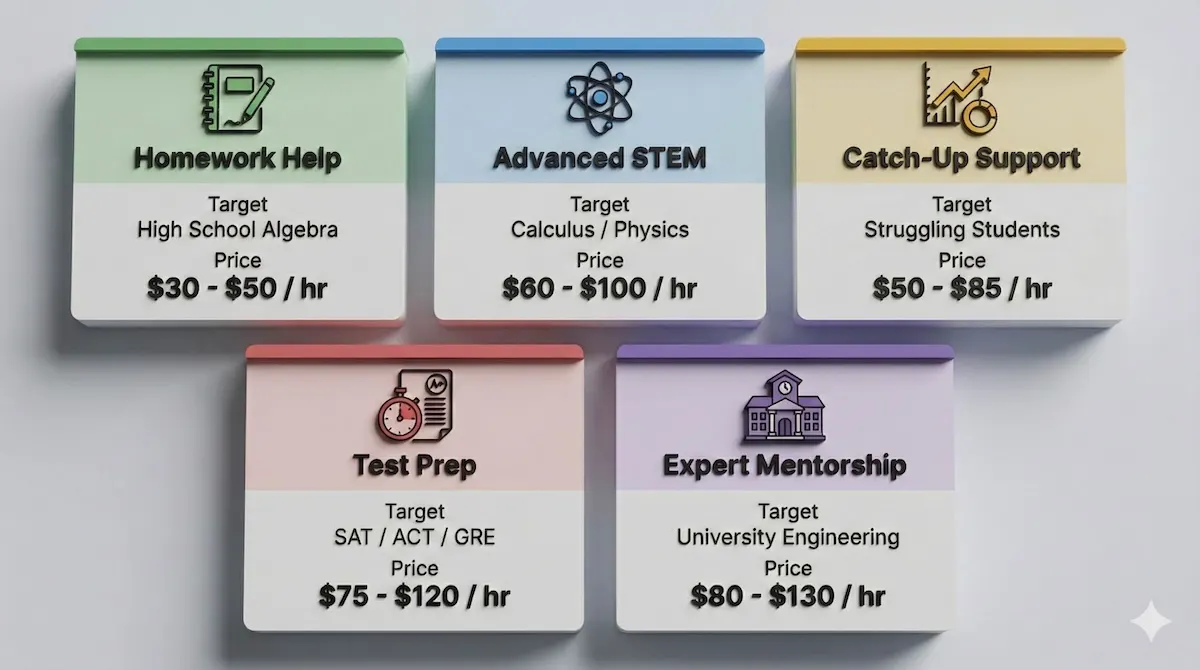
Find your specific situation in this pricing menu to see the fair market rate range.
Most engineering students fall into the ‘Advanced STEM’ or ‘Expert Mentorship’ categories, so budget accordingly.
Scenario 1: General Math Homework Help (High School Algebra/Geometry)
- No specialized content needed
- Weekly help with homework and concept review
- Fair price: $30-$50/hour (online) or $40-$65/hour (in-person)
- What you’re paying for: Subject knowledge and availability
- Red flag: Paying more than $60/hour unless the tutor has a strong track record
Scenario 2: Specialized Advanced Subjects (AP Calculus, Physics, Circuits)
- Requires deep subject expertise
- Often for motivated students preparing for exams
- Fair price: $60-$100/hour (online) or $70-$110/hour (in-person)
- What you’re paying for: Specialized expertise and proven teaching track record
- Red flag: Paying more than $110/hour without evidence of exceptional results (e.g., consistent 5s on AP exams)
Scenario 3: Struggling Student / Catch-Up Support
- Student is failing or severely behind
- Requires diagnostic assessment, customized plan, progress monitoring
- Fair price: $50-$85/hour
- What you’re paying for: Personalization, emotional support, strategic intervention
- Red flag: Paying $120+/hour if the tutor hasn’t documented a plan or progress metrics
Scenario 4: Test Prep (SAT/ACT/GRE/Engineering Exams)
- Specialized content knowledge and strategy coaching
- Often time-limited (12-week intensive prep)
- Fair price: $75-$120/hour
- What you’re paying for: Exam expertise, proven strategy
- Red flag: Paying $150+/hour unless they’ve achieved exceptional score improvement rates
Scenario 5: Ongoing Expert Mentorship (University-Level Engineering/Math)
- University-level courses with complex problem-solving
- Tutor has advanced degree (Master’s/PhD) and teaching experience
- Fair price: $80-$130/hour
- What you’re paying for: Advanced expertise, proven results with university students
- Red flag: Paying more than $150/hour unless the tutor has published work or is a university instructor
Students studying quantitative fields such as discrete mathematics or operations research typically fall into Scenario 5, where advanced-degree expertise is genuinely warranted.
The 5-Point Value Check: Before Committing to Any Tutor
Use this checklist before signing up:
- Experience Level Match: Do their credentials and experience align with the price? A PhD should charge more than a college junior. A tutor with 10 years of successful experience should charge more than someone tutoring for the first time.
- Subject Complexity: More complex subjects command higher rates. General math ($30-$60/hour) versus calculus/physics ($70-$110/hour) is a fair differential.
- Customization Signals: Did they ask about your learning style, goals, and current level before quoting a price? Tutors who customize ask questions first, then price.
- Track Record Clarity: Can they show evidence of results? Student testimonials? Grade improvements? Exam score data? Vague claims (“I help lots of students improve”) don’t justify premium pricing.
- Communication Baseline: Did they respond promptly? Ask clarifying questions? Seem genuinely interested? Poor communication at the inquiry stage signals it will be worse once you’re paying.
Common Mistakes: Why Students Overpay
Mistake 1: Confusing Credentials with Teaching Ability A tutor with a PhD in Physics from MIT is impressive. But that doesn’t automatically mean they can teach undergraduate physics well. Teaching is a distinct skill. A PhD justifies higher rates only if paired with evidence of good teaching.
Mistake 2: Assuming Expensive = Better The tutoring market has no quality certification. A tutor charging $120/hour isn’t necessarily better than one charging $75/hour. They might just be better at marketing or working in an expensive urban market.
Mistake 3: Not Pricing for Your Specific Need Not all tutoring is the same. Homework help doesn’t require the same expertise as exam prep. Catching a student up from failure is different from enrichment. Price should reflect scope.
Mistake 4: Ignoring Red Flags Because of a Good Initial Impression A charismatic tutor can mask poor teaching practice. Use the checklist above. Track progress over 4-6 weeks. Don’t let sunk-cost fallacy keep you trapped.
Mistake 5: Paying Upfront for Many Sessions Some tutors ask for upfront payment for 10-20 sessions. Avoid this until you’ve validated that the tutor is effective. Pay as you go initially.
For subject-specific context on what good structured support looks like in practice, see this guide on A-Level Further Maths: momentum and impulse explained.
Cost-Saving Strategies Without Sacrificing Quality
Start with university resources. Most colleges offer free tutoring through math labs or academic support centers. Try these first before paying for private help.
Combine methods. Use free online resources (Khan Academy, MIT OpenCourseWare, YouTube) for initial concept learning. Save paid tutoring hours for working through complex problems and addressing persistent confusion. Another way to manage academic costs is to match the type of support to the task. When coursework includes essays, reports, or other writing-heavy assignments, resources such as writepaperforme can provide focused writing assistance, leaving tutoring sessions for the complex math concepts that truly require one-on-one explanation.
Negotiate. Many independent tutors reduce rates for bulk session purchases or off-peak timing. A tutor might charge $60 during busy pre-finals weeks but accept $45 for sessions in early October.
Share the cost. If three classmates need Calculus II help, organize group sessions. Even if the tutor charges $75 per hour for groups, you each pay $25.
Example Cost Calculations
How much will this actually cost over a full semester? Use this simple formula to estimate your total investment.
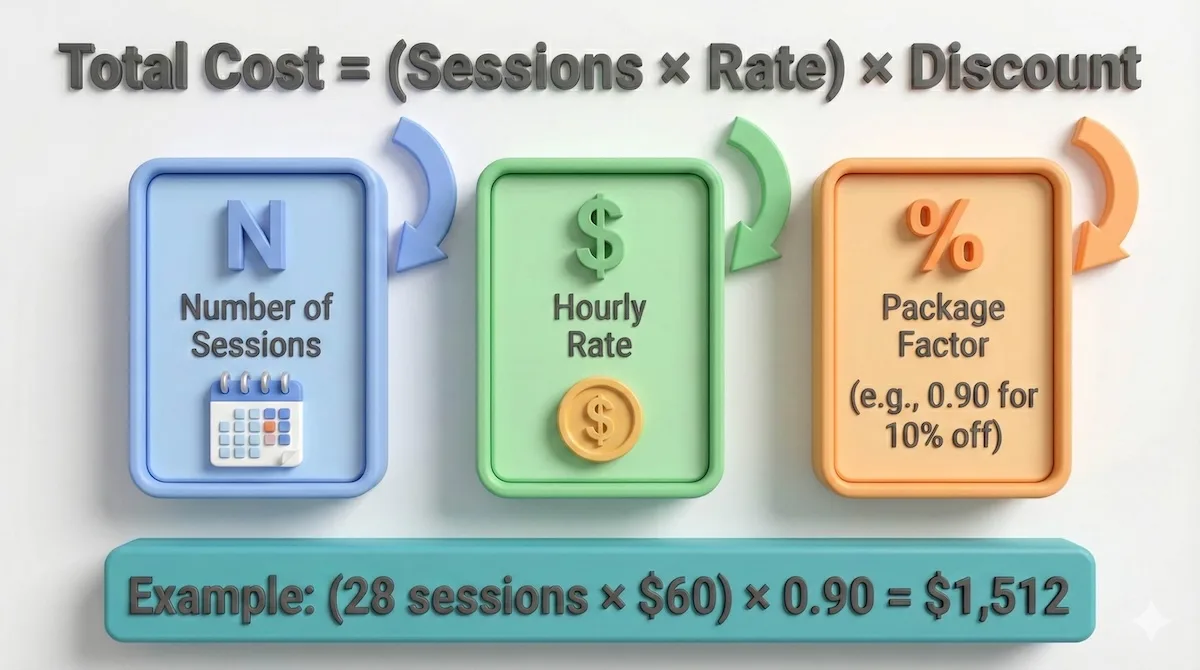
Use this formula to calculate your total semester investment and see how package discounts impact the final price.
As the formula shows, applying a package discount factor (like 0.90 for 10% off) significantly reduces your total spend over 20+ sessions.
Scenario 1: Engineering Student, Differential Equations, Full Semester
- Qualified tutor (B.S. Mathematics): $60/hour
- Two sessions per week, 14 weeks = 28 sessions
- 10-session package discount: 10% off
- Total cost: (28 sessions × $60) × 0.90 = $1,512 for semester
Scenario 2: High School Student, Algebra II, Exam Prep
- College student tutor: $35/hour
- One session per week, 6 weeks before final = 6 sessions
- No package discount
- Total cost: 6 sessions × $35 = $210 for exam prep
Scenario 3: Group Study, Calculus I, Ongoing Support
- Certified teacher: $80/hour for group of 4
- One session per week, 12 weeks = 12 sessions
- Cost per student: (12 sessions × $80) / 4 = $240 per student for semester
What the Research Shows About Effective Tutoring
Peer-to-peer tutoring programs improve student GPA by an average of 25%. In math specifically, students receiving regular tutoring show marked improvements in exam performance, with 85% of students improving by at least one grade band in their final results.
A meta-analysis of 89 randomized controlled trials shows tutoring improves student achievement by approximately four additional months of learning for the typical student.
Key finding: The effectiveness depends on tutor qualifications. Teacher-led tutoring produces larger effects than tutoring by non-professionals. Tutoring programs with at least three sessions per week produce greater impacts than those with fewer sessions.
Translation: You’re paying for expertise and frequency. A cheap tutor seeing you once a month won’t deliver results. A qualified tutor seeing you 2-3 times per week likely will.
When a Tutoring Price Is Actually Fair
- Tutor has clear goals for your learning and tracks progress explicitly
- Tutor customizes their approach based on how you learn best
- Tutor communicates regularly, responds promptly, and welcomes feedback
- Tutor creates confidence, not anxiety (or handles anxiety with support)
- Tutor understands your classroom/exam context and coordinates with it
- Tutor’s experience level, credentials, and subject expertise justify their rate
- You see measurable improvement within 4-6 weeks (grade lift, concept clarity, confidence)
- Tutor provides evidence of success with other students in your situation
If most of these are true, you’re getting fair value. If most are false, you’re likely paying too much for what you’re getting.
Conclusion
Math tutor costs range from $25 to $150 per hour based on five primary factors: geographic location, subject complexity, tutor qualifications, session format, and frequency arrangements.
Students in major cities pay 30-50% more than those in smaller markets. Advanced mathematics (calculus and beyond) costs $50-$125 per hour compared to $20-$40 for elementary topics. Certified teachers charge $60-$100 per hour while college students typically charge $20-$50.
But price alone doesn’t determine value. A tutor charging $120/hour who provides no feedback, uses one standardized approach, and never communicates is overpriced. A tutor charging $70/hour who customizes lessons, tracks progress, and genuinely supports their student is a bargain.
Use the five red flags in this guide to identify overpricing. Apply the value framework to separate fair pricing from exploitation. Ask the right questions in the trial session. Monitor for red flags in the first 4-6 weeks.
And remember: if you’re not seeing progress and feeling supported, it doesn’t matter how impressive their credentials are. They’re not worth what they’re charging.
Calculate your semester budget early. A typical engineering student needing twice-weekly help with Calculus II pays $1,200-$1,800 for a full term with a qualified tutor, but can reduce this to $400-$600 through strategic use of group sessions, package deals, and online platforms.
The best value comes from matching tutor qualifications to your actual needs not automatically choosing the cheapest or most expensive option.
Related Reading
******************************
This article provides general educational guidance only. It is NOT official exam policy, professional academic advice, or guaranteed results. Always verify information with your school, official exam boards (College Board, Cambridge, IB), or qualified professionals before making decisions. Read Full Policies & Disclaimer , Contact Us To Report An Error