A-Level Physics A* Blueprint 2026: Exam Traps Fixed

- The A* boundary for OCR H556 is 206/270 marks (76.3%) — know your exact target.
- Command words are precise: “Explain” requires causal reasoning; “Describe” does not.
- Spaced repetition with active recall moves formulas into long-term memory faster than re-reading.
- Synoptic questions combining two or more topics are where A* students gain their edge.
- Box breathing, sleep, and nutrition are evidence-based exam-performance tools, not optional extras.
A-Level physics demands precision, conceptual depth, and exam technique in equal measure. The gap between a grade B and a grade A* is often just 50 marks — a difference that comes not from working harder but from working smarter. This blueprint reveals the specific strategies that distinguish high achievers from the rest, grounded in exam board specifications, past paper analysis, and evidence-based learning science.
The 2026 exam series presents both opportunity and challenge. With grade boundaries set at 206 marks out of 270 for an A* (76.3%), every point counts. If you are finding the conceptual load overwhelming, working with an online physics tutor can help you close gaps faster. This guide walks you through identifying hidden gaps in your knowledge, decoding exactly what examiners want from each question type, linking formulas across topics for deeper retention, and managing the exam-day mindset that converts preparation into results.
Section 1: Identifying Topic Gaps Early
Using Syllabus Checklists and Past Papers to Spot Weaknesses
The first step is honest assessment. Rather than revising everything equally, use a systematic approach to identify which topics are dragging down your grade.
For Edexcel (9PH0), AQA (7408), or OCR (H556), download the official specification and create a checklist of all subtopics. Go through your notes and past paper performance, marking each topic as:
- Green (Secure): You’ve scored 80%+ on recent questions
- Amber (Developing): 60–79% consistency
- Red (Weak): Below 60%, or avoided in past practice
The majority of students spend revision time on topics they’re already good at. Instead, front-load red zones — these are where significant marks are available. For instance, if you score consistently low on “resistivity calculations” or “SHM phase diagrams,” these become your priority in the next 12 weeks.
Self-Assessment from 2024–2025 Papers
Use 2024–2025 past papers under timed conditions to establish a baseline. Score your papers honestly (not rounding up on “almost correct” calculations). Identify which command words — Calculate, Explain, Evaluate — cost you the most marks.
Critical insight: If you consistently lose marks on “Explain” questions, the issue is rarely knowledge; it’s usually incomplete reasoning. A 4-mark “Explain” typically requires three separate points. Students often give one and lose 75% of available marks. This is a technique problem, not a knowledge gap.
Borderline A/A* Focus Areas
The difference between an A and A* at OCR is 27 marks (206 vs. 179). This typically breaks down to:
- 3–4 marks on Component 01 (out of 100)
- 10 marks on Component 02 (out of 100)
- 8–10 marks on Component 03 (out of 70, the synoptic paper)
Components 02 and 03 are disproportionately important for A* students because they test deeper conceptual integration. Focus revision on:
- Synoptic links (questions that combine two or more topics)
- Extended response answers (6–8 mark questions requiring sustained reasoning)
- Less-practiced optional topics in your exam board’s offering
Students preparing for AP exams face similar synoptic demands; a tutor for AP Physics can show you how cross-topic reasoning is tested on both sides of the Atlantic.
Section 2: Past Paper Deconstruction Method
Timed Practice with Mark Scheme Alignment
The most effective revision is interrogating past paper mark schemes, not just checking your answers.
Process:
- Take a past paper under exam conditions (2 hours 15 minutes for Component 01 or 02). No notes, no calculator check-aids, realistic timing pressure.
- Score it immediately using the official mark scheme. Record your total.
- For every single question you lost marks on, write down the exact reason:
- Missing substitution step in calculation?
- Explained the concept but didn’t link it to the data?
- Didn’t identify both strengths AND limitations in an evaluation?
- Calculation correct but forgot units?
- Track patterns across papers. Do you consistently lose the same marks? This reveals whether you have a knowledge gap, a technique gap, or an exam pressure problem.
Analyzing Patterns of Lost Marks
Most students lose marks in predictable ways. The mark scheme reveals these patterns explicitly.
OCR Component 02 Exploring Physics (2025):
- Component 02 requires 74 marks out of 100 for an A grade (74%).
- Many students score 50–65 marks because they lose ground on questions combining electricity + waves or thermal physics + fields.
Why? These are synoptic questions. You need to not only recall the formula but recognize when to apply it in an unfamiliar context.
The fix: After taking a paper, don’t just retake it. Instead, rework the questions you got wrong, but this time explain your reasoning aloud. Use the mark scheme to check not just your final answer but your intermediate steps. Mark schemes explicitly show where partial credit is available — often a correct formula with a substitution error is worth 50% of the marks.
For a broader look at why physics problem sets consume so much time, see this guide on 15 game-changing physics homework hacks.
Section 3: Command Word Mastery
The biggest untapped opportunity in physics revision is understanding exactly what each command word demands. Examiners follow strict rubrics, and these rubrics show how many marks each element of your answer is worth.
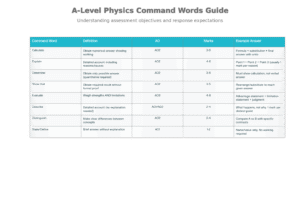
A-Level Physics Command Words: Assessment Objectives, Mark Values, and Response Strategies
“Explain” vs. “Describe” vs. “Show That”
Explain (AO2, typically 4–6 marks)
An Explain question requires you to provide reasons or causes. The key word is detailed account.
Example: “Explain why the extension of a spring increases when the load increases.” [4 marks]
Student answer 1: “Because the force increases so the extension increases more.” ← 1 mark (restates the question)
Student answer 2: “When the load increases, the gravitational force (weight) pulling down increases. This creates a larger tension force in the spring. According to Hooke’s Law (F = kx), a larger force means larger extension. The spring material stretches more because the intermolecular bonds are pulled further apart.” ← 4 marks (multiple reasoning steps)
The difference: Student 2 provides three separate explanatory points (force increases → tension increases → extension follows from Hooke’s Law). Each distinct point is worth approximately 1 mark.
Strategic approach for Explain questions:
- Look at the mark allocation. A 4-mark explain needs ≥3 separate points.
- Use the word “because” between each point to force yourself to justify.
- Link concepts: define the key terms, show the mechanism, connect to the specific scenario.
The guide to conquering A-Level Physics and why it’s worth the challenge explores the broader conceptual demands of the course in detail.
Describe (AO1/AO2, typically 2–4 marks)
Describe requires a detailed account but without explanation. You say what happens, not why.
Example: “Describe the motion of a ball thrown vertically upward.” [3 marks]
Good answer: “Initially, the ball moves upward with decreasing velocity. At the highest point, velocity is momentarily zero. Then the ball moves downward with increasing velocity in the opposite direction.” ← 3 marks (three distinct descriptions of motion)
Show That (AO2, typically 3–5 marks)
Show that questions ask you to rearrange or manipulate information to reach a given answer. The given answer is your target.
Example: “Show that the time period of a simple pendulum of length 0.5 m is approximately 1.4 s.” [3 marks]
Working: T = 2π√(L/g) = 2π√(0.5/10) = 2π√0.05 = 2π × 0.224 = 1.41 s ✓
Your working must be shown step-by-step. The answer is already given, so the examiner checks whether your method is correct. Often, one arithmetic error means loss of only 1 mark (not the full 3) because the method was sound.
Real Examples from 2024–2025 Papers
OCR H556 Component 03 (Unified Physics) synoptic question example:
“A student investigates the motion of a falling sphere in a viscous liquid. Explain why the acceleration of the sphere initially decreases as it falls.” [6 marks]
Mark scheme breakdown:
- 1 mark: Identifies that upthrust/drag increases with velocity
- 1 mark: States Newton’s second law (F = ma)
- 1 mark: Explains that as drag increases, net force decreases
- 1 mark: Therefore acceleration decreases
- 1 mark: Reaches terminal velocity when forces balance
- 1 mark: At terminal velocity, acceleration = zero
Students losing marks typically provide only 2–3 of these points. The solution: practice writing 6-mark explains by always listing six separate points before writing your answer.
For students who also study chemistry alongside physics, working with a chemistry teacher online can reinforce the materials science and atomic concepts that appear in synoptic questions.
Section 4: Formula Retention and Cross-Topic Application
Most physics revision focuses on memorizing formulas in isolation. This is ineffective. Instead, successful A* students build a conceptual web linking formulas across topics.
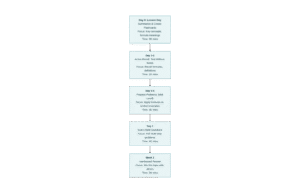
The 2-3-5-7 Spaced Repetition Schedule: A-Level Physics Formula Mastery Timeline
Active Recall and Spaced Repetition: The Evidence-Based Method
Research on learning science shows that spaced repetition with active recall (testing yourself) moves information into long-term memory dramatically faster than passive re-reading.
The 2-3-5-7 method adapted for physics:
Day 0 (Lesson Day): Immediately after learning a new formula or concept, summarize it in your own words. Don’t memorize — understand. Write a 2–3 sentence explanation of what it means and when you’d use it. Create one flashcard with the formula and a worked example.
Days 1–2: Close your notes. Test yourself: Can you recall the formula? More importantly, can you explain why it works? Write the derivation from first principles if possible. This reveals gaps in your understanding before they become exam problems.
Days 3–5: Work 2–3 practice problems using the formula. These should be different contexts than your textbook examples. Can you recognize when to apply this formula in an unfamiliar scenario? This is where synoptic understanding develops.
Day 7: Solve a full exam-style question that combines this formula with another topic. For example, after learning about Young’s modulus, solve a question that links it to forces and energy.
Week 2+: Interleave. Mix this topic with others in revision sessions. Don’t block all “mechanics” questions together; instead, do a mechanics problem, then an electricity problem, then another mechanics problem from a different subtopic. This randomization strengthens your ability to recognize which concept applies in exam conditions.
The article on mastering physics with online tutors covers how structured sessions can accelerate exactly this kind of interleaved practice.
Linking Formulas Across Mechanics, Electricity, and Waves
The highest-scoring students see patterns that connect disparate topics.
Force-Momentum-Energy Conceptual Web
Newton’s Second Law starts as F = ma. But deeper understanding comes from seeing it as:
- F = dp/dt (force is the rate of change of momentum)
- Work = ∫F dx = ΔKE (force applied over distance transfers energy)
- Impulse = FΔt = Δp (force applied over time changes momentum)
From this web, you understand:
- Why collision problems use momentum (force acts over short time)
- Why energy methods apply to springs (force varies, so integration needed)
- Why terminal velocity matters (when drag force equals weight, acceleration stops, velocity is constant)
Electricity Parallel:
- F = qE (force on charge in electric field) ↔ F = ma (force on mass)
- V = E/Q (electric potential) ↔ E = W/Q (energy per unit charge) ↔ E = Ep/m (potential energy per mass in gravity)
- I = Q/t (current) ↔ v = distance/time (velocity analogy)
Students who score A* explicitly draw these connections in their revision notes. They ask: “What’s the gravitational analog of this electrical formula?” This deep linking means fewer formulas to memorize and more confident application in unseen contexts.
Practical technique: Create a single-page formula sheet where related equations are grouped (not listed alphabetically). Add annotations showing which formula links to which. Review this sheet weekly. By exam day, you’ve reinforced not isolated formulas but a connected conceptual framework.
Students preparing for the A-Level Physics exam can also explore dedicated support through an A-Level Physics tutor who specialises in exactly these cross-topic connections.
Section 5: Exam Day Anxiety Management
High revision quality means nothing if exam-day anxiety blocks access to your knowledge. Neuroscience shows that anxiety activates the amygdala (emotional processing) and reduces prefrontal cortex activity (reasoning, memory recall). The solution is not to “calm down” through willpower but to use physiology-based techniques.
Breathing Techniques: Immediate Activation on Exam Day
Box Breathing (4-4-4-4 method)
In the five minutes before your exam starts, practice this:
- Inhale slowly through your nose for 4 seconds.
- Hold your breath for 4 seconds.
- Exhale slowly through your mouth for 4 seconds.
- Hold empty for 4 seconds.
- Repeat 3–5 times (takes approximately 2 minutes).
Why it works: The vagus nerve, which controls your parasympathetic nervous system (the “rest and digest” response), is stimulated by the exhale phase. Extended exhalation signals your brain that you’re safe, counteracting the amygdala’s “threat” response to exam pressure.
2-1-4 Breathing (quicker activation)
If you need a faster reset during the exam, use:
- Inhale for 2 seconds
- Hold for 1 second
- Exhale for 4 seconds
- Repeat for 1 minute
The longer exhale still activates the parasympathetic system but works faster. Use this if you feel anxiety spiking on a particular question.
Sleep, Nutrition, and Movement: The Foundation
Exam anxiety is amplified by physical stress. Three factors dominate.
Sleep
Teenagers require 8–10 hours nightly. During intense revision (the 2 months before exams), this is non-negotiable. Sleep is when your brain consolidates memory — revising late into the night actively damages what you studied earlier.
- Stick to a regular bedtime, even weekends.
- Reduce screen time after 8 PM (blue light suppresses melatonin).
- Avoid caffeine after 2 PM.
- Proper sleep is worth more than extra revision hours.
Nutrition
Exam performance directly correlates with blood sugar stability. Avoid the energy crash:
- Eat slow-release carbohydrates: oats, brown rice, wholegrain bread (steady glucose).
- Include protein at each meal (supports concentration and sustained attention).
- Omega-3 fatty acids (fish, nuts, flax) support neurotransmitter balance and mood.
- Avoid excess sugar, caffeine, and energy drinks (these spike and crash, worsening anxiety).
Movement
Exercise releases endorphins (natural mood boosters) and reduces cortisol (stress hormone). During revision weeks:
- Take a 15-minute walk every 90 minutes of study.
- Gentle yoga or stretching releases physical tension.
- Even light activity improves focus and reduces exam day jitters.
Mock Exam Routines: Practice Your Performance Under Pressure
The final two weeks before the real exam, treat mock exams as authentic simulations. This is not about the score (though it’s helpful feedback); it’s about building the neural pathways you’ll use on exam day.
Mock exam protocol:
- Take it under strict exam conditions: timed, no notes, in a quiet space.
- Use the same breakfast/preparation as you’ll use on real exam day. Consistency matters — your body learns routines.
- After finishing, review your work using the mark scheme (not immediate — wait a day).
- Identify which questions triggered anxiety (usually the same types). Practice those specifically in your final week.
Section 6: Integrating Materials Science Revision
Materials science topics (Young’s modulus, stress-strain graphs, mechanical properties) are essential for OCR and AQA A-Level but often treated as isolated from the rest of physics. This is a mistake. Materials directly links to forces, energy, and engineering applications.
Students who also take AP Physics benefit from the same cross-topic thinking; a tutor for AP Physics 1 can help you see how materials concepts appear in mechanics questions on that exam too.
Key Properties and Testing Methods
Young’s Modulus (E = stress/strain)
This is not just a formula; it’s a measure of material stiffness. Understanding it requires linking three concepts:
- Stress (σ) = F/A (force per unit area)
- Strain (ε) = ΔL/L (proportional deformation)
- Young’s Modulus (E) = σ/ε (how much stress is needed to produce strain)
From the stress-strain graph:
- The gradient of the elastic region = Young’s Modulus
- The area under the entire curve = energy stored (resilience) per unit volume
- The yield point marks the elastic limit (material begins permanent deformation)
- The ultimate tensile strength (UTS) is the maximum stress the material can withstand
Material Properties Terminology:
- Ductile: Material deforms significantly before breaking (curve shows large strain region). Examples: copper, steel. Useful in engineering because failure is gradual, giving warning.
- Brittle: Material breaks suddenly with little deformation (sharp drop after UTS). Examples: glass, ceramics. Poor for structures but excellent for specific high-strength applications.
- Tough: Material absorbs energy before breaking (large area under curve). The more area, the more energy absorbed.
- Elastic: Material returns to original shape after force is removed (reversible deformation). Applies up to the elastic limit.
Cross-Links to Engineering Applications
Example: Bridge Design
A bridge engineer chooses materials based on a linked understanding of:
- Force calculations (how much weight the bridge must support)
- Stress analysis (F/A distributing force over cross-sectional area)
- Material selection (which material provides adequate stiffness and toughness without unnecessary weight)
- Energy absorption (can the material handle unexpected dynamic loads without failure?)
- Cost-benefit (stronger material is more expensive; engineer balances safety with economics)
Students at A* level can answer questions that ask: “Explain why steel (not glass) is used for bridge construction, considering mechanical properties and force analysis.” This requires integrating materials science, forces, and real-world application.
Practical revision technique: For each materials topic, find a real-world application (bridge, airplane wing, medical implant, etc.). Explain why that material is chosen using Young’s modulus, tensile strength, ductility, and toughness. This contextual learning locks the concepts into memory far more effectively than memorizing isolated definitions.
For a deeper look at how specialist physics topics are taught online, the guide to condensed matter physics tutoring online is a useful companion read.
Section 7: The 12-Week Revision Schedule (OCR/AQA/Edexcel variant)
This schedule assumes you’re starting 12 weeks out from May–June 2026 exams (approximately mid-February 2026). Adjust backwards or forwards based on your starting point.
| Week | Focus Area | Key Activity | Assessment |
| 1–2 | Foundations (Module 2 for OCR: quantities, units, vectors) | Establish baseline with 2025 past paper. Identify red/amber/green topics. Create concept map of forces-momentum-energy linking. | Take timed diagnostic paper, score honestly. |
| 3–4 | Mechanics Deep Dive (OCR Modules 3: Forces, motion, materials) | Spaced repetition on kinematics, Newton’s laws, moments. Work 5+ mechanics problems from past papers, focusing on synoptic questions. | Mini-test: 10 mechanics questions under timed conditions. |
| 5–6 | Electricity & Circuits (OCR Module 4: charge, current, resistance, circuits) | Learn command words in context: practice 4-mark “Calculate” and 6-mark “Explain” electricity questions. Link circuits to forces (analogy: current like velocity, resistance like friction). | Timed Component 02-style questions. |
| 7 | Waves & Optics (OCR Module 4: waves, superposition, interference, photons) | Integrate waves with energy concepts. Use spaced repetition on wave equations. Practice synoptic questions combining waves + electricity. | Review a past paper combining waves + circuits. |
| 8–9 | Thermal, Circular, Oscillations (OCR Module 5) | SHM requires deep understanding (not memorization). Link circular motion to forces (centripetal). Create energy equations for each topic. | Practice full-length Component 01 or 02 (time self). |
| 10 | Fields & Modern Physics (OCR Module 5–6: gravitational, electric fields, nuclear, particle physics) | These are assessment-heavy topics in many exam boards. Use active recall daily. Identify any remaining weak areas. | Review past papers focusing on these modules. |
| 11 | Synoptic Integration & Mock Exams | Take full 3-hour mock exam (all components). Review immediately with mark scheme. Rework all errors. Practice anxiety management breathing. | Full mock exam + detailed mark scheme review. |
| 12 | Final Polish & Mindset | Light review (spaced repetition only). Focus on exam technique, not new content. Practice breathing and sleep routines. Mentally rehearse exam day. | Final timed Component 03 (synoptic) paper. |
Grade Boundary Reality Check
Understanding what your target score means in practice helps motivation stay realistic.
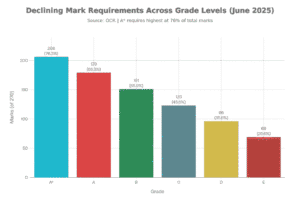
OCR A-Level Physics (H556) 2025 Grade Boundaries: Marks and Percentages Required
For OCR H556 (2025 data):
- A* (206/270 marks = 76.3%): No careless errors. Typically requires near-perfect performance on two components and strong (but not perfect) third component. Requires complete command of synoptic concepts.
- A (179/270 marks = 66.3%): Solid performance across all areas. Can drop marks on extended responses or one difficult paper but compensates elsewhere.
- B (151/270 marks = 55.9%): Demonstrates core competence. Can have a weak paper and still achieve this grade. Extended responses may be incomplete.
The A* challenge: The jump from A (179) to A* (206) is 27 marks. That’s equivalent to losing perfect marks on one Component 03 (70 marks) and getting a B on one of the 100-mark papers. Many students think A* requires superhuman performance. In reality, it requires eliminating careless errors and showing complete reasoning on extended responses.
Conclusion: From Revision to Results
Physics revision at A-Level succeeds through three integrated approaches:
- Strategic Knowledge: Identify gaps using past papers, not by re-reading notes. Link concepts across topics so formulas make intuitive sense.
- Exam Technique: Master command words so every mark you understand translates into a mark you score. Understand that “Explain” ≠ “Describe” and structure your answers accordingly.
- Mindset and Physiology: Anxiety isn’t a personal failing — it’s a predictable physiological response that evidence-based techniques (breathing, sleep, nutrition, movement) effectively manage.
The students who achieve A* in physics don’t necessarily have the highest raw intelligence. They have better systems. They identify gaps faster, revise more strategically, and manage exam day pressure more effectively.
The 12-week schedule and evidence-based techniques in this blueprint are not suggestions — they’re the methods supporting high achievers across all exam boards. Commit to them systematically, trust the process, and your grade will follow.
Related Reading
******************************
This article provides general educational guidance only. It is NOT official exam policy, professional academic advice, or guaranteed results. Always verify information with your school, official exam boards (College Board, Cambridge, IB), or qualified professionals before making decisions. Read Full Policies & Disclaimer , Contact Us To Report An Error