Aerospace Engineering Explained: Courses, Careers, and Study Strategies

- Aerospace engineering is one of the most demanding undergraduate majors, requiring 8–20+ study hours per week.
- Median aerospace engineer salary is $134,830; top earners at SpaceX and NASA exceed $272,000.
- Aerodynamics, orbital mechanics, and control systems are the three hardest courses for most students.
- MATLAB, ANSYS, and SolidWorks proficiency is expected but rarely taught from scratch in university courses.
- Aerospace students take the FE Other Disciplines or FE Mechanical exam — no aerospace-specific FE exists.
Personalized tutoring helps students master challenging aerospace engineering topics like propulsion and flight dynamics, boosting confidence and grades through targeted guidance and flexible online sessions.
Maya, a college freshman passionate about space exploration, saw her first aerospace engineering assignment on rocket propulsion and was daunted. The math and physics felt overwhelming, involving complex fluid dynamics and thermodynamics. Maya soon learned that mastering aerospace engineering requires a profound understanding of advanced mathematics and physics.
Eventually, she reached out for help. Only after working with a tutor did the confusing concepts start to click. With one-on-one guidance, confusion turned to confidence, illustrating how personalized tutoring can unlock success in challenging STEM subjects. Students who need an engineering tutor often find that early intervention makes the biggest difference.
Why Aerospace Engineering is Challenging
Aerospace engineering tutoring addresses a field that is uniquely challenging because it combines multiple advanced subjects in one discipline. Students face an intensive curriculum that includes aerodynamics, propulsion, materials science, control systems and avionics. They must solve complex physics and calculus problems from fluid dynamics to structural analysis to understand how aircraft and spacecraft function.
This difficult coursework demands extra study time and dedication. However, the payoff can be big: aerospace engineers earn a median of about $134,830 per year, and the U.S. Bureau of Labor Statistics projects roughly 6% job growth (about 4,500 openings per year) through 2034.
Is the hard work worth it? The market data suggests a resounding yes.
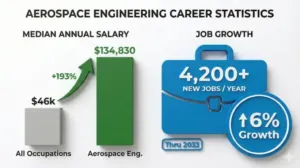
Despite the academic challenges, the aerospace engineering career path offers exceptional salary potential and steady job growth. With high median salaries and steady growth, your investment in education pays dividends. These strong career prospects attract many students to the field, even though the subject remains highly demanding.
Understanding why this major is so difficult often starts with seeing how the core subjects overlap. The diagram below illustrates the five pillars you must master.
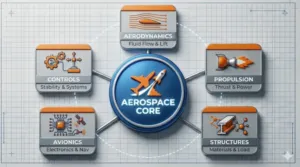
Mastering aerospace engineering requires connecting these five complex disciplines, which is why specialized tutoring is often essential. When these disciplines converge, complexity increases, making expert guidance crucial.
How Difficult Are Aerospace Engineering Courses and How Many Hours Do They Really Take?
Aerospace engineering courses range from moderately demanding introductory classes (~8–12 study hours per week) to highly intensive upper-division courses like theoretical aerodynamics and flight dynamics that regularly require 15–20+ hours weekly outside of class. Understanding this range before you hit a difficult semester is what separates students who plan effectively from those who are blindsided.
Aerospace engineering sits among the most demanding undergraduate majors at any university, typically requiring more credit hours per semester than most other fields. That load combined with lab sessions, design projects, and software work is the reason many students need more than four years to complete the degree.
The key insight most content skips: difficulty is not evenly distributed. Some courses feel manageable; a small number are genuine grade-killers. Knowing which is which lets you allocate study time and decide when to get help strategically rather than reactively.
The table below ranks core aerospace courses by typical student-reported difficulty and weekly study hour estimates:
| Course | Difficulty Level | Est. Study Hours/Week | Why Students Struggle |
| Theoretical Aerodynamics | Very High | 15–20+ | Complex PDEs, boundary layer theory, compressible flow |
| Flight Dynamics & Control | Very High | 15–18 | Nonlinear control, state-space models, stability analysis |
| Orbital Mechanics / Astrodynamics | High | 12–18 | Three-body problems, trajectory calculations, abstract spacetime geometry |
| Thermodynamics & Propulsion | High | 12–16 | Combustion chemistry, gas dynamics, multi-system integration |
| Structural Mechanics | High | 12–15 | Stress/strain under extreme loads, fatigue analysis |
| Fluid Mechanics | High | 12–15 | Navier-Stokes equations, turbulence modeling, viscous flow |
| Aircraft Performance | Moderate–High | 10–14 | Performance envelopes, energy methods, requires strong physics foundation |
| Materials Science for Aerospace | Moderate | 8–12 | More accessible; lab-focused, less abstract |
| Introduction to Aerospace Engineering | Low–Moderate | 6–10 | Broad survey; foundational, not deeply mathematical |
One important nuance: upper-level courses cause GPA drops averaging 0.3 points compared to introductory-level courses, according to data from multiple university program surveys. This is not a universal truth about student ability — it reflects a genuine step-change in abstraction and workload that catches well-prepared students off guard.
What does this mean practically? If you enter a theoretical aerodynamics or flight dynamics course expecting it to feel like your earlier physics coursework, you will be behind before week three.
These courses require prior mastery of differential equations, linear algebra, and numerical methods simultaneously — not as separate skills but applied together in real time. A tutor who has taught these subjects understands exactly where the conceptual walls are and can work with you on those specific points before they compound into exam failures. For broader context on online learning options, see this guide to online engineering tutoring benefits, trends, and how to choose.
Which Aerospace Engineering Programs Have the Highest GPA Requirements?
Top-ranked aerospace engineering programs at MIT, Caltech, Stanford, Georgia Tech, and Purdue University have the most rigorous academic requirements. MIT, Stanford, and Caltech typically admit undergraduates with GPAs of 3.95 or above and exceptional math/science records. At the graduate level, competitive applicants across top programs average above a 3.6 GPA, with a 3.0 generally considered the minimum for consideration.
If you are deciding which program to target or figuring out how to stay enrolled once admitted — understanding these benchmarks is more useful than a general ranking list.
Here is an honest look at how the leading programs break down by selectivity and academic expectations:
| Program | US News Grad Rank (Approx.) | Typical Undergrad GPA for Admission | Key Strength | Notes |
| MIT (Dept. of Aeronautics & Astronautics) | Top 3 | 3.95+ | Research, space systems, propulsion | Extremely selective; near-perfect STEM record expected |
| Caltech (GALCIT) | Top 3 | 3.95+ | Experimental facilities, theory | Undergrad offered as minor only; graduate program world-class |
| Stanford (Aero/Astro) | Top 3 | 3.90+ | Cross-disciplinary, industry ties | Strong connections to Silicon Valley and aerospace sector |
| Georgia Tech (Guggenheim School) | #1 Public | 3.7–3.9 | Breadth, Mentors-in-Residence | 97% of incoming students have AP Calculus background |
| Purdue (School of Aeronautics & Astronautics) | Top 5 | 3.5–3.8 | Propulsion (Zucrow Labs), accessibility | Strong outcomes at lower cost than private peers |
| University of Michigan | Top 6 (Shanghai) | 3.6–3.8 | Research volume, oldest large program | Holistic admissions; GPA + test scores + coursework rigor |
| University of Texas Austin | Top 15 | 3.3–3.6 | Value, defense industry links | Strong in-state program with good ROI |
| Virginia Tech / Penn State / Texas A&M | Tier 2–3 | 3.0–3.5 | Practical focus, strong alumni networks | Solid outcomes for students who may not reach top-5 schools |
A few things most rankings omit: first, aerospace programs at Georgia Tech and Purdue deliver graduate employment outcomes closely comparable to MIT and Stanford, at substantially lower cost — a critical factor for students weighing debt against starting salary. Second, many programs require a B or better in all math and core engineering courses to remain enrolled in the major. A single poor grade in differential equations or fluid mechanics can derail your progression.
Getting targeted tutoring in prerequisite courses is often the most cost-effective academic investment a student can make because keeping your GPA above the program’s internal threshold is harder to recover from than a single bad exam. Students in related disciplines face similar pressures — see how mechanical engineering tutoring guides students from high school to PhD success.
Where Do Aerospace Students Struggle Most? Aerodynamics, Orbital Mechanics, and Control Systems Explained
Aerodynamics, orbital mechanics, and control systems are consistently the three subjects where aerospace engineering students experience the sharpest difficulty spikes — not because the topics are impossibly hard, but because each requires integrating multiple prior subjects simultaneously under time pressure. Understanding what specifically breaks down in each one helps you prepare before the crisis, not after.
Aerodynamics
Aerodynamics builds on fluid mechanics but adds compressibility, shock waves, boundary layers, and wing theory — all governed by partial differential equations that most students have only encountered in abstract form.
The central challenge is not doing the math; it is understanding what the math is physically describing. When a student cannot visualize the flow separation occurring at high angles of attack, manipulating the equations becomes mechanical rather than meaningful — and exam questions that slightly alter the setup expose that gap immediately.
Where tutoring helps: a skilled aerodynamics tutor works with physical intuition first — using airfoil sketches, pressure distribution diagrams, and worked examples from real aircraft behavior — before returning to the governing equations. This approach builds the mental model that makes formulas stick. Students who struggle with aerodynamics overwhelmingly report that they could follow lecture derivations but could not apply them to unfamiliar geometries.
Orbital Mechanics
Orbital mechanics (astrodynamics) is uniquely disorienting because the intuitions students bring from Newtonian mechanics — push harder, go faster — are actively wrong in orbit. A satellite performing a Hohmann transfer to a higher orbit fires its engine to slow down relative to Earth — a genuinely counterintuitive result that textbooks often state without resolving the confusion it creates. The mathematical framework (vis-viva equation, orbital elements, Kepler’s laws in multi-body systems) is precise but abstract, and poorly connected to physical experience.
Students who have a strong calculus and physics background often still struggle here because the conceptual frame is unfamiliar. Early focused sessions on orbital intuition — spending 30 minutes building a solid mental model of why orbits behave as they do before touching equations — compress weeks of confusion into something students can build on.
Control Systems
Control systems introduces Laplace transforms, transfer functions, root locus, Bode plots, and state-space representation in rapid succession. Each is a complete mathematical framework in its own right. The course assumes students have internalized linear algebra and differential equations, and it applies both simultaneously in complex domain analysis. The practical connection — that all of this governs whether an aircraft holds altitude and heading — is often lost in the mathematical volume. Students who need a control systems tutor frequently report exactly this disconnect.
The most common failure pattern: students memorize the Routh-Hurwitz stability criterion and Bode plot rules without understanding what stability actually means in a physical aircraft context. Exam problems that slightly reframe the setup or ask “why would this be unstable at high gain?” expose the gap. A tutor can reverse-engineer each method from the physical question it answers, making the math purposeful rather than procedural.
| Subject | Core Difficulty | What Breaks Down | Tutor’s Role |
| Aerodynamics | Compressible flow, boundary layers, PDEs | Physical intuition behind equations | Build airfoil/flow mental models first |
| Orbital Mechanics | Counterintuitive orbital physics, 3-body problem | Connecting math to actual orbital behavior | Orbital intuition before equation work |
| Control Systems | Laplace, root locus, state-space all at once | Stability meaning in physical aircraft context | Physics-first explanation of each method |
Aerospace Engineering Career Outlook 2026: Salary Data and What Students Should Know
Aerospace engineering offers a strong and improving career outlook: the U.S. Bureau of Labor Statistics (BLS) projects 6% employment growth from 2024 to 2034 — faster than the average for all occupations — with approximately 4,500 job openings per year. The median annual salary for aerospace engineers was $134,830 as of May 2024, making it one of the highest-compensating undergraduate engineering degrees available.
These headline numbers tell part of the story. Here is what they do not tell you — and what matters more for students planning their path.
The BLS figure is a government median covering all aerospace engineers. Industry self-reported data from Glassdoor (January 2026, 3,124 salary submissions) puts the average at approximately $164,000, with the 25th–75th percentile range running $127,000–$215,000. Entry-level engineers with recent bachelor’s degrees typically start around $84,000–$90,000. The top-10% earner ceiling, per BLS, is approximately $176,000–$180,000 — driven by specialization and experience, not just tenure.
| Career Stage | Approximate Annual Salary | Notes |
| Entry-level (0–3 years, BS) | $84,000–$95,000 | Varies sharply by employer and location |
| Mid-career (5–10 years) | $110,000–$145,000 | Specialization in propulsion or avionics commands premium |
| Senior / Principal Engineer | $150,000–$180,000+ | PE licensure and advanced degree increase ceiling |
| Top earners (SpaceX, Blue Origin, NASA) | $180,000–$272,000+ | Propulsion, GNC, and space systems attract highest offers |
Which specializations pay most?
Propulsion engineering (SpaceX and Blue Origin starting ranges reported at $90,000–$115,000) and guidance, navigation, and control (GNC) attract some of the highest starting salaries in the field, driven by limited talent supply. Avionics and controls engineers who can also code Python, C++, or MATLAB command $10,000–$20,000 premiums above peers in more traditional roles.
Where growth is concentrated: Satellite communications infrastructure (Starlink, OneWeb, Kuiper), commercial space stations, urban air mobility (eVTOL aircraft), and defense drone development are driving demand beyond the traditional Boeing/Northrop/Lockheed pipeline. The BLS cites fuel efficiency redesign programs and reduced satellite launch costs as two structural drivers expected to sustain demand through the 2030s.
The honest caveat: geography significantly shapes actual earnings. California, Texas, and the Pacific Northwest (Washington state) host the densest aerospace employment clusters and pay above the national median. Students willing to relocate to aerospace hubs consistently see faster salary growth than those anchored to lower-cost-of-living markets.
A student in a strong program who graduates with solid grades, MATLAB and ANSYS proficiency, and a competitive internship is genuinely well-positioned — the $134,830 median understates what a new graduate entering a growth-stage space company can achieve within five years. Engineers pursuing PE licensure in related structural disciplines may also find value in reviewing PE Civil Structural exam preparation.
How Do You Prepare for the FE Exam as an Aerospace Engineering Student?
Aerospace engineering students take the FE Exam (Fundamentals of Engineering) — the first step toward Professional Engineer (PE) licensure — using the FE Other Disciplines or FE Mechanical exam tracks, since NCEES does not offer a dedicated aerospace-specific FE exam. The exam consists of 110 multiple-choice questions delivered over a 6-hour computer-based session, offered year-round at Pearson VUE test centers, with a $225 registration fee.
For aerospace students, this distinction matters: you are not being tested on aerodynamics or orbital mechanics. You are being tested on the foundational engineering and science subjects that underpin your degree — mathematics, thermodynamics, fluid mechanics, statics, dynamics, materials, and engineering economics. This is actually good news for students with strong aerospace foundations, because the exam rewards exactly the broad technical fluency your degree has built.
What the FE Other Disciplines exam covers (core topics relevant to aerospace students)
| Topic Area | Relevance to Aerospace Students |
| Mathematics (differential equations, linear algebra, numerical methods) | Direct overlap with aero coursework |
| Fluid Mechanics & Dynamics | Core of aerodynamics and propulsion preparation |
| Thermodynamics | Directly tested; propulsion background is an advantage |
| Dynamics / Statics / Strength of Materials | Structures and flight mechanics crossover |
| Engineering Economics | Light weight; mostly formulas |
| Probability & Statistics | Often underemphasized in aerospace programs |
| Electricity & Magnetism | Avionics background helps; otherwise requires review |
| Ethics & Professional Practice | Minimal preparation needed |
The most common failure trap: aerospace students overconfidently skip review in mathematics (particularly differential equations) and statistics because they use these tools constantly — but using a tool in context is different from answering exam-style questions about it in isolation. NCEES exam questions are deliberately stripped of context clues; knowing how to apply a formula inside an aerodynamics problem does not guarantee you can answer a pure math question framed as the FE presents it.
Tutor-supported preparation approach: many aerospace students who struggle with initial FE practice exams find that one to two focused tutoring sessions on the topics below the NCEES diagnostic threshold — typically statistics, electricity, and engineering economics — produce the most efficient improvement. A tutor familiar with the FE framework can identify exactly which knowledge areas your diagnostic report flags, rebuild those specific foundations in targeted sessions, and drill you on NCEES-format questions rather than aerospace-style problem sets.
Timing guidance: take the FE exam in your final year or within six months of graduation, while course material is fresh. ASCE and most state licensing boards agree: the exam becomes meaningfully harder after 12 months out of school. Students who delay often find that the FE requires a full restart rather than a review.
Which Software Tools Do Aerospace Engineering Students Need Help With and Why?
Aerospace engineering students are typically expected to develop working proficiency in MATLAB, ANSYS, and SolidWorks during their undergraduate degree — yet almost no university course teaches these tools from scratch. The assumption is that students will figure them out alongside coursework that is already demanding. This gap between expectation and instruction is one of the most consistent reasons aerospace students seek tutoring help outside of theory-based subjects.
MATLAB
MATLAB is the closest thing aerospace engineering has to a universal language. You will use it for numerical simulation, control system design (in combination with Simulink), data processing, and programming assignments across multiple courses. The challenge for most students is not syntax — it is the translation from a hand-calculated derivation to a properly structured script.
Students frequently understand the physics but produce MATLAB code that silently gives wrong answers (off-by-one errors in array indexing, unit inconsistencies, incorrect matrix operations). A tutor who works through MATLAB problems from the structural level — script architecture, debugging methodology, vectorization — saves enormous time compared to troubleshooting alone.
Most universities provide MATLAB licenses to enrolled students, and MathWorks offers extensive tutorials. However, documentation is designed for users who already understand the mathematical concepts; it is a reference tool, not a teaching resource. One-on-one tutoring fills the gap between “I know what equation I need” and “I can write code that correctly implements it.”
ANSYS
ANSYS is the industry-standard simulation suite for finite element analysis (structural) and computational fluid dynamics (CFD). Aerospace students typically encounter ANSYS Mechanical and ANSYS Fluent in upper-division coursework on structures and aerodynamics. Its learning curve is steep in a specific way: the software is powerful enough to produce results for almost any input, including wrong inputs. A student who has not correctly defined boundary conditions, mesh density, or material models will receive a result that looks plausible but is physically incorrect. Recognizing incorrect results requires both software knowledge and strong underlying theory — a combination that is hard to develop from tutorials alone.
ANSYS offers free student versions and extensive self-paced academic resources through its Learning Forum. However, students working under assignment deadlines frequently find that asynchronous resources cannot answer “why is my simulation diverging?” in real time. A tutor who has worked through ANSYS assignments in aerospace contexts can diagnose these problems efficiently, distinguish between software errors and theory errors, and explain the connection between what the software is computing and what the physics actually requires.
SolidWorks
SolidWorks is the primary 3D CAD tool in most undergraduate aerospace programs, used for component design, assembly modeling, and structural analysis (SolidWorks Simulation). Its interface is significantly more accessible than ANSYS, but students encounter difficulty at the point where geometry must interface with analysis — ensuring that a 3D model is correctly constrained, mated, and meshed for simulation purposes.
SolidWorks runs on Windows only, which creates additional access friction for students on Mac or Linux systems. Student editions are available directly from Dassault Systèmes for under $100 annually with proof of enrollment. For students also working with CAD tools in design contexts, this guide to mastering computer-aided design covers expert approaches for future engineers.
| Software | Primary Use in Aerospace | Where Students Get Stuck | Tutoring Focus |
| MATLAB | Simulation, controls, data analysis, programming assignments | Script architecture, debugging, unit handling | Structured coding from the derivation down |
| ANSYS (Fluent / Mechanical) | CFD, structural FEA, thermal analysis | Boundary conditions, mesh quality, interpreting results | Theory-software connection; simulation validation |
| SolidWorks | 3D CAD, component design, SolidWorks Simulation | Geometry constraints, FEA setup, Mac/Linux access | Model setup; constraint and mate logic |
One practical observation most software guides do not make: the three tools serve different types of reasoning. MATLAB is programming-logic work; ANSYS is physics-interpretation work; SolidWorks is spatial-geometry work. Students who are strong in one often struggle with another precisely because they require different cognitive skills. A tutor who understands this can diagnose quickly whether a student’s difficulty is conceptual, procedural, or software-specific — and address the actual source of the problem rather than walking through generic tutorials.
How Aerospace Tutors and Teachers Help
In many colleges, aerospace engineering teaching is delivered through large lectures and labs, which may not address every student’s questions. An Aerospace Engineering teacher provides the foundational classroom instruction, but an individual tutor offers focused, one-on-one support outside of class.
Tutors can spend time breaking down tough topics step by step, reviewing homework questions, or practicing exam problems at the student’s own pace. Research shows that even modest tutoring significantly improves learning; one study found tutoring boosted math learning by the equivalent of two-thirds of a school year. Tutoring programs provide that extra guidance and practice students need to understand complex concepts. By working regularly with a tutor, students often see better grades and greater confidence.
The Power of Online Tutoring
Online tutoring has grown rapidly, especially for STEM subjects. The global online tutoring market was about $10.4 billion in 2024 and is projected to reach $23.7 billion by 2030. STEM courses — including engineering — make up the largest share of this market. For students, this means it’s easier than ever to find an aerospace engineering tutor online from anywhere in the world.
Many platforms let you browse tutor profiles, schedule sessions, and even record lessons for later review. This convenience is a major advantage: you can get help on weekends or late evenings without travel. Compared to in-person tutoring, online sessions often cost less overall (since there’s no travel time or expense), and tutors can use digital whiteboards and simulations to illustrate concepts.
How does a private online tutor compare to your standard university lecture? Let’s look at the key differences.
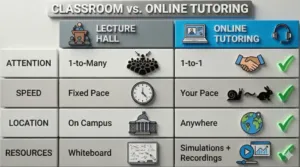
Online tutoring offers personalized pacing and advanced digital tools that traditional large lecture halls often cannot provide. The ability to pause, rewind, and ask questions without judgment is a game-changer for many students.
According to industry estimates, private tutors typically charge $25–$80 per hour depending on subject and location, so students with limited budgets may look for shared classes or homework help forums as alternatives.
How to Find and Choose an Aerospace Engineering Tutor
First, identify which aerospace topics you need help with (for example, flight mechanics or propulsion). Then explore available tutoring resources: many colleges have tutoring centers for engineering subjects, and online platforms list independent tutors around the world. Engineering students are advised to “seek tutoring services available at their college or university… or online tutoring” once they know their weak areas.
Don’t just pick the first name you see. Follow this streamlined process to find a tutor who fits your learning style. Follow this simple five-step process to vet and hire an aerospace engineering tutor who matches your specific academic needs. Taking these steps ensures you don’t waste time or money on a mismatch.
Here are some tips for choosing the right tutor:
- Check Expertise: Choose a tutor with a strong aerospace background (such as an engineering degree or industry experience) who understands your course content.
- Review Teaching Style: A good tutor listens to your questions and explains concepts clearly at your level. Consider trying a sample lesson to see if their approach works for you.
- Use Feedback: Read reviews or ask for recommendations from classmates. Positive feedback about helping with “Aerospace Engineering homework help“ or “assignment help“ can be a good sign.
- Availability & Cost: Make sure the tutor’s schedule fits yours and confirm the hourly rate. While prices vary, many qualified STEM tutors start around $30–$50/hr online.
Effective Tutoring Strategies and Tips
- Set Clear Goals: Tell your tutor which topics or problems you need help with, so sessions stay focused on your challenges.
- Be Prepared: Always bring your lecture notes and homework to each session, and list specific questions. Doing this helps the tutor address exactly what’s tripping you up.
- Practice Regularly: Work on additional problems between sessions. Consistent practice reinforces what you learn, making each tutoring session more effective.
- Communicate: If something isn’t clicking, speak up. A good tutor will adapt explanations until you understand.
- Stay Consistent: Schedule regular sessions (for example, once a week). Tutoring builds on itself over time, so consistent attendance yields better results than cramming right before exams.
- Use Technology: Take advantage of digital tools. For instance, your tutor might share a screen or use an online whiteboard. If the session is recorded, re-watch it when studying.
To get the most out of every dollar, treat tutoring as a cycle, not a one-time event. Tutoring is most effective when treated as a continuous cycle of preparation, engagement, and independent practice.
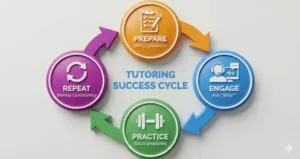
Consistency turns isolated lessons into long-term mastery.
Aerospace engineering is tough, but with persistence and the right resources, students can succeed. Remember Maya’s story: she turned anxiety into achievement by getting help early. You can do the same. Reach out when you’re stuck, ask questions, and use tutoring strategically. Over time, every bit of extra support — whether in the classroom or online — adds up to big gains. Aerospace engineering might seem like rocket science, but personalized tutoring puts the wind beneath your wings.
Students in adjacent engineering disciplines face similar academic journeys — this overview of architectural engineering tutoring and online help for students explores comparable strategies. You can also explore signals and systems tutoring for foundational support in the mathematical frameworks that underpin aerospace control and communications coursework.
Frequently Asked Questions About Aerospace Engineering
Who can benefit from aerospace engineering tutoring?
High school and college students enrolled in aerospace or engineering courses can benefit from aerospace engineering tutoring to clarify concepts and improve their grades.
What topics can an aerospace engineering tutor help with?
An aerospace engineering tutor can assist with subjects like aerodynamics, propulsion, flight mechanics, structural analysis, control systems, and related math or software tools including MATLAB, ANSYS, and SolidWorks.
Is online aerospace engineering tutoring effective?
Yes — research shows structured aerospace engineering tutoring yields strong learning gains, and online formats add convenience without sacrificing quality.
How do I find a qualified aerospace engineering tutor?
Look for aerospace engineering tutors with relevant engineering degrees or experience, read reviews or ask for referrals, and consider a trial session to ensure their teaching style fits your needs.
What is the difference between an aerospace engineering teacher and a tutor?
An aerospace engineering teacher leads classroom lectures for many students, while an aerospace engineering tutor provides individualized, one-on-one help focused on your specific questions.
How can I hire an aerospace engineering tutor?
You can hire an aerospace engineering tutor through online tutoring platforms or local services that allow you to compare tutors’ qualifications, availability, and rates.
Do aerospace engineering students need to take the FE Exam?
The FE Exam is not always required for entry-level aerospace roles, but it is the first step toward PE licensure and is strongly recommended during your final year or immediately after graduation while coursework is fresh.
Which FE exam should aerospace engineering students take?
Most aerospace engineering students take the FE Other Disciplines or FE Mechanical exam, as NCEES does not offer a dedicated aerospace-specific FE exam. The FE Other Disciplines exam covers thermodynamics, fluid mechanics, mathematics, and dynamics — all directly relevant to aerospace training.
Related Reading
******************************
This article provides general educational guidance only. It is NOT official exam policy, professional academic advice, or guaranteed results. Always verify information with your school, official exam boards (College Board, Cambridge, IB), or qualified professionals before making decisions. Read Full Policies & Disclaimer , Contact Us To Report An Error