
AP Physics 2026 Changes Fluids in Physics 1 + Exam Secrets

The College Board released significant updates to AP Physics 1 and 2 for the 2025-2026 exam cycle. The most dramatic change: fluids, formerly part of AP Physics 2, now belongs to AP Physics 1. Simultaneously, the exam structure shifted substantially. Multiple-choice questions dropped from 50 to 40. Free-response questions dropped from 5 to 4. New question types replaced the paragraph answer. Digital testing via Bluebook replaced paper-based MCQs.
For students and educators, this means rethinking preparation strategies. Students taking Physics 1 now must master fluids a topic previously optional for them. Students in Physics 2 gain breathing room but face expanded waves and optics coverage. Both courses now align on identical exam formats, making comparison study easier.
This guide explains what changed, why it matters, and how to prepare.
Hire Verified & Experienced Online Tutoring
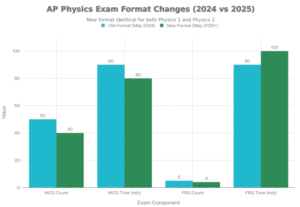
AP Physics 1 & 2: Exam Format Changes (May 2024 vs. May 2025+)
Key Curriculum Shifts: Why Fluids Moved
The Logic Behind Redistribution
Fluids moved from Physics 2 to Physics 1 for three reasons:
1. Course Balance
Physics 2 was overloaded. It covered thermodynamics, electricity, magnetism, waves, optics, and fluids too many topics for equal depth. Moving fluids to Physics 1 redistributes the cognitive load. Physics 1 now has 8 units instead of 7. Physics 2 loses fluids but gains expanded waves (standing waves, sound, Doppler effect now fully emphasized).ap+1
- Foundational Coherence
Fluids are rooted in mechanics. Pressure relates to force per unit area. Buoyancy applies Newton’s third law. Bernoulli’s equation derives from energy conservation. Placing fluids in Physics 1 the introductory mechanics and oscillations course creates a logical sequence: students master forces, energy, and momentum before tackling fluids that depend on these concepts.collegesimplified - Enhanced Depth
Physics 2 now dedicates more attention to waves and optics. Geometric optics and physical optics are split into two units (Units 13 and 14). Standing waves, the Doppler effect, and sound waves receive fuller treatment. Modern physics topics like blackbody radiation and Compton scattering now connect explicitly to thermodynamics.iitianacademy+1
What Students Must Now Learn in Physics 1
Unit 8: Fluids includes:
- Fluid Statics: Density, pressure (including pressure variation with depth), Pascal’s principle, buoyant force, and Archimedes’ principle
- Fluid Dynamics: Flow rate via the continuity equation, Bernoulli’s equation, Torricelli’s theorem
- Applications: Hydraulic systems, floating objects, fluid exit speeds from containers
This is not new content invented for 2025. It is standard introductory physics material. What changed is its placement in the curriculum sequence.
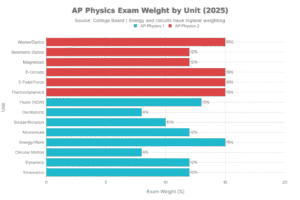
AP Physics 1 & 2 Unit Distribution & Exam Weighting (2025-2026)
Read More: Top Benefits of Hiring an AP Physics Tutor Online
New Exam Format Breakdown: What Changed on Test Day
Multiple-Choice Section (Section I)
| Feature | Old Format (Pre-2025) | New Format (2025+) | Impact |
| Number of Questions | 50 MCQs | 40 MCQs | 10 fewer questions to answer |
| Time Allocated | 90 minutes | 80 minutes | 10 fewer minutes, but 2 min/question average (vs. 1.8 before) |
| Question Types | Single-select + multiselect | Single-select only | Removes “pick two” complexity; simpler cognitive load |
| Answer Choices | 4 choices per question | 4 choices per question | No change |
| Testing Platform | Paper | Bluebook (digital) | Multiple-choice now fully digital; FRQs still handwritten |
| Guessing Penalty | None | None | No change |
The benefit: More time per question (2 minutes) allows careful reading and checking. Removing multiselect questions eliminates the high-stakes “pick both correct answers or zero points” dilemma. Students can now focus on demonstrating understanding rather than navigating complex question mechanics.arborsci+1
Free-Response Section (Section II)
| Feature | Old Format (Pre-2025) | New Format (2025+) | Impact |
| Number of Questions | 5 FRQs | 4 FRQs | 1 fewer question, but more flexible |
| Time Allocated | 90 minutes | 100 minutes | 10 extra minutes (25 min/FRQ average) |
| Answer Format | Mixture of paragraph, short answer, sketch | Four standardized types | Clearer expectations; no paragraph requirement |
| Scoring | Variable points per question | Standardized: 6-8 points per FRQ | More predictable scoring |
| Handwritten Submission | Yes | Yes | No change (not digitized) |
| Equation Sheet | Provided | Provided | No change |
The benefit: Students gain 10 minutes overall, translating to 25 minutes per FRQ. This permits deeper reasoning, clearer written explanations, and multiple attempts to correct errors. The paragraph answer a format that frustrated many students is eliminated.arborsci+2
Read More: 7 Smart Ways To Use Predicted Papers Without Risking Your A-Level Physics Grade
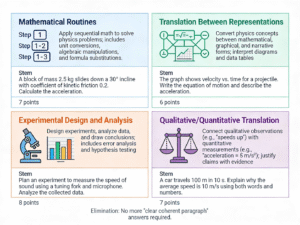
AP Physics 2025 FRQ Types: New Exam Format Guide
Four New FRQ Types: What to Expect
The College Board standardized FRQ formats. All four FRQs now fit one of these types:
- Mathematical Routines
Students perform multi-step calculations, derive relationships, or solve for unknowns. This is the most straightforward FRQ type.
Example prompt:
“A 2 kg block slides down a frictionless incline at 30°. Calculate the acceleration down the incline. Then calculate the time for the block to slide 5 meters from rest.”
What the scorer looks for:
- Correct formula identification (F_net = ma; a = g sin θ)
- Substitution of values with correct units
- Algebraic steps shown
- Final answer with units
- Dimensional analysis correctness
Typical points: 6-8 pointsap+1
- Translation Between Representations
Students convert between equations, graphs, verbal descriptions, and diagrams. This tests conceptual understanding and the ability to “see” the same physics through multiple lenses.
Example prompt:
“The position-time graph shows a car accelerating uniformly from rest. Write the equation for position as a function of time. Then sketch the velocity-time graph for the same motion.”
What the scorer looks for:
- Correct identification of motion type (uniform acceleration)
- Accurate equation derivation from graph
- Correct graph features (linear velocity, positive slope)
- Consistency between representations
- Proper labeling
Typical points: 6-8 pointsap+1
- Experimental Design and Analysis
Students propose experimental setups, interpret data, and draw conclusions. This tests scientific reasoning beyond mere calculation.
Example prompt:
“Design an experiment to measure the spring constant of a spring using a hanging mass and a ruler. Describe the measurements you would take, explain your procedure, and derive the formula you would use to calculate the spring constant from your data.”
What the scorer looks for:
- Logical experimental design (variables controlled, measured, manipulated)
- Clear procedure (step-by-step instructions)
- Appropriate measurements identified (mass, displacement, etc.)
- Correct physics reasoning for the calculation
- Error discussion or systematic improvements
Typical points: 6-8 pointsarborsci+1
- Qualitative/Quantitative Translation
Students convert between conceptual descriptions and mathematical expressions or data. This bridges conceptual and quantitative reasoning.
Example prompt:
“A ball is thrown upward. Describe qualitatively how the velocity changes during flight. Then write the equation relating velocity to time and use it to find the velocity at t = 0.5 s given initial velocity of 10 m/s upward.”
What the scorer looks for:
- Accurate qualitative description (velocity decreases going up, increases coming down, becomes negative on the way down)
- Correct equation (v = v₀ – gt)
- Proper substitution (v = 10 – 9.8 × 0.5 = 5.1 m/s)
- Consistency between qualitative and quantitative answers
Typical points: 6-8 pointsarborsci+1
Read More: Physics Tutor Cost Guide: What You’ll Pay, Regional Rates & Hidden Fees (2026)
Fluids Mastery Guide: High-Probability Exam Content
Fluids is now Unit 8 of AP Physics 1. Expect 12-13% of the AP Physics 1 exam to cover fluids roughly 5-6 points across the exam (both MCQ and FRQ sections).ap+1
Fluids Unit 8 Essential Equations
| Concept | Equation | Variables | When to Use |
| Density | ρ = m/V | ρ = density (kg/m³), m = mass, V = volume | Finding mass from volume OR identifying if an object floats |
| Pressure | P = F/A | P = pressure (Pa), F = force (N), A = area (m²) | Calculating force from pressure OR pressure from force |
| Pressure with Depth | P = P₀ + ρgh | P₀ = surface pressure, h = depth (m) | Finding pressure at different water depths; h is positive downward |
| Pascal’s Principle | P₁ = P₂; F₁/A₁ = F₂/A₂ | Applies to confined fluids | Hydraulic lifts and systems; pressure transmits equally |
| Buoyant Force | Fb = ρ_fluid × V_submerged × g | ρ_fluid = density of fluid displaced | Objects floating or sinking; apparent weight changes |
| Continuity Equation | A₁v₁ = A₂v₂ | A = cross-sectional area, v = fluid speed | Flow rate constant; when pipe narrows, fluid speeds up |
| Bernoulli’s Equation | P + ½ρv² + ρgh = constant | All terms in Pa (Pascals) | Relating pressure, velocity, and height in flowing fluids |
| Torricelli’s Theorem | v = √(2gΔh) | Δh = height difference | Speed of fluid exiting a hole at depth h |
Read More: 5 Reasons Physics Homework Takes 10+ Hours ?
Worked Example 1: Buoyancy Problem
Problem:
A 1,200 kg wooden block with density 600 kg/m³ is fully submerged in water (ρ = 1,000 kg/m³). Find the buoyant force and the net force on the block.
Step 1: Find the volume of the block.
ρ = m/V → V = m/ρ = 1,200 kg / 600 kg/m³ = 2 m³
Step 2: Calculate buoyant force using Archimedes’ principle.
Fb = ρ_water × V × g = 1,000 × 2 × 9.8 = 19,600 N (upward)
Step 3: Calculate weight of the block.
W = mg = 1,200 × 9.8 = 11,760 N (downward)
Step 4: Find net force.
F_net = Fb – W = 19,600 – 11,760 = 7,840 N (upward)
Insight: The block accelerates upward because buoyant force exceeds weight. In an open system, the block would rise to the surface and float, displacing water equal to its weight.youtube+1
Worked Example 2: Pressure and Depth
Problem:
A submerged object experiences a pressure of 150,000 Pa. The surface pressure is 101,325 Pa. Water density is 1,000 kg/m³, and g = 9.8 m/s². Find the depth of the object.
Step 1: Rearrange pressure equation.
P = P₀ + ρgh → ρgh = P – P₀
gh = (P – P₀)/ρ
h = (P – P₀)/(ρg)
Step 2: Substitute values.
h = (150,000 – 101,325) / (1,000 × 9.8)
h = 48,675 / 9,800
h = 4.97 m ≈ 5 m
Answer: The object is approximately 5 meters below the water surface.
Insight: Pressure increases about 10,000 Pa per meter of depth. This is why scuba divers experience significant pressure increases even at shallow depths.youtubenerd-notes
Worked Example 3: Bernoulli’s Equation and Flow Speed
Problem:
Water flows through a horizontal pipe. At point 1, the diameter is 10 cm and the speed is 2 m/s. At point 2, the pipe narrows to a diameter of 5 cm. Find the speed at point 2.
Step 1: Use continuity equation (A₁v₁ = A₂v₂).
Area depends on radius squared: A = πr²
At point 1: r₁ = 5 cm = 0.05 m
A₁ = π(0.05)² = 0.00785 m²
At point 2: r₂ = 2.5 cm = 0.025 m
A₂ = π(0.025)² = 0.00196 m²
Step 2: Solve for v₂.
A₁v₁ = A₂v₂
0.00785 × 2 = 0.00196 × v₂
v₂ = 0.0157 / 0.00196 = 8 m/s
Answer: When the pipe narrows, the fluid speed increases from 2 m/s to 8 m/s.
Key Insight: This is why water shoots faster from a narrow garden hose nozzle than from a wide opening. The same volume of water must pass through a smaller area, so it accelerates.
Check out smart test prep solutions to score higher
Waves and Optics in AP Physics 2: New Emphasis
AP Physics 2 now devotes more time to waves and optics. Key topics expanded:
Standing Waves (New Emphasis in Physics 2)
Standing waves occur when waves reflect and interfere constructively, creating a pattern that appears stationary.
Key equations:
- Fundamental frequency: f₁ = v / (2L) for a string fixed at both ends
- Harmonic frequencies: fn = n × f₁ where n = 1, 2, 3…
- Wavelength relationship: L = n(λ/2)
- Nodes: points of zero amplitude (spaced λ/2 apart)
- Antinodes: points of maximum amplitude (between nodes)
Worked example:
A string 1 meter long vibrates in its third harmonic. The wave velocity is 40 m/s. Find the frequency and wavelength.
Length = 3(λ/2) → λ = 2L/3 = 2/3 m = 0.67 m
f = v/λ = 40 / 0.67 = 60 Hz
Alternatively: f₃ = 3f₁ = 3 × (40 / 2 × 1) = 60 Hz ✓bnmv+1
Doppler Effect (New Emphasis in Physics 2)
The Doppler effect is the shift in observed frequency when a source and observer move relative to each other.
Key equations:
- Source moving toward observer: f’ = f × v / (v – vs)
- Source moving away: f’ = f × v / (v + vs)
- Observer moving toward source: f’ = f × (v + vo) / v
- Doppler shift = f’ – f (apparent frequency minus actual frequency)
Why it appears on exams: Doppler applies to sound (ambulance sirens, train horns) and light (astrophysics). The concept tests understanding of wave behavior and relative motion.bnmv+1
Worked example:
An ambulance with a siren frequency of 1,000 Hz approaches a stationary observer. The speed of the ambulance is 20 m/s and the speed of sound is 343 m/s. Find the apparent frequency heard by the observer.
f’ = f × v / (v – vs) = 1,000 × 343 / (343 – 20) = 1,000 × 343 / 323 = 1,062 Hz
The observer hears a higher frequency (1,062 Hz vs. actual 1,000 Hz) because the ambulance moves toward them, compressing sound waves.savemyexams+1
Preparing for Digital Exams: Bluebook Platform Tips
Starting May 2025, the MCQ section is fully digital via the College Board’s Bluebook platform. The FRQ section remains handwritten.arborsci+3
Bluebook Basics
What is Bluebook?
Bluebook is the College Board’s digital testing application used for AP Exams and SAT. Students access it on school-provided or personal devices (laptop, tablet, Chromebook). The MCQ section is fully administered through Bluebook. The FRQ section uses Bluebook to display questions, but students write answers by hand in exam booklets.bluebook.collegeboard+1
How to Prepare:
- Practice with test previews on Bluebook. The College Board offers untimed test previews to familiarize students with the digital interface. Access via the Bluebook app under “Practice and Prepare.” Previews are free and take 15-30 minutes.bluebook.collegeboard
- Use AP Classroom for full-length practice tests. AP Classroom (separate from Bluebook) provides full-length timed practice tests designed to match the actual exam format. Teachers provide access. Complete at least two full-length practice tests before the exam.bluebook.collegeboard
- Test keyboard and mouse speed. Digital exams require faster reading and navigation. Practice selecting answers quickly. Ensure you can type and click confidently under time pressure.arborsci+1
- Familiarize yourself with the digital calculator. The Bluebook app includes a digital calculator tool. Practice using it before test day.askfilo
- Simulate test-day conditions. Complete practice tests in a quiet room with a timer, without interruptions. This replicates actual exam stress and timing.arborsci
Strategic Time Allocation
Multiple-Choice Section (80 minutes for 40 questions):
- Target 1.5-2 minutes per question
- Spend 30 minutes on the first 20 questions (careful reading)
- Spend 30 minutes on questions 21-40 (moderate pace)
- Reserve 10 minutes for review (only if time permits)
- Do NOT leave questions blank; guess if unsure (no penalty)
Free-Response Section (100 minutes for 4 FRQs):
- Target 20-25 minutes per FRQ
- Spend first 2-3 minutes reading and planning
- Spend 12-15 minutes solving
- Spend 5-7 minutes writing up the solution clearly
- Leave 10-15 minutes for review and checking calculations
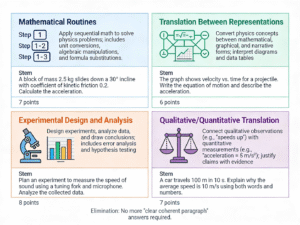
AP Physics 2025 FRQ Types: New Exam Format Guide
Cross-Links: How Waves/Optics Split Affects Physics 2
Previously, AP Physics 2 had one “Optics” unit covering both geometric optics (mirrors, lenses, refraction) and physical optics (interference, diffraction, polarization). This unit was dense.
What changed:
- Unit 13: Geometric Optics (mirrors, lenses, refraction, Snell’s law, total internal reflection)
- Unit 14: Waves, Sound, and Physical Optics (mechanical waves, standing waves, sound, Doppler effect, interference, diffraction)
Benefit: Students now spend more time on waves and sound, which are foundational for understanding light as a wave. The split also clarifies the distinction between ray optics (geometric) and wave optics (physical).
Implication for Physics 1 students: Physics 1 students do not study optics or waves in depth. This makes Physics 2 a true continuation, not a duplication.
Read more to get instant, accurate homework help
Resource Roundup: Updated Study Materials for 2026
Official College Board Resources
- AP Central (apcentral.collegeboard.org): Complete course descriptions, exam samples, and grading rubrics. Essential reference.apcentral.collegeboard+2
- AP Classroom: Full-length practice tests, question banks, and auto-grading. Provided free to schools. Request access from your teacher.
- Bluebook App (bluebook.collegeboard.org): Test previews and platform familiarization. Download to practice MCQ format.
Recommended Textbooks and Study Guides
- “5 Steps to a 5: AP Physics 1” by Greg Jacobs (McGraw-Hill)
- “Princeton Review AP Physics 1 Premium Prep”
- “Barron’s AP Physics 1 and 2”
- These are updated annually and reflect current exam format.
Online Practice Platforms
- Khan Academy: Free videos and practice aligned to AP Physics. Excellent for concept review.
- Fiveable.me: Student-created flashcards, study guides, and live review sessions (seasonal).
- Physics Online Lab (PhysicsLab.org): Practice problems with detailed solutions.
- Save My Exams (SavemyExams.com): High-quality revision notes and exam technique tips.
Video Resources
- YouTube channels like “Flipping Physics,” “Physics Universe,” and “The Organic Chemistry Tutor” have updated 2025-2026 content, including fluids walkthroughs and new FRQ examples.
- Search “AP Physics 1 Unit 8 Fluids” or “AP Physics 2 Standing Waves 2026” for recent videos.
Key Takeaways
- Fluids moved to Physics 1 (Unit 8). This balances course load and places fluids in mechanical/energy context where it belongs.
- Exam format standardized. 40 MCQs (80 min) + 4 FRQs (100 min). Multiselect and paragraph answers eliminated. Clearer expectations for students.
- Four new FRQ types. Mathematical Routines, Translation Between Representations, Experimental Design, and Qualitative/Quantitative Translation. Each type tests different skills.
- Physics 2 emphasizes waves and optics. Standing waves, Doppler effect, and expanded physical optics receive greater depth. Geometric optics is separated into its own unit.
- Digital testing is here. MCQ section on Bluebook (fully digital). FRQ section still handwritten. Practice digital platform before exam.
- Fluids requires understanding (not just memorization). Buoyancy, pressure, Bernoulli, and continuity are tested in multiple formats. Master worked examples and be ready to translate between equations, diagrams, and descriptions.
- More time per question. The reduction in question count, paired with time increases, gives students breathing room for deeper reasoning and clearer written responses.
Next Steps: Your 2026 Exam Preparation Timeline
January-February 2026 (Now):
- Identify which AP Physics course you will take
- Gather approved study materials (textbooks, online platforms)
- If taking Physics 1, begin reviewing kinematics and dynamics (Units 1-2). Fluids (Unit 8) will come later.
- If taking Physics 2, begin with thermodynamics review.
March 2026 (2 months before exam):
- Complete all content review for your course
- Take one full-length practice test (Bluebook MCQ preview + AP Classroom FRQ practice)
- Identify weak areas from practice test results
April 2026 (1 month before exam):
- Focus on weak areas with targeted problem sets
- Complete two more full-length practice tests (under timed conditions)
- Review new FRQ types; practice at least one of each type
- Simulate test-day conditions (quiet room, timer, no distractions)
May 2026 (Exam week):
- Light review only; avoid learning new content
- Sleep, exercise, and manage stress
- Review equation sheet one more time (provided on exam)
- Arrive early; test Bluebook access on school device
- Remember: 40 questions on MCQ, 4 on FRQ, 180 minutes total
******************************
This article provides general educational guidance only. It is NOT official exam policy, professional academic advice, or guaranteed results. Always verify information with your school, official exam boards (College Board, Cambridge, IB), or qualified professionals before making decisions. Read Full Policies & Disclaimer , Contact Us To Report An Error