
Cracking the Code: A Medical Student’s Ultimate Guide to Conquering the USMLE

Success on the USMLE hinges on early preparation, smart resource utilization, and personalized support. Understanding the exam’s structure and seeking expert guidance can transform this daunting challenge into a manageable milestone.
Imagine Sarah, a second-year medical student. Her desk is a fortress built of textbooks, notes, and half-empty coffee mugs. The single word that haunts her waking moments and fuels her caffeine addiction is “USMLE.” It feels less like an exam and more like a mythical beast guarding the gates to her dream of becoming a doctor. She’s smart, she’s dedicated, but the sheer scale of the United States Medical Licensing Examination is overwhelming. Sarah’s story isn’t unique; it’s a rite of passage for nearly every aspiring physician in the United States and many from around the globe.
This exam is a marathon, not a sprint. It’s a comprehensive test of knowledge, endurance, and critical thinking. But here’s the good news: it’s not an unbeatable monster. With the right strategy, mindset, and support system, you can conquer the USMLE and take a confident step toward your medical career. This guide will help you crack the code.
What Exactly Is the USMLE?
Navigating the USMLE series can be confusing for new students. The roadmap below clarifies the specific focus and goal of each step in your licensure journey.
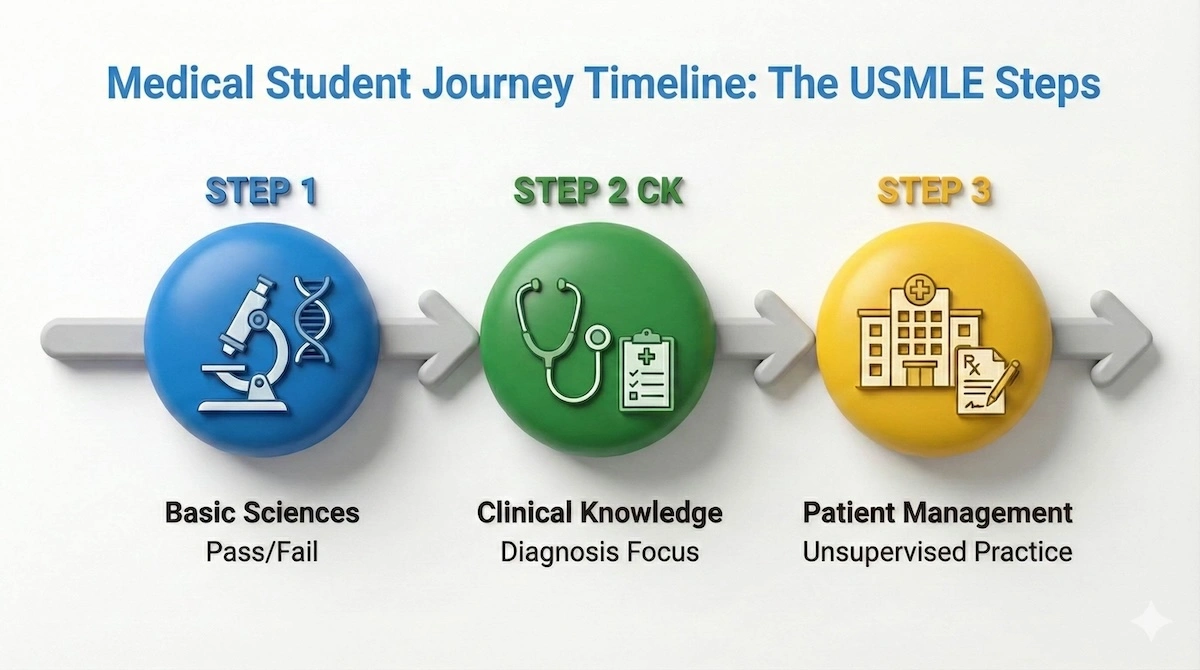
This roadmap outlines the three critical stages of the USMLE journey, from basic sciences to independent practice.
As you can see, the progression moves from foundational science to clinical application and finally to patient management.
Before you can defeat the beast, you need to understand it. The USMLE, sponsored by the Federation of State Medical Boards (FSMB) and the National Board of Medical Examiners (NBME), is a three-step examination required for medical licensure in the United States. Its primary goal is to assess a physician’s ability to apply knowledge, concepts, and principles, and to demonstrate fundamental patient-centered skills.
It’s broken down into three distinct parts, each a significant milestone:
- Step 1: This is the exam that loomed over Sarah. It’s a one-day, eight-hour ordeal that focuses on the basic sciences. Think anatomy, biochemistry, pathology, pharmacology—all the foundational knowledge from your first two years of medical school. While it recently transitioned to a pass/fail system, a pass is still a critical requirement for moving forward.
- Step 2 Clinical Knowledge (CK): This step tests your ability to apply medical knowledge and understanding of clinical science essential for patient care. It’s more focused on diagnosis and management, covering internal medicine, surgery, pediatrics, and more.
- Step 3: The final step is a two-day exam that assesses your ability to apply medical knowledge and clinical science to the unsupervised practice of medicine. It places a heavy emphasis on patient management, including initial workups, continuing care, and emergency cases.
The Everest of Exams: Why Is the USMLE So Challenging?
Students often describe the USMLE as one of the most difficult exams they’ve ever faced, and for good reason. The challenge is multi-faceted, pushing candidates to their absolute limits.
The Sheer Volume of Information
The amount of material you need to know is staggering. It encompasses years of intensive medical education, from the smallest biochemical pathway to the broadest principles of public health. Just lifting the First Aid review book can feel like a workout. This vastness is often the first source of anxiety for students like Sarah.
The Marathon Format
These are not short exams. As the official USMLE website states, Step 1 is an eight-hour exam divided into seven 60-minute blocks. Maintaining focus, managing time, and battling mental fatigue over such a long period is a skill in and of itself, separate from simply knowing the material.
Critical Thinking Over Rote Memorization
The USMLE is cleverly designed to test how you think. It’s not enough to memorize facts. Questions are presented as clinical vignettes, requiring you to analyze a patient’s case, identify relevant information, and make diagnostic or management decisions. You have to connect the dots between different disciplines in real-time, just as a physician would.
The Stakes Are Incredibly High
Your performance on the USMLE sequence has a profound impact on your future career, particularly when it comes to matching with a residency program. Even with Step 1 being pass/fail, a failure can be a significant red flag. According to the National Resident Matching Program (NRMP), program directors consistently cite USMLE scores as one of the most important factors when selecting applicants. The pressure to perform well is immense.
It’s not just one thing that makes this exam difficult; it is a combination of four distinct pressures. Visualizing these challenges can help you prepare for them mentally.
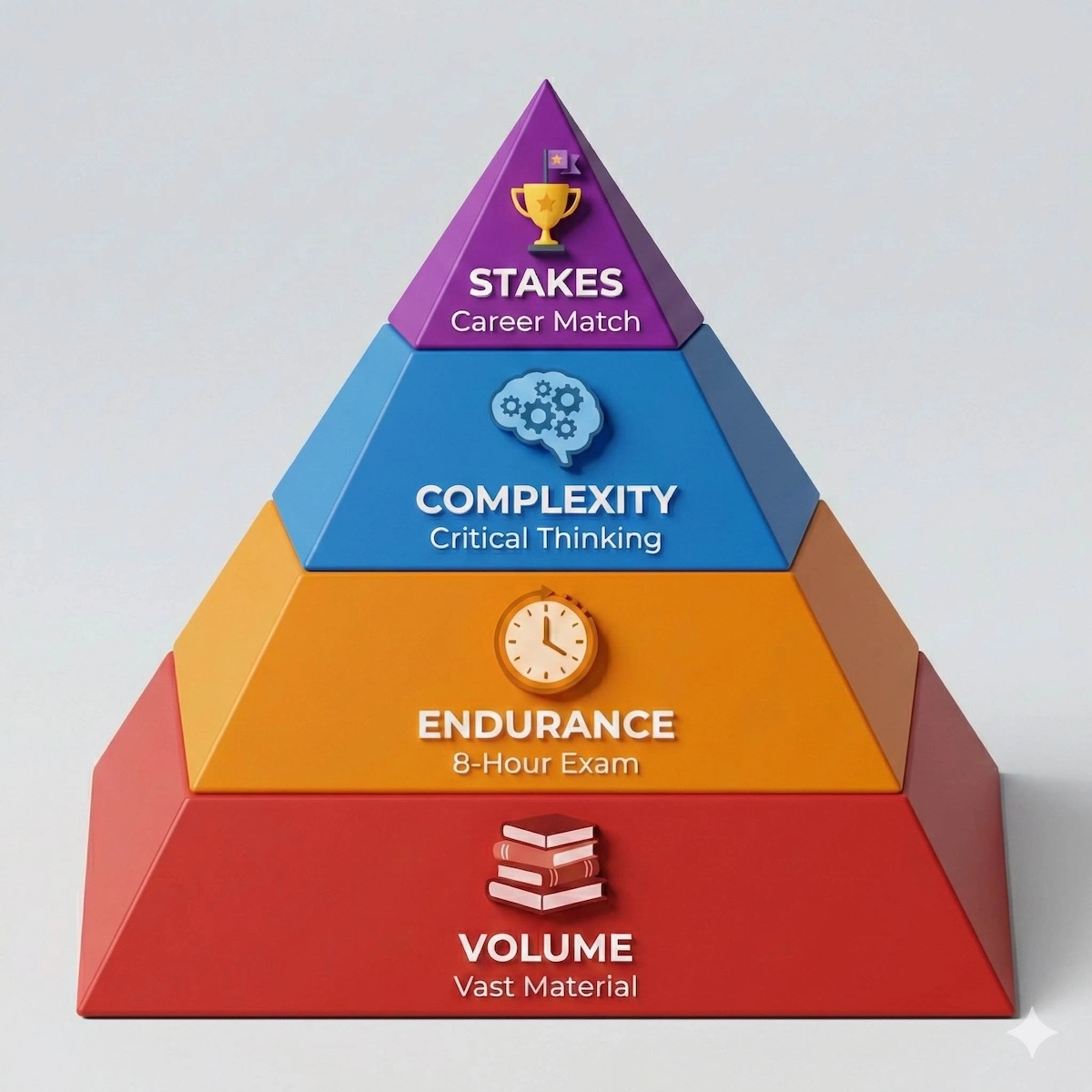
Understanding these four pillars of difficulty is the first step toward conquering the “Everest of Exams.”
Recognizing these four pillars of difficulty allows you to build a study plan that addresses volume, endurance, complexity, and stress management simultaneously.
Crafting Your Battle Plan: Effective USMLE Prep Strategies
Abandon passive reading and adopt a dynamic study loop. This cycle ensures you are constantly reinforcing your memory rather than just reviewing familiar topics.
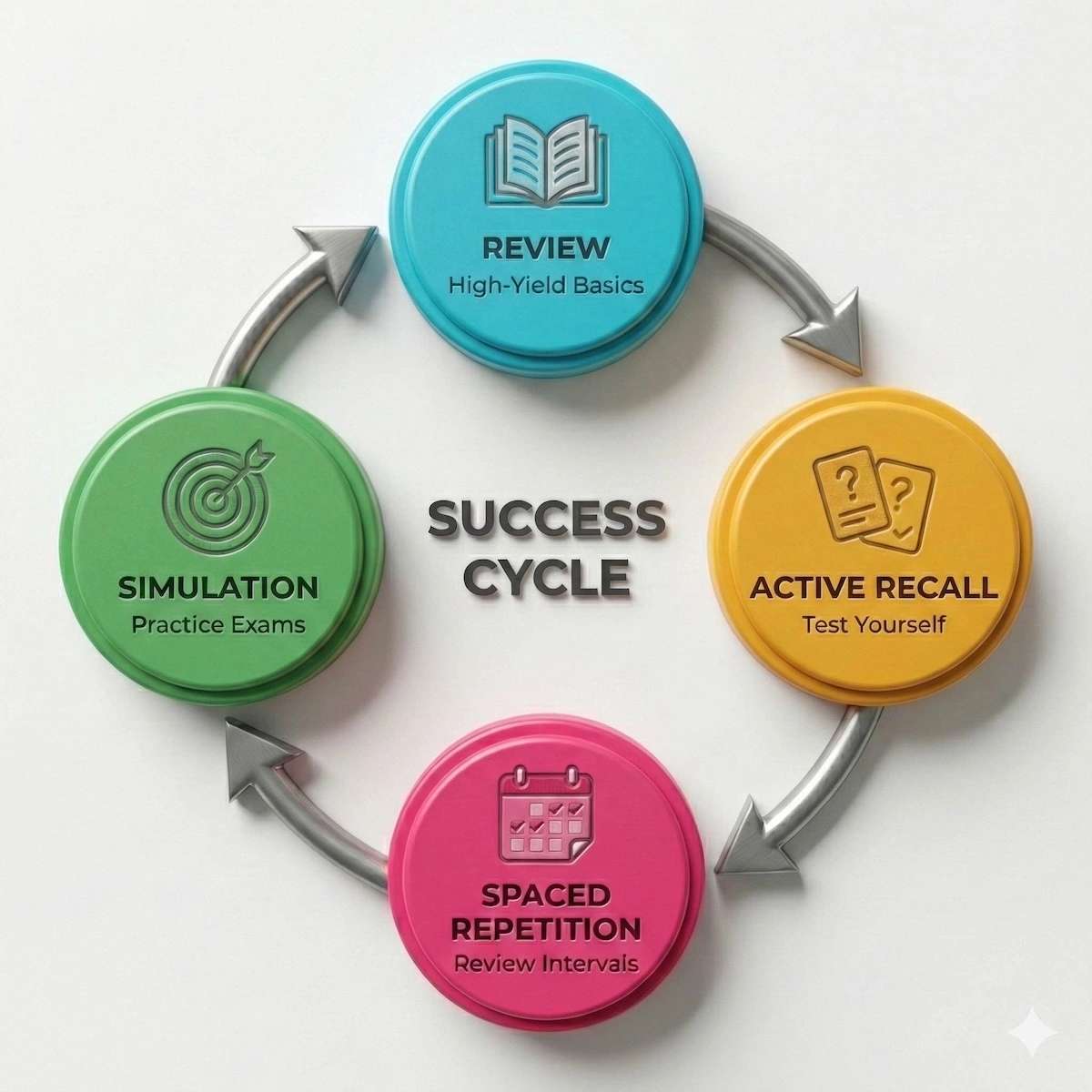
Adopt this continuous cycle of active learning to maximize retention and exam performance.
By keeping this cycle in motion, you ensure that information moves from short-term memory into long-term retention.
Facing this challenge requires a well-thought-out plan of attack. Simply reading textbooks cover-to-cover won’t cut it. You need to study smarter, not just harder.
Start Early, Stay Consistent
The most successful students begin integrating USMLE preparation into their regular medical school studies from day one. Don’t wait for the dedicated study period to learn everything. Build a strong foundation as you go, and your future self will thank you. Consistency beats cramming every single time.
High-Yield Resources Are Your Best Friends
There’s a galaxy of study resources available, and it’s easy to get lost. The key is to focus on a few high-quality, high-yield resources. Most students build their study plan around a core question bank (like UWorld), a comprehensive review book (like First Aid), and resources that explain difficult concepts (like Pathoma or SketchyMedical). Find what works for your learning style and stick with it.
With so many books and apps available, it helps to categorize them by function. Here is how you should organize your primary study toolkit.
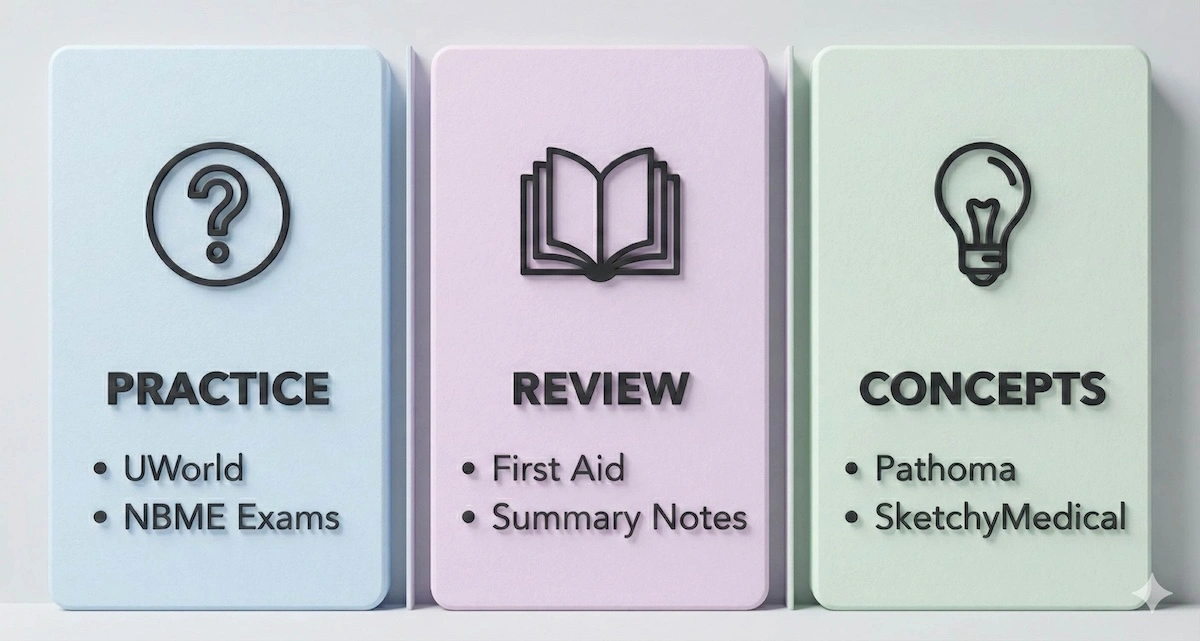
Build your study arsenal by selecting one key resource from each of these three essential categories.
Select one high-quality resource from each category to avoid ‘resource overload’ and keep your daily study schedule focused.
The Power of Active Recall and Spaced Repetition
Passive learning, like reading or watching videos, is not enough. You must actively engage with the material. This is where techniques like active recall (testing yourself with flashcards or practice questions) and spaced repetition (reviewing material at increasing intervals) become superpowers. They are scientifically proven to enhance long-term memory retention.
Simulation is Key: Taking Practice Exams
You wouldn’t run a marathon without practicing on the racecourse. Taking full-length practice exams, like the NBME Self-Assessments, is crucial. It builds your mental stamina, helps you perfect your timing, and provides a reliable estimate of your readiness. At AUAMED (American University of Antigua College of Medicine), this strategy is deeply embedded in their curriculum, ensuring students are well-prepared for USMLE success through structured, data-driven self-assessment.
When to Call for Reinforcements: The Role of a USMLE Tutor
Let’s go back to Sarah. She did everything right. She started early, used the best resources, and took practice tests. But her score plateaued. The sheer volume of her “weak” areas felt paralyzing. This is a common crossroad where many students find themselves, and it’s the perfect time to consider getting expert help. Effective USMLE tutoring isn’t about being spoon-fed answers; it’s about receiving personalized, strategic guidance.
Personalized Learning Paths
A one-size-fits-all study plan doesn’t work for everyone. A skilled USMLE tutor acts like a personal trainer for your brain. They can analyze your performance data, pinpoint your specific conceptual gaps, and build a tailored study plan that focuses your energy where it will have the most impact. This targeted approach can break through plateaus and lead to significant score improvements.
Demystifying Complex Concepts
Let’s face it, some topics in medicine are brutally difficult. No matter how many times you read the chapter on renal physiology or watch a video on the coagulation cascade, it just doesn’t click. This is where high-quality USMLE teaching shines. A great USMLE teacher can reframe these complex ideas, use analogies, and draw connections that finally make the lightbulb go on.
Accountability and Motivation
The road to the USMLE is long and often lonely. It’s easy to lose motivation or fall behind schedule. Having regular check-ins with a USMLE tutor online provides structure and, just as importantly, accountability. Knowing someone is there to support you, track your progress, and provide encouragement can make all the difference. The convenience of USMLE tutoring online means you can access top-tier help from anywhere in the world.
Beyond the Books: Test-Taking Strategies
A significant part of the USMLE is gamesmanship. How do you break down a long, convoluted question stem? How do you manage your time when you’re running behind? An experienced tutor provides more than just content review; they offer invaluable strategies for navigating the exam itself. This can include targeted USMLE assignment help, where you work through difficult question blocks together to refine your analytical approach. Whether you need USMLE homework help with a tough subject or a complete overhaul of your test-day strategy, a tutor can guide you.
Making the Decision to Hire a Tutor
So, when should you seriously consider it? If you’re feeling overwhelmed, not seeing improvement in your practice scores, struggling with a specific subject, or simply don’t know how to create an effective study schedule, it might be time to hire a USMLE tutor. It’s an investment in your education and your future career, providing a level of support that can turn a stressful experience into a successful one.
Are you unsure if you need external help or just more time? Follow this simple decision path to see if a tutor is the right investment for your current situation.
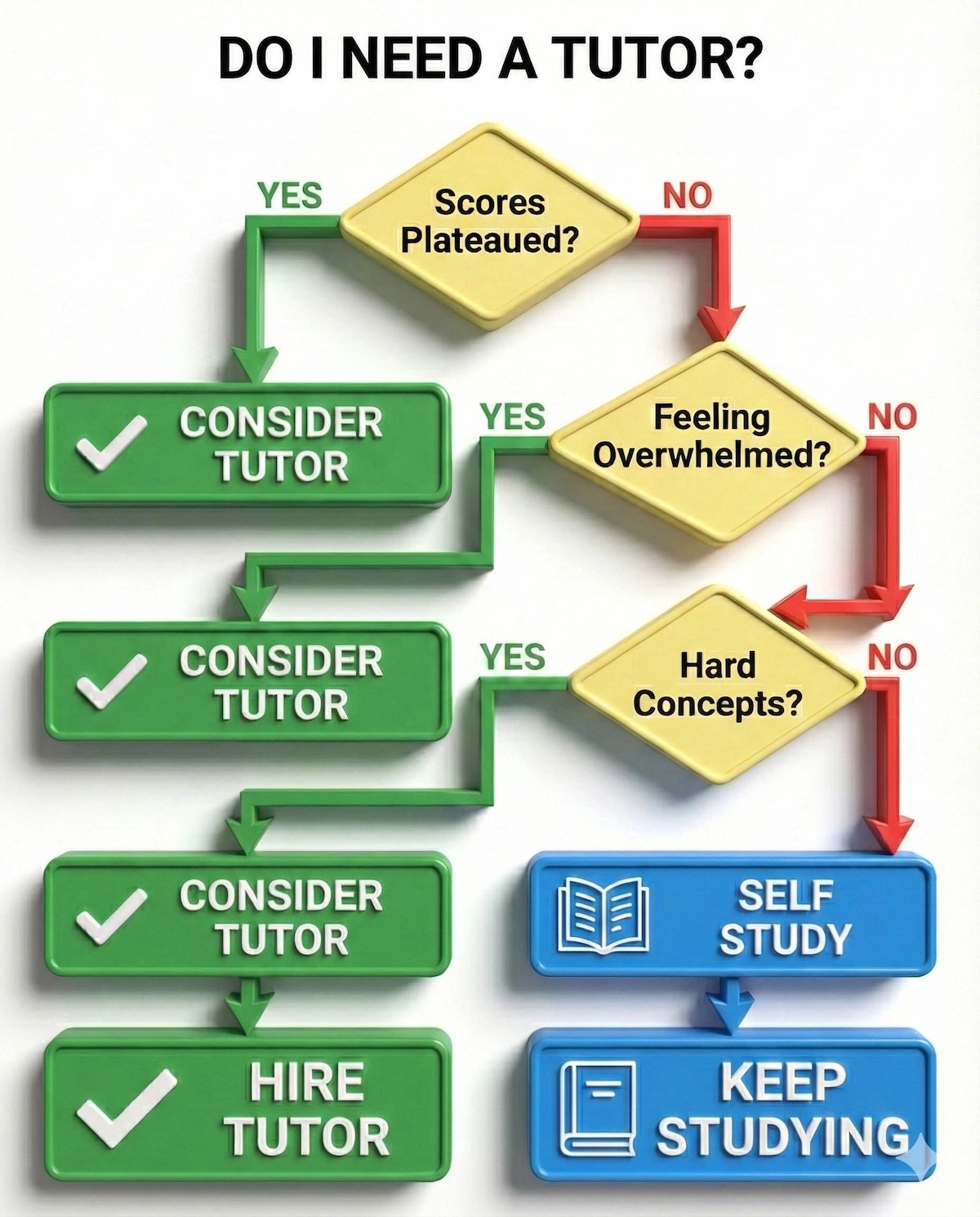
Use this simple checklist to determine if professional guidance is the missing link in your preparation.
If you landed on ‘Hire Tutor,’ getting help early can save you months of frustration and significantly boost your match potential.
Reaching the Summit
After hitting a wall, Sarah decided to work with a tutor. Together, they identified that her main issue wasn’t a lack of knowledge, but trouble applying it under pressure. They focused on question-dissection strategies and targeted content review. Slowly but surely, her confidence grew, and her practice scores began to climb. On test day, she walked in feeling prepared, not panicked.
The USMLE is a formidable challenge, but it is not insurmountable. It is a journey that every successful physician in the U.S. has completed. With dedication, a smart strategy, and the right support system, you can reach the summit and continue on the path to a rewarding and impactful career in medicine.
Frequently Asked Questions (FAQs)
Q1. What is the main purpose of the USMLE?
Its main purpose is to assess a physician’s ability to apply medical knowledge and skills to provide safe and effective patient care.
Q2. Is USMLE Step 1 still scored?
No, USMLE Step 1 is now reported on a pass/fail basis for all exams taken on or after January 26, 2022.
Q3. How long should I study for the USMLE?
Most students use a dedicated study period of 6 to 10 weeks, but consistent, long-term preparation throughout medical school is ideal.
Q4. Can a tutor help if I’m already doing well?
Yes, a tutor can help you optimize your study plan, master test-taking strategies, and turn a good score into a great one.
Q5. Is online tutoring effective for the USMLE?
Absolutely, online tutoring offers flexible scheduling and access to a wider pool of expert tutors from any location.
Q6. Where can I find reliable USMLE hw help?
Reliable help often comes from experienced tutors who can provide personalized guidance on challenging topics and practice questions.
Related Subjects
******************************
This article provides general educational guidance only. It is NOT official exam policy, professional academic advice, or guaranteed results. Always verify information with your school, official exam boards (College Board, Cambridge, IB), or qualified professionals before making decisions. Read Full Policies & Disclaimer , Contact Us To Report An Error