
From Confusing Lectures to Clear Understanding: How to Enhance Note Taking

Engineering lectures often feel overwhelming. In a single class, students may encounter dense Fourier transform derivations, fluid dynamics equations, or multi-variable systems all delivered at speed. In such high-pressure STEM environments, many students fall into passive transcription mode, trying to write everything down word for word.
This approach comes at a cost. When the focus shifts to copying, the underlying logic and reasoning behind mathematical steps are easily missed. For engineering students, success is not about surviving one semester it is about mastering concepts that build on each other over time. Moving from confusing lectures to clear understanding requires a fundamental shift in how information is captured and processed.
By integrating structured note-taking techniques with tools like an AI voice agent, students can bridge the gap between frantic scribbling and genuine conceptual mastery.

The Engineering Note-Taking Dilemma: Why Conventional Methods Fail
Nearly all engineering students experience a cognitive bottleneck during lectures. A 2025 educational study highlights that the human brain cannot effectively perform three demanding tasks at once listening, analyzing, and writing simultaneously. In engineering classes, where new variables and assumptions are introduced every few seconds, this limitation becomes even more pronounced.
Why is it so hard to keep up? Science suggests our brains hit a limit when multitasking. Here is what happens during a fast-paced lecture:
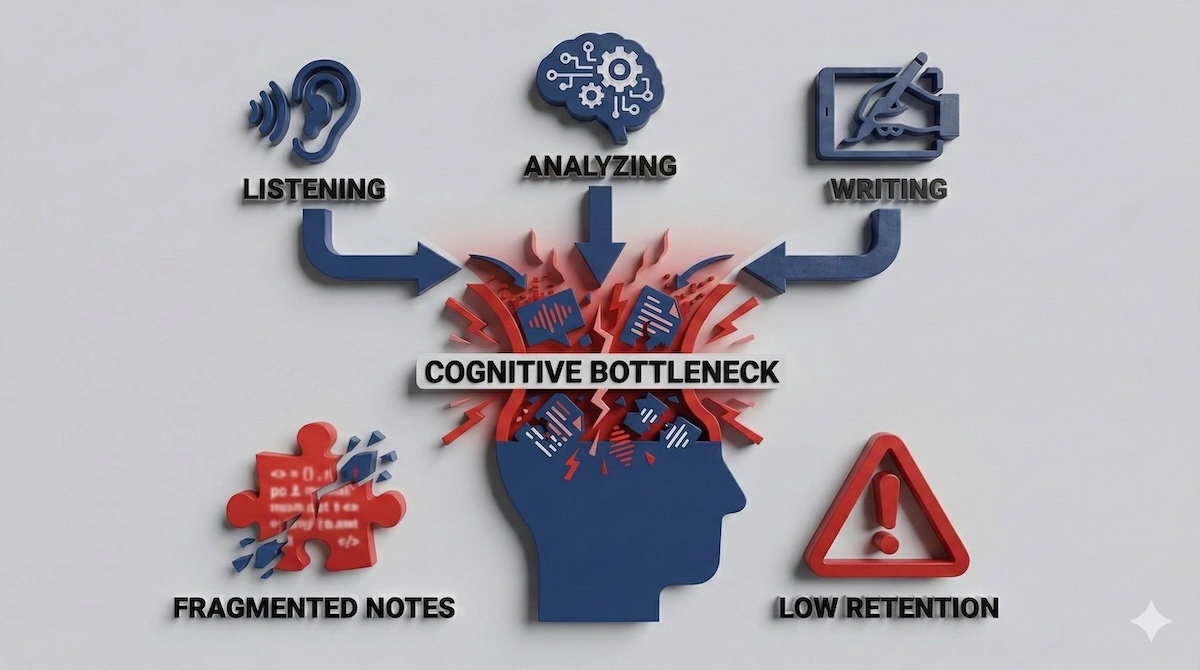
Trying to do too much at once creates a “cognitive bottleneck,” leading to fragmented notes.
Recognizing this bottleneck is the first step toward fixing your workflow.
The result is fragmented notes that often make little sense during late-night revision sessions.
Common Reasons Traditional Note-Taking Falls Short
-
The Verbatim Trap
Writing down exactly what the professor says discourages active thinking and problem analysis. -
Diagram Disconnect
Engineering is highly visual. When students focus only on writing, they often miss critical circuit diagrams, stress-strain curves, or system block diagrams. -
Delayed Review
Research shows that when notes are not reviewed within 24 hours, retention can drop by 50% to 80%, making revision far less effective.
Improving Your Workflow: Structured Approaches in STEM Disciplines
To overcome these challenges, engineering students need note-taking strategies that prioritize logic over language.
The Cornell Method for Technical Subjects
Divide each page into three sections:
-
Cues: Key formulas, variables, and assumptions
-
Notes: Step-by-step calculations and derivations
-
Summary: The physical significance of the result—what it means in real-world engineering terms
Structuring your page is critical for math-heavy subjects. Here is the optimal layout for an engineering notebook:
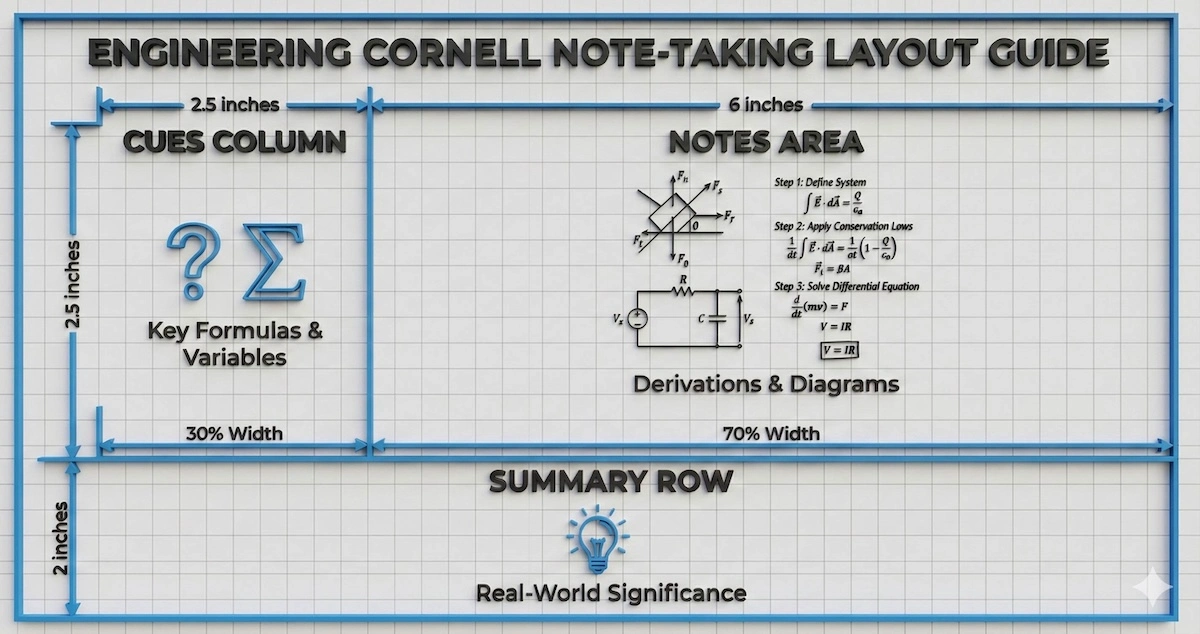
Divide your page into these three zones to organize complex technical derivations effectively.
Using the bottom summary row for ‘real-world significance’ helps connect abstract math to physical reality.
This structure aligns well with how engineering problems are evaluated and explained.
The Flow Method
Instead of listing ideas side by side, use arrows to show cause-and-effect relationships.
For example:
-
Temperature change (Input)
-
Thermal expansion (Process)
-
Reduced material strength (Outcome)
Engineering is about systems. Instead of linear sentences, visualize the logic flow like this:
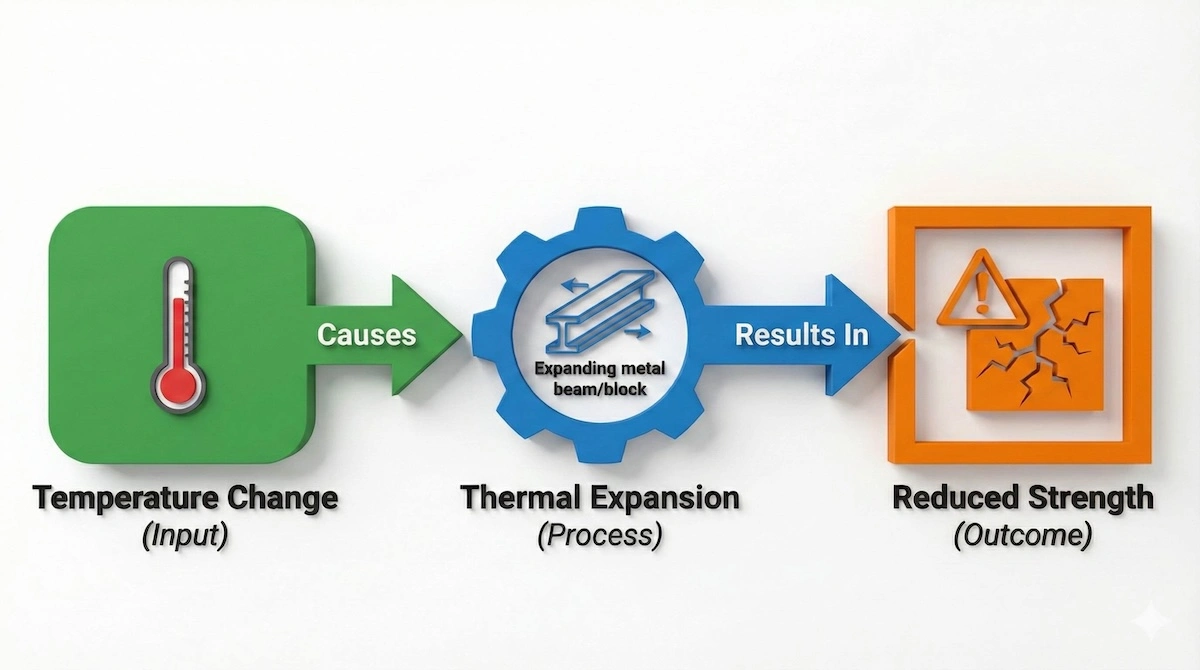
Use the Flow Method to map cause-and-effect relationships in engineering systems.
This visual approach mirrors how actual engineering systems function.
This mirrors how engineering systems behave and improves conceptual clarity.
The AI Voice Agent: Using It as a “Second-Pass” Tool
One of the most impactful study shifts in 2025 STEM learning strategies is the use of an AI voice agent. While transcription technology has existed for years, adding an intelligent voice layer transforms passive recordings into active learning resources.
How an AI Voice Agent Fits Into an Engineering Study Loop
-
Audio-to-Insight
With permission, lectures can be recorded and converted into accurate technical transcripts. Advanced AI voice agents recognize engineering terminology, ensuring “Laplace” is not misinterpreted as “the place.” -
Variable Explanation
Students can ask the AI voice agent to create audio explanations from their own notes. Converting written summaries into spoken explanations activates auditory learning pathways, which studies show can improve recall by up to 38% in STEM subjects. -
On-the-Go Review
Complex problem logic can be reviewed while commuting, allowing productive revision without additional screen time.
Eliminating Human Error in Technical Capture
In disciplines such as civil or mechanical engineering, small errors can have serious consequences. A misplaced decimal or misunderstood unit is not just a grading issue—it can represent a real-world safety risk.
Using structured notes combined with AI-assisted review reduces the likelihood of such mistakes by reinforcing clarity and accuracy.
The Power of Multi-Modal Study in STEM
A study published in the Journal of STEM Education in late 2024 found that students who adopted multi-modal note-taking—combining handwritten diagrams with AI-generated audio summaries performed 1.5 times better on application-based exam questions than those using traditional methods.
By offloading the task of recording to an AI voice agent, students free up cognitive capacity to focus on problem-solving. The technology captures the what, allowing the student to focus on the why.
Practical Implementation: A 3-Step “Clear Understanding” Method
Let’s put it all together into a repeatable workflow you can use for every class:
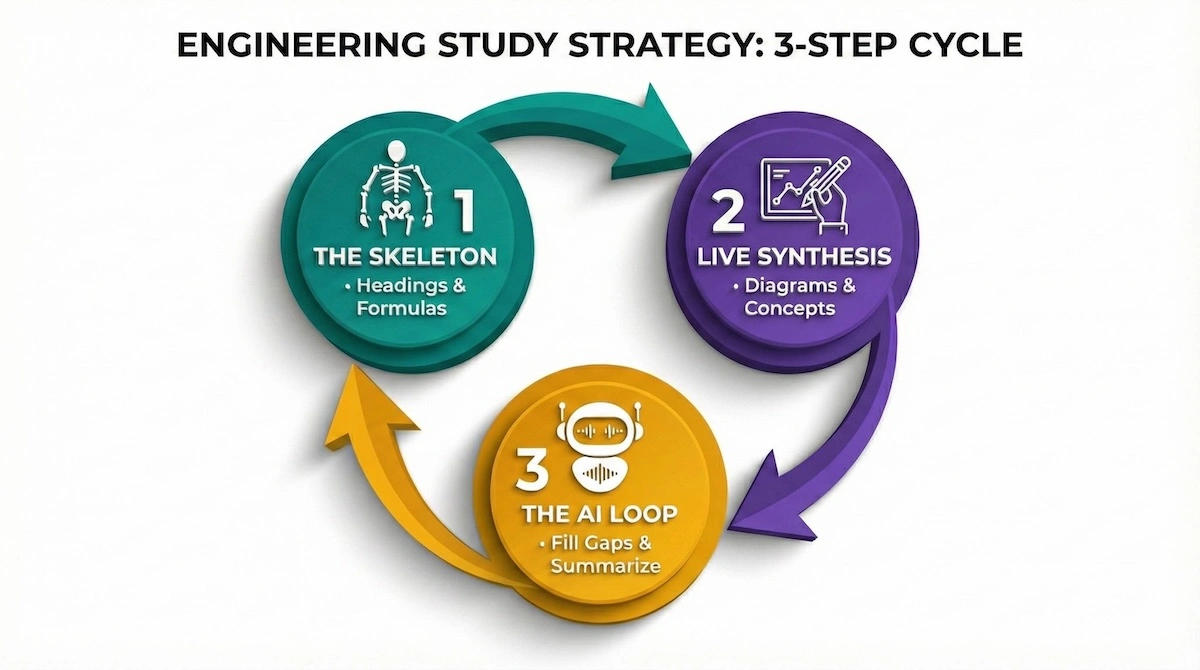
Follow this 3-step cycle to transform passive listening into active conceptual mastery.
By offloading the transcription to AI in Step 3, you free up your brain for the critical thinking in Step 2.
Whether studying independently or working with a tutor, engineering students can apply this simple framework:
1. Prepare the Skeleton
Before class, write down:
-
Lecture headings
-
Key formulas from textbooks
2. Live Synthesis
During the lecture:
-
Draw diagrams
-
Note “lightbulb moments” where concepts click
3. The AI Loop
After class:
-
Process the recording using an AI voice agent
-
Fill gaps in the skeleton notes
-
Generate a short audio summary for revision before the next session
Conclusion: From Transcription to Transformation
Effective note-taking in engineering is not about acting as a recorder—it is about becoming an architect of knowledge. Achieving clear understanding from complex STEM lectures requires both structure and the right tools.
By combining proven frameworks like the Cornell Method with the technological advantage of an AI voice agent, students ensure that no critical detail is lost and no concept is misunderstood. The result is deeper comprehension, stronger retention, and greater confidence in tackling real engineering problems.
******************************
This article provides general educational guidance only. It is NOT official exam policy, professional academic advice, or guaranteed results. Always verify information with your school, official exam boards (College Board, Cambridge, IB), or qualified professionals before making decisions. Read Full Policies & Disclaimer , Contact Us To Report An Error