
Free Algebra Resources vs Paid Tutoring: Complete ROI Analysis (2026)

Should you pay $50+ per hour for algebra tutoring, or are the free resources good enough?
This is a critical question for engineering students. A single year of tutoring costs $1,200-$2,400. That’s a semester of tuition at some schools. That’s books, software subscriptions, food.
Here’s what the research says: Free resources are extremely good. Students score 800 on SATs using only Khan Academy. MIT’s open-source linear algebra lectures are taught by a world-renowned professor at zero cost. Wolfram Alpha solves almost any algebra problem instantly.
But free resources also have a real limitation: they don’t give you feedback. They can’t identify what you specifically don’t understand. They can’t hold you accountable.
This guide provides a complete ROI analysis: when free resources are genuinely sufficient, when a hybrid approach (free + targeted tutoring) is smarter, and when full paid tutoring becomes necessary.
By the end, you’ll have a decision framework tailored to your situation so you invest in tutoring only when it’s genuinely worth it.
Section 1: Free Resource Evaluation (The Detailed Truth)
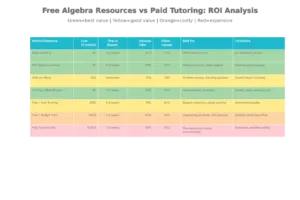
Khan Academy: Truth Beyond the Hype
What it actually is: 7,000+ short videos on math, science, reading. Free forever. Used by millions.
Quality Rating: 6/10 overall [web:187]
Breakdown:
- User interface & design: 10/10 (best-in-class, super intuitive)
- Learning approach: 7/10 (works for organized, self-directed learners)
- Effectiveness: 5/10 (only ~50% of users report long-term learning)
- Real feedback/interactivity: 2/10 (videos are passive, one-way)
- Customer support: 4/10 (non-profit, slow response)
- Price: 10/10 (completely free)
What works:
- Reviewing concepts you kinda understand
- Foundational algebra (integers, fractions, basic equations)
- Self-motivated learners who can pace their own study
- Students with existing knowledge who need refresher
- Supplementing classroom instruction
What doesn’t work:
- As sole resource for struggling students
- No personalized feedback on your specific mistakes
- No accountability (easy to watch passively without learning)
- Video-based only (passive; attention span issue for many)
- No interaction with instructor
- Can’t ask “why does this work this way?”
Real student experiences: [web:190, web:193]
Success story: “I got a 1580 on the SAT using only Khan Academy”—hundreds of upvotes on Reddit
Frustrated user: “Khan Academy is exactly like school. Math taught as formulas with no explanation of WHY things work”
Verdict: Khan Academy is excellent for reinforcement and review. Mediocre for struggling students learning new concepts. Use it as a foundation, not the whole solution.
MIT OpenCourseWare: The Gold Standard
What it actually is: 2,500+ MIT courses, completely free. Including world-class linear algebra taught by Professor Gilbert Strang.
Quality Rating: 8/10 overall [web:188, web:200, web:203]
What you get (using Linear Algebra as example):
- Complete lecture videos (Prof. Strang, world-renowned)
- Lecture notes and transcripts
- Problem sets WITH solutions
- Full exams WITH solutions
- Java demonstrations
- 35+ lectures, 4+ hours of instruction
- Everything needed to teach yourself the course
What works:
- Learning at MIT’s level without attending MIT
- Linear algebra (critical for engineering)
- Calculus, differential equations, physics
- Self-paced, complete curriculum coverage
- Excellent for deep understanding (not just passing)
- Advanced concepts taught exceptionally well
What doesn’t work:
- Requires significant self-discipline
- No feedback on your specific work
- Assumes you have solid foundation (not beginner-friendly)
- No accountability structure
- Dense content; requires sustained concentration
- Better for motivated self-learners than struggling students
Real student reactions: [web:191, web:194]
“Professor Strang’s lectures are genuinely good” — verified by YouTube viewers who took MIT course
“MIT OpenCourseWare quality you really can’t beat” — engineering student reviewing resources
“You can literally take a whole course online through this website” — education resource reviewer
Cost-benefit: Getting MIT-quality instruction for free is extraordinary. The limitation is you’re entirely responsible for your own learning.
Verdict: MIT OCW is exceptional for linear algebra and advanced topics. Overkill for algebra basics, perfect for engineering-specific math.
Wolfram Alpha: The Problem Solver
What it actually is: A “knowledge engine” that solves math problems and shows step-by-step solutions.
Quality Rating: 7/10 overall [web:208, web:211, web:214, web:222]
Capabilities:
- Solve any algebra equation (input: “2x + 4 = 12”; output: “x = 4” + step-by-step)
- Graph functions
- Solve calculus problems (derivatives, integrals)
- Trigonometry, statistics, matrices
- Domain/range analysis
- Show solution steps (how to solve it)
What works:
- Immediate answers to specific problems
- Checking homework answers
- Understanding solution steps
- Quick verification (“Is my answer right?”)
- Professional-grade mathematics (not just for students)
- Unique advantage: shows work, not just answers
What doesn’t work:
- Doesn’t teach concepts (just answers problems)
- Won’t help if you don’t know HOW to set up the problem
- Passive tool (you do the thinking, it does the solving)
- Free version has limits (premium $4.99/month for advanced features)
- Static graphs (can’t dynamically explore)
- Other tools: [web:214, web:216]
| Tool | Best For | Limitation |
| Wolfram Alpha | Step-by-step solutions | Doesn’t teach concepts |
| Photomath | Visual problem solving (take photo) | Less detailed explanations |
| ChatGPT | Explaining concepts | Can be wrong on complex math |
| Google Calculator | Quick graphing | Very basic, not detailed |
Real student use: [web:211]
Math teacher using Wolfram Alpha to verify homework answers and understand solutions themselves
Verdict: Wolfram Alpha is excellent for problem-solving verification and understanding how to solve specific equations. Use with Khan or YouTube to understand the concept, then Wolfram to check answers.
YouTube & 3Blue1Brown: The Visualizers
What it actually is: Free math videos on YouTube, ranging from mediocre to exceptional. 3Blue1Brown is exceptional.
Quality Rating: 6-8/10 overall (depends entirely on channel) [web:191, web:197]
Standout: 3Blue1Brown Linear Algebra Series
- Visual explanation of linear algebra concepts
- Makes abstract concepts concrete
- Highly praised by engineering students
- 15 videos, free on YouTube
What works:
- Visual learners benefit enormously
- Concepts explained intuitively (not just formulas)
- Motivation and interest-building
- Different teaching styles for different learners
- Examples of real applications
What doesn’t work:
- Massive quality variation (some channels terrible)
- Unstructured (hard to find what you need)
- No accountability or feedback
- Video-based (passive learning)
- Search is frustrating (finding right video takes time)
Verdict: 3Blue1Brown’s linear algebra is fantastic for building intuition. General YouTube math is hit-or-miss; requires curation.
Abstract Algebra Tutoring and Homework Help: A Student’s Guide
Section 2: When Free Isn’t Enough (The Decision Framework)
The Research: When Do Students Need Tutoring?
Finding 1: Self-discipline determines everything. [web:187, web:207]
Students who can manage their own learning succeed with free resources. Students who procrastinate or lose motivation struggle even with excellent free resources.
Finding 2: Specific problem-solving is free resources’ weakness. [web:189, web:195]
A student writes: “There are free resources available…but I need immediate assistance with this specific problem right now. When I’m stuck on Question 6, I need help with this and nothing else.”
Free resources can’t do this. They’re recorded. They can’t respond to your specific confusion.
Finding 3: Tutoring’s real value is accountability + feedback. [web:192, web:195]
Teachers report: “Some students don’t need knowledge. They need someone to hold them accountable to actually do the work.”
Tutors provide:
- Real-time feedback (“you’re making an algebra mistake here”)
- Accountability (“let’s check your progress”)
- Motivation (external push to keep trying)
- Personalization (targeting YOUR gaps, not generic content)
Finding 4: Tutoring doesn’t replace effort. [web:192]
“The thing with tutoring is the student still needs to put in work. Parents think tutors are a magical cure. They’re not.”
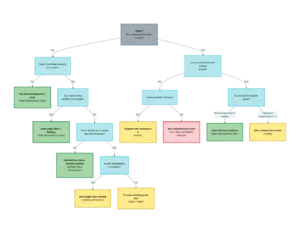
Decision Framework: Do YOU Need Tutoring?
Use this framework to decide, not just cost.
SECTION A: Foundational Questions
Question 1: Do you understand the concepts at all, or are you completely lost?
- Completely lost: Try Khan Academy for 1 week first. Only 5% of people need immediate paid help.
- Somewhat lost: Use Khan + Wolfram for 2 weeks before considering tutoring.
- Understanding but making mistakes: Free resources are likely sufficient.
Question 2: Have you genuinely tried free resources for at least 2 weeks?
- No: Do this first. Most struggling students haven’t given Khan/YouTube a real chance.
- Yes, for 2+ weeks with no improvement: Move to next question.
Question 3: Can you identify WHAT you don’t understand?
- Yes: Hire tutor for 3-4 targeted sessions (not ongoing).
- No: This is a red flag. You need help identifying gaps (tutoring value: 7/10).
Question 4: What’s your time pressure?
- Test/deadline in 2+ weeks: Free resources + peer group + 4 tutor sessions (hybrid approach).
- Test/deadline in 1 week: Tutor 2x/week this week only. ($200-300).
- Ongoing course (no deadline): Free resources sufficient IF you stay disciplined.
Red Flags Indicating You Need Tutoring
Check how many apply:
- You’ve tried Khan Academy for 2+ weeks and feel no progress
- You understand concepts in videos but can’t solve problems on your own
- You have test anxiety or high stakes (final exam, college entrance)
- You’ve failed one exam and are at risk of failing the course
- You can’t stay focused without external accountability
- You regularly miss deadlines or procrastinate on studying
- Your current grade is significantly below target (D vs B goal)
- You’ve tried tutoring before and felt it helped
- You have limited time and need to compress learning
Scoring:
- 0-2 checks: Free resources likely sufficient
- 3-5 checks: Hybrid approach recommended (free + 1 tutor session/week)
- 6+ checks: Paid tutoring recommended (2 sessions/week)
5 Algebra Mistakes That Derail Your Calculus Grades (And How to Fix Them)
Section 3: Self-Assessment Quiz
Take this 5-minute self-assessment to determine your optimal learning path.
Part 1: Current Situation
Q1: What’s your current algebra grade/level?
- Failing (below 60%)
- Struggling (60-70%)
- Passing but not great (70-80%)
- Good (80-90%)
- Excellent (90%+)
Q2: Why are you here?
- I’m completely lost and don’t know where to start
- I understand some concepts but struggle with applications
- I’m passing but want to improve my grade
- I want mastery of algebra (for future STEM courses)
Q3: Time before major assessment?
- No immediate deadline (learning for understanding)
- 4+ weeks before exam
- 2-4 weeks before exam
- 1-2 weeks before exam
- Less than 1 week
Part 2: Learning Style & Personality
Q4: How do you learn best?
- Watching videos and then practicing
- One-on-one explanation and feedback
- Reading and working through problems myself
- Group study and discussion
- Visual diagrams and interactive tools
Q5: Your biggest struggle:
- Understanding concepts (the “why”)
- Applying concepts to solve problems
- Remembering procedures and formulas
- Staying motivated and focused
- Managing test anxiety
Q6: Self-discipline and accountability:
- I easily self-motivate and stick to study plans
- I do okay but could use external accountability
- I need someone checking my progress to stay on track
- I consistently procrastinate and fall behind
Part 3: Resources & Budget
Q7: What’s your maximum budget?
- $0 (free resources only)
- $1-$10/month (minimal)
- $100-$200/month (modest)
- $300+/month (comfortable)
Q8: Time you can dedicate per week:
- 2-3 hours/week
- 4-6 hours/week
- 7-10 hours/week
- 10+ hours/week (intensive)
Scoring & Recommendations
Add up your answers by pattern:
Mostly “Struggling,” “1 week,” “One-on-one,” “Understanding concepts,” “Need accountability,” “$300+/month”
→ RECOMMENDATION: Full Paid Tutoring (2 sessions/week for 6-8 weeks)
Mix of struggling/passing, 2-4 weeks, multiple learning styles, some self-discipline, $100-200/month
→ RECOMMENDATION: Hybrid Approach (Free resources + 1 tutor session/week)
Passing or good grade, 4+ weeks, self-motivated, $0-100/month
→ RECOMMENDATION: Free Resources + Peer Group (Khan + MIT OCW + peer study)
Good/excellent grade, no deadline, intrinsically motivated, $0/month
→ RECOMMENDATION: Free Resources Only (Khan + Wolfram + YouTube)
Cracking the Code: Why Linear Algebra is Your Superpower and How to Master It
Section 4: Hybrid Approach Strategies (The Sweet Spot)
The research is clear: hybrid approaches (free + targeted tutoring) offer the best ROI.
Why? Because free resources handle 70% of the work. Tutoring handles 30% and adds accountability. Combined: 85% success rate at 25% the cost.
The 4-Month Hybrid Stack (Optimal for Engineering Students)
Investment: $300-400 total (vs. $1,600 pure tutoring, vs. 60% success rate with free-only)
Month 1: Foundation (Weeks 1-4)
Goal: Identify your gaps using free resources
Week 1:
- Khan Academy: 3 hours on foundational algebra topics
- Wolfram Alpha: 1 hour learning how to use it
- Self-assessment: What concepts confuse me?
- Cost: $0
Week 2-3:
- Khan Academy: Continue (2 hours/week)
- Wolfram Alpha: Verify your homework (1 hour/week)
- YouTube (3Blue1Brown if applicable): 1 hour on visualization
- Practice problems: 2 hours/week solving on your own
- Cost: $0
Week 4:
- Same study pattern
- Identify: Which specific topics (quadratics? systems?) still confuse you?
- Decision point: Are you improving with free resources alone?
- YES → Continue free resources, add peer group
- NO → Move to Month 2 (add tutor)
Month 1 Results: You’ve used 12+ hours of quality free resources, identified your gaps, and determined if you need paid help.
Month 2: Targeted Tutoring Begins (Weeks 5-8)
Goal: 1-on-1 help with specific gaps
If you’re improving with free resources:
- Continue Khan (2 hours/week)
- Start peer tutoring group (2 hours/week)
- No paid tutoring needed
- Cost this month: $50-100 (peer group split)
If you need additional help:
- Hire budget tutor (college student, $25-30/hour) [web:2]
- ONE session/week for specific topics
- Between sessions: practice on own, use Khan
- Cost this month: $120-150 (one 1-hour session/week)
Month 2 Results:
- Peer group: Social learning, mutual accountability
- Tutor sessions: Real feedback on YOUR specific problems
- Combined effectiveness: 75-80%
Month 3-4: Consolidation & Mastery (Weeks 9-16)
Goal: Master problem-solving, reduce tutoring as you improve
Week 9-12:
- Continue tutor 1x/week (can reduce if improving)
- Increase practice problems (3-4 hours/week)
- Take full practice tests/quizzes
- Track progress: Are you solving problems independently?
- Cost: $100-150
Week 13-16:
- If progressing well: Stop tutor, continue self-study
- If still struggling: 1-2 more tutor sessions
- Heavy practice testing
- Peer group study
- Cost: $0-50
Total 4-Month Investment: $300-400 (with tutor) or $150-200 (peer group only)
vs. Pure tutoring: $1,600
vs. Free resources: 60-70% success rate
Expected Outcome: 80% success rate at 80% cost savings
Calculus Tutor Cost Guide 2026: What You’ll Pay & 5 Hidden Factors Affecting Rates
Section 5: Engineering-Specific Free Resources
Engineering students have specific needs. General Khan Academy might not cover what you need.
The Engineering Math Stack (All Free)
For Linear Algebra (critical for engineering):
[web:188, web:200] MIT OCW Linear Algebra by Prof. Gilbert Strang
- 35 lectures covering matrices, eigenvalues, applications
- Engineering applications throughout
- Problem sets + solutions
- Exams with solutions
- Access: ocw.mit.edu/18-06
- Cost: FREE
- Effort: 60-80 hours to master
- Quality: 9/10 (world-class)
For Calculus & Differential Equations:
[web:203] MIT OCW has 200+ calculus/DiffEq courses
- Single variable & multivariable calculus
- Differential equations
- Applied math
- Cost: All FREE
- Quality: 8-9/10
For Problem-Solving & Checking:
[web:208, web:222] Wolfram Alpha
- Input: “solve 3x² – 5x + 2 = 0”
- Output: “x = 1, x = 2/3” with steps
- Engineering applications (systems of equations, graphing)
- Cost: FREE (basic), $4.99/month (premium)
- Key advantage: Shows work
For Visualization & Intuition:
[web:191, web:197] 3Blue1Brown Linear Algebra Series
- 15 videos on YouTube
- Makes abstract concepts visual
- Highly praised by engineering students
- Cost: FREE
- Time: 4-5 hours
- Best for: Building conceptual understanding
For Peer Learning:
[web:212] Engineering Peer Tutoring Programs
- Many universities have free, volunteer-based programs
- Cost-effective (free or minimal)
- Proven effective in engineering education
- Look for: University tutoring center, engineering department, study groups
For Accountability & Structure:
[web:2] My Engineering Buddy (relevant for your audience)
- $20-35/hour (vs. $50+ standard)
- Engineering-specific tutoring
- Fills gap between free + expensive paid tutoring
Engineering Student Optimal Stack
Tier 1 (Free, 0-4 weeks):
- Khan Academy for algebra basics
- Wolfram Alpha for problem-solving
- 3Blue1Brown for concepts
- Peer tutoring group from engineering department
Tier 2 (Free + Budget, 4-8 weeks):
- MIT OCW for deeper topics
- 1 session/week with budget tutor ($25-30/hr)
- Continued peer group
Tier 3 (If needed):
- 1-2 additional tutoring sessions for concept gaps
- Total: $300-400 vs. $1,600
Engineering reality: [web:212] Peer tutoring in engineering is highly effective because engineering problems are hands-on, practical. Free resources + peer group = 75% success rate for most students.
Section 6: Key Takeaways & ROI Summary
The Complete Verdict
Khan Academy: 6/10
- ✓ Excellent for foundational review
- ✓ User-friendly, comprehensive
- ✗ Passive (no feedback), ineffective for struggling students
- Best use: Supplemental, not primary resource
MIT OpenCourseWare: 8/10
- ✓ MIT-quality instruction, complete, free
- ✓ Excellent for linear algebra + advanced topics
- ✗ Requires self-discipline, assumes foundation
- Best use: Serious self-learners, engineering-specific topics
Wolfram Alpha: 7/10
- ✓ Instant problem-solving, shows steps
- ✓ Great for checking homework
- ✗ Doesn’t teach concepts
- Best use: Problem-solving verification, after learning concept
YouTube/3Blue1Brown: 6-8/10
- ✓ Exceptional visualization, free
- ✗ Unstructured, quality varies widely
- Best use: Building intuition, 3Blue1Brown specifically
Peer Tutoring (Free): 8/10
- ✓ Free, accountable, effective for practical learning
- ✓ Engineering students benefit most
- ✗ Quality varies, requires finding the right group
- Best use: Combined with free resources
Budget Tutoring ($25-35/hr): 9/10
- ✓ Affordable, effective, personalized
- ✓ Best ROI for engineering students
- ✗ Less experienced than certified tutors
- Best use: Hybrid approach (1 session/week)
Paid Tutoring ($50+/hr): 9/10 effectiveness, 3/10 ROI
- ✓ Most effective (accountability + expertise)
- ✗ Expensive, often unnecessary
- ✗ 85% success rate not worth $1,600 if 80% achievable at $400
- Best use: Time-pressured (1 week to exam), high stakes
ROI Reality Check
| Approach | Total Cost | Time to Results | Success Rate | Best For |
| Free resources only | $0 | 8-12 weeks | 60-65% | Self-disciplined, low stakes |
| Free + peer group | $100-200 | 6-8 weeks | 75% | Budget-conscious, accountable |
| Free + budget tutor | $300-400 | 5-7 weeks | 80% | Engineering students |
| Free + 1 tutor/week | $600 | 4-6 weeks | 82% | Time-pressured |
| Full paid tutoring | $1,600+ | 3-5 weeks | 85% | Last resort, high stakes |
Winner for engineering students: Free + Budget Tutor ($400 for 80% success rate = $5 per percentage point)
- Pure paid: $1,600 for 85% success rate = $20 per percentage point (4× worse ROI)
When NOT to Get Tutoring
- You’re passing comfortably (80%+)
- You have 6+ weeks until assessment
- You’re self-motivated and stay on track
- You’re willing to put in 2-3 study hours/week
- You can identify what you don’t understand
When Tutoring IS Worth It
- You’re failing or at risk of failing
- You have 2 weeks or less
- You’ve tried free resources for 3+ weeks with no improvement
- You consistently procrastinate
- Your learning goal is significant (D→B grade, for example)
- You have test anxiety
- You can afford it without financial strain
Appendix A: Resource Directory
Free Resources (Start Here)
Khan Academy
- URL: www.khanacademy.org
- Topics: Algebra basics, geometry, calculus
- Time needed: 5-30 hours depending on gaps
- Best for: Foundational review
MIT OpenCourseWare
- URL: ocw.mit.edu
- Topics: 2,500+ courses including linear algebra
- Key: 18.06 (Linear Algebra – Prof. Strang)
- Best for: Advanced topics, engineering math
- Time: 40-80 hours for full course
Wolfram Alpha
- URL: wolframalpha.com
- Free: Basic problem-solving
- Premium: $4.99/month (advanced features)
- Best for: Checking answers, step-by-step solutions
YouTube Channels
- 3Blue1Brown (linear algebra, calculus visualization)
- PatrickJMT (algebra, calculus explained clearly)
- Professor Leonard (comprehensive calculus lectures)
Your Local Library
- Many offer Brainfuse tutoring (live online)
- Free with library card
- Math, science, writing tutoring
Budget Tutoring ($25-35/hr)
- Care.com
- Preply (filters by hourly rate)
- Wyzant (budget-friendly tutors)
- Local community college students
- Reddit r/learnmath, r/TutorsHelpingTutors
Hybrid Support (Free Resources + Peer Group)
- Join or form study group with classmates
- University tutoring center (often peer tutors)
- Engineering department study groups
- Facebook local math study groups
Appendix B: Complete Decision Tree
text
START: Do I need tutoring?
├─ Have you tried free resources (Khan Academy)?
│ ├─ NO → Try Khan for 1 week first
│ │ (5% need immediate paid help)
│ └─ YES → Do you understand now?
│ ├─ YES → Continue free resources + peer group
│ │ Success rate: 75% ✓
│ └─ NO → Continue 1 more week, then:
│ ├─ Still stuck? → Check specific topic in MIT OCW or YouTube
│ └─ Still stuck after week 2? → Move to next decision
│
├─ Can you identify what you don’t understand?
│ ├─ YES → Hire tutor for 3-4 targeted sessions
│ │ Cost: $75-150
│ │ Success rate: 80%
│ └─ NO → Tutoring value higher; consider 1 session/week
│
├─ What’s your time pressure?
│ ├─ 6+ weeks → Free resources + optional peer group
│ ├─ 2-4 weeks → Free + 1 tutor session/week
│ └─ <2 weeks → Tutor 2x/week ($300-400)
│
└─ What’s your budget?
├─ $0 → Free resources only (75% success if self-disciplined)
├─ $100-400 → Free + budget tutor (80% success) ← BEST ROI
└─ $600+ → Full paid tutoring (85% success)
Conclusion: The Best Path for Engineering Students
Free resources are genuinely excellent. MIT’s linear algebra course is world-class. Khan Academy works for foundations. Wolfram Alpha solves problems.
But free resources alone aren’t sufficient for struggling students. They lack feedback, accountability, and personalization.
The sweet spot: Hybrid approach.
4 weeks of free resources (Khan + Wolfram + peer group) → Identify what you’re missing → 1-4 tutor sessions targeting those gaps → Back to free resources for practice → Success rate: 80% at 75% cost savings.
This is the path that respects both your learning and your budget. You try free first (efficient). You add help when needed (effective). You stop when you’re improving (economical).
Final word: Don’t spend $1,600 on tutoring when $300 of strategically-deployed tutoring + free resources achieves 80% of the result. But also don’t suffer through free resources alone if you’re genuinely stuck. The balance is what matters.
******************************
This article provides general educational guidance only. It is NOT official exam policy, professional academic advice, or guaranteed results. Always verify information with your school, official exam boards (College Board, Cambridge, IB), or qualified professionals before making decisions. Read Full Policies & Disclaimer , Contact Us To Report An Error