Friction of Distance and Distance Decay: A Simple Student Guide

Have you ever chosen a nearby store instead of a better store far away? Have you ever skipped an event because the travel time was too long? Have you ever preferred an online class because going in person felt difficult?
All three of those are the same geography idea wearing different clothes: friction of distance and distance decay.
These terms sound technical, but they’re simple once you see them in daily life — they explain how distance affects travel, trade, shopping, migration, culture, communication, and yes, how you get tutoring help. This guide breaks both concepts down in plain language, with the kind of examples that show up on the AP Human Geography exam.
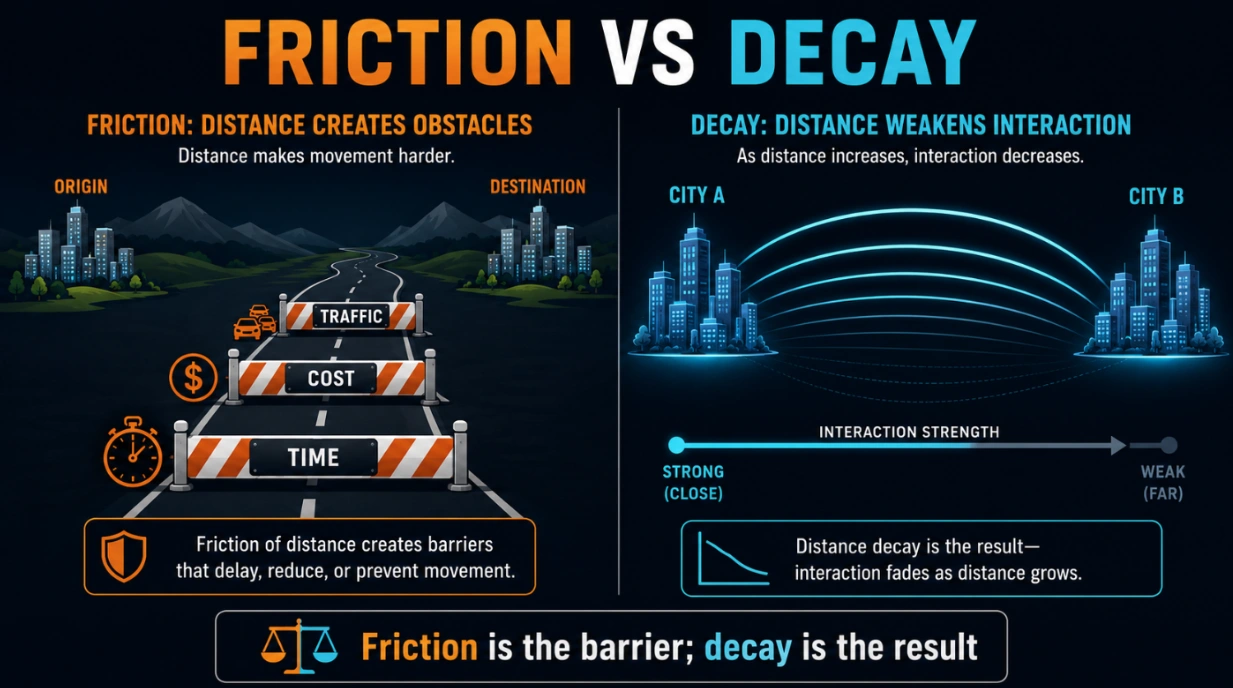
Friction of distance creates barriers, while distance decay weakens connections as places get farther apart.
Key Takeaways
- Friction of distance is the difficulty — time, cost, effort — that distance adds to movement or interaction.
- Distance decay is the result: interaction weakens as distance increases.
- Friction of distance is usually the cause; distance decay is usually the effect.
- Distance isn’t only physical miles — it includes time, cost, safety, borders, and technology access.
- Technology reduces these effects but doesn’t remove them completely.
- Both concepts are core AP Human Geography spatial-interaction vocabulary in Unit 1.
What Is Friction of Distance?
Friction of distance means that distance makes movement harder. The farther something is, the more time, money, energy, and effort it usually takes to reach it — and that difficulty is the “friction.”
Think about literal friction: when you rub your hands together, friction slows movement and creates resistance. In geography, distance creates a similar resistance between people and places.
For example, a student may want to attend a great geography tutoring center. But if the center is an hour away, the student may not go often. The distance itself is the problem — and that problem is friction of distance.
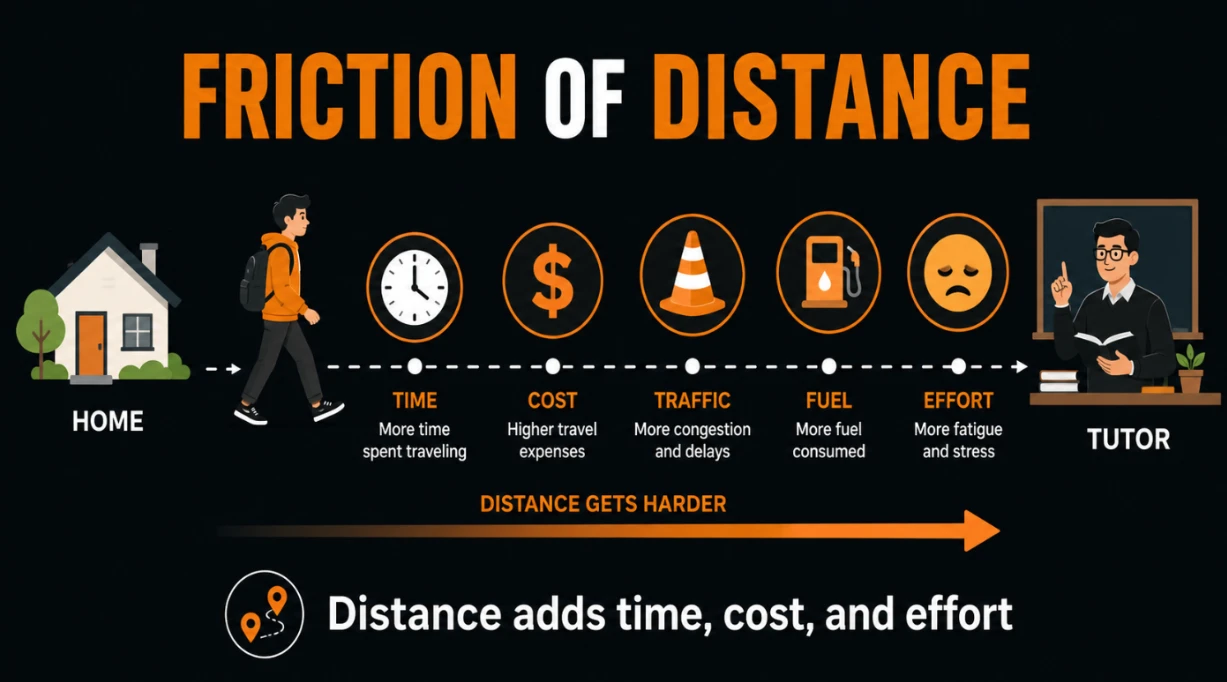
Distance adds time, cost, traffic, fuel needs, and effort, making movement harder between places.
Simple Examples of Friction of Distance
- A student avoids a library because it’s too far from home.
- A family chooses a nearby grocery store instead of a cheaper store far away.
- A company pays more to ship goods across the country.
- A patient delays seeing a doctor because the hospital is far away.
- A student chooses online tutoring because there’s no travel time.
In each case, distance adds some kind of difficulty — time, cost, traffic, fuel, tiredness, or stress. This is one reason online tutoring has become so popular — it removes the travel component of friction entirely.
What Creates Friction of Distance?
Distance isn’t only about miles or kilometers. Several things can increase friction:
- Travel time: A place may be only 10 miles away but take 45 minutes because of traffic.
- Cost: Fuel, tolls, bus tickets, train fares, or shipping fees can make distance harder.
- Physical effort: Walking, driving, or changing transport can make travel tiring.
- Weather: Rain, snow, heat, or storms can make travel more difficult.
- Safety: Some routes may feel unsafe, especially at night.
- Borders: National borders, visas, customs, and rules can slow movement.
- Technology access: Weak internet can create distance even in online learning.
So friction of distance isn’t just physical distance — it’s the total difficulty of moving or interacting across space.
What Is Distance Decay?
Distance decay means that interaction usually becomes weaker as distance increases. In simple words: people interact more with nearby places and less with faraway places.
For example, a restaurant usually gets most of its customers from nearby neighborhoods. People who live far away visit less often. As distance increases, visits decrease — that’s distance decay.
Distance decay is a foundational idea in human geography, and it’s one of the spatial concepts the College Board covers in the AP Human Geography Course and Exam Description, within the “Thinking Geographically” unit.
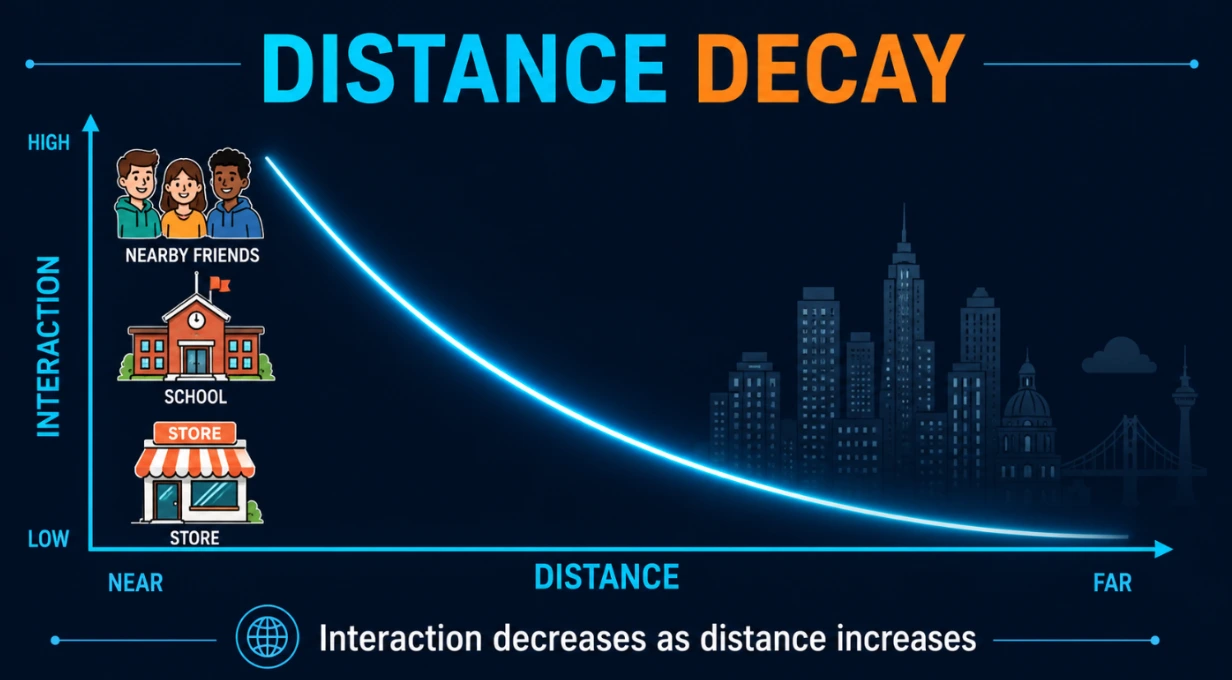
Distance decay shows that interaction is usually strongest nearby and becomes weaker as distance increases.
Simple Examples of Distance Decay
- People usually visit nearby friends more often than friends who live far away.
- A school gets most of its students from nearby areas.
- A mall attracts more shoppers from nearby neighborhoods than distant towns.
- A local news story spreads faster in the nearby region first.
- A person may call family in the same city more often than relatives overseas.
In each example, interaction becomes weaker as distance grows. Geographers describe this as the idea that places closer together are more likely to interact than places farther apart — a core piece of how relationships between places are shaped by distance, movement, and access.
Friction of Distance vs. Distance Decay
Many students confuse these two terms. They’re related, but not identical.
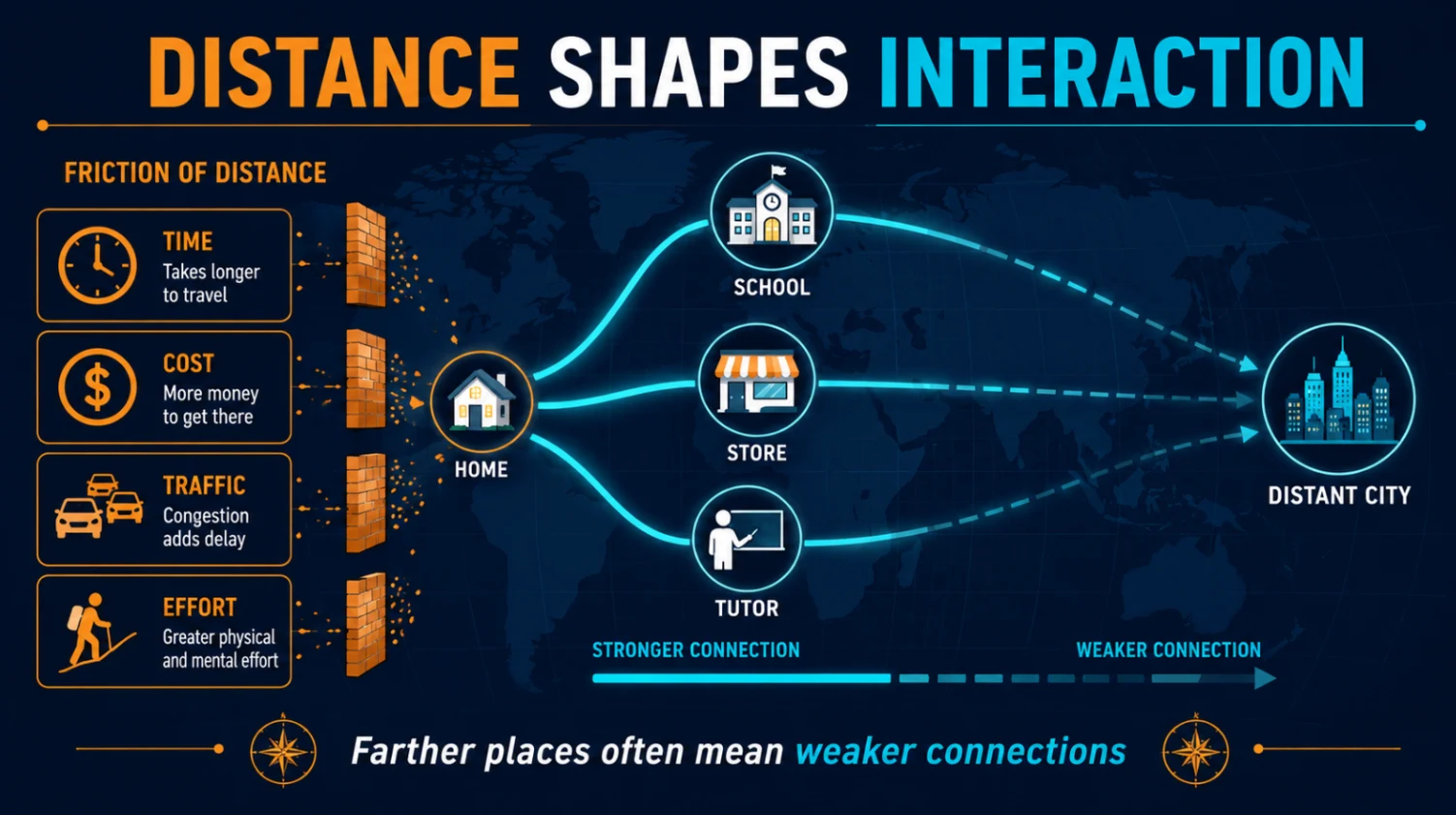
Friction of distance is the barrier that makes movement harder; distance decay is the reduced interaction that follows.
| Concept | Simple Meaning | Main Question | Example |
|---|---|---|---|
| Friction of distance | Distance makes movement harder | What makes interaction difficult? | A student avoids a tutor because travel takes one hour |
| Distance decay | Interaction decreases as distance increases | What happens when distance grows? | Fewer students attend a faraway tutoring center |
A simple way to remember it: friction of distance is the cause; distance decay is often the result.
Suppose a tutoring center is far from a student’s home. The long drive, traffic, and fuel cost are friction of distance. Because of that, the student attends less often — that reduced interaction is distance decay.
Why Distance Still Matters in a Digital World
Some people think distance no longer matters because of the internet, video calls, online classes, e-commerce, and social media. Technology does reduce the effect of distance — but it doesn’t remove it completely.
Online learning cuts travel time, but students still need good internet, a quiet place to study, a workable time zone, and clear communication. Online shopping cuts the need to visit a store, but delivery time and shipping cost still matter. This is exactly why online tutoring has grown so quickly — it doesn’t eliminate friction, it just lowers it dramatically.
Distance decay still exists in the modern world. It’s weaker than it used to be, but it doesn’t disappear.
Friction of Distance in Education
Education is one of the clearest examples of friction of distance.
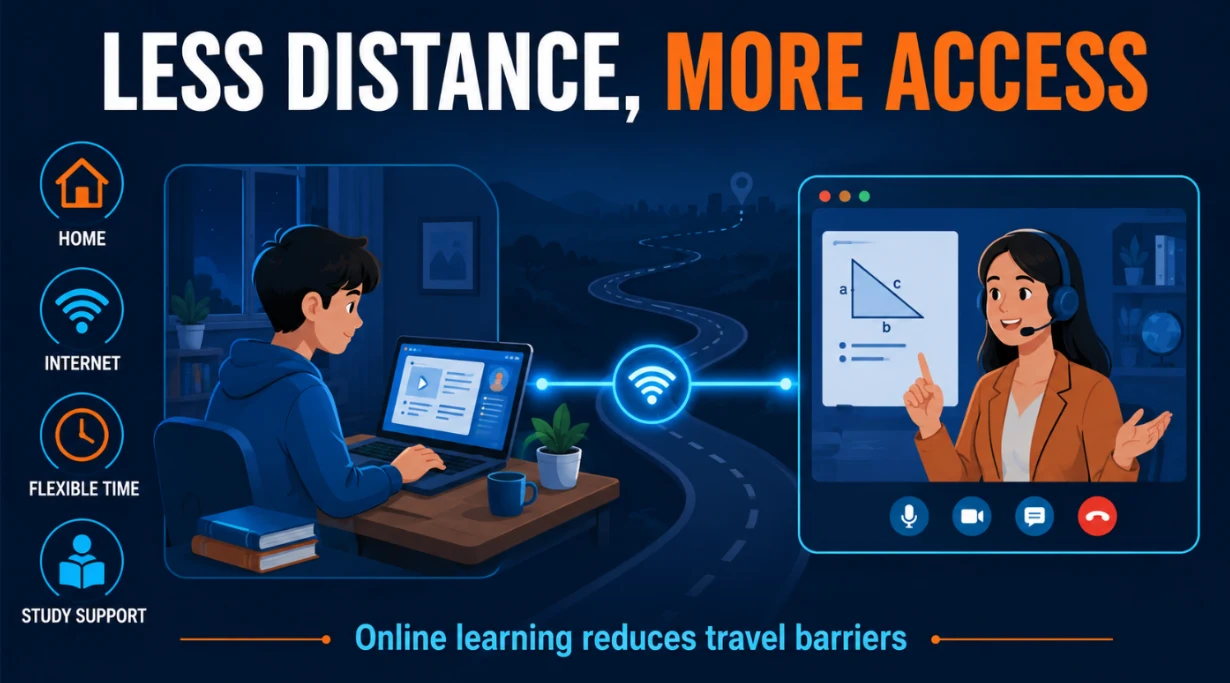
Online learning reduces friction of distance by helping students access tutors without travel barriers.
Education is one of the clearest examples of friction of distance. A student may need help in math, physics, engineering, economics, or geography — but if the tutor is far away, the student may not get regular support. Travel time becomes a barrier.
This is where online tutoring reduces friction directly. A student doesn’t need to travel to another city, or even another neighborhood, to meet a Human Geography tutor — they can connect online and save the time that friction would otherwise cost them. For a broader look at how this plays out specifically for geography students, see Mastering Geography with Tutoring: A Guide for Students. The same principle applies to other forms of academic support available online. Students who need help with written assignments can turn to services such as Speedypaper.com, regardless of whether similar assistance is available nearby. In this way, digital academic services provide another example of how technology can reduce the friction created by physical distance.
Friction of Distance in Business
Businesses deal with friction of distance constantly. A shop near a busy neighborhood gets more customers because it’s easy to reach. A shop far away needs better prices, better service, or delivery to compete.
Shipping is another example. Sending a package across town is usually easier than sending it across the country — longer distance can mean higher cost, longer delivery time, and more chances of delay. This is why companies place warehouses near highways, ports, airports, or large cities: to reduce friction of distance. It’s a core theme in economic geography, which studies exactly this kind of location decision-making.
Distance Decay in Cities
Distance decay helps explain how people use cities. People visit places that are close, convenient, and easy to reach. A neighborhood park gets more visitors from nearby homes. A local restaurant gets more customers from nearby streets. A school usually serves students from nearby areas.
As distance increases, visits often decrease. City planners use this idea when planning roads, bus stops, train stations, parks, hospitals, and schools — good planning reduces friction and makes important services easier to reach.
Distance Decay in Migration
Migration shows distance decay clearly. People often move to places where they already have connections — family, friends, jobs, language, culture, or community support. A person is more likely to move to a nearby city than to a country on the other side of the world, since farther destinations usually mean higher cost, risk, and uncertainty.
That said, distance decay can weaken when strong pull factors exist — a person may move far away for a better job, college, safety, or family reunification. This push-pull dynamic is a major topic within population geography.
Distance Decay in Culture and Communication
Ideas, languages, food habits, clothing styles, and traditions spread from one place to another. Nearby places usually share more cultural features because people interact more often — neighboring regions may share similar foods, festivals, words, or music because people travel, trade, marry, study, and communicate across nearby areas. This is a central idea in cultural geography.
Social media can spread culture faster across long distances — a song, video, or trend can go global quickly. Still, language, internet access, local interest, and time zones affect how far and how fast ideas actually spread.
Classroom Example: Tutoring and Distance
Imagine four students need help with geography:
- Student A lives 5 minutes from the tutor.
- Student B lives 20 minutes from the tutor.
- Student C lives 1 hour from the tutor.
- Student D lives in another country.
Student A can attend easily. Student B may still attend. Student C may attend less often because travel is tiring. Student D probably can’t attend in person at all.
The travel time, cost, and effort here are friction of distance. The lower chance of attending regularly as distance increases is distance decay. If all four students can meet the tutor online instead, friction drops sharply for everyone — which is exactly why online AP Human Geography tutoring can reach students regardless of where they live.
Common Mistakes Students Make
- Thinking both terms mean the same thing. They’re connected but not identical — friction of distance is the difficulty created by distance; distance decay is the decrease in interaction as distance increases.
- Thinking distance only means physical distance. Distance can also mean time, cost, effort, language barriers, internet access, safety, or rules.
- Thinking technology removes distance completely. Technology reduces distance problems, but it doesn’t remove all barriers.
- Forgetting scale. These concepts apply at many scales — inside a city, between states, between countries, or across the world.
Quick Practice Questions
- A student chooses a nearby library because the far library takes too long to reach. Which concept is this?
- A restaurant gets most customers from nearby homes. Which concept is this?
- A company charges more to ship goods across the country. Which concept is this?
- A person talks more often to nearby friends than friends overseas. Which concept is this?
- Online tutoring allows students to learn without traveling. Which concept is being reduced?
Answers: 1. Friction of distance 2. Distance decay 3. Friction of distance 4. Distance decay 5. Friction of distance
For more practice on this exact concept, see APScore5’s Distance Decay practice questions and evaluate how confident you are on the topic.
Conclusion
Friction of distance and distance decay are simple but powerful geography ideas. They explain why people choose nearby places, why businesses care about location, why students often prefer online tutoring, and why interaction weakens as distance grows.
The core idea is easy to remember: distance creates difficulty, and difficulty usually reduces interaction. Once you understand this, you can apply it across transportation, migration, business, education, city planning, and — directly — your AP Human Geography coursework.
Frequently Asked Questions
What is the difference between friction of distance and distance decay?
Friction of distance is the difficulty — time, cost, or effort — that distance adds to movement. Distance decay is the outcome of that difficulty: interaction between places weakening as distance increases. Friction of distance is usually the cause; distance decay is usually the effect.
Is distance decay only about physical distance?
No. Distance can be measured in time, cost, effort, safety, language barriers, or even internet access — not just miles or kilometers. Two places that are physically close but hard to reach because of traffic or poor infrastructure can still show strong distance decay.
Does the internet eliminate distance decay?
It reduces it significantly but doesn’t eliminate it. Online interaction still depends on internet access, time zones, and language — so distance decay becomes weaker in a digital world, not absent.
Where does distance decay appear on the AP Human Geography exam?
Distance decay is introduced in Unit 1 (Thinking Geographically) as part of spatial interaction, and it reappears across later units — migration, cultural diffusion, and trade — since the same underlying principle applies throughout the course.
Related Reading
- Mastering Geography with Tutoring: A Guide for Students
- Mathematics Tutoring Online and In-Person: A Guide for Students and Parents
- Top 6 Reasons Why Online Tutoring Is So Popular
This article provides general educational guidance only. It is NOT official exam policy, professional academic advice, or guaranteed results. Always verify information with your school, official exam boards (College Board, Cambridge, IB), or qualified professionals before making decisions. Read Full Policies & Disclaimer, Contact Us To Report An Error.
Guest Contribution
******************************
This article provides general educational guidance only. It is NOT official exam policy, professional academic advice, or guaranteed results. Always verify information with your school, official exam boards (College Board, Cambridge, IB), or qualified professionals before making decisions. Read Full Policies & Disclaimer , Contact Us To Report An Error