Mathematics Tutoring Online and In-Person: A Complete Student Guide

- Personalized math tutoring can add 3–15 extra months of learning progress.
- Online tutoring offers 24/7 flexibility, virtual whiteboards, and global tutor access.
- Tutors cover everything from grade-school arithmetic to advanced differential equations.
- UAE students use math tutors at an 83% rate, far above the US at 10%.
- High-quality tutoring can move a student from the 50th to the 66th percentile.
Personalized mathematics tutoring (online or in-person) helps students turn confusion into confidence by tackling everything from algebra to calculus. Even short-term tutoring can add several months of learning to a student’s understanding and grades.
Why Students Seek Math Tutoring
Many high school and college students find mathematics challenging, often needing extra help beyond the classroom. A good mathematics tutor provides personalized guidance, tailoring lessons to a student’s pace and learning style. Unlike one-size-fits-all classroom teaching, individual tutoring ensures that if a topic like calculus or geometry seems hard, it can be broken down into steps that make sense.
Tutors (often former mathematics teachers or top students themselves) are trained to explain concepts clearly and to identify exactly where a student is stuck. This supportive one-on-one approach often turns frustration into understanding. The rest of this article explores how math tutoring helps students of all levels improve and regain confidence.
To better understand the immediate impact of personalized instruction, let’s look at the four core pillars of student success.

Discover how personalized math tutoring transforms frustration into understanding and measurable academic gains.
As shown above, the combination of confidence building and personalized pacing creates a cycle of improvement that extends far beyond just better grades.
Benefits of Mathematics Tutoring
Research and experience show many clear advantages. Students working with an A-Level Mathematics tutor or any qualified math instructor benefit across several dimensions:
- Personalized Learning: A tutor can give each student the full attention they need, adapting the lesson to focus on specific problem areas (whether it’s fractions, trigonometry, or advanced calculus).
- Improved Understanding: Tutors often explain concepts differently than classroom teachers did, helping students find the explanation that clicks. For example, using visual aids or step-by-step breakdowns can make complex topics clear.
- Homework and Assignment Guidance: Tutors provide one-on-one mathematics homework guidance and assignment support, ensuring students fully understand each solution rather than just copying answers.
- Confidence and Motivation: Over time, solving problems correctly builds confidence. Students report that hands-on tutoring makes math feel less intimidating, which in turn keeps them engaged.
- Documented Gains: Studies show that tutoring can significantly boost math learning. For example, one large study found tutoring programs added about two-thirds of a year’s worth of math progress, and high-impact math tutoring can yield 3–15 extra months of learning.
- Regular Practice: Consistent tutoring (often 2–3 times per week) provides more practice on tough concepts. This frequent practice, especially when a student meets the same tutor each time, has been linked to big score gains.
For students who also struggle with data-heavy coursework, understanding how to approach statistical thinking is equally important. This guide on finding a great online statistics tutor and mastering statistical thinking covers that ground in detail.
How Online Math Tutoring Works
Mathematics tutoring online brings all these benefits via the internet. Here’s what makes it effective:
- Flexibility and Convenience: Students can meet a mathematics tutor online from home at times that fit busy schedules (even evenings or weekends). No commute is needed, and often online tutoring costs less than in-person rates.
- Wide Selection of Tutors: Online platforms offer tutors from many backgrounds. This means you can find a tutor for almost any math topic (even niche subjects like differential equations or number theory) who understands your curriculum.
- Interactive Tools: Online tutoring often includes virtual whiteboards, chat, and file sharing. Tutors can write equations and diagrams in real time, mimicking face-to-face teaching. Many use tablets or software (e.g. GeoGebra) for dynamic graphs and models.
- Immediate Feedback: During a live session, students get instant corrections and answers. This builds skills faster than struggling alone. Tutors can also assign practice problems to reinforce learning after the session.
- 24/7 Availability: Math homework help is just a click away at any hour. For example, a student in the Gulf region might connect with a tutor late at night if needed, or a student in the U.S. can get help on a weekend deadline.
Deciding between these two formats can be difficult. The comparison table below breaks down the key differences in cost, flexibility, and tools to help you choose.

Compare the key differences between online and in-person tutoring to decide which format fits your schedule and budget best.
While in-person tutoring offers physical presence, the digital tools and 24/7 flexibility of online tutoring often make it the more practical choice for busy engineering students.
Engineering students in particular face a steep mathematical curve. The engineering mathematics survival kit and AI-assisted learning strategies resource offers practical techniques for managing that workload.
What Topics Can Math Tutors Cover?
Mathematics tutors are prepared to help with virtually any math subject. Whether a student needs help with basic arithmetic or advanced theory, there is likely an expert available. Common subjects include:
Grade and High School Math
- 6th Grade Math
- 7th Grade Math
- 8th Grade Math
- 9th Grade Math
- 10th Grade Math
- Pre-Algebra
- Algebra 1 & Algebra 2
- Geometry & Trigonometry
- Pre-Calculus
- Statistics & Probability
College and Advanced Math
- College Algebra
- Advanced College Math
- Calculus (Single & Multivariable)
- Differential Equations
- Linear Algebra
- Real Analysis & Complex Analysis
- Discrete Mathematics
- Abstract & Modern Algebra
- Number Theory & Combinatorics
- Graph Theory & Topology
- Probability & Statistics (Advanced)
- Numerical Analysis
- Logic and Reasoning (Propositional/Predicate)
Students tackling differential equations at the college level will find dedicated support through an online differential equations tutor who can work through problem sets step by step.
Specialized Topics and Tools
- Engineering Mathematics
- Mathematical Methods (Fourier/Harmonic Analysis, Laplace/Wavelet Transforms)
- Tensor Analysis
- Permutations & Combinations
- Mathematics Software (Maple, Mathcad, SageMath, SciPy, SymPy, gnuplot, etc.)
- Quantitative Reasoning and Advanced Problem Solving
The scope of mathematics is vast. We structure our tutoring expertise hierarchically, ensuring support from foundational school concepts all the way to complex engineering analysis.
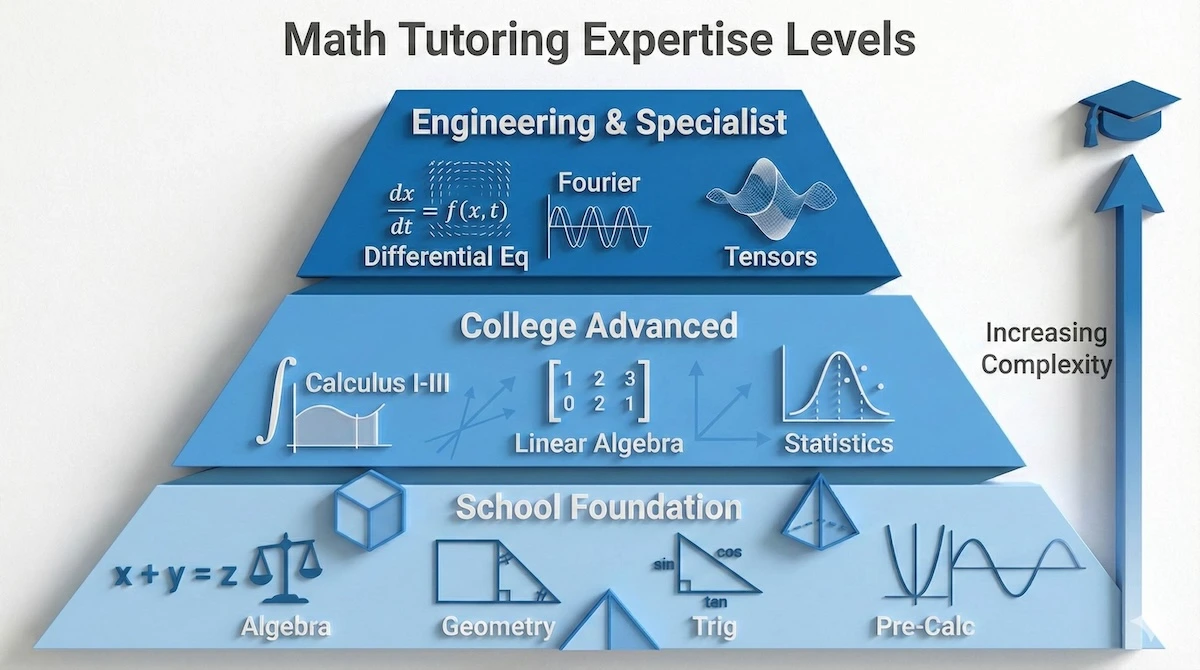
From basic Algebra to advanced Engineering Mathematics, expert tutors cover the full spectrum of mathematical complexity.
Whether you are building a foundation at the base of the pyramid or tackling specialized topics at the peak, expert guidance ensures you master every level.
Probability and statistics sit at the intersection of many math disciplines. This guide to choosing the right probability distribution for engineers is a useful companion resource for students working through those topics.
Students who also need support in quantitative research methods may benefit from working with a psychological statistics tutor, particularly when coursework bridges math and behavioral science.
Mathematics Tutoring in the USA, UK, and Gulf Regions
The demand for math tutors is strong around the globe. In the UK, about 27% of students ages 11–16 had private math tutoring by 2019 (up from 20% a decade earlier). In the Gulf region, rates are even higher — surveys show roughly 83% of students in the UAE use math tutors, reflecting a strong emphasis on STEM education.
In the US, only about 10% of students receive private tutoring, but interest is rising as more families seek support (the U.S. online tutoring market was $4.3B in 2024). Whether in London or Dubai, students can find math tutoring services tailored to their curricula and needs.
Educational trends vary significantly by region. The chart below illustrates the stark difference in private tutoring adoption rates across major global markets.
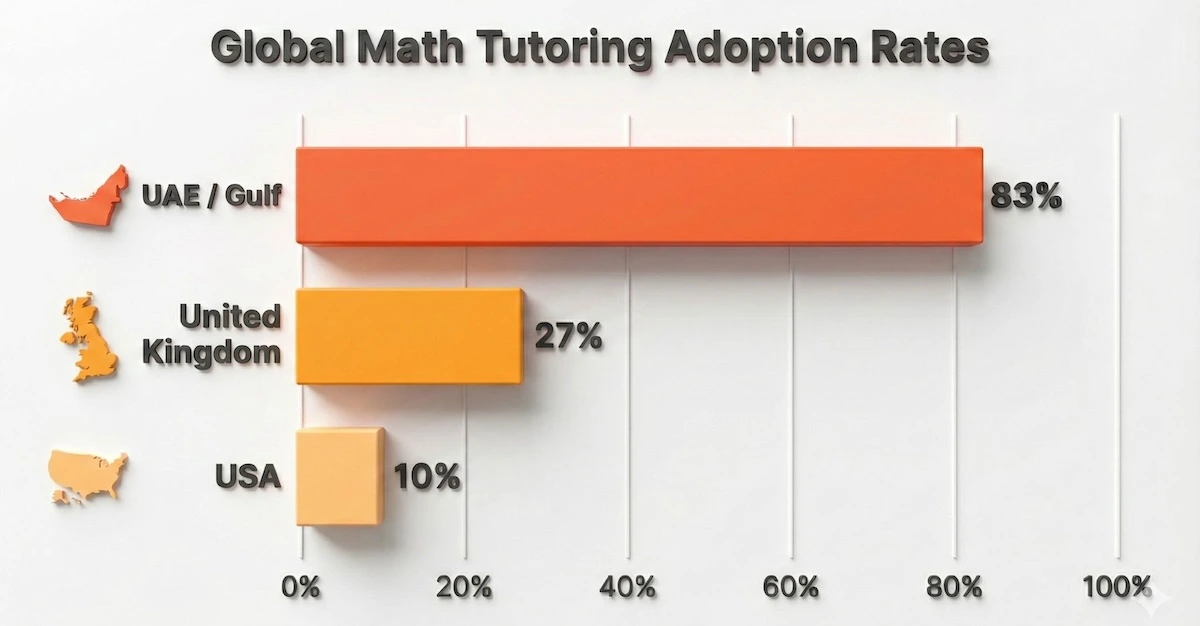
Data shows high adoption of math tutoring in the Gulf region compared to the UK and USA, reflecting a global focus on STEM education.
The exceptionally high adoption rate in the Gulf region reflects a cultural emphasis on competitive STEM education, a trend that is steadily growing in Western nations as well.
For students working through hypothesis-driven coursework alongside their math studies, this step-by-step walkthrough on how to solve hypothesis testing provides a clear methodological framework.
Choosing and Hiring a Math Tutor
Finding the right math tutor means considering several factors:
- Subject Expertise: Match the tutor’s skills to your needs. Need test prep? Find a tutor specialized in that exam or course. For calculus or statistics help, look for someone who has studied or taught those subjects.
- Qualifications: Many tutors are certified mathematics teachers or hold math degrees. Verify credentials if you can. An effective tutor should communicate clearly and adapt to your learning style.
- Format (Online or In-Person): Decide what works for you. Online tutoring lets you hire a mathematics tutor online quickly, with flexible hours. In-person tutoring may offer more personal interaction but depends on location.
- Schedule & Budget: Plan how often you’ll meet. Many students start with 1–2 sessions per week. Tutoring fees vary by experience and region; in the U.S., many tutors charge roughly $30–60 per hour, though some charge around $20–40 depending on qualifications.
- Trial Session: If possible, try a lesson first. Many online platforms let you switch tutors if needed. A short trial can help you gauge whether a tutor’s style is the right fit.
Students who need support in quantitative methods beyond standard math may also find value in working with an operations research tutor for optimization and decision-modeling coursework.
Ready to find the perfect tutor? Follow this simple 5-step roadmap to ensure you hire a qualified educator who meets your specific academic needs.

Follow this simple 5-step process to find a qualified math tutor who matches your specific learning needs and budget.
By systematically verifying credentials and booking a trial session first, you eliminate the risk and ensure a productive long-term learning relationship.
Final Thoughts
Mathematics tutoring can transform a student’s experience with math. By providing personalized teaching and focused practice, tutors help close knowledge gaps and make math less intimidating. The evidence is clear: students who get regular tutoring often make far larger gains than those who study alone.
For example, one report found that high-quality math tutoring moved the average student from the 50th percentile to the 66th percentile in math achievement. If you or your child is struggling with math — whether in the USA, UK, Gulf, or elsewhere — don’t hesitate to seek help. With a knowledgeable math tutor by your side, challenging topics become manageable and confidence grows.
FAQs About Mathematics Tutoring
What is mathematics tutoring?
Mathematics tutoring is individualized instruction (online or in person) that helps a student understand math concepts and improve problem-solving skills.
Can an online math tutor help with homework?
Yes, an online mathematics tutor can work through homework problems with you step by step, providing instant feedback and guidance.
Which math topics can a math tutor cover?
Math tutors can cover everything from elementary and high school math (algebra, geometry, trigonometry) to advanced subjects (calculus, linear algebra, statistics, and more).
How do I hire a math tutor?
You can hire a mathematics tutor online through tutoring websites or local services; look for an experienced tutor with good reviews and expertise in the topic you need help with.
What does math tutoring cost?
Tutoring rates vary by region and experience, but many tutors charge around $25–60 per hour; rates often depend on subject complexity and tutor credentials.
When should a student start math tutoring?
Students often begin tutoring at the first sign of difficulty or before important tests; even a few sessions early on can build confidence and prevent falling behind.
Related Reading
******************************
This article provides general educational guidance only. It is NOT official exam policy, professional academic advice, or guaranteed results. Always verify information with your school, official exam boards (College Board, Cambridge, IB), or qualified professionals before making decisions. Read Full Policies & Disclaimer , Contact Us To Report An Error