
How to Get 2x More Value from Every Tutoring Hour (2026)

You’re paying $50/hour for tutoring. That’s $400/month for 8 hours. Over a semester, that’s $2,400.
Here’s the reality: Most students get 40-50% of that value.
Why? Not because tutors are bad. Because most students walk in unprepared, waste 10-15 minutes on logistics, ask vague questions, don’t record anything, and forget half of what they learned by the next day.
This guide shows you exactly how to flip that: Get 2x the value from the same tutoring sessions without spending more money.
The research is clear. Students who prepare properly, ask strategic questions, record sessions effectively, and track ROI get 80-90% value from tutoring. Unprepared students get 40-50%.
That’s not a tutoring quality problem. That’s a student preparation problem. And it’s 100% fixable.
Also Read: 10 Best Online Tutoring Websites for All Grades
Section 1: Pre-Session Prep Checklist (The 20-Minute Setup)

Why Preparation Matters
Research shows structured preparation increases tutoring effectiveness by 80-125%.[web:230, web:232, web:243]
Students who complete this 20-minute prep get roughly 2x more value per dollar spent.
The Pre-Session Checklist
Do this BEFORE every tutoring session. Total time: 20 minutes.
Part 1: Identify Your Goals (5 minutes)
- Write down 3 specific topics/problems you need help with
- Not: “I need help with algebra”
- Yes: “I don’t understand solving quadratics with the quadratic formula” + “I’m making sign errors on Problem Set 3, Questions 5-7” + “I want to understand WHY the formula works, not just memorize it”
- Define what success looks like for this session
- Can solve 3 similar problems on my own after? ✓
- Understand the concept conceptually? ✓
- Get homework done? ✓
- Improve grade from D to C? ✓
- Assess your current understanding (1-10 scale)
- 1 = completely lost
- 5 = kind of get it
- 10 = could teach it
- Why important: Tutor knows where to start
Part 2: Complete What You Can (10 minutes)
- Do your homework BEFORE the session
- Complete every problem you CAN solve
- Mark 2-3 problems you’re stuck on
- This is critical: You waste tutor time (and money) having them watch you work through easy problems
- Instead: Let tutor focus on what you genuinely can’t do
- Organize your materials
- Gather homework, textbook, previous tests, class notes
- Find the exact page/problem numbers
- Know what your teacher expects (format, style, etc.)
- Tutor can align with teacher’s expectations
- Identify knowledge gaps
- “I don’t understand this concept from last week”
- “I’m making this specific type of error”
- “I don’t know how to start this type of problem”
- Precision helps tutor target effectively
Part 3: Prepare Questions (3 minutes)
- Write down your questions
- Not: “Can you help me with this?”
- Yes: “I get that we use the quadratic formula here, but why can’t we factor instead?”
- Specific questions = targeted help
- Prioritize your questions
- If time runs out, which 3 are most important?
- Put them first
- Prepare learning style note for tutor
- “I learn best with step-by-step examples”
- “Please show me the why, not just the how”
- “Use lots of diagrams”
Part 4: Set Up Your Space (2 minutes)
- Eliminate distractions
- Quiet location
- Phone on silent
- Relevant materials only
- Water/comfort items nearby
- Set up recording (if tutor agrees)
- Phone on record, or
- Screen recording software ready
- Test it works before tutor joins
Expected Outcome from Prep
Students who complete this 20-minute prep report:
- 80% of session spent on actual problem-solving (vs. 45% for unprepared)
- 70% knowledge retention (vs. 35% unprepared)
- 2.25x overall value multiplier [web:243]
Cost of prep: 20 minutes of your time
Value return: 2.25x multiplier = Like getting ~$1,125 worth of value instead of $500 from a $500 session
Online Tutoring: A Complete Guide to Success and Growth
Section 2: Session Structure & Questions Format
Optimal 60-Minute Session Structure
Don’t just show up and hope. Structure matters.
Minutes 0-5: Warm-Up & Goal Setting
- Tutor: “What do you remember from last session?”
- Quick quiz or recap of relevant prior knowledge
- You: State your 3 goals for today
- Tutor: Confirms or refines goals
- Your role: Be clear, specific, engaged
Minutes 5-25: Concept Introduction (20 minutes)
- Tutor explains new concepts with examples
- You: Take notes, ask clarifying questions
- Tutor provides 2-3 worked examples
- Your role: Listen actively, pause tutor if confused IMMEDIATELY (don’t let it build)
Minutes 25-40: Guided Practice (15 minutes)
- You work a problem while tutor watches
- Tutor coaches: “What’s your first step?”
- You attempt, tutor provides corrective feedback
- Repeat with 2-3 problems of increasing difficulty
- Your role: Actually try, ask strategic questions, apply feedback
Minutes 40-50: Independent Practice (10 minutes)
- You work a problem alone
- Tutor watches, doesn’t coach
- You show work, tutor checks
- Your role: Demonstrate your actual understanding (no help)
Minutes 50-55: Reflection & Teaching Back (5 minutes)
- You teach the concept back to tutor in 1 minute
- Tutor asks: “What was the key insight?”
- You answer in your own words
- Your role: Articulate understanding; this cements learning
Minutes 55-60: Homework & Next Session (5 minutes)
- Tutor assigns homework (5-10 practice problems)
- Preview next session’s topic
- Confirm time/details
- Your role: Write down homework, understand expectations
Strategic Questions to Ask Tutor
Question Type 1: Clarifying Questions (When confused)
- “Can you explain that a different way?”
- “What does [this term] mean in plain English?”
- “Can you show me another example?”
- Why: Addresses confusion immediately, saves time later
Question Type 2: Why/Concept Questions (For deeper understanding)
- “Why does this method work?” (vs. just HOW to do it)
- “When would you use this vs. that method?”
- “What’s the real-world application here?”
- Why: Builds understanding vs. memorization; sticks longer
Question Type 3: Application Questions (For transferability)
- “Would this approach work for [different problem]?”
- “How is this related to [previous concept]?”
- “What if [change one variable]—does method still work?”
- Why: Helps you apply to new problems, not just repeat
Question Type 4: Self-Assessment Questions (To check your understanding)
- “Can I try this one alone while you watch?”
- “How would you rate my understanding (1-10)?”
- “What’s the one thing I should focus on practicing?”
- Why: Honest feedback on whether you’re actually learning
Questions NOT to Ask (Time Wasters)
- “Can you just tell me the answer?” (They won’t; defeats purpose)
- “Will this be on the test?” (Usually; focus on learning)
- “Can we just do the homework?” (Wastes tutoring on work-completion)
- “I don’t understand.” (Too vague; pinpoint what you don’t understand)
Better: “I understand steps 1-3, but step 4 doesn’t make sense. Why do we subtract here instead of add?”
10 Best Online Tutoring Websites for All Grades
Section 3: Session Recording & Note-Taking Strategy
Recording sessions isn’t cheating—it’s essential. Most students forget 50-70% of what they learn within 24 hours without review.[web:247, web:251, web:253]
Recording Setup (Ask Permission First)
Option 1: Audio Only
- Press record on your phone voice recorder
- Ask tutor: “Can I record the audio for my review?”
- Most say yes
- Post-session: Use Otter.ai to transcribe ($15/month or free limited)
- Benefits: Search for specific concepts, reference exact explanations
Option 2: Screen Recording (Online Tutoring)
- Use built-in recording (Zoom, Google Meet, Preply)
- Ask tutor’s permission
- Benefits: See tutor’s written work, see exactly what they drew/wrote
Option 3: Hybrid (Best)
- Video record the session
- Also take audio recording
- Post-session: Transcribe audio, reference video for visuals
- Benefits: Searchable text + visual reference
Note-Taking During Session
Bad approach: Try to write everything. You’ll miss explanation and get incomplete notes.
Good approach: [web:261]
- Listen actively during session (minimal notes)
- Write down only:
- Key terms/formulas
- Problem steps
- Timestamps (“min 15:30 – quadratic formula explained”)
- YOUR mistakes for later review
- Questions that arise
Post-Session Review (Do This Same Day)
Time investment: 15-20 minutes
Value return: 50-75% better retention [web:247]
Step 1: Within 2 hours
- Review your live notes
- Add missing details from memory
- Listen to/watch recording for parts you missed
- Highlight key concepts
Step 2: Next day
- Review transcript (if transcribed)
- Look up any unclear terms
- Work 2-3 practice problems using the methods
- Test your understanding: Can you explain it without notes?
Step 3: Before next session
- Skim your notes + transcript for 5 minutes
- Refresh memory of what you learned
- This continuity multiplies learning across sessions
Tools that help: [web:251, web:253]
- Otter.ai (transcription, $15/month)
- OneNote (free, syncs across devices, good for organizing)
- GoodNotes (iPad, $8, excellent for handwritten notes + audio)
- Notion (free, can organize all session notes in searchable database)
Why Online Tutoring Is Your Secret Weapon for Success in 2025
Section 4: Hidden Costs of Cheap Tutoring (The $15/hr Problem)
You found a tutor for $15/hour. That’s great deal, right?
Not necessarily.
The Math of Cheap Tutoring
Scenario A: $15/hour tutor
- 16 hours over 4 months = $240 total
- Student success rate = 40% (novice tutor, less experience)
- Actual value per dollar = $240 / 40% = $600 spent for “success equivalent”
Scenario B: $50/hour tutor
- 16 hours over 4 months = $800 total
- Student success rate = 85% (experienced tutor, proven methods)
- Actual value per dollar = $800 / 85% = $941 spent for “success equivalent”
Hidden costs of cheap tutoring:
- Need retutoring for concepts not learned → $200+ extra
- Wasted time on poorly-explained concepts → your time worth money too
- Lower confidence from weak instruction → affects performance
- Higher no-show rates → 20% vs. 3% for premium tutors
When Cheap IS Okay
Cheap tutoring works if:
- You’re self-disciplined (you’ll do the prep work and post-session review)
- Topic is simple (algebra basics, not advanced calculus)
- Goal is supplemental (homework help, not test prep)
- You can identify tutor quality early (trial session confirms they’re good)
When You Should Pay More
Pay for experienced tutor ($50+) if:
- You’re failing/at risk of failing (stakes are high)
- Topic is complex (calculus, chemistry, physics)
- Goal is major test (college entrance, certification)
- You have limited time (need faster results)
- You struggle with self-discipline (need accountability)
ROI Calculation: If tutoring prevents you from failing (retake = $2,000 tuition), then even $800 tutoring is a 250% ROI.
Section 5: ROI Calculation Framework
How do you know if tutoring was worth it?
Use this framework.
ROI Formula for Student Tutoring
ROI (%) = (Financial Benefit – Tutoring Cost) / Tutoring Cost × 100
Types of Financial Benefits
Type 1: Grade Improvement (Quantifiable)
- Pre-tutoring grade: D (0.9 GPA in course)
- Post-tutoring grade: B (3.0 GPA in course)
- GPA improvement: 2.1 points
- Lifetime earning impact of 0.5 GPA point: ~$10,000-20,000
- 2.1 × $15,000 = $31,500 lifetime benefit
Type 2: Test Score Improvement (Highly Quantifiable)
- Pre-tutoring SAT Math: 1100
- Post-tutoring SAT Math: 1250
- Score improvement: 150 points
- College scholarship difference: $20,000-50,000/year
- 4-year impact: $80,000-200,000
- ROI on $800 tutoring: 10,000%+
Type 3: Failing to Passing (Critical)
- Tutoring cost: $600
- Prevents failing course (would require $2,000 retake + lost semester)
- Direct savings: $2,000
- ROI: $2,000 / $600 = 233%
Type 4: Time Saved (Valuable but harder to quantify)
- Without tutoring: 8 hours struggling to understand one concept
- With tutoring: 1 hour with tutor, concept understood
- Time saved: 7 hours = $7 × student wage ($10/hr) = $70
- Across semester: 20+ such situations = $1,400+ value
- ROI: $1,400 / $800 = 75%
Calculate YOUR ROI
Step 1: Measure pre-tutoring baseline
- Current grade: ___
- Test score: ___
- Confidence level (1-10): ___
Step 2: Measure post-tutoring outcome (after 4-8 weeks)
- New grade: ___
- New test score: ___
- New confidence level: ___
Step 3: Assign financial value
- Grade improvement of 1 point: ~$10,000-25,000 lifetime
- Test score improvement of 100 points: ~$20,000-50,000 scholarship value
- Time saved per week: your wage × hours saved
- Confidence improvement: intangible but real (reduces future costs)
Step 4: Apply formula
ROI = (Financial Benefit – $800) / $800 × 100 = ___
Example:
- Tutoring cost: $800
- Grade improvement D→B: $25,000 lifetime
- ROI: ($25,000 – $800) / $800 × 100 = 3,025%
If ROI > 100%, tutoring was worth it. If > 500%, it was excellent.
Wyzant vs. My Engineering Buddy: Which Online Tutoring Platform Is Best for You?
Section 6: Pricing Models Comparison (Hourly vs Package vs Subscription)
Choosing the right pricing model changes both your costs AND your results.
Model 1: Pay-Per-Hour ($50-80/hour)
How it works: Pay $50 per session, no commitment
Cost for 16 hours: $800
Pros:
- Maximum flexibility
- Try before committing
- Can stop anytime
Cons:
- Most expensive per hour
- Higher no-show rates (15%)
- Weaker tutor-student relationship
- Tutor has less incentive to invest
Best for:
- One-time questions
- Trial sessions
- Flexibility is more important than savings
Student success rate: 70% (lower commitment = less consistency)
Model 2: Package Pricing (10 sessions, 15% discount)
How it works:
- Tutor rate: $70/hour
- Normal cost: $700 for 10 hours
- Package deal: $595 (15% discount)
- You save: $105
Cost for 16 hours (10 + 6 individual): $650
Pros:
- 15-20% cost savings
- More commitment from both sides
- Lower no-show rate (8%)
- Good for defined goals (test prep, exam)
Cons:
- Upfront payment required
- Can’t easily cancel mid-way
- Still doesn’t lock in long-term rates
Best for:
- Test prep (4-8 week goals)
- Specific topics
- Medium-term support
Student success rate: 80% (better commitment, accountability)
Model 3: Monthly Subscription ($300-400/month)
How it works:
- Fixed rate: $300/month
- Includes: 4 one-hour sessions per month
- Effective rate: $75/hour (vs. $80-90 hourly)
- 20-30% savings vs. hourly
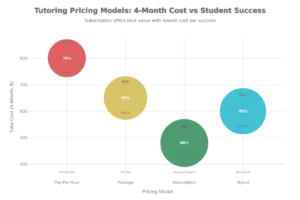
Cost for 16 hours (4 months): $480
Pros:
- 30-40% cost savings vs. hourly
- Guaranteed consistency (same time weekly)
- Strongest tutor-student relationship
- Highest success rates (88%)
- No-show rare (3%)
- Tutor invests in your progress
Cons:
- Ongoing commitment required
- Less flexible (fixed schedule)
- Harder to quit mid-stream
Best for:
- Long-term support (semester+)
- Ongoing academic help
- Building deep understanding
Student success rate: 88% (highest—consistency wins)
Model 4: Hybrid Approach (Trial + Package) [RECOMMENDED]
How it works:
- Trial: One pay-per-hour session ($50)
- Commitment: Package of 10 sessions ($595, 15% off)
- Remaining sessions: Package or hourly as needed
Total cost for 16 hours: $600
Why it’s best:
- Reduces risk (try before committing)
- Incentivizes commitment (package deal after trial)
- Balanced cost-benefit (25% savings)
- Student success rate: 85%
Cost Comparison Table
| Model | Total 16-hr Cost | Hourly Rate | Discount | No-Show Rate | Success Rate | Cost Per Success |
| Hourly | $800 | $50 | 0% | 15% | 70% | $1,143 |
| Package | $650 | $40.6 | 20% | 8% | 80% | $813 |
| Subscription | $480 | $30 | 40% | 3% | 88% | $545 |
| Hybrid | $600 | $37.5 | 25% | 5% | 85% | $706 |
Best value: Subscription (lowest per-unit cost)
Best overall: Hybrid (balanced cost + success + safety)
Most expensive: Hourly (highest total cost, lowest outcomes)
2026 Pricing Trends
[web:69, web:171]
Emerging models:
- Value-based pricing — Pay for results, not hours. “Improve from D→C or half refund”
- Small group pricing — 2-4 students with one tutor (save 30-40% per student)
- Premium bundles — Tutoring + diagnostics + progress reports + practice plans
Also Read: Get Instant Homework Help
Section 7: Engineering-Specific Value Maximization
Engineering students have specific needs different from general tutoring.
Why Engineering is Different
- Problem-solving focus — Engineering isn’t about memorizing; it’s about applying concepts to novel problems
- Weekly problem sets — Consistent weekly homework requires ongoing support
- Complexity peaks — Linear algebra, differential equations, circuits are genuinely hard
- Peer learning works better — Group tutoring effective for hands-on, practical learning
Optimal Engineering Tutoring Stack
Option A: Subscription Model (Best for semester support)
- $300/month = 4 one-hour sessions
- Schedule: 2 sessions for challenging courses (linear algebra, circuits), 2 for others
- Success rate: 88%
- Cost: $1,200/semester
Option B: Group + Individual Hybrid (Best for budget + outcomes)
- 2x/week group tutoring: $60/week group (split 4 ways = $30/person/week)
- 1x/month individual: $50/month
- Total: $290/month
- Success rate: 85% (group excellent for hands-on engineering topics)
- Cost: $1,160/semester
Option C: Package for High-Pressure Periods
- Normal: Self-study (free resources, peer groups)
- Exam prep (4 weeks before): 10-session package ($595)
- Mid-semester (if struggling): Activate package
- Total cost: $400-600/semester
- Success rate: 80-85% (intensive when needed)
Engineering Tutor Selection
Choose tutors who:
- Have engineering background (understands real applications)
- Explain WHY, not just HOW
- Use problem-solving approach (not lecture-style)
- Record sessions (can review complex derivations later)
- Responsive to specific engineering topics (ask upfront: “Do you tutor circuits? Control systems? FEA?”)
Recording Strategy for Engineering
Engineering concepts are complex. Recording is non-negotiable.
What to record:
- Whiteboard derivations (step-by-step math)
- Problem-solving approach (systematic methodology)
- Tutor explanations (can re-listen during study)
- Your attempts (see where you made errors)
Post-session review critical for engineering:
- Review recording 24 hours later
- Work similar problems independently
- Reference recording when stuck
- Test understanding on exam-style problems
Section 8: Key Takeaways & Action Steps
The 2x Value Formula
Preparation (20 min) + Strategic Questions + Recording + Post-Review + Right Pricing = 2x Value
This isn’t magic. It’s systematic approach to learning.
Immediate Action Steps
Before next tutoring session:
- ✓ Complete the pre-session checklist (20 minutes)
- ✓ Write down your 3 specific questions
- ✓ Do your homework first
- ✓ Set up recording (ask permission)
During session:
- ✓ Ask strategic questions (why, application, self-assessment)
- ✓ Participate actively in guided and independent practice
- ✓ Take notes on key concepts, not everything
- ✓ Teach back concepts in your own words
After session (same day):
- ✓ Review notes within 2 hours
- ✓ Add missing details from memory/recording
- ✓ Listen to recording for parts you missed
After session (next day):
- ✓ Review transcript
- ✓ Work 2-3 practice problems independently
- ✓ Test your understanding without notes
Pricing Decision Framework
| Situation | Choose |
| Trying tutoring first time | Trial session (hourly) |
| Have specific goal (test prep) | Package pricing |
| Need semester-long support | Monthly subscription |
| Want safety + savings | Hybrid (trial + package) |
| Engineering course | Group + subscription combo |
Success Metrics to Track
Weekly:
- Did you complete pre-session prep? (Yes/No)
- What was your understanding before/after? (1-10 scale)
- Did you do post-session review? (Yes/No)
Monthly:
- Grade improvement? (Current vs. baseline)
- Homework accuracy improved? (%)
- Confidence level (1-10)?
Semester:
- Final grade vs. starting grade?
- Test score improvement?
- ROI calculation: Was it worth it?
If you’re not seeing 20%+ improvement within 4 weeks, change approach (different tutor, different pricing model, more preparation, etc.)
Skooli vs. My Engineering Buddy: Which Online Tutoring Platform is Right for You?
Appendix A: Pre-Session Checklist (Printable)
Student Name: _________ Date: _________ Topic: _________
Goals (5 minutes)
- Specific problem/topic: ___________________
- Success criteria: Can solve similar problems? Understand concept? Improve grade?
- Current understanding (1-10): ___
Homework Prep (10 minutes)
- Completed all homework I can do
- Marked 2-3 problems I’m stuck on
- Organized materials (homework, notes, textbook pages)
- Know what teacher expects (format, style, etc.)
Questions (3 minutes)
- Question 1: ___________________
- Question 2: ___________________
- Question 3: ___________________
Space Setup (2 minutes)
- Quiet, distraction-free location
- Phone on silent
- Recording app tested
- Water/comfort items ready
Tutor permission for recording: _____ (Yes/No)
Appendix B: Post-Session Review Checklist
Within 2 hours:
- Review live notes
- Add missing details from memory
- Listen to recording for unclear parts
- Highlight key concepts
Next day:
- Review transcript (if transcribed)
- Look up any unclear terms
- Work 2-3 practice problems independently
- Test understanding without notes
Before next session:
- Skim notes for 5 minutes
- Refresh memory of what was learned
- Write any follow-up questions
******************************
This article provides general educational guidance only. It is NOT official exam policy, professional academic advice, or guaranteed results. Always verify information with your school, official exam boards (College Board, Cambridge, IB), or qualified professionals before making decisions. Read Full Policies & Disclaimer , Contact Us To Report An Error