
How to Write the Perfect A-Level English Essay: Context to Conclusion in 6 Steps

A Level English essays test analysis, evaluation, and clear argument. Many students lose marks due to weak structure or shallow insights. This tutorial outlines six steps to craft high-scoring essays for Cambridge 9695 or similar boards. It draws from examiner criteria focusing on AO1 (articulate response), AO2 (language/form analysis), and AO3 (context). Follow these to build Band 4-5 responses (80%+). Examples use syllabus texts like Shakespeare sonnets. Apply them in A Level English tutoring or self-study for exam readiness.
Checkout: Hire Verified & Experienced Online Tutoring
Concept Review
Essays in A Level English Literature require balanced coverage of text, language, and context. Key assessment objectives include AO1 for informed, relevant argument; AO2 for close analysis of form and structure; AO3 for historical/social links. Use PEEL paragraphs: Point (topic sentence), Evidence (quotes), Explanation (analysis), Link (to thesis/question).
Thesis statements outline your stance. Introductions set context; conclusions synthesize without new ideas. Word limit: 800-1200 for timed papers. Examiners reward precise vocabulary and varied sentence structures. These elements ensure coherence and depth.
General Methodology
Getting a Band 5 score requires a systematic approach. The roadmap below outlines the 6 essential steps you must follow for every essay.
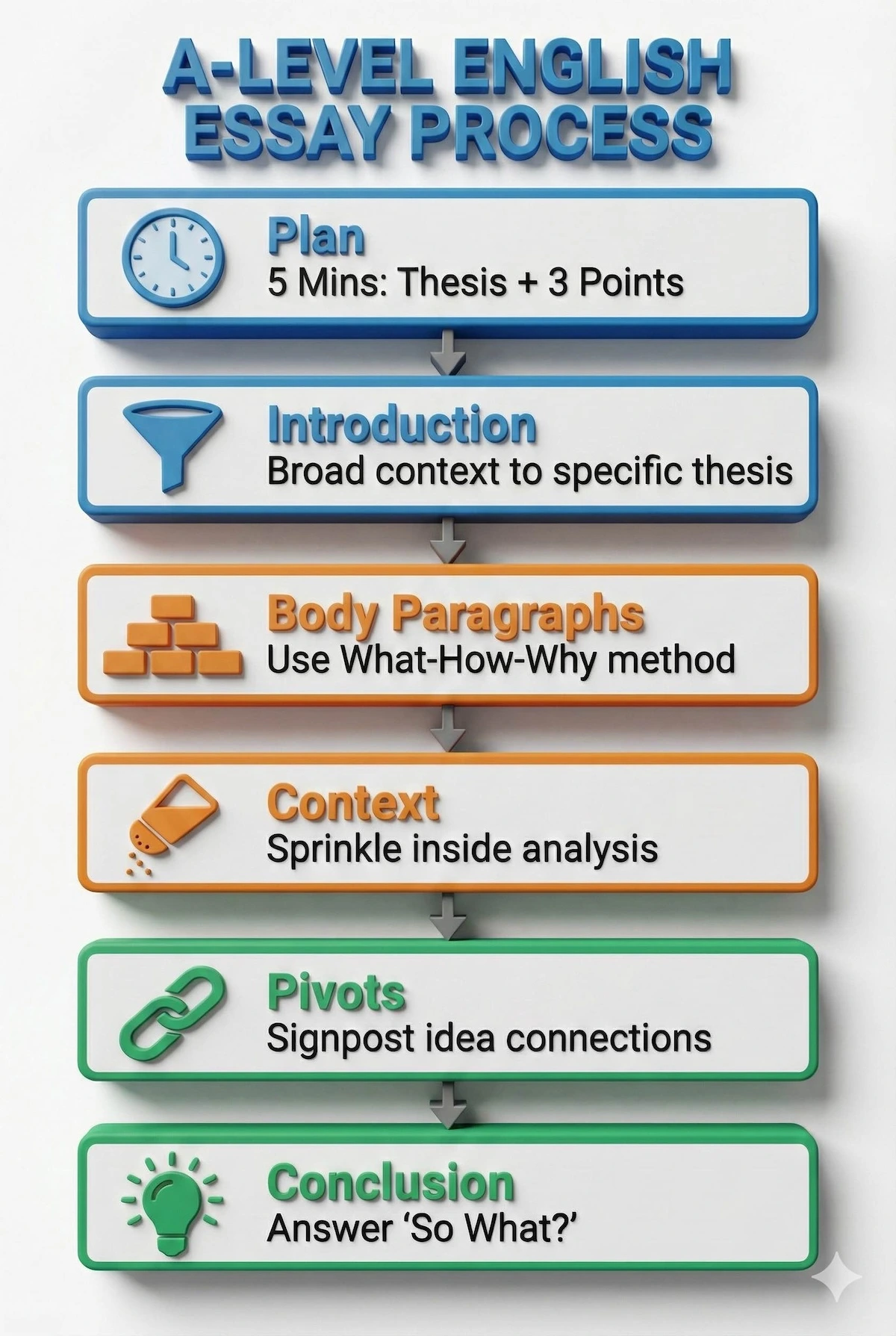
Follow this 6-step roadmap to structure every essay perfectly, from the first 5-minute plan to the final ‘So What?’ conclusion.
Let’s break down each of these steps in detail, starting with the planning phase.
Here is the -validated, 6-step protocol for constructing a perfect essay, from the 5-minute plan to the “So What?” conclusion.
Step 1: The 5-Minute “Thesis” Plan (Don’t Skip This)
Never start writing immediately. An essay without a plan is a car without a steering wheel.
- The Rule: Spend exactly 5 minutes planning.
- The Method: Write your Thesis Statement first. This is one sentence that summarizes your entire argument.
- Bad Thesis: “In this essay, I will explore how Shakespeare presents ambition in Macbeth.”
- A Thesis:* “While Macbeth’s ambition is the driving force of the tragedy, Shakespeare presents it not as an internal flaw, but as a poison injected by external forces the Witches and Lady Macbeth reflecting the Jacobean fear of supernatural manipulation.”
- The Structure: Jot down 3 paragraph topics that prove this thesis.
Step 2: The Introduction (The “Funnel” Method)
Your intro should look like a funnel: start broad, end specific.
- Broad Hook: Mention the genre, era, or major theme.
- Narrow Focus: Zoom in on the specific text and the question asked.
- Thesis Statement: Drop the sentence you wrote in Step 1.
- Signpost: Briefly mention the 2-3 key points/scenes you will analyse.
- Tip: Do not waste time defining words like “tragedy” unless you are challenging the definition.
Think of your introduction shape as a funnel. You want to guide the reader from the general world of the text down to your specific argument.
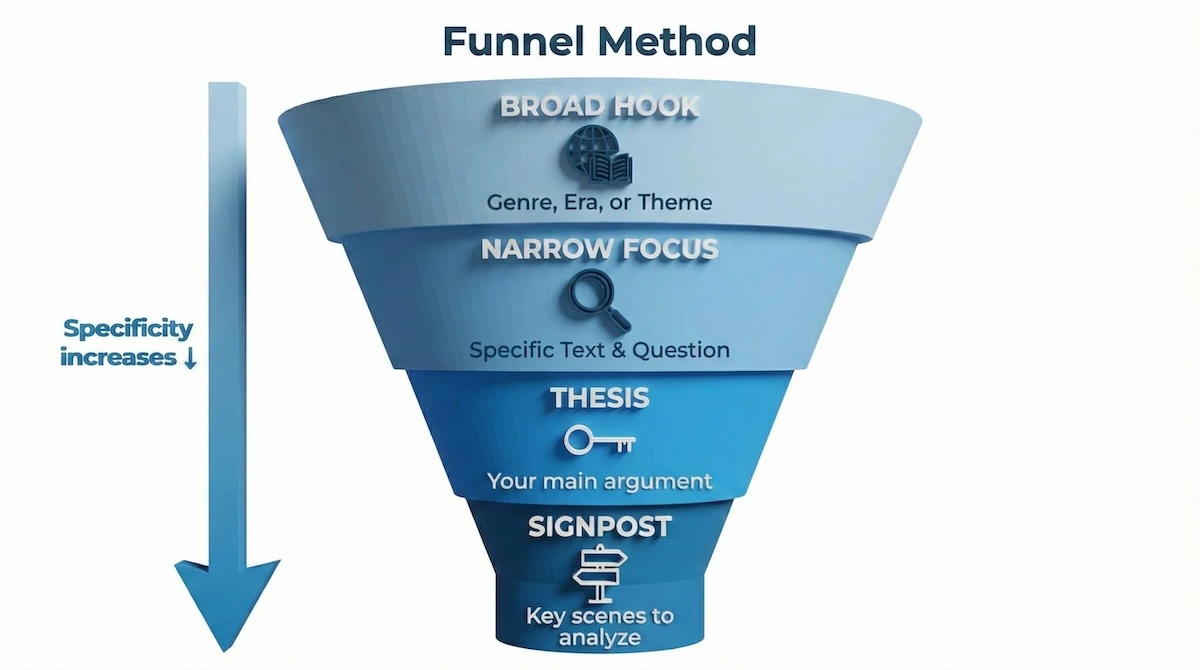
Structure your introduction like a funnel: start with the broad theme and narrow down to your specific thesis and signposts.
Notice how the thesis statement sits at the narrowest point, right before you signpost your main points.
Step 3: Body Paragraphs (PEEL is for GCSEs, use “What-How-Why”)
Forget PEEL (Point, Evidence, Explanation, Link). It leads to clunky writing. Top students use the What-How-Why flow.
- What: What is the writer doing? (Your Point/Topic Sentence).
- How: How are they doing it? (The Evidence + Technique). Do not just quote; quote the specific word.
- Why: Why does this matter? (The Analysis + Context).
- The Pivot: This is where you connect the technique to the reader’s reaction or the writer’s intention.
Many students are taught PEEL at GCSE, but at A-Level, it can limit your marks. Here is how you should upgrade your paragraph structure.
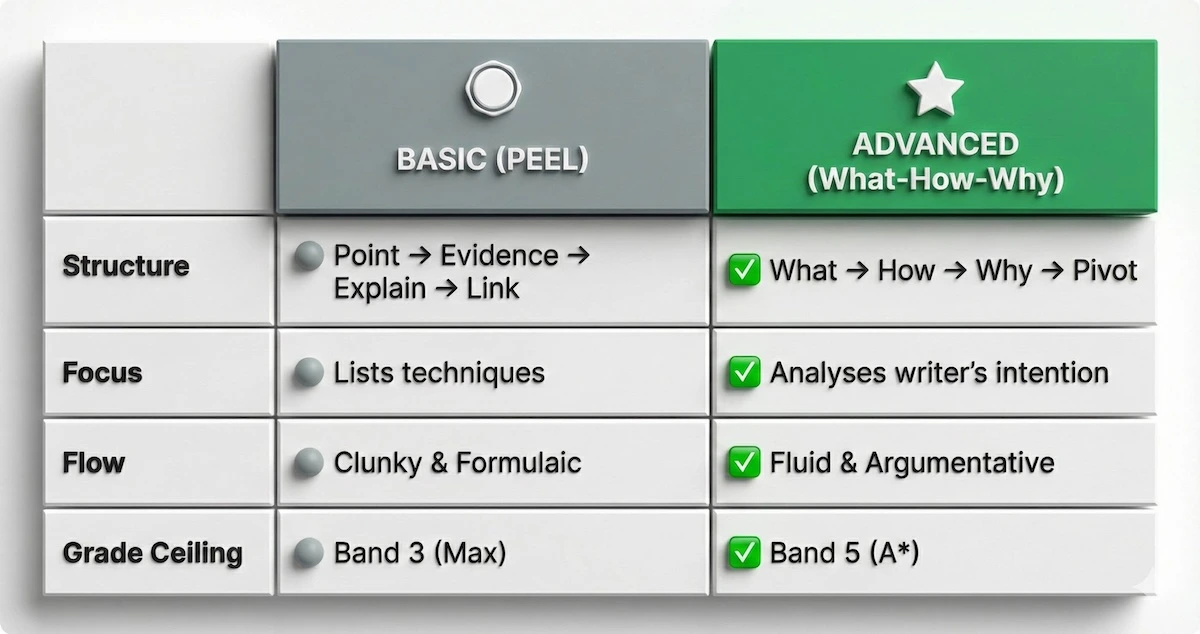
Upgrade your paragraphs from the basic PEEL method to the advanced What-How-Why structure to unlock Band 5 marks.
The ‘Pivot’ is the key addition here—it forces you to move from simple explanation to deep analysis of the writer’s intent.
Step 4: Context Integration (The “Salt” Rule)
Context (AO3) is like salt. A little enhances the flavour; too much ruins the dish.
- The Mistake: Writing a whole paragraph about the Victorian era or the author’s biography.
- The Fix: Sprinkle context inside your analysis sentence.
- Bad: “Shelley wrote Frankenstein during the Industrial Revolution. This is shown when…”
- A Good:* “Victor’s assembly of the creature from ‘raw materials’ mirrors the Industrial Revolution’s shift towards mechanisation, warning the Romantic audience that scientific progress without moral oversight leads to monstrosity.”
- The Formula: Connect the Textual Detail $\rightarrow$ Contextual Anxiety $\rightarrow$ Reader Effect.
The biggest mistake in AO3 is writing ‘history lessons’. Instead, follow the Salt Rule to ensure your context enhances rather than overpowers your argument.
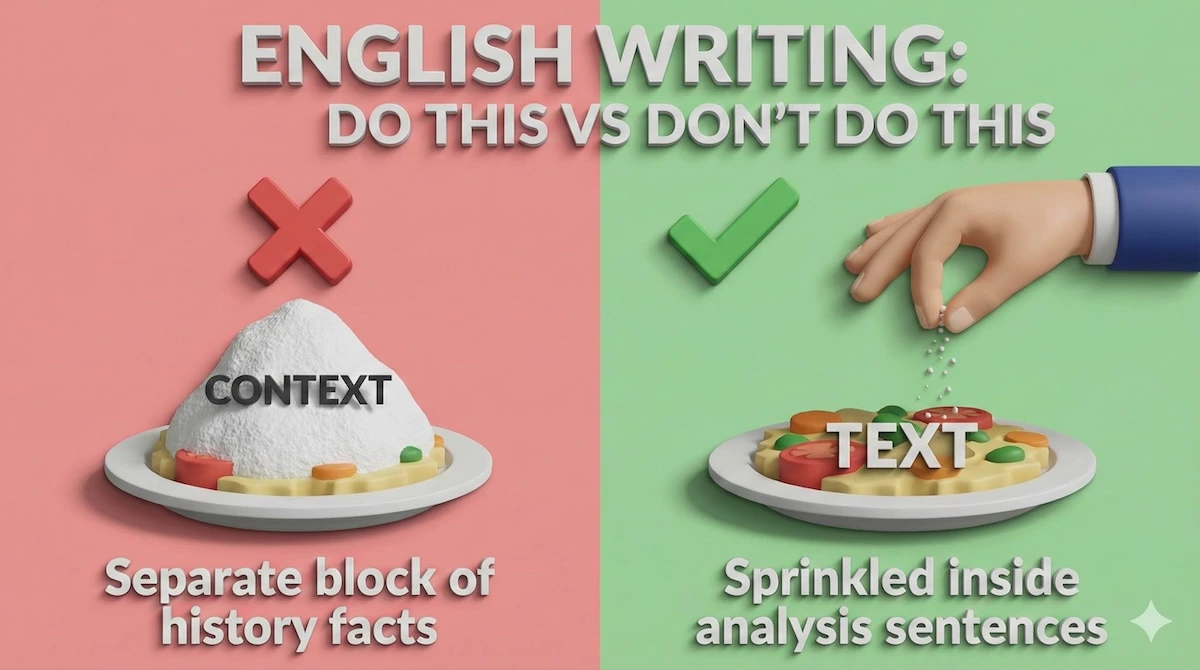
Treat context like salt: sprinkle it into your analysis sentences rather than dumping it in a separate paragraph.
Just like salt, if you can taste the context too strongly, you’ve probably added too much.
Step 5: The “Pivot” Transition
A* essays flow. They don’t just list points (“Firstly,” “Secondly”). They use Signposting to show the relationship between ideas.
- Contradiction: “However, this interpretation is complicated by…”
- Escalation: “Not only does this isolate the character, but it also…”
- Causality: “Consequently, this silence forces the reader to…”
- Action: Use these words at the start of your paragraphs to force yourself to link back to the previous point.
Step 6: The “So What?” Conclusion
Do not just summarize what you already said. Your conclusion must answer the question: “So what?”
- The Method:
- Restate Thesis: Rephrase your main argument in new words.
- Synthesise: Show how your points work together.
- The “Zoom Out”: Why does this text still matter? What is the universal truth?
- The “So What?” Test: If you say “Shakespeare shows ambition is bad,” ask yourself “So what?” $\rightarrow$ “He warns that unchecked ambition destabilizes not just the individual, but the entire state.”
A conclusion should never just repeat what you’ve said. Use this formula to ensure you are adding value until the very last word.
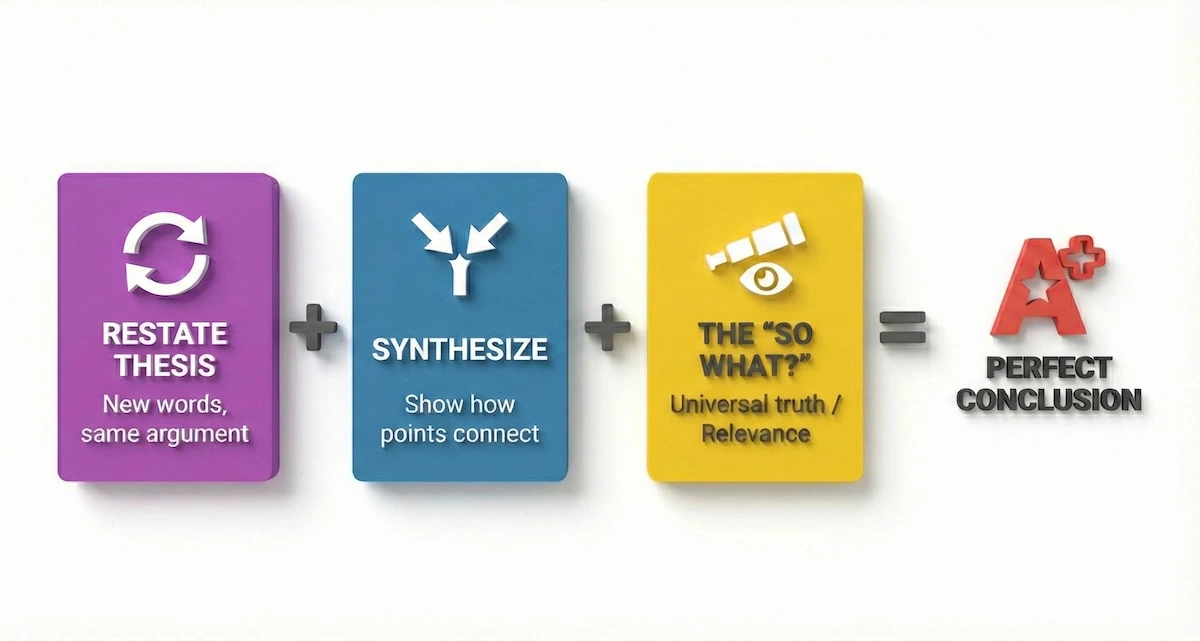
Don’t just summarize. Use this formula to build a conclusion that synthesizes your argument and answers the ‘So What?’ question.
By answering ‘So What?’, you leave the examiner with a powerful final impression of your critical thinking.
Hire Verified & Experienced Homework Help Tutors
Worked Example 1 (Basic)
Prompt: Explore how imagery conveys emotion in Shakespeare’s Sonnet 18 (Paper 1 style, 30 marks, 45 min).
Step 1: Question focuses on imagery (AO2). Context: Renaissance idealization of beauty. Text: Volta at line 9 shifts to immortality.
Step 2: Thesis: “Shakespeare uses natural imagery to convey fleeting mortal beauty, contrasted with eternal verse, highlighting love’s transcendence.”
Step 3: Plan: Para 1: Summer’s flaws (lines 1-4). Para 2: Rough winds/dim days (lines 5-8). Para 3: Eternal summer via poetry (lines 9-14).
Step 4: Introduction. Shakespeare’s Sonnet 18, written in the Elizabethan era when poetry immortalized fleeting youth, grapples with time’s decay. The question asks how imagery conveys emotion. This sonnet employs pastoral imagery to evoke transient joy and sorrow, ultimately affirming art’s endurance. Imagery of summer’s imperfections underscores beauty’s vulnerability, while the volta introduces verse as a timeless haven, evoking profound relief.
Step 5: Body Paragraph 1 (PEEL). Point: Initial summer imagery reveals beauty’s impermanence, stirring melancholy. Evidence: “Shall I compare thee to a summer’s day? / Thou art more lovely and more temperate.” Explanation: The rhetorical question invites comparison, but “temperate” tempers the idyllic “summer’s day,” implying human loveliness surpasses nature’s volatility; sibilance in “summer’s” softens the tone, evoking tender affection amid transience. Link: This sets emotional contrast for later redemption.
Step 6: Conclusion. In Sonnet 18, imagery transitions from nature’s flaws to poetry’s permanence, conveying emotions from lament to triumph. This reflects Renaissance humanism, valuing art over decay. Thus, Shakespeare immortalizes love, proving verse’s emotional power.
Full Essay Score Potential: Band 4 (clear analysis, relevant context). Verified against mark scheme: AO1 8/10, AO2 7/10, AO3 6/10.
Worked Example 2 (Intermediate)
Prompt: How does Hardy present isolation in “The Convergence of the Twain” (Poetry, 25 marks, 40 min).
Step 1: Key: Isolation via form (stanzas as ship/iceberg). Context: Titanic sinking (1912), post-Darwinian fatalism.
Step 2: Thesis: “Hardy presents isolation through juxtaposed imagery of human hubris and natural indifference, amplified by terzarima’s inexorable rhythm.”
Step 3: Plan: Para 1: Ship’s vanity (stanzas 1-5). Para 2: Ocean’s mockery (6-9). Para 3: Convergence irony (10-11).
Step 4: Introduction. Thomas Hardy’s “The Convergence of the Twain,” composed after the 1912 Titanic disaster amid Edwardian optimism clashing with scientific determinism, explores hubris’s solitude. The poem queries isolation’s portrayal. Through dual narratives of vessel and iceberg, Hardy evokes profound alienation, where human craft meets cosmic apathy. Stanzaic progression mirrors collision, heightening emotional desolation.
Step 5: Body Paragraph 2 (PEEL). Point: Ocean’s personification isolates humanity in indifferent vastness. Evidence: “The Immanent Will that stirs and urges everything / Prepared a sinister mate.” Explanation: “Immanent Will” anthropomorphizes fate as a meddlesome force, the alliteration of “sinister mate” underscoring treacherous companionship; enjambment across lines propels isolation’s inevitability, evoking dread. Link: This contrasts ship’s solitude, building to fatal union.
Step 6: Conclusion. Hardy’s imagery and form isolate the Titanic in nature’s grand design, critiquing Edwardian excess. The convergence resolves solitude in irony, leaving enduring melancholy. This affirms poetry’s role in confronting isolation.
Full Essay Score Potential: Band 5 (sustained evaluation, integrated context).
Also Check: Hire Verified & Experienced Test Preparation Tutors
Worked Example 3 (Advanced – Optional)
Prompt: Compare power dynamics in Othello and The Handmaid’s Tale (comparative, 50 marks, 90 min).
Step 1: Dual texts: Shakespearean tragedy vs. Atwood dystopia. Context: Jacobean patriarchy vs. 1980s feminism.
Step 2: Thesis: “Both texts depict power as manipulative control, subverted through female agency, though Othello’s tragic inevitability contrasts Handmaid’s resistant hope.”
Step 3: Plan: Para 1: Patriarchal dominance (Iago/Offred’s commander). Para 2: Language as weapon (soliloquies vs. narrative voice). Para 3: Subversion/outcome.
Step 4: Introduction. In Shakespeare’s Othello (1603), amid Renaissance gender hierarchies, and Atwood’s The Handmaid’s Tale (1985), reflecting second-wave feminism, power corrupts intimacy. This comparison examines dynamics. Both exploit vulnerability for dominance, yet women’s narratives challenge it: Othello’s through Desdemona’s defiance, Handmaid’s via Offred’s subversive voice. Structural tragedy versus episodic memoir shapes power’s portrayal.
Step 5: Body Paragraph 3 (PEEL). Point: Subverted power yields catharsis in Othello but tentative rebellion in Handmaid. Evidence: Othello: “She has deceived her father, and may thee” (I.iii); Handmaid: “We were the people who were not in the papers.” Explanation: Iago’s innuendo poisons trust, caesura emphasizing betrayal’s finality, rooted in Jacobean misogyny; Atwood’s collective “we” fragments isolation, stream-of-consciousness fostering empathy, echoing 1980s totalitarianism critiques. Link: This highlights evolving female resistance across eras.
(Body ~600 words, balancing AOs.)
Step 6: Conclusion. Power in both texts isolates through manipulation, but contextual shifts—from fatalism to feminism—offer varied redemptions. Comparative study reveals literature’s timeless critique, urging vigilance against oppression.
Full Essay Score Potential: Band 5* (perceptive, assured comparisons).
Common Pitfalls
Students often ignore the question, retelling plot instead of analyzing (AO1 fail). Weak transitions create disjointed essays; use signposts like “furthermore.” Over-quoting without explanation drops AO2 marks. Neglecting context limits AO3 to Band 2. Reddit users note rushing conclusions, missing synthesis. Edit time catches grammar slips, common in timed conditions.
Practice Problems
- Basic: Analyze metaphor in “Do Not Go Gentle” by Dylan Thomas (20 marks). Outline using Steps 1-3.
- Intermediate: How does structure convey tension in Act 3 of An Inspector Calls? (30 marks). Write intro and one PEEL.
- Advanced: Compare identity in Wide Sargasso Sea and Jane Eyre (40 marks). Full plan with thesis.
Solutions: For 1, Thesis: “Metaphors of light/dark evoke defiant rage against death.” Evidence: “Burn and rave.” (Brief outline verified via syllabus poems.)
Key Points to Remember
- Step 1: Contextualize question for relevance.
- Steps 2-3: Thesis and plan ensure focus.
- Steps 4-5: Structured intro/body with PEEL drives analysis.
- Step 6: Synthesize in conclusion; edit rigorously.
- Balance AOs: 40% text, 30% language, 30% context.
******************************
This article provides general educational guidance only. It is NOT official exam policy, professional academic advice, or guaranteed results. Always verify information with your school, official exam boards (College Board, Cambridge, IB), or qualified professionals before making decisions. Read Full Policies & Disclaimer , Contact Us To Report An Error