
Mastering A-Level German: Your Comprehensive Guide to Fluency and Top Grades

A-Level German is a challenging yet rewarding subject that opens doors to global opportunities. Success requires mastering complex grammar and cultural nuances, where personalized support from online tutoring can be transformative.
Sarah stared at her German textbook, the page a blur of declensions and subjunctive moods. She had aced her GCSEs, fueled by a passion for German culture—the films of Fatih Akin, the music of Rammstein, the crisp logic of German engineering. But A-Levels felt like a different beast entirely. The leap was steeper than she had imagined, and the dream of studying in Berlin was beginning to feel a little further away. Her story isn’t unique; many students find A-Level German a significant challenge that tests their resolve.
But why push through? Because German is more than just a language; it’s a gateway. It is the most widely spoken native language in the European Union, with approximately 130 million speakers worldwide (Source: Goethe-Institut). It’s the language of innovation, science, and business, with Germany being a global economic powerhouse. Mastering it at the A-Level opens up a world of academic and professional opportunities that are simply inaccessible to most.
This article is a deep dive into the world of A-Level German. We’ll explore the hurdles you might face, discuss effective strategies to overcome them, and examine how targeted support, such as A Level German tutoring, can be the key to unlocking your full potential.
Understanding the A-Level German Challenge
The A-Level German curriculum is designed to move you from a functional language user to a sophisticated and analytical thinker. It’s not just about what you can say, but how you say it and the cultural context behind your words. The course typically involves an in-depth study of German-language films and literature, as well as an exploration of contemporary social issues in German-speaking countries.
It’s easy to feel overwhelmed when you first see the syllabus, so let’s break down exactly how the requirements shift. The table below visualizes the specific differences in vocabulary and complexity you need to prepare for.
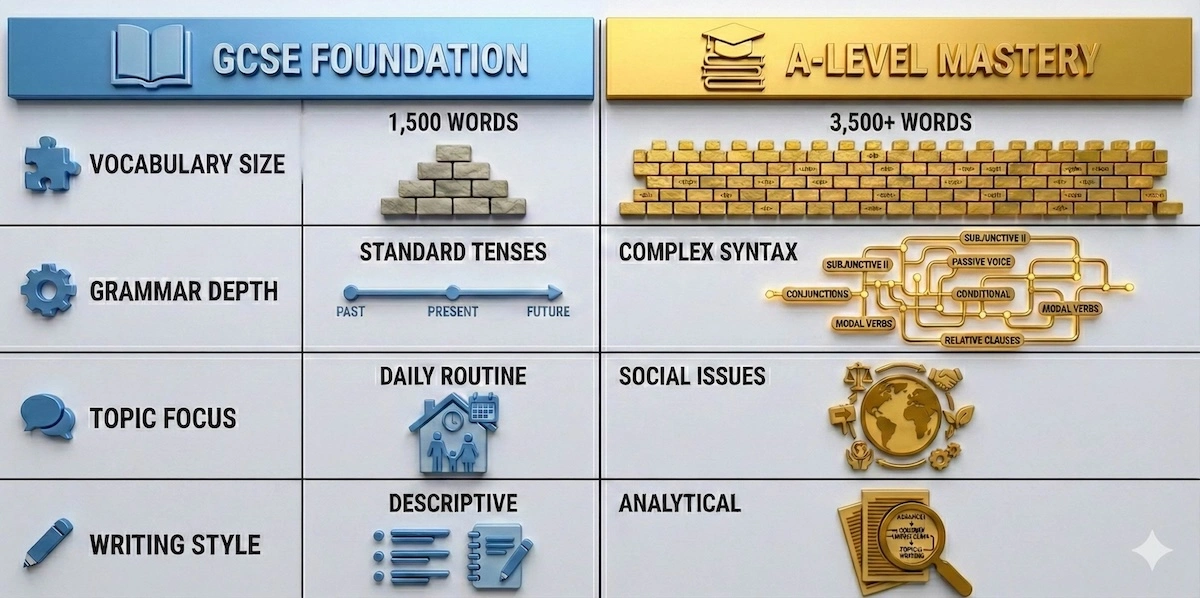
Understanding the leap from GCSE to A-Level is the first step to fluency; this table outlines exactly what changes.
As you can see, the shift isn’t just about learning more words; it’s about moving from descriptive sentences to analytical arguments.
The Great Grammar Hurdle
If GCSE German was about building sentences, A-Level German is about becoming an architect of complex, nuanced language. This is where many students hit a wall. The four grammatical cases—nominative, accusative, dative, and genitive—must become second nature, governing everything from articles to adjectives.
Then come the intricate sentence structures, with subordinate clauses sending verbs to the end of the sentence, and the dreaded subjunctive mood used to express hypotheticals and indirect speech. It’s a lot to juggle. This is often where students first seek out A Level German homework help, needing someone to clarify the rules that their classroom teacher may not have time to explain in detail for each student.
Unlike English, where word order can be flexible, German follows a strict logical sequence for adverbial phrases. We call this the ‘TeKaMoLo’ rule, and visualizing it as a formula makes it much easier to remember.
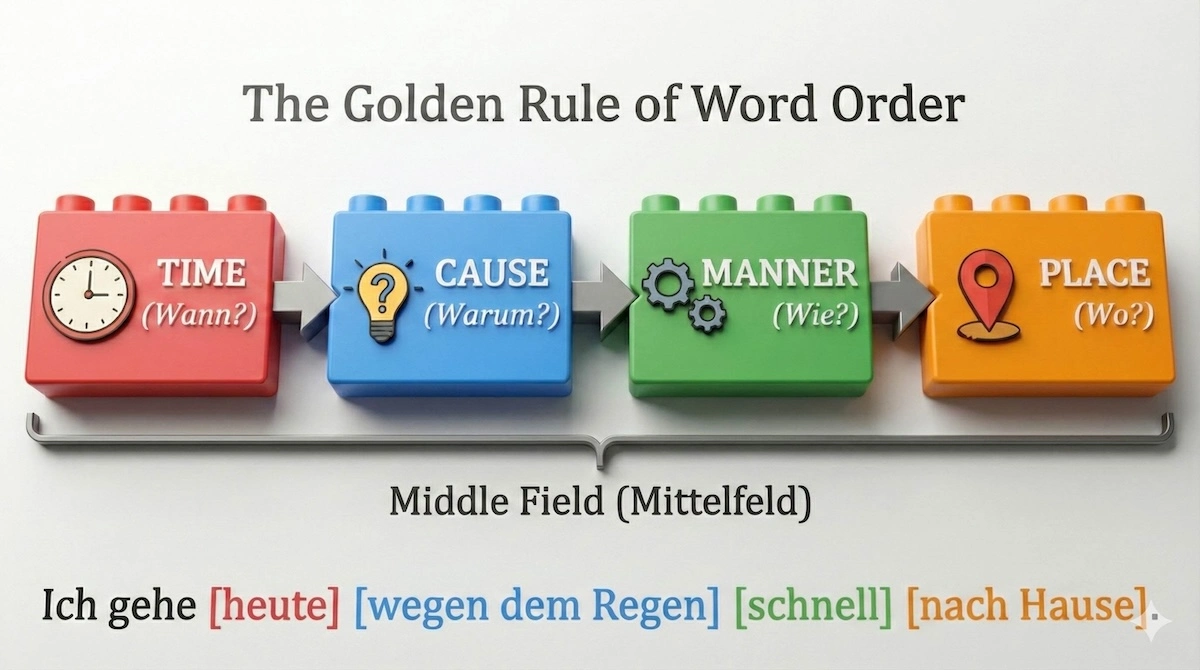
Mastering the TeKaMoLo rule helps you construct complex German sentences with mathematical precision.
Memorize this sequence: Time always comes before Place. Applying this single formula will instantly fix 80% of the syntax errors in your essays.
Beyond the Textbook: Culture and Nuance
Studying a film like Das Leben der Anderen or a novel by Kafka requires more than just translation. You need to understand the historical context, the cultural subtleties, and the author’s intent. Why did the characters behave in a certain way? What does this piece of art say about German society at the time?
An effective A Level German teacher does more than just teach vocabulary; they act as a cultural guide. They help you read between the lines and develop the analytical skills needed to write high-scoring essays. Without this deeper understanding, your analysis can remain superficial, costing you valuable marks.
It is heartbreaking to lose marks on brilliant arguments because of simple grammatical slips. Use this ‘Safety Net’ visualization as a mental checklist in the final 5 minutes of every exam.
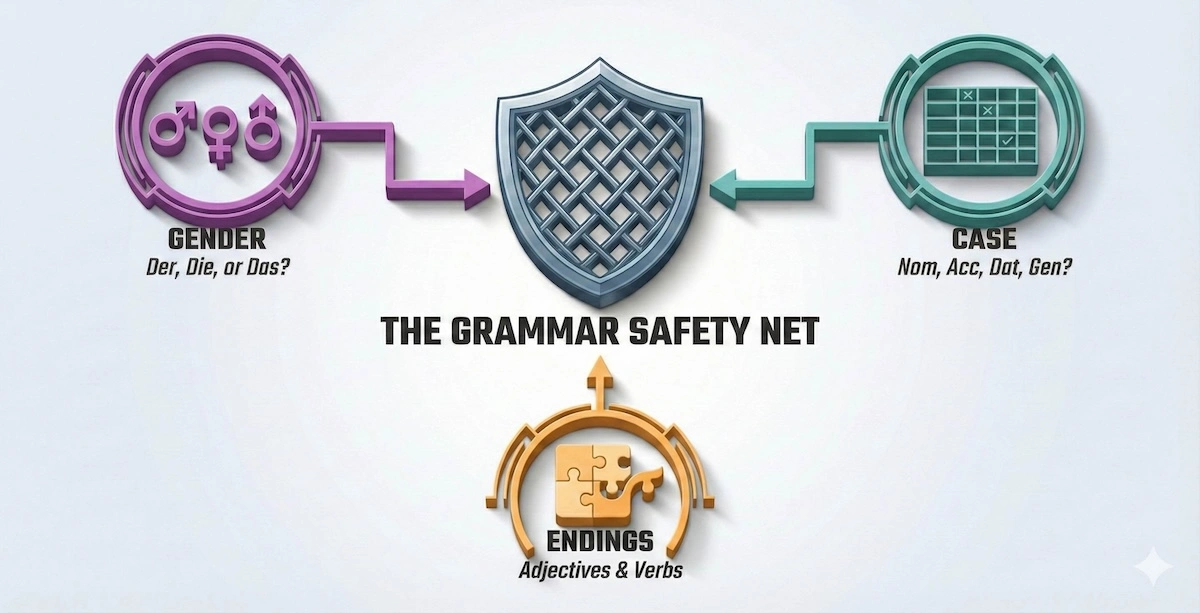
Before submitting any written work, run it through this 3-point ‘Safety Net’ to catch the most common grade-lowering errors.
Checking these three specific elements—Gender, Case, and Endings—covers the most heavily penalized grammatical errors in the mark scheme.
The Pressure of the Final Exams
The A-Level exams are rigorous. The speaking test requires you to think on your feet, presenting a topic and defending your arguments with fluency and accuracy. The listening and reading comprehensions use authentic, complex materials, and the writing papers demand well-structured, grammatically precise essays. The pressure to perform in all these areas can be immense.
The Power of One-on-One Support
Let’s go back to Sarah. Feeling overwhelmed, she talked to her parents, who suggested looking for some extra help. She was skeptical at first, wondering how one person could make a difference. But she decided to try a session with an A Level German tutor online. That decision changed everything.
The global online tutoring market is projected to grow significantly, a testament to its effectiveness (Source: Grand View Research). For a subject as complex as A-Level German, this personalized approach can be a game-changer.
A Personalized Learning Path
In a class of 20 students, a teacher has to cater to the average pace. But what if you’re struggling specifically with dative prepositions, or you’re ready to move faster on verb conjugations? This is the magic of A Level German tutoring. A tutor assesses your unique strengths and weaknesses and tailors each lesson to you.
Suddenly, Sarah wasn’t just another student in a classroom. Her tutor, a university student from Hamburg, identified her specific issues with word order in subordinate clauses. They spent entire sessions just on that, using interactive exercises and real-world examples until it clicked. This is a level of focus impossible to achieve in a standard school setting.
Building Confidence for the Speaking Exam
The speaking exam is often the most nerve-wracking part of the A-Level. Many students lack opportunities to practice speaking German freely and without judgment. A tutor provides a safe, supportive environment for exactly that.
Practicing regularly with a fluent or native speaker demystifies the exam. You get used to the rhythm of a real conversation, receive immediate feedback on your pronunciation and grammar, and build the confidence to express your ideas fluently. The goal of this focused A Level German teaching is to make the final exam feel like just another conversation.
The Convenience of Online Tutoring
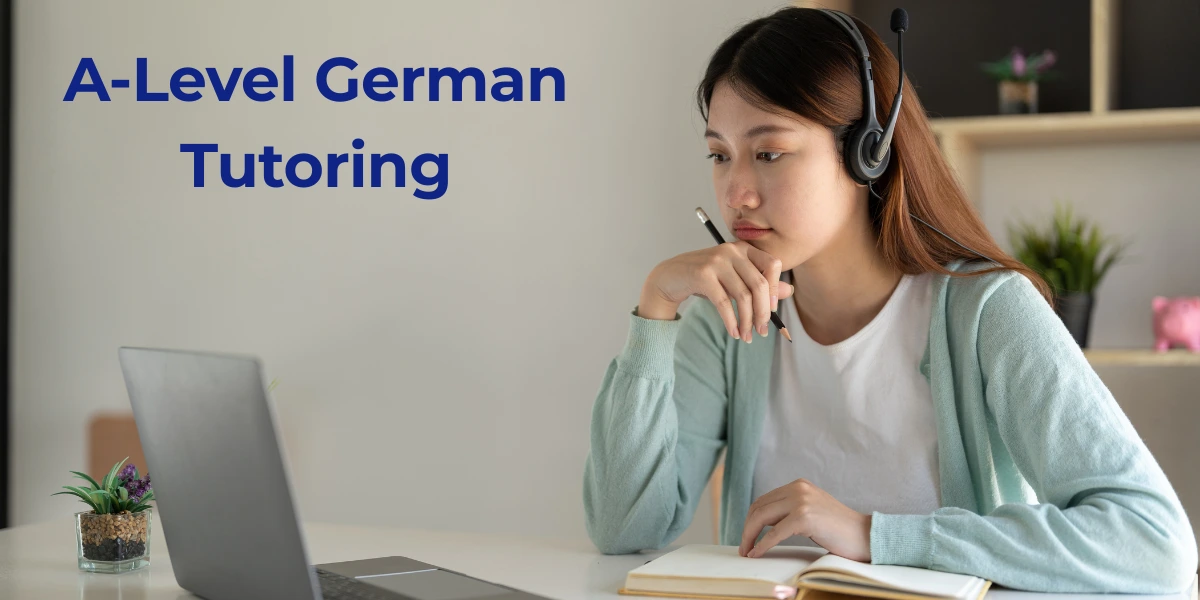
The digital age has revolutionized education. Platforms offering A Level German tutoring online connect you with top experts from around the world, right from the comfort of your home. There’s no travel time, scheduling is flexible, and you have access to a much wider pool of talent than you would locally.
These sessions often use digital whiteboards, shared documents, and other interactive tools, making learning engaging and effective. For students juggling multiple subjects, extracurriculars, and a social life, the efficiency of online learning is a massive advantage.
The Independent Research Project often causes the most anxiety because it feels so open-ended. To keep your preparation on track, follow this step-by-step workflow to build your presentation systematically.
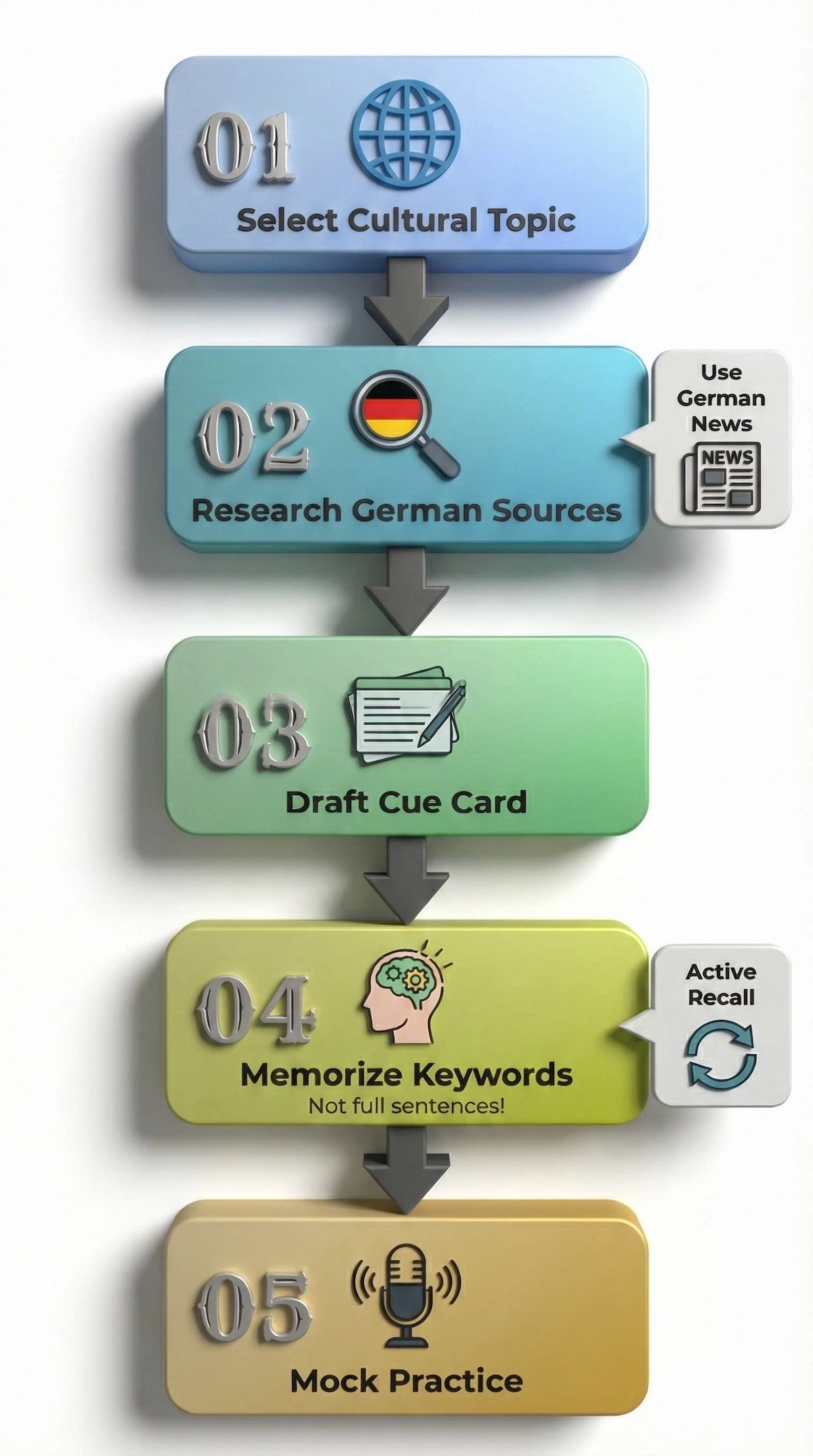
Follow this 5-step workflow to build your Independent Research Project from a simple idea to a high-scoring presentation.
By breaking the massive task down into these five manageable stages, you ensure you’re never researching aimlessly.
How to Find the Right A-Level German Tutor
Once you’ve decided to seek support, the next step is finding the right person. The quality of your tutor is the single most important factor in this journey. Whether you are looking for ongoing support or specific A Level German assignment help, making the right choice is crucial.
What Makes a Great Tutor?
A great A Level German tutor is more than just a fluent speaker. They should have:
- Expert Knowledge of the Curriculum: They need to know the A-Level syllabus inside and out, including the specific requirements of your exam board (AQA, Edexcel, etc.).
- Teaching Experience: Being good at German and being good at teaching German are two different skills. Look for someone with a proven track record of helping students succeed.
- Patience and Empathy: They need to understand the struggles students face and create a positive, encouraging learning environment.
- Excellent Communication Skills: They must be able to explain complex concepts clearly and concisely.
Where to Look for Your Tutor
While personal recommendations can be useful, specialized online tutoring platforms have become the most reliable way to find vetted experts. These services do the hard work for you, verifying tutors’ credentials, experience, and language proficiency.
When you decide to hire a A Level German tutor through a reputable platform, you gain peace of mind knowing they are qualified. These platforms also handle scheduling and payments securely, letting you focus entirely on learning.
Key Questions to Ask a Potential Tutor
Before committing, have a brief chat with a potential tutor. Here are a few questions to ask:
- What is your experience with the A-Level German syllabus?
- How would you describe your style of A Level German teaching?
- How do you help students prepare for the speaking exam?
- Can you provide targeted A Level German hw help if I’m struggling with a specific topic?
- How do you track a student’s progress over time?
The answers to these questions will give you a good sense of whether their approach aligns with your learning style and goals.
Strategies for Success Beyond Tutoring
While a great tutor is a powerful asset, they are part of a broader strategy for success. To truly master the language, you need to immerse yourself in it and practice consistently.
Live the Language
Make German a part of your daily life. Switch your phone’s language to German. Watch German-language series on Netflix (Dark or How to Sell Drugs Online (Fast) are popular choices). Listen to German podcasts on your way to school or college. Follow German news sites or influencers on social media. Every little bit of exposure helps your brain normalize the language.
Many students try to speak before they have listened enough, leading to frustration. This ‘Immersion Pyramid’ shows the healthy ratio of input to output you should aim for during your revision.
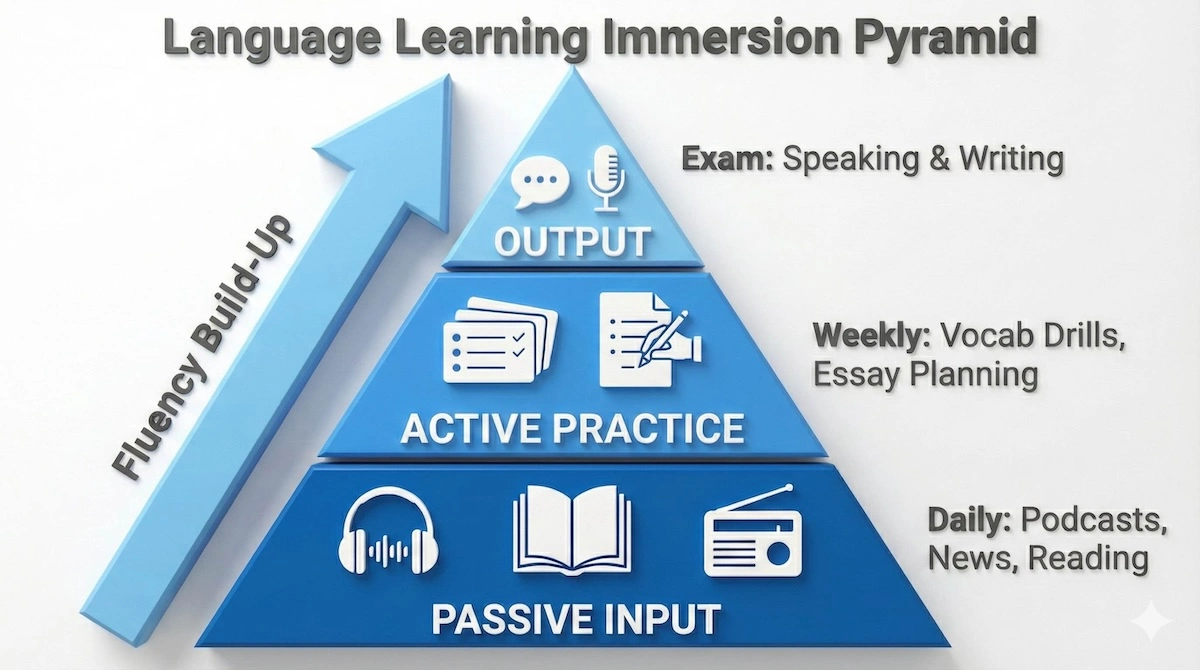
Success at A-Level requires a solid base of passive immersion; you cannot output (speak/write) what you haven’t first input (read/heard).
Don’t rush the peak of the pyramid; build a wide base of daily listening first, and the speaking fluency will follow naturally.
Use Technology to Your Advantage
Beyond tutoring sessions, technology offers a wealth of resources. Use spaced-repetition apps like Anki to create digital flashcards for vocabulary—this is far more effective than passive reading. Websites like Deutsche Welle offer news articles and videos graded by difficulty. Even 15 minutes a day with these tools can make a huge difference.
Practice, Practice, Practice
Language learning is a marathon, not a sprint. Consistency is key. It’s better to do 30 minutes of focused practice every day than to cram for four hours on a Sunday. This consistent effort builds the neural pathways needed for fluency and recall under exam pressure.
The Long-Term Rewards of Mastering German
Achieving a high grade in A-Level German is a fantastic accomplishment, but the benefits extend far beyond the exam hall. You are equipping yourself with a skill that is highly valued in our interconnected world.
Academic and Career Opportunities
Fluency in German opens doors to world-class universities in Germany, Austria, and Switzerland, many of which have very low or no tuition fees. In the professional world, bilingual candidates are highly sought after. According to the Confederation of British Industry (CBI), German is one of the top languages requested by UK employers. Industries like engineering, technology, automotive, and finance have deep ties to the German economy, and language skills can give your CV a significant edge.
Cognitive and Cultural Enrichment
Learning a second language has profound cognitive benefits, including improved memory, problem-solving skills, and enhanced multitasking abilities (Source: American Council on the Teaching of Foreign Languages).
But beyond that, it’s about connection. It’s the ability to travel through Bavaria and order a coffee in the local tongue, to watch an award-winning film without subtitles, and to understand a culture from the inside out. It enriches your life in ways you can’t measure.
In the end, Sarah, with the guidance of her A Level German tutor, didn’t just pass her exam—she earned an A*. She is now in her second year of a history degree at the Free University of Berlin, living the dream that once felt so distant. Her journey shows that while A-Level German is tough, it is an achievable and incredibly rewarding challenge. With the right mindset, consistent effort, and expert support, you can conquer it too.
Frequently Asked Questions (FAQs)
Q1. Why is A-Level German considered so difficult?
Its difficulty comes from the significant jump in grammatical complexity and the need for deep cultural and analytical understanding.
Q2. Can an online German tutor be as effective as an in-person one?
Yes, for many students, the combination of convenience, access to top experts, and interactive digital tools makes it even more effective.
Q3. How often should I have sessions with an A Level German tutor?
Most students find one or two one-hour sessions per week to be ideal for consistent progress without feeling overwhelmed.
Q4. What is the main focus of A Level German tutoring?
The focus is on identifying and strengthening your specific weak areas, whether in grammar, essay writing, or speaking confidence.
Q5. Can I get help with just one difficult German assignment?
Absolutely, many tutors are available to provide targeted A Level German assignment help for specific tasks or topics.
Q6. How do I find a qualified A Level German tutor online?
Using a reputable online tutoring platform is the best way to connect with pre-vetted, experienced, and qualified German tutors.
******************************
This article provides general educational guidance only. It is NOT official exam policy, professional academic advice, or guaranteed results. Always verify information with your school, official exam boards (College Board, Cambridge, IB), or qualified professionals before making decisions. Read Full Policies & Disclaimer , Contact Us To Report An Error