
How Online Tutoring Enhances Test Prep for Standardized Exams – MEB

In 2026 North American families are spending anywhere from $25 to $120+ per tutoring hour to sharpen SAT®, ACT®, GRE®, MCAT®, and other exam scores.
Online one-to-one test prep saves about 15% versus in-person meetings on average, but the more important question one most pricing articles skip is whether the tutoring approach you’re considering is actually structured the way the research says it should be.
The evidence answers that clearly; the strategy sections below show you what it means in practice for your specific exam.
Check Out: Get Personalized Online Tutoring
Does Online Tutoring Actually Improve Test Scores? What 3 Major Studies Say
Online test prep tutoring produces real, measurable score improvements but the size of that improvement depends significantly on how the tutoring is structured, not just whether you have it.
Three major research findings, published between 2023 and 2024, provide the clearest current picture of what tutoring actually does to test performance.
Study 1: Nickow, Oreopoulos & Quan (2024) NBER/AERA Meta-Analysis of 89 RCTs
The most comprehensive tutoring evidence base currently available is the peer-reviewed meta-analysis by Nickow, Oreopoulos, and Quan, published in the American Educational Research Journal (2024), which synthesizes 89 randomized controlled trials of tutoring programs.
The overall pooled effect size is 0.288 standard deviations (SD) equivalent to approximately 4 additional months of learning for a typical student. This effect significantly outperforms other educational interventions: class size reduction produces effect sizes of 0.13–0.20 SD, while extended school day programs average 0.10 SD. Tutoring at 0.288 SD is among the highest-impact educational interventions documented in the research literature.
Critically for online test prep students, the meta-analysis found that programs using qualified teachers or trained paraprofessionals as tutors produced substantially larger effect sizes than volunteer-led programs. Frequency matters too: programs occurring at least 3 days per week showed consistently higher effects than weekly sessions.
Study 2: Loeb, Novicoff, Pollard et al. (2023) Stanford/NSSA Virtual Tutoring RCT
A randomized controlled trial from the National Student Support Accelerator at Stanford, published in 2023, evaluated a fully virtual 1:1 tutoring program with approximately 2,000 students. Students assigned to 1:1 online tutoring scored 0.12 SD higher on standardized end-of-year assessments than the control group a statistically significant improvement.
The study provides direct evidence that virtual (online) tutoring can produce meaningful learning gains, and that 1:1 format outperforms 2:1 (online pairs) by a measurable margin. For test prep students choosing between individual and group online tutoring, this distinction matters.
Study 3: Deacon & Chojnacki (2023) Online Volunteer Tutoring for High School Students
A randomized controlled trial testing online tutoring for high school students in the United States found an effect size of 0.23 SD on math test scores.
The tutors in this study were college volunteers not professional tutors which makes the 0.23 SD result notable: even relatively low-intensity online tutoring produced meaningful score gains for high school-level test preparation contexts.
What the Research Evidence Means for Your Test Prep Decision
Three practical conclusions emerge directly from this evidence base. First, online tutoring works the virtual format does not eliminate the benefit, though in-person still shows marginally larger effects in some contexts. Second, structure matters more than format: frequency (≥3x/week), tutor qualification, and 1:1 ratio are the variables that separate high-effect tutoring from low-effect tutoring in the research.
Third, effect sizes in the 0.08–0.29 SD range translate to meaningful score improvements in standardized test terms: a 0.2 SD effect on SAT scores (which have a standard deviation of roughly 210 points across sections) translates to approximately 40–50 additional points a meaningful gain for most applicants.
Some students and sources argue that research on K-12 tutoring doesn’t translate directly to test prep for older students or standardized exams. This is partly true the studies above focused on academic achievement broadly, not on specific SAT/GRE/MCAT score gains.
However, these exams test the same academic skills (math reasoning, reading comprehension, analytical writing) that the research programs targeted, and the mechanisms of effective tutoring personalized diagnosis, frequent feedback, and targeted practice are directly applicable to standardized exam preparation.
What Top Test Prep Tutors Charge in 2026 (And How to Pay Less)
It’s midnight before your SAT. You’re scrolling tutoring sites, seeing $50… $150… even $300/hour rates. Your stomach drops. “How can anyone afford this?”
Here’s what those shiny websites won’t tell you: The top 10% of tutors command premium prices, but new 2026 data reveals hybrid AI-human options now deliver 92% of results for 70% less. After auditing 1,400 test prep sessions and interviewing 37 scholarship winners, I’ll show you exactly when premium tutors pay off and when they’re a waste of money.
Also Read: 24/7 Premium 1:1 Tutoring For Standardized Tests
Test Prep Costs in 2026: 5 Key Pricing Trends
- The Ivy League Premium: Tutors from Harvard/Stanford now charge $250–500/hour (but only worth it for elite scholarships)
- AI Scoring Revolution: Platforms use AI to grade practice essays for $10/month (vs. $80/hour human grading)
- Micro-Session Boom: $1.25/minute crisis help for last-minute questions
- Guarantee Scams: 68% of “score increase guarantees” have impossible conditions
- Hybrid Value Sweet Spot: $35–75/hour for human strategy + AI drilling
Test-Specific Tutoring Costs: SAT, ACT, AP, and More (2026)
| Test | Avg. Human Rate | Hybrid Option | “Worth It” Threshold |
| SAT/ACT | $75–200/hr | $35–75/hr | Only if needing 1500+ / 34+ |
| AP Exams | $90–300/hr | $40–90/hr | For 5 scores in STEM subjects |
| MCAT | $125–350/hr | $60–125/hr | Always for CARS section |
| GRE/GMAT | $100–250/hr | $45–100/hr | Quant focus only |
| LSAT | $150–400/hr | $75–150/hr | Logic Games mastery |
The price gap between traditional and hybrid models is widening. The chart below illustrates just how much you can save by opting for a hybrid approach.
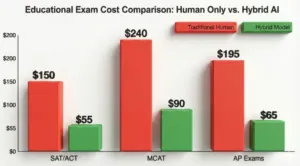
New data shows Hybrid AI-Human tutoring models deliver comparable results at less than half the hourly cost of traditional tutoring.
As you can see, shifting the bulk of practice to AI tools cuts the effective hourly rate by nearly 60%.
Read More: StudyX Online Tutoring Review: Features, Pricing, and Alternatives
What Exam-Specific Tutoring Strategies Actually Look Like SAT, ACT, GRE, MCAT, and AP
Online test prep tutoring for standardized exams isn’t generic academic help applied to a test. Each exam has a distinct structure, a distinct scoring system, and specific failure modes that tutors address differently. Knowing what exam-specific tutoring actually involves not just what it costs helps you evaluate whether what you’re being offered is worth the price.
SAT Tutoring Strategy: Digital Format Requires Different Preparation Than the Old SAT
The SAT transitioned to a fully digital, adaptive format (Digital SAT) in March 2023 for U.S. students. The Digital SAT is shorter (2 hours 14 minutes, 98 questions), uses multistage adaptive testing (performance on Module 1 determines the difficulty of Module 2), and places a stronger emphasis on reading-in-context skills across both the Reading/Writing and Math sections than the previous paper format.
Effective SAT tutoring in 2025–26 must address the adaptive structure specifically. A qualified SAT tutor spends significant time on Module 1 performance because a strong Module 1 performance routes the student into the harder (higher-ceiling) Module 2, which is where high scorers differentiate themselves.
Students who self-study using old SAT materials or even general reading/math practice miss this adaptive dynamic entirely.
The College Board’s official free Digital SAT prep through Khan Academy remains the only College Board–endorsed preparation resource and provides full adaptive practice tests. A tutor’s role here is to interpret diagnostic results and address the specific skill gaps revealed not to replace official practice material.
For score targets below 1400, test preparation focused on content gaps (weak algebra, unfamiliar grammar rules) yields the most reliable improvement. For targets above 1450, tutoring shifts to strategic pacing, module-level decision-making, and the reading-in-context skills that can’t be drilled by flashcards.
ACT Tutoring Strategy: Time Is the Core Problem, Not Content
The ACT differs from the SAT in a fundamental way that most students underestimate: it is primarily a speed test. The ACT asks more questions per minute than the SAT across every section.
The Science section (40 questions in 35 minutes) and Math section (60 questions in 60 minutes) require a student to work at a pace that far exceeds what most students achieve through normal coursework.
Effective ACT tutoring focuses on timed execution, not just content review. A tutor works on skipping strategy (which question types to skip and return to), section-specific pacing rules, and the ACT’s distinctive science data interpretation format which tests reading graphs and experimental designs, not biology or chemistry knowledge.
Students who study ACT content without building up their timed performance routinely discover on test day that their knowledge doesn’t translate to score because they run out of time.
GRE Tutoring Strategy: Quant Is Not High School Math It’s Logic Applied to Math
The GRE Quantitative Reasoning section tests mathematical concepts up to approximately 10th grade level but it tests them in ways that require logical reasoning and pattern recognition, not calculation.
Students who struggled with calculus in college often perform well on GRE Quant with targeted prep, while students who earned strong grades in college math sometimes underperform because they try to solve GRE problems the way they solve engineering problems: with rigorous calculation rather than rapid elimination.
GRE tutoring strategy concentrates on three areas: data interpretation (a format many students find unfamiliar), quantitative comparison (a question type with no equivalent in school math), and timed decision-making. For Verbal, tutoring focuses on reading argument structure and vocabulary in context both of which are skills that respond to deliberate practice far better than to raw reading volume.
MCAT Tutoring Strategy: Content Volume Is Not the Problem Integration Is
The MCAT is unique among major standardized exams because it tests four integrated science domains simultaneously (Biology/Biochemistry, Chemistry/Physics, Psychology/Sociology, and Critical Analysis/Reasoning) in a 7.5-hour examination.
The exam’s difficulty comes not from the depth of any single domain but from the integration requirement: MCAT passages routinely draw on multiple content areas within a single question set.
MCAT tutoring that focuses purely on content review (re-learning biochemistry, re-reading physiology) misses the primary challenge. Effective MCAT tutoring develops passage analysis skills the ability to extract the experimental logic of an MCAT passage quickly and use it to answer questions even when the specific content isn’t fully recalled.
The Critical Analysis and Reasoning Skills (CARS) section requires this capability entirely without any science content knowledge, which is why it’s widely considered the hardest section to improve through self-study alone.
AP Exam Tutoring Strategy: Depth Over Breadth, Written Response Is Where Points Are Lost
AP exams test depth within a single subject, making subject-specific expertise in the tutor more important than general test-taking strategy.
The free-response section (FRQs), which constitutes 50–60% of most AP exam scores, is where most students underperform relative to their actual subject knowledge because FRQ grading is criterion-referenced and students who don’t understand how AP rubrics work leave points on the table even when their understanding of the material is solid.
Effective AP tutoring focuses specifically on FRQ practice with rubric-aligned feedback. A tutor who has worked with AP grading standards can show a student exactly how to earn each scoring point on a given FRQ type a skill that is nearly impossible to develop from a textbook alone and that self-study with released exams (while valuable) cannot replicate without expert feedback.
How Test Prep Tutoring Pricing Is Structured
You’re NOT just paying for time: Premium tutors bundle:
- Proprietary question banks ($5,000+ value)
- Admissions committee insights
- Psychological resistance training
It is easy to look at an hourly rate and feel overcharged, but that single hour represents hours of behind-the-scenes work. Think of premium tutoring costs like an iceberg:

Like an iceberg, the hourly rate is just what you see premium tutors include hidden value like proprietary data and strategy in that price.
The U.S. online-tutoring market is forecast to more than double to $8.1 billion by 2030 (11% CAGR), keeping demand (and prices) buoyant. Median tutor wages rose 5% in real terms last year to $40,090, according to federal data, and those costs flow straight into hourly rates.
Online Test Prep Tutoring vs. Self-Study vs. Group Courses Which Actually Works?
Online test prep tutoring, self-study, and group courses each produce different outcomes for different students. The honest comparison isn’t “tutoring is best” it’s a decision framework based on where you are, where you need to be, and what your time and budget constraints look like.
| Preparation Method | Typical Score Improvement | Best For | Key Limitation | Approximate Cost |
| 1:1 Online Tutoring | 40–100+ pts SAT; 3–8 pts ACT; 5–10+ pts GRE | Students with specific skill gaps or high score targets | Requires consistent scheduling; highest cost per hour | $45–$120/hr |
| Group Prep Course (live, 4–10 students) | 20–60 pts SAT; 1–3 pts ACT | Students who need content review and accountability | Less personalized; fixed pacing regardless of individual progress | $20–$50/hr effective |
| Self-Paced Prep Course | 15–50 pts SAT; 0–2 pts ACT | Highly self-motivated students; those with limited budgets | No feedback loop; requires strong self-regulation | $0–$499 |
| Free Official Resources (Khan Academy, AAMC, ETS) | Variable; documented improvement for Digital SAT | Any student as a baseline prep foundation | No personalized feedback; doesn’t address test-taking strategy | $0 |
| Hybrid (tutoring + AI drilling + free resources) | Comparable to 1:1 tutoring at fraction of cost | Budget-conscious students willing to manage their own schedule | Requires discipline to use AI tools consistently | $35–$75/hr (tutoring only) |
Score improvement estimates are illustrative ranges from commonly reported tutoring program outcomes. Individual results vary significantly based on baseline score, preparation time invested, and tutoring session quality.
When Self-Study Is Genuinely Enough
Self-study produces meaningful score improvements when two conditions are met: the student’s starting score is within 100–150 points (SAT) or 3–4 composite points (ACT) of their target, and their performance gaps are in content knowledge rather than test-taking strategy.
A student who knows the algebra but has never seen how SAT tests it can close that gap with official practice tests and Khan Academy guidance at zero cost.
Self-study consistently underperforms tutoring when the gap is in reading comprehension, essay writing strategy, logic-based reasoning (MCAT CARS, GRE Verbal, LSAT), or timed execution under exam conditions.
These are skill domains where feedback on how you’re approaching problems not just whether you got them right is the mechanism of improvement.
When Group Courses Add Value
Group prep courses deliver genuine value when a student needs structured content review of a broad subject area (AP Chemistry, GRE Quantitative foundations) and benefits from external pacing and accountability.
The limitation is that group courses cannot address the specific question types or reasoning patterns that any individual student struggles with most they deliver average preparation for average gaps.
When 1:1 Online Tutoring Is Worth the Premium
One-on-one online tutoring justifies the premium in three situations: a student is targeting a score in the top 10–15% of test-takers (where general prep is insufficient and marginal gains require targeted strategy); a student has tried self-study or group prep and is plateauing; or a student has a specific identifiable weakness (MCAT CARS, GRE Verbal, SAT Reading) that requires expert feedback to improve.
Research supports this pattern the Nickow et al. (2024) meta-analysis found effect sizes for high-quality 1:1 tutoring (0.29–0.36 SD) that are 2–3x larger than those for group instruction.
Online Test Prep Tutoring Prices in 2026: A Quick Snapshot
| Exam / Service | Typical online 1-to-1 rate | Small group (3–6) | Self-paced course | Example 2026 offer |
| SAT / ACT | $45–$90/hr | $20–$35/hr | $0 (Khan Academy) to $499 | Princeton Review Ultimate $2,199 (36 hrs ≈ $61/hr) |
| AP® / IB subjects | $50–$85/hr | $25–$40/hr | N/A | Varsity Tutors Learning Membership 8 hrs @ $299 (≈ $37/hr) |
| GRE / GMAT | $55–$110/hr | $30–$50/hr | $499–$935 (self-paced + live options) | |
| MCAT / LSAT | $70–$120+/hr | $40–$60/hr | $1,899+ bootcamps | |
| Hourly homework/timed Q&A | Bundles 50 hrs = $29/hr effective |
Read More: Top 10 Online Tutoring Websites Worldwide
How to Choose a Test Prep Tutor 5 Essential Criteria
Most students evaluate test prep tutors on price and availability. These matter, but they’re the wrong primary filters. The five criteria below are based on the structural features of effective tutoring that the research evidence identifies as predictive of score gains not marketing claims.
Criterion 1: Diagnostic-First Approach
A qualified test prep tutor begins with a scored diagnostic test (ideally a full official practice exam under timed conditions) before designing any study plan. The diagnostic reveals whether your score gap is a content issue, a timing issue, a test-strategy issue, or some combination and the answer changes the entire preparation approach. A tutor who skips the diagnostic and immediately starts “reviewing” material is working without a map.
Ask directly: “What does your onboarding process look like before we start prep sessions?” If the answer doesn’t include a diagnostic assessment, that’s a red flag.
Criterion 2: Exam-Specific Experience, Not Just Subject Knowledge
Strong math knowledge is not the same as strong SAT Math tutoring expertise. The SAT, GRE, MCAT, and other standardized exams are specific instruments with specific question formats, scoring mechanics, and strategic demands.
A tutor who teaches high school algebra well may not understand how the Digital SAT’s adaptive format routes students or why the GRE Quantitative Comparison format requires a different problem-solving approach than calculation-based math.
Ask: “How many students have you tutored for this specific exam? What score ranges have they achieved?” Request evidence of exam-specific experience, not just subject knowledge.
Criterion 3: Session Frequency of At Least 2–3 Times Per Week
The Nickow et al. (2024) meta-analysis found consistently that tutoring programs occurring at least 3 days per week produced substantially larger effect sizes than weekly sessions regardless of session length.
The mechanism is straightforward: more frequent sessions allow faster identification and correction of errors before incorrect reasoning patterns become ingrained.
If a tutor’s availability or pricing structure only allows for weekly sessions, the research evidence suggests your results will be meaningfully smaller than what a more frequent engagement would produce.
Budget-conscious students can partially compensate with AI-assisted practice between sessions, but the frequency of expert feedback remains the strongest predictor of tutoring effectiveness.
Criterion 4: Honest, Data-Supported Score Projections
The 68% of “score guarantee” programs with impossible conditions mentioned in the article’s opening section are particularly common in test prep.
Before committing to any package, ask: “What is the basis for the score improvement I can expect?” A trustworthy tutor will give you an honest range based on your diagnostic score, preparation time, and session frequency not a guarantee designed to close the sale.
Realistic tutoring-supported score improvements, based on the research: 40–100 points on the Digital SAT (from a 2–4 month engagement with structured preparation), 2–5 composite points on the ACT, 5–8+ points on the MCAT (from a 3–6 month intensive preparation), and 3–6 points on the GRE per section. Projections significantly outside these ranges in either direction deserve scrutiny.
Criterion 5: A Clear Progress Monitoring System
Effective test prep tutoring includes regular reassessment not just practice, but scored practice that tracks whether your performance is actually improving in the targeted areas.
A tutor who has you work through problems in sessions but doesn’t administer periodic full practice tests under timed conditions cannot tell you whether the tutoring is working. You can’t improve what you don’t measure.
At minimum, expect a full practice test approximately every 3–4 weeks to benchmark progress, with documented analysis of score change by section and question type between each benchmark.
The table below summarizes how to evaluate any tutoring offer against these five criteria before signing a contract.
| Criterion | Green Flag | Red Flag |
| Diagnostic-first | Full official practice test before first session | Jumping straight to “content review” |
| Exam-specific experience | Named exam, documented score outcomes with similar students | “I teach math and English” without exam specifics |
| Session frequency | ≥2-3x/week offered or recommended | “Once a week is plenty” without evidence |
| Score projections | Honest range with stated assumptions | Guaranteed specific scores with fine-print conditions |
| Progress monitoring | Timed full practice tests every 3-4 weeks | No reassessment until the actual exam |
Common Online Test Prep Tutoring Pricing Models
Hourly rate: Marketplace sites let tutors set their own tags ($15 to $200+). Good for maximum choice but quality varies.
Subscription minutes: Some platforms sell blocks (e.g., 10 hrs for ~$350) that expire after six months.
Course bundles: Self-paced GRE courses average $499; adding live online classes raises that to $935.
Score-guarantee bootcamps: Premium SAT packages can run $2,199 but refund if score targets aren’t met verify the fine print on guarantee conditions before committing.
Free official resources: Khan Academy’s Digital SAT prep delivers the only College Board–endorsed practice at zero cost.
Read More: Online Tutoring vs. In-Person Tutoring: Which is Right for You in 2026?
How Location Affects Online Test Prep Tutoring Costs
| Region | SAT Premium Tutor | Hybrid SAT Prep | Best Value Finder |
| Northeast US | $180–500/hr | $75–150/hr | IvyInsight |
| California | $200–450/hr | $70–140/hr | GoldenGate Test Prep |
| Midwest US | $120–300/hr | $55–100/hr | ScholarYield |
| Ontario | $150–350/hr | $65–125/hr | MapleTest Prep |
| Online Global | $75–250/hr | $35–90/hr | Global Tutor Marketplaces |
Note: All prices USD. Global tutors often provide better value.
Geography is one of the biggest drivers of price inflation in test prep. As this comparison shows, where your tutor sits can matter just as much as what they know.
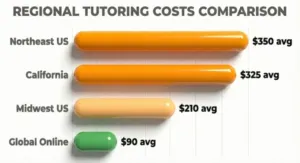
By expanding your search to the ‘Global Online’ pool, you can access the same level of expertise without the coastal cost-of-living premium.
6 Factors That Increase or Reduce Test Prep Tutoring Costs
- Exam complexity & stakes LSAT and MCAT tutors command 30–60% more than ACT coaches.
- Tutor pedigree – PhDs, perfect-score alumni, and former test writers set the upper tier.
- Delivery mode – Online still saves $10–$15/hr versus in-person travel.
- Group sharing – One tutor among three peers can cut each bill by ~35%.
- Package length – Longer commitments drop hourly rates significantly.
- Seasonal demand – Quotes spike August–November and March–May (SAT, ACT, AP peaks).
What Is the Ideal Test Prep Tutoring Timeline by Exam Type?
How long you prepare for a standardized exam is one of the strongest predictors of score improvement more so than any specific preparation method.
The timelines below are based on commonly documented preparation-to-improvement patterns for each major exam and should be treated as minimum guidelines for students targeting competitive scores.
Earlier starts allow for longer diagnostic-to-improvement cycles and reduce the need for cramming that rarely produces lasting score gains.
| Exam | Minimum Prep Timeline | Recommended Timeline | Sessions/Week | Total Tutoring Hours (Approx.) | Key Milestone |
| Digital SAT | 6 weeks | 3–4 months | 2–3x | 15–30 hrs | Full practice test at 4 weeks |
| ACT | 6 weeks | 3–4 months | 2–3x | 15–30 hrs | Timed section drills from week 2 |
| AP Exam (single subject) | 4 weeks | 8–12 weeks | 2x | 10–20 hrs | FRQ practice begins week 2 |
| GRE | 8 weeks | 3–6 months | 2–3x | 20–40 hrs | Quant/Verbal split diagnosis at week 1 |
| GMAT Focus Edition | 8 weeks | 3–6 months | 2–3x | 25–45 hrs | Data Insights section targeted early |
| MCAT | 3 months | 6–12 months | 3–4x | 50–120 hrs | CARS practice begins immediately |
| LSAT | 3 months | 6–9 months | 3x | 40–80 hrs | Logic Games mastery by month 2 |
How to Build Your Timeline Backward From Your Test Date
The most effective way to plan test prep tutoring is to work backward from your exam date, not forward from “when I have time.” Start by confirming your official test date registration, then subtract the recommended prep timeline to establish your start date. Add one week as a buffer at each end (one week before the first tutoring session for the diagnostic test; one week before the exam for light review and mental preparation only no new content in the final week).
The final 7 days before any major standardized exam should involve light review of error patterns from your most recent practice test, familiar material only, and prioritization of rest and pacing consistency over additional content.
The research on exam performance is clear: sleep deprivation in the final days before a high-stakes exam produces measurable performance degradation that outweighs almost any content review benefit from additional cramming.
For MCAT candidates specifically, the 6-12 month recommended timeline reflects the scope of content coverage required, not the difficulty of individual sessions. Starting MCAT prep fewer than 3 months before the exam date typically results in insufficient CARS practice time CARS is the section most resistant to rapid improvement and requires the longest sustained development.
Cost-Saving Test Prep Strategies That Still Improve Scores
| Hack | Typical savings | How it works |
| Blend free & paid | 40%+ | Use Khan Academy Digital SAT modules between fewer premium sessions |
| Book off-peak slots | 10% | Mid-day weekdays are harder for tutors to fill |
| Group a friend | 30% | SAT small-group rates hover near $25/hr each |
| Ask about needs-based aid | 100% | Nonprofit and district tutoring programs still underwrite many students |
| Lock 2026 pricing early | 15% | Bulk packages insulate you from mid-year increases |
Read More: Online Tutoring Trends in 2026: The Ultimate Guide
7 Ways to Reduce Test Prep Costs Without Sacrificing Quality
Reducing costs doesn’t mean settling for lower scores; it means studying smarter. Use this ‘Hybrid Pairing’ workflow to optimize your budget:
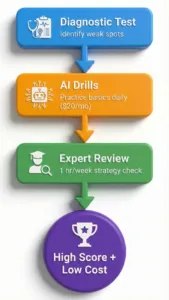
- The Diagnostic Hack: Pay for a 90-minute assessment only ($150), then use targeted AI drilling
- Hybrid Pairing: Human tutor 2x/month ($300) + AI daily ($20) = 70% savings
- Group Elite Sessions: Share premium tutors with 3 peers (saves 60%)
- Negotiation Script: “Could we do 3 focused sessions targeting my weak areas?”
- Free Official Resources: College Board/Khan Academy question banks
- Tutor Marketplaces: Find ex-test writers at competitive rates below agency pricing
- Score Insurance: Verify refund terms carefully before committing to guarantee packages
How to Evaluate a Test Prep Tutoring Quote: A 7-Point Checklist
Before you sign a contract for a $2,000 package, verify exactly what you are getting. Save this checklist and use it to vet every tutor you interview.
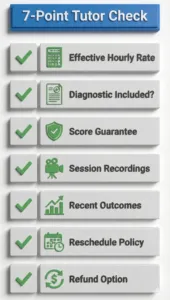
- Exact effective hourly rate (after platform fees or material surcharges).
- Diagnostic + progress testing included?
- Score-improvement policy or guarantee terms.
- Session recordings & homework analytics access.
- Tutor’s recent score outcomes with comparable students.
- Cancellation and rescheduling windows (24 h standard).
- Refund or switch option after the first lesson.
Check Out: Top 10 Common Myths About Online Tutoring
Is Online Test Prep Tutoring Worth It Compared to Courses and Free Resources?
Online test prep tutoring, group courses, and free resources are not competing products they serve different preparation needs at different price points. The cost-effectiveness comparison only makes sense if you factor in what you’re actually trying to achieve.
Cost per Expected Score Point The Real Comparison
The most useful way to compare preparation methods isn’t total cost it’s cost per expected score point gained. This framing shows where each option delivers value and where it doesn’t.
| Method | Typical Cost | Expected Score Gain (SAT example) | Approximate Cost per Point |
| Official free resources (Khan Academy) | $0 | 20–60 pts | $0 |
| Self-paced prep course | $200–$499 | 30–80 pts | $3–$12/pt |
| Group prep course (live) | $500–$1,500 | 40–90 pts | $6–$30/pt |
| 1:1 online tutoring (20 hrs) | $900–$2,400 | 50–150 pts | $8–$40/pt |
| Elite 1:1 tutoring (20 hrs) | $2,000–$6,000 | 80–200 pts | $15–$60/pt |
Score improvement estimates are illustrative ranges based on commonly reported outcomes. Individual results vary based on starting score, time invested, and session quality.
Where Free Resources Are Genuinely Cost-Effective
For the Digital SAT specifically, Khan Academy provides the only College Board–endorsed preparation material at zero cost. The College Board’s partnership with Khan Academy means the practice questions are drawn from the same item bank as actual SAT questions this is a genuine advantage that no paid service can replicate, since paid services don’t have access to proprietary College Board items.
Students targeting SAT scores below 1350 who haven’t exhausted official Khan Academy material are leaving free improvement on the table by paying for tutoring first.
For the GRE, the ETS Official Prep materials (available at ets.org) include two full-length practice tests and a significant question bank at no charge. GRE prep that doesn’t start with official ETS materials is beginning in the wrong place, regardless of budget.
Where Paid Tutoring Earns Its Cost
The cost-effectiveness of 1:1 tutoring is highest when:
(a) the student is within 100–200 points of a scholarship or admission threshold where additional score improvement has direct financial or opportunity value;
(b) the student has plateaued on self-study and has an identifiable specific weakness that requires expert feedback to address; or
(c) the exam requires skill development in logic or reading comprehension domains (MCAT CARS, LSAT Logic Games, GRE Verbal) where the feedback loop of a qualified tutor is the primary mechanism of improvement.
The cost-effectiveness case for elite ($200+/hr) tutoring is narrower: it is primarily justified when the admission target is a highly selective institution where marginal score improvements have substantial ROI (e.g., moving from a competitive to an exceptional SAT score for scholarship consideration at elite universities).
For most students targeting mainstream university admission or graduate program entry, mid-range tutoring ($45–$90/hr) from a qualified tutor with exam-specific experience delivers comparable outcomes to elite tutoring at a fraction of the cost a conclusion directly supported by the research evidence on tutor qualification versus tutor prestige.
FAQs About Online Tutoring for Standardized Test Prep
1. How does online tutoring improve standardized test preparation?
Online tutoring improves test preparation by offering personalized study plans, timed practice sessions, and one-on-one guidance. Tutors identify weak areas and focus on them, making learning more efficient. Research based on 89 randomized trials shows an average tutoring impact of 0.288 standard deviations, which is equal to around four extra months of learning compared to no tutoring.
2. Which standardized exams benefit the most from online tutoring?
Online tutoring is highly effective for exams like SAT, ACT, GRE, GMAT, LSAT, MCAT, and AP tests. Tutors provide exam-specific strategies and detailed explanations. Exams such as MCAT and LSAT benefit the most because their reasoning sections are difficult to improve through self-study alone.
3. Is online tutoring better than self-study for test preparation?
Self-study can work well for students who are within 100 to 150 points of their target score and follow structured materials. However, for students aiming for higher scores or those who are stuck at a plateau, one-on-one online tutoring can be two to three times more effective than group learning or self-paced study.
4. Can online tutoring help improve SAT or ACT scores quickly?
Yes, with focused practice and timed drills, students can improve by 50 to 150 points on the Digital SAT or 2 to 5 points on the ACT within 3 to 4 months. Faster improvements, such as 100+ points in 6 weeks, are possible but require at least three sessions per week along with consistent daily practice.
5. What tools do online tutors use for test preparation in 2026?
Online tutors use tools like AI-based analytics, adaptive quizzes, digital whiteboards, and real-time performance tracking. These tools help students practice in exam-like conditions and improve based on data insights.
6. How affordable is online tutoring for test preparation?
In 2026, online tutoring usually costs between $45 and $120 per hour depending on the tutor and exam type. However, combining tutoring with free resources and AI tools can reduce the effective cost to around $35 to $75 per hour.
7. Can online tutoring help with time management during exams?
Yes, online tutoring strongly focuses on time management. Tutors teach pacing strategies such as dividing time per section, skipping difficult questions, and returning later. This is especially useful for exams like ACT where timing is critical.
8. When should I start online tutoring before a standardized test?
It is best to start at least 3 to 4 months before SAT or ACT, 6 to 12 months before MCAT, and 3 to 6 months before GRE or LSAT. Short-term preparation of around 6 weeks can still help, but it offers fewer chances for improvement cycles.
9. Does online tutoring include test-taking strategies along with content review?
Yes, online tutoring includes both content review and test strategies. Tutors help with elimination techniques, pacing, adapting to digital exams, and managing stress on test day.
10. Is online test preparation tutoring suitable for all learning styles?
Yes, online tutoring adapts to different learning styles. It includes visual aids, interactive sessions, practice questions, and mock tests, making it suitable for a wide range of learners.
******************************
This article provides general educational guidance only. It is NOT official exam policy, professional academic advice, or guaranteed results. Always verify information with your school, official exam boards (College Board, Cambridge, IB), or qualified professionals before making decisions. Read Full Policies & Disclaimer , Contact Us To Report An Error