8 Digital Marketing Agencies That Grow Online Student Enrollment — Ranked by Verified Results

- Online enrollment competition is national — non-branded search visibility is a strategic priority.
- Eight agencies address distinct bottlenecks: traffic, differentiation, conversion, or demand gaps.
- AI platforms (ChatGPT, Perplexity) now function as independent enrollment discovery channels.
- Agency retainers range from $2,500 to $25,000/month; project work is priced separately.
- Diagnosing your funnel stage before selecting an agency is the highest-leverage decision.
Online education programs compete nationally, not locally. A prospective student researching a master’s in data science in Ohio sees the same Google results as a student in Oregon, and the universities that consistently capture high-intent applications are those with strategic digital visibility, not just the biggest advertising budgets.
This guide profiles eight agencies with documented track records specifically in higher education enrollment, with results tied to actual application and inquiry numbers, not vanity metrics. It also covers what universities typically budget for digital marketing in 2026 and a practical framework for matching agency type to your specific enrollment bottleneck, because hiring the wrong agency fit is expensive in both money and opportunity cost.
Students looking to strengthen their understanding of the field can work with a digital marketing tutor to build the strategic foundation that informs these decisions.
Why Digital Marketing Drives Online Enrollment
Prospective students searching for online degree programs in 2026 begin their research on search engines and AI platforms before ever contacting an admissions office. Deloitte’s 2026 Higher Education Trends report identifies search behavior as the primary discovery channel for online program consideration, with AI-powered tools like ChatGPT and Perplexity now factored into how institutions manage content visibility alongside traditional Google rankings. Institutions without a deliberate digital marketing strategy are increasingly invisible at the moment students are making enrollment decisions.
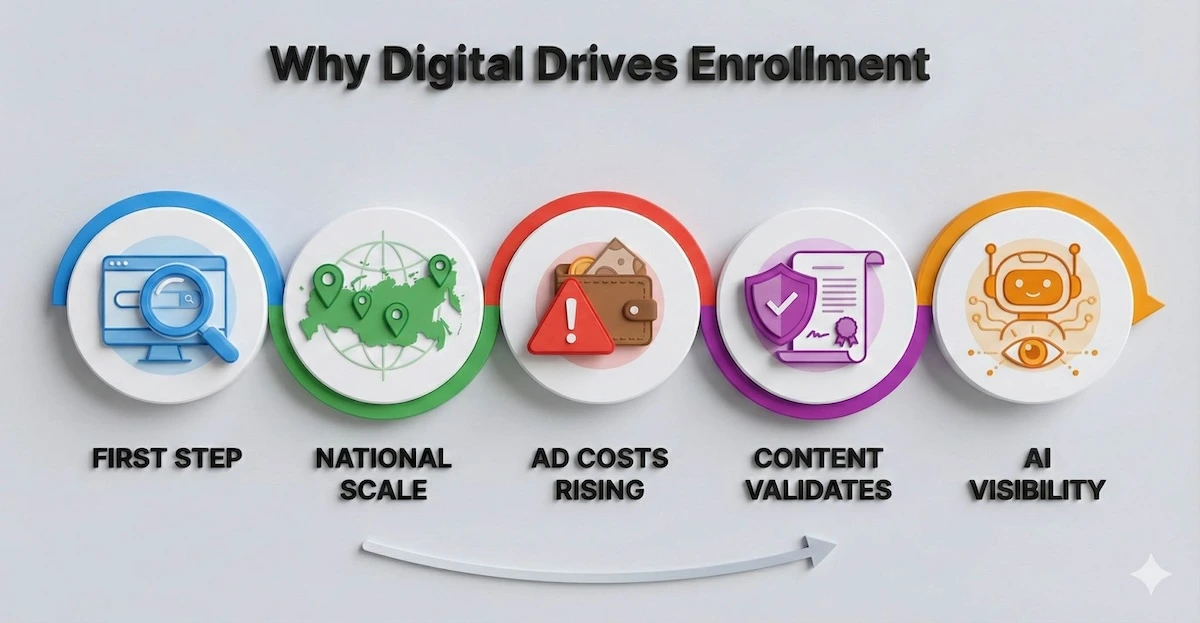
Five structural factors make digital marketing the central lever for sustainable online enrollment growth:
- Search is the starting point. Students validate program quality, faculty credentials, and employment outcomes on Google before speaking with any recruiter. Institutions that rank on page one for high-intent queries — “online master’s in [field] ranking,” “accredited online [program] program cost” — intercept prospective students at the moment of serious evaluation. Institutions that do not rank are not considered, regardless of program quality.
- Competition is national. Online programs do not compete only with geographically nearby institutions. A regional university offering an online MBA competes directly with every accredited online MBA program in the country. Ranking for non-branded program searches requires sustained content strategy and technical SEO, not just institutional name recognition. Students who have never heard of an institution will still enroll if that institution appears in their research at the right moment with compelling content.
- Paid advertising costs are rising. Cost-per-click for higher education enrollment keywords regularly reaches $45–$80 in competitive categories such as business administration, nursing, and computer science. Institutions relying solely on paid search for enrollment growth face compounding acquisition costs without building lasting organic equity. Every dollar spent on paid ads produces results only while the campaign runs; SEO investment compounds over time.
- Content builds institutional credibility. Prospective students who research multiple programs spend significantly more time on pages that explain curriculum depth, faculty research backgrounds, career outcomes data, and alumni profiles. Institutions that publish comprehensive, well-structured program content consistently outperform thin landing pages on both time-on-site and inquiry conversion rate. This content layer also directly feeds AI platform responses, since ChatGPT and Perplexity cite specific institutions based on the quality and authority of their published content.
- AI platforms are an emerging enrollment discovery channel. Responses from ChatGPT, Perplexity, and Google AI Overviews increasingly name specific institutions and programs in answer to questions like “which universities offer accredited online engineering degrees” or “best online public health master’s programs.” Institutions without strong content authority and structured data markup are consistently excluded from these AI-generated recommendations, which now influence a growing segment of the prospective student research journey.
Engineering programs navigating these visibility challenges may also find value in connecting students with a civil engineering tutor to support academic outcomes alongside enrollment growth efforts.
The Best Digital Marketing Agencies for Online Programs
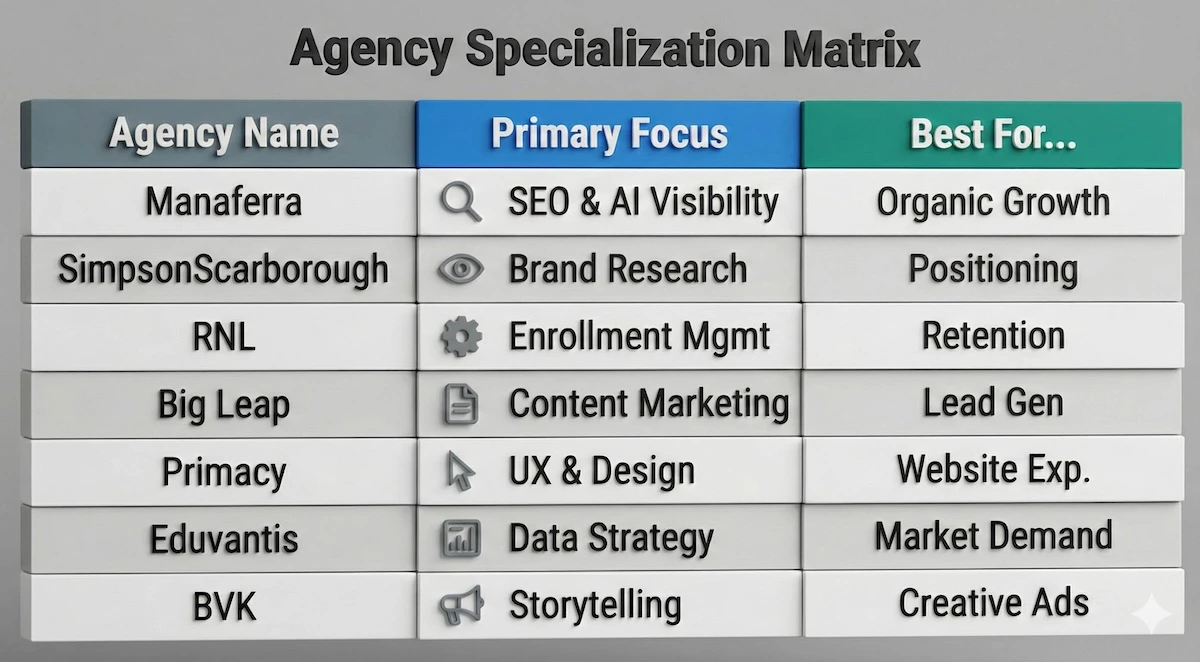
The agencies listed here were selected for documented results in higher education enrollment contexts — meaning confirmed client outcomes with measurable inquiry volume, traffic growth, or cost-per-lead improvements. General digital marketing capability is not sufficient; online enrollment marketing requires understanding of admissions cycles, program positioning, financial aid seasonality, and the multi-stage research behavior of prospective graduate and undergraduate students that can span six to eighteen months.
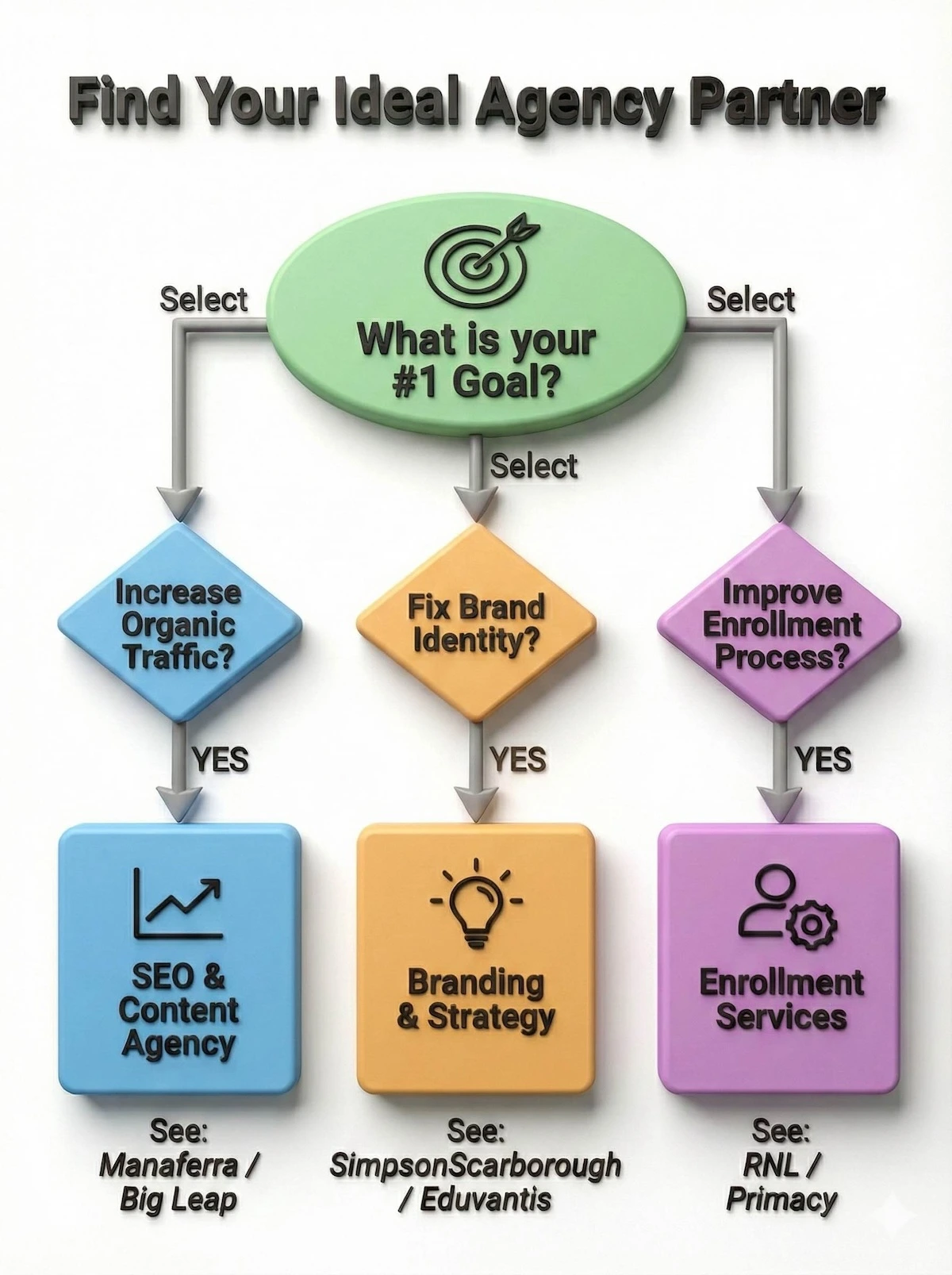
The flowchart above illustrates the core selection principle this guide returns to throughout: match agency specialty to your enrollment gap, not to agency size or reputation. An agency with a strong general digital marketing portfolio but no higher education enrollment track record will spend months learning the admissions context that specialist agencies already know.
1. Manaferra Higher Education SEO Agency
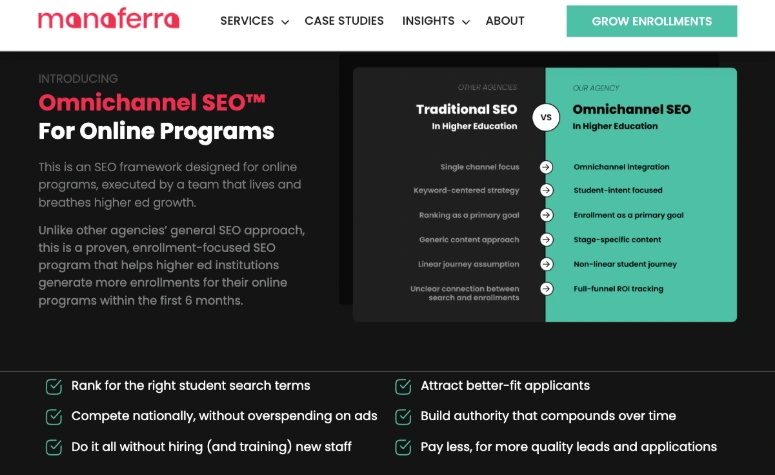
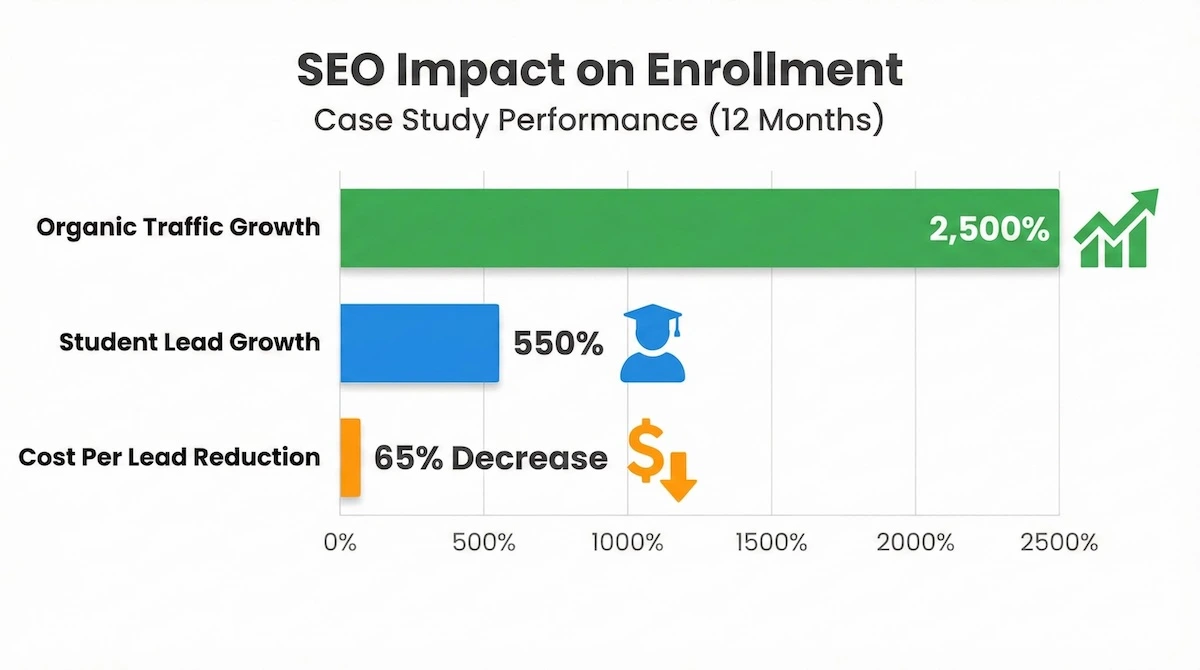
Manaferra’s SEO for online programs focuses specifically on program-level search visibility and AI citation positioning, not broad institutional branding SEO. Their documented case results include a 1,700% increase in non-branded organic traffic for an Ivy League engineering school, $148,000 in added monthly organic traffic value for a public research university, a 65% reduction in cost-per-lead for a private Catholic university in Texas, and 2,500% organic traffic growth combined with 550% lead volume increase for a downtown private university.
What distinguishes Manaferra from general SEO agencies is their focus on non-branded program search queries — the specific query type where students are actively evaluating programs for enrollment rather than searching for an institution they already know. For universities with strong brand recognition but poor visibility in competitive non-branded searches, this approach targets the traffic gap that paid advertising cannot efficiently close without compounding cost increases.
Their approach also incorporates AI visibility optimization, which positions program content to appear in ChatGPT and Perplexity responses alongside traditional Google rankings — a dual-channel strategy that reflects how prospective students in 2026 actually conduct program research.
Best fit for: Institutions with a traffic deficit on program pages that need organic search visibility for competitive non-branded enrollment queries, particularly graduate programs in competitive categories.
2. SimpsonScarborough – Research and Positioning
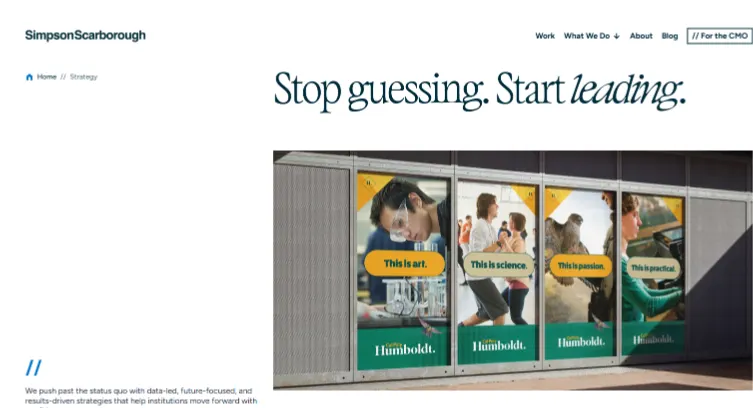
SimpsonScarborough works upstream of the campaign — identifying what genuinely differentiates an institution from competitors before any messaging or media investment is made. Their research methodology reveals the gap between how prospective students actually perceive an institution and how the institution believes it is perceived, which are frequently significantly different. This perception gap, when unaddressed, causes enrollment marketing campaigns to amplify messages that do not resonate with the students institutions are trying to reach.
The resulting positioning clarity feeds all downstream digital marketing channels: paid media copy, content strategy, landing page messaging, and email nurture sequences. Institutions that invest in positioning research before launching digital campaigns consistently produce higher inquiry-to-application conversion rates because the messaging aligns with actual student motivations rather than institutional self-perception.
Best fit for: Institutions with adequate traffic and inquiry volume but inconsistent inquiry-to-enrollment conversion, where the bottleneck is message differentiation rather than visibility. Also well-suited for institutions planning new online program launches who need validated positioning before marketing investment begins.
3. Ruffalo Noel Levitz (RNL) – Enrollment Services for Online Growth
RNL addresses the full enrollment lifecycle from initial digital outreach through retention, which makes them distinct from agencies that focus only on top-of-funnel lead generation. Their multi-channel approach combines paid media management, email nurture sequences, SMS outreach, and enrollment counselor support — particularly relevant for online programs where the conversion cycle from first inquiry to confirmed enrollment can extend six to twelve months, requiring sustained and coordinated nurture at each stage.
RNL’s enrollment lifecycle methodology is especially strong for community colleges and regional universities scaling online programs, where the prospective student population includes a high proportion of working adults with competing priorities who require multiple touchpoints and flexible communication channels before committing to enrollment.
Best fit for: Institutions with complex enrollment funnels that need coordinated management across multiple communication channels and lifecycle stages. Particularly suited for institutions where the inquiry-to-enrollment conversion window is long and multi-touch nurture is required.
4. Big Leap – Content-Driven Digital Marketing
Big Leap’s content marketing and SEO methodology prioritizes sustainable organic lead generation through informational content that captures prospective students during the research phase before they have narrowed their program choices to a short list. Their cross-industry experience, combined with documented education sector results, makes them a strong option for online programs that need to build content authority rapidly without the higher retainer costs of enrollment-specialist firms.
Big Leap’s inbound methodology is particularly effective for programs where prospective students engage in extended research phases: professional master’s programs, post-baccalaureate certificates, and online doctoral programs where the consideration-to-enrollment window extends beyond six months. Their content frameworks are designed to remain relevant throughout this extended research journey rather than optimizing only for immediate inquiry capture.
Institutions building content around technical disciplines may find it useful to review EF Education First’s approach to structured learning programs as a reference point for content depth and program positioning.
Best fit for: Online programs with limited existing content infrastructure that need rapid organic authority growth at a mid-range budget, particularly programs where student research behavior involves multiple content touchpoints before inquiry.
5. Primacy – Digital Experience for Online Students
Primacy’s differentiation is web experience design and user journey optimization — the layer between traffic arrival and inquiry submission that most enrollment marketing agencies do not address. Institutions that generate adequate traffic to program pages but see high bounce rates, low time-on-page, and poor inquiry-form completion rates often have a web experience problem, not a visibility problem. Adding more traffic to a broken conversion experience compounds the cost of each inquiry rather than solving it.
Primacy maps the student decision journey across all digital touchpoints and identifies the specific friction points — unclear program differentiation on landing pages, confusing application navigation, missing outcome data, slow page load on mobile — that cause prospective students to abandon the inquiry process before completing it. Their redesign work is tied to measurable conversion rate outcomes rather than purely aesthetic improvements.
For context on how structured academic platforms handle student experience design, the Princeton Review’s platform and pricing review offers a useful comparison of how established education brands approach student-facing digital experiences.
Best fit for: Institutions with healthy traffic volumes to program pages but poor inquiry-to-application conversion rates, indicating a UX or content-clarity barrier rather than a visibility gap. Also well-suited for institutions planning website overhauls during the enrollment slow season.
6. Eduvantis – Data-Driven Strategy
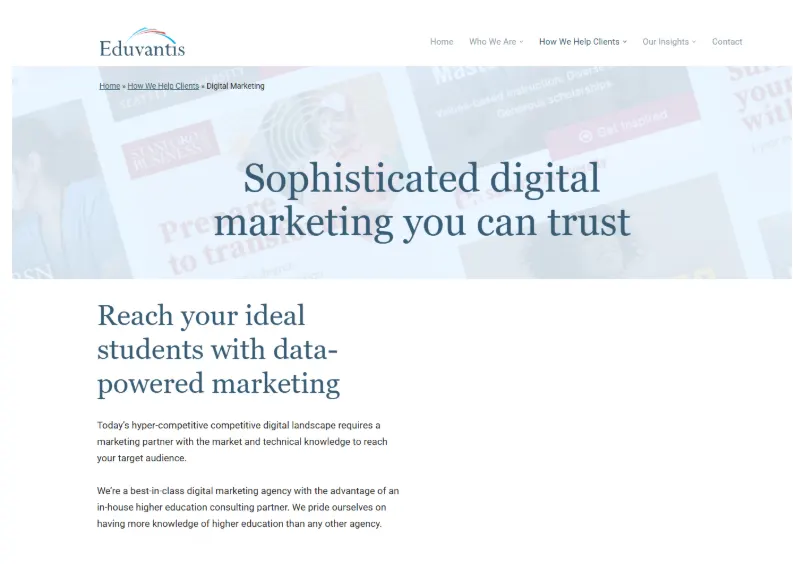
Eduvantis focuses on market demand assessment and program viability analysis before marketing investment is committed — which makes them distinct from agencies that begin with campaign execution. Their approach is particularly valuable for institutions planning new online programs or evaluating whether to continue investing in underperforming ones. By mapping actual student demand data against competitive program supply, Eduvantis provides the strategic foundation that prevents misallocated marketing spend on programs with structurally weak demand.
For institutions where enrollment marketing investment has produced traffic growth without corresponding inquiry or enrollment gains, Eduvantis-style demand analysis often reveals that the underlying issue is program positioning or market saturation rather than marketing execution. Identifying this root cause before committing additional budget to campaign activity is a significant cost-avoidance capability.
Institutions evaluating research support platforms as part of their program development strategy may find the Grad Coach platform review a useful reference for understanding how academic coaching services position themselves in the graduate education market.
Best fit for: Institutions in program planning, portfolio rationalization, or new market entry mode. Also suitable for universities that have experienced unexplained enrollment declines and need independent market analysis before recommitting digital marketing budgets.
7. BVK – Campaign Storytelling
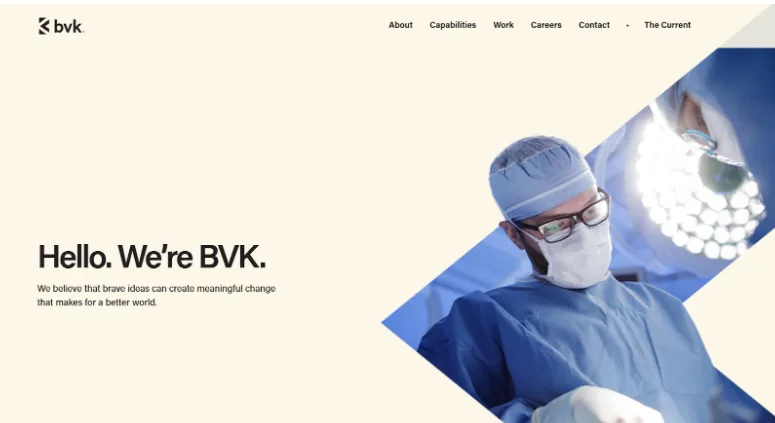
BVK specializes in narrative-driven campaign development that centers on student outcomes and program flexibility — the two factors that consistently drive enrollment decisions for working adults considering online programs. Their messaging frameworks are built around enrollment motivations specific to online students: career advancement timelines, schedule flexibility for working professionals, credential credibility in hiring contexts, and return-on-investment clarity for programs with meaningful tuition costs.
For institutions targeting adult learners and career-changers, BVK’s approach directly addresses the skepticism this demographic brings to online education marketing. Adult learners who have previously experienced underfunded online programs or who question whether an online credential carries the same weight as a residential one require storytelling that addresses these concerns with specificity rather than generic flexibility messaging.
Institutions whose programs include electrical or chemical engineering disciplines may benefit from pairing strong enrollment messaging with accessible academic support — for example, connecting enrolled students with an electrical engineering tutor to improve retention outcomes alongside enrollment growth.
Best fit for: Institutions targeting adult learners and career-changers where outcomes-based messaging and flexibility narratives are central to the enrollment value proposition. Particularly effective for programs in business, healthcare, technology, and education where credential credibility questions are common during the research phase.
8. Echo Delta – Full-Service Enrollment Marketing
Echo Delta, operating since 1991, has built a specialist reputation in higher education enrollment marketing that spans prospective student outreach, alumni engagement, and integrated campaign development. Their service portfolio covers SEO, web development, content strategy, and marketing automation — all developed specifically within the higher education admissions context rather than adapted from other industries.
Echo Delta’s long tenure in enrollment marketing means their campaigns are calibrated for the admissions cycle rhythms that newer agencies must learn through iteration: the timing of inquiry campaign surges, the content types that convert during the decision window, and the messaging shifts required as application deadlines approach. For institutions that have worked with multiple general marketing agencies without achieving consistent enrollment results, Echo Delta’s depth in enrollment-specific campaign management represents a meaningful capability difference.
Institutions building out STEM program enrollment may also find value in supporting admitted students with a chemical engineering tutor to strengthen academic outcomes and retention rates.
For a broader view of how academic support platforms structure their offerings, the Bartleby platform review provides useful context on how content-driven education services approach student engagement.
Best fit for: Institutions seeking a full-service enrollment marketing partner with deep experience across the complete admissions campaign calendar, particularly those that need SEO, content, web development, and marketing automation coordinated by a single team with higher education enrollment expertise.
Digital Marketing Agency Pricing: What Universities Budget in 2026
Higher education digital marketing agency pricing varies significantly based on service scope, agency specialization, and institutional scale. Universities that define a cost-per-enrolled-student target before setting an agency budget — rather than working backward from a spend cap — consistently report better return on investment. Enrollment-focused agencies price their services against inquiry and enrollment outcomes; institutions that frame the engagement as a cost line rather than an investment with a measurable per-enrollment return tend to underfund effective strategies and overfund ineffective ones.
| Service Type | Typical Range | Engagement Model | Best Suited For |
|---|---|---|---|
| SEO Retainer (specialist firm) | $3,000–$10,000/month | Monthly retainer, 12–24 months | Institutions with traffic deficit on program pages |
| Content Marketing Retainer | $2,500–$8,000/month | Monthly retainer, 12+ months | Programs building content authority from a low baseline |
| Brand Positioning + Research | $25,000–$75,000 | Project-based, 3–6 months | Institutions launching or repositioning programs |
| Full-Service Enrollment Marketing | $8,000–$25,000/month | Monthly retainer, 12+ months | Multi-channel coordination across full funnel |
| Web UX Redesign | $50,000–$200,000 | One-time project, 4–9 months | Institutions with high traffic but poor inquiry conversion |
| Market Demand Research | $15,000–$50,000 | Project-based, 2–4 months | New program planning and portfolio rationalization |
The most common budget mistake in higher education digital marketing is treating agency fees as a fixed cost line rather than an investment against a measurable cost-per-enrolled-student target. Institutions that establish enrollment targets before budgeting — working backward from an acceptable cost-per-enrolled-student figure to determine appropriate agency retainer levels — consistently outperform those that set marketing budgets based on prior-year spend patterns or peer institution benchmarks.
A concrete illustration: the 65% cost-per-lead reduction documented in Manaferra’s Texas Catholic university case study means that if the institution was previously generating qualified leads at $400 each through paid advertising, an SEO engagement reducing that cost to $140 would recover a $7,000 monthly retainer from roughly 22 additional conversions over prior performance. Universities enrolling 50–200 students annually in online programs should evaluate agency retainer costs against this type of per-conversion math, not against an abstract marketing budget ceiling.
For institutions in the early stages of online program development, market demand research projects ($15,000–$50,000) often produce the highest ROI of any digital marketing investment by preventing misallocated campaign spend on programs that lack the market demand to achieve enrollment targets regardless of marketing quality. Identifying a weak-demand scenario before committing a 12-month agency retainer avoids a much larger sunk cost.
Institutions whose programs include a marketing component may find that pairing enrollment strategy with accessible academic support helps students succeed once enrolled, reinforcing the return on marketing investment.
How to Choose the Right Digital Marketing Agency for Your Institution
Institutions that evaluate agencies against their specific enrollment bottleneck — traffic deficit, brand differentiation gap, or funnel conversion problem — reach enrollment targets significantly faster than those that select based on agency reputation, client portfolio size, or marketing budget ceiling. The selection process that consistently produces strong ROI follows three sequential steps: diagnose the funnel stage that is failing, match agency specialty to that stage, and define measurable success criteria before the engagement begins.
Step 1: Diagnose your enrollment funnel stage before issuing an RFP
The four enrollment funnel breakdowns each require a different agency specialty. Identifying which one applies to your institution before requesting agency proposals prevents the most common selection error — hiring a strong agency for the wrong problem:
- Awareness gap (low organic impressions on program pages, poor rankings for non-branded enrollment queries, low direct traffic to program landing pages): requires SEO and content authority investment. Agencies best positioned: Manaferra, Big Leap, Echo Delta.
- Differentiation gap (adequate traffic arriving to program pages but high bounce rates, low time-on-page, and inquiry rates below 2–3% of sessions): indicates a messaging problem — prospective students are finding the institution but not finding a compelling reason to inquire. Agencies best positioned: SimpsonScarborough, BVK.
- Conversion gap (strong inquiry volume but poor inquiry-to-application and application-to-enrollment rates): may indicate a web experience friction issue, a nurture sequence gap, or a counselor-response problem. Agencies best positioned: Primacy (UX), RNL (lifecycle nurture).
- Demand or strategy gap (uncertainty about whether a program has sufficient market demand to justify enrollment marketing investment, or recent unexplained enrollment declines without a clear cause): requires market demand analysis before campaign engagement. Agency best positioned: Eduvantis.
Step 2: Match the engagement model to your timeline and budget structure
Retainer-based engagements (SEO, content marketing, full-service enrollment management) are appropriate for continuous visibility building that compounds over 12–24 months. Project-based engagements (brand positioning research, web redesign, demand analysis) are appropriate for specific deliverables with defined endpoints. The most common structural mistake is engaging a retainer agency for a project-scope problem or commissioning a project when a sustained retainer is what produces results.
For institutions without an established digital marketing foundation, sequencing matters: demand research and positioning work should precede campaign retainers. Launching an SEO or paid media campaign before the institution has a differentiated message and clear program positioning means spending agency budget to drive traffic to messaging that does not convert.
Step 3: Define success metrics before the contract is signed
Enrollment marketing engagements that fail — producing agency activity without enrollment outcomes — typically share one characteristic: success metrics were not defined before the engagement began. Institutions that specify measurable targets in the contract (a cost-per-inquiry ceiling, an organic traffic growth percentage for program pages over 12 months, an inquiry-to-application conversion rate improvement) give agencies clear performance criteria and give themselves clear criteria for renewal or contract termination decisions.
The single most revealing question to ask any prospective enrollment marketing agency is: “Can you show us results from a program with a similar competitive profile to ours, and walk us through the specific strategy that produced those results?” Agencies that answer with outcome numbers only — without being able to explain the process — are less likely to be able to replicate those results in a new institutional context. Agencies that can explain why a specific content type outperformed another for a similar program in a similar market are demonstrating transferable strategic understanding, not just a favorable historical outcome.
Frequently Asked Questions About Digital Marketing Agencies for Online Enrollment
What should a university budget for digital marketing agency services?
Higher education digital marketing agency retainers typically range from $2,500 to $25,000 per month depending on service scope and agency specialization. SEO-focused engagements for online program visibility generally run $3,000–$10,000 per month for specialist firms. Full-service enrollment marketing partnerships covering SEO, content, paid media coordination, and analytics run $8,000–$25,000 monthly. Project-based work such as brand positioning research or website redesign is typically priced as a one-time engagement ranging from $25,000 to $200,000 depending on scope. Institutions that set their budget based on a target cost-per-enrolled-student calculation consistently report better ROI than those working from a fixed marketing spend cap.
How long does it take to see enrollment results from digital marketing?
SEO and content marketing investments typically produce measurable organic traffic improvements within 4–6 months of consistent execution, with enrollment conversion impact visible over a 9–18 month cycle as organic visibility compounds. Paid advertising adjustments produce faster traffic results but do not build lasting organic equity. Brand positioning research and messaging work generally requires a full admissions cycle (12 months) to accurately attribute enrollment impact, since the positioning change affects how prospective students in the pipeline respond over an extended decision window. Institutions expecting ROI within 90 days should focus on conversion rate optimization and paid media campaign refinement rather than organic SEO, which requires longer timelines to demonstrate enrollment-level outcomes.
Do specialist higher education marketing agencies cost more than general digital marketing agencies?
Higher education enrollment specialist agencies typically charge 20–40% more than general digital marketing agencies at equivalent service scope. However, specialist agencies bring established knowledge of admissions cycles, accreditation communication requirements, enrollment seasonality, and prospective student research behavior that general agencies must learn at the institution’s expense during the early months of an engagement. For competitive online programs, the specialist premium is generally recovered within 6–12 months through faster campaign ramp-up, fewer strategy iterations, and avoidance of the common errors that general agencies make when applying non-enrollment marketing logic to admissions contexts.
What is the most common mistake universities make when selecting a digital marketing agency?
The most consistently documented failure mode is selecting an agency based on general digital marketing capability or client portfolio recognition rather than demonstrated higher education enrollment outcomes. Institutions that hire agencies with strong B2B or e-commerce backgrounds frequently find that these agencies optimize for the metrics they know — website traffic volume, click-through rate, social engagement rate — rather than the enrollment-specific outcomes that matter: qualified inquiry volume, inquiry-to-application conversion rate, and cost-per-enrolled-student. A second common mistake is selecting an agency for the wrong funnel stage: hiring an SEO agency when the problem is conversion, or commissioning brand research when the problem is traffic. Diagnosing the actual bottleneck before selecting an agency is the highest-leverage decision in the entire engagement process.
Selecting a digital marketing agency for online enrollment growth is a multi-year strategic decision, not an annual vendor rotation. Institutions that consistently grow online program enrollment share one consistent characteristic: they matched agency capability to their specific enrollment funnel problem rather than to their marketing budget ceiling or peer institution choices.
Use the agency profiles, pricing benchmarks, and selection framework in this guide as a starting point, but validate every shortlisted agency with the direct question: documented results for programs in your competitive category, with the process explained, not just the outcome.
For students and institutions seeking a foundation in digital marketing strategy as it relates to program development and enrollment planning, the digital marketing resources at MyEngineeringBuddy provide accessible grounding in the core concepts that inform agency evaluation and campaign decisions.
Educational content only. Verify all agency pricing, services, and enrollment marketing decisions with qualified institutional marketing professionals and your institution’s strategic context before committing to any agency engagement.
Related Reading
******************************
This article provides general educational guidance only. It is NOT official exam policy, professional academic advice, or guaranteed results. Always verify information with your school, official exam boards (College Board, Cambridge, IB), or qualified professionals before making decisions. Read Full Policies & Disclaimer , Contact Us To Report An Error