

Hire Verified & Experienced
Chemical Engineering Tutors
Email: [email protected]
4.8/5 40K+ session ratings collected on the MEB platform



Hire The Best Chemical Engineering Tutor
Top Tutors, Top Grades. Without The Stress!
Most students who fail a Chemical Engineering module don’t run out of time — they run out of someone to explain why their mass balance was wrong on page 3.
Chemical Engineering Tutor Online
Chemical engineering applies principles of chemistry, physics, mathematics, and biology to design and operate processes that convert raw materials into useful products, equipping students to analyse reaction kinetics, mass and energy balances, and process safety.
MEB provides 1:1 online tutoring and homework help in 2800+ advanced subjects — including expert support for every level of engineering study. Whether you’re searching for a Chemical Engineering tutor near me or need someone who knows your exact module, MEB matches you with a verified specialist, usually within the hour. Sessions are live, built around your syllabus, and correct your specific errors in real time — not a recorded lecture.
- 1:1 online sessions tailored to your course, module, or university syllabus
- Expert verified tutors with degrees and professional experience in chemical engineering
- Flexible scheduling across US, UK, Canada, Australia, and the Gulf
- Structured learning plan built after a first-session diagnostic
- Ethical homework and assignment guidance — you understand the work, then submit it yourself
52,000+ students across the US, UK, Canada, Australia, and the Gulf have used MEB since 2008 — including students in Engineering subjects like Chemical Engineering, Mechanical Engineering, and Petroleum Engineering.
Source: My Engineering Buddy, 2008–2025.
How Much Does a Chemical Engineering Tutor Cost?
Most Chemical Engineering tutoring sessions run $20–$40/hr depending on level and topic complexity. Graduate-level and niche process engineering topics can reach $60–$100/hr. The $1 trial gets you 30 minutes of live 1:1 tutoring or a full explanation of one homework question — no registration required.
| Level / Need | Typical Rate | What’s Included |
|---|---|---|
| Undergraduate (Year 1–3) | $20–$35/hr | 1:1 sessions, homework guidance, exam prep |
| Advanced / Graduate | $35–$100/hr | Expert tutor, niche process topics, thesis support |
| $1 Trial | $1 flat | 30 min live session or one full question explained |
Tutor availability tightens in April–May and October–November during university exam cycles. Book early if you’re working to a deadline.
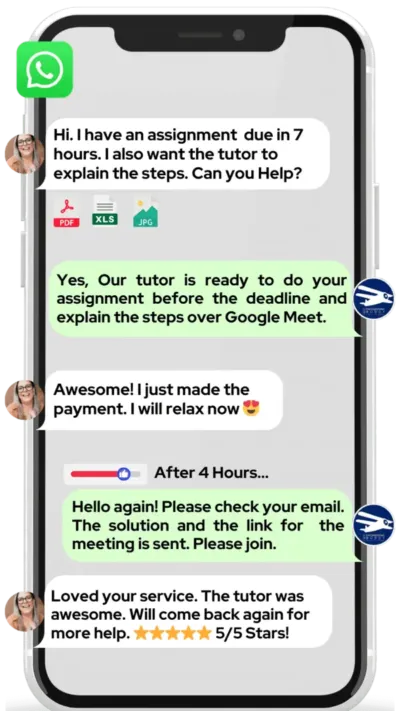
WhatsApp MEB for a quick quote — average response time under 1 minute.
Who This Chemical Engineering Tutoring Is For
Chemical engineering is one of the most mathematically demanding branches of engineering. Most students who reach out to MEB aren’t struggling because they don’t work hard — they’re stuck because nobody has explained the underlying reasoning clearly enough, fast enough.
- Undergraduates at universities like MIT, Imperial College London, ETH Zurich, University of Toronto, University of Melbourne, or TU Delft hitting a wall in thermodynamics or transport phenomena
- Students retaking after a failed first attempt at a core module like reaction engineering or process control
- Graduate students with a thesis or research project involving modelling, simulation, or process optimisation
- Students with a university conditional offer depending on their final-year grade in chemical engineering
- Parents watching a child’s confidence drop alongside their grades in second-year heat and mass transfer
- Students 4–6 weeks from finals with gaps in fluid mechanics, equilibrium calculations, or unit operations
MEB also works with students at Georgia Tech, Caltech, University of Cambridge, McGill, UNSW, and KU Leuven — wherever the coursework is tough and the office hours aren’t enough.
1:1 Tutoring vs Self-Study vs AI vs YouTube vs Online Courses
Self-study works if your notes are complete and you already know what you don’t understand. AI tools answer fast but can’t watch you botch a Raoult’s Law calculation and stop you mid-step. YouTube covers distillation column theory well — it cannot tell you why your specific answer is wrong. Online courses give structure but run at a fixed pace, not yours. With MEB, a 1:1 online Chemical Engineering tutor works through your exact problem set, on your syllabus, correcting errors live — not after you’ve already submitted.
Outcomes: What You’ll Be Able To Do in Chemical Engineering
After working with an MEB Chemical Engineering tutor, students can solve multi-component mass and energy balance problems without reaching for a worked example first. They can analyse reaction kinetics and apply rate laws to both ideal and non-ideal reactor designs. Students learn to model phase equilibrium using equations of state and activity coefficient models. They can explain heat exchanger design parameters and specify appropriate configurations for given process conditions. Most students also develop enough confidence in process flow diagrams and P&IDs to approach design assessments without second-guessing every step.
Supporting a student through Chemical Engineering? MEB works directly with parents to set up sessions, track progress, and keep coursework on schedule. WhatsApp MEB — average response time is under a minute, 24/7.
Based on feedback from 40,000+ sessions collected by MEB from 2022 to 2025, 58% of students improved by one full grade after approximately 20 hours of 1:1 tutoring in subjects like Chemical Engineering. A further 23% achieved at least a half-grade improvement.
Source: MEB session feedback data, 2022–2025.
What We Cover in Chemical Engineering (Syllabus / Topics)

Track 1: Core Fundamentals
- Material and energy balances — single and multi-unit systems
- Thermodynamics: equations of state, phase equilibria, Gibbs free energy
- Fluid mechanics: Bernoulli, pipe flow, pumps, and pressure drop calculations
- Heat transfer: conduction, convection, radiation, and heat exchanger design
- Mass transfer: diffusion, absorption, distillation, and extraction
- Chemical reaction engineering: batch, CSTR, and PFR reactor design
- Process safety and HAZOP principles
Key texts: Felder & Rousseau — Elementary Principles of Chemical Processes; Smith, Van Ness & Abbott — Introduction to Chemical Engineering Thermodynamics.
Track 2: Process Design and Control
- Process flow diagrams and piping & instrumentation diagrams (P&IDs)
- Process simulation using Aspen Plus, HYSYS, or CHEMCAD
- Equipment sizing: distillation columns, heat exchangers, reactors
- Process control: PID controllers, control loops, stability analysis
- Economic evaluation and cost estimation of chemical plants
- Environmental and sustainability considerations in process design
Key texts: Turton et al. — Analysis, Synthesis and Design of Chemical Processes; Seider, Seader & Lewin — Product and Process Design Principles. ASTM International standards are referenced extensively in process safety and materials selection — see ASTM International for current standards coverage.
Track 3: Advanced and Specialist Topics
- Transport phenomena: simultaneous heat, mass, and momentum transfer
- Catalysis and surface chemistry
- Polymer engineering and materials processing
- Biochemical engineering and bioprocess design
- Computational fluid dynamics (CFD) fundamentals
- Research project and thesis support — literature review, methodology, results
Key texts: Bird, Stewart & Lightfoot — Transport Phenomena; Fogler — Elements of Chemical Reaction Engineering.
At MEB, we’ve found that Chemical Engineering students often understand a concept when it’s explained in isolation — but freeze when a problem combines mass balances with thermodynamics and reaction kinetics simultaneously. That’s exactly where a live tutor makes the difference that a textbook can’t.
What a Typical Chemical Engineering Session Looks Like
The tutor opens by revisiting the previous topic — often something like CSTR reactor sizing or a distillation equilibrium problem — to check what stuck and what didn’t. From there, the student and tutor work through the current problem set together on screen: the tutor uses a digital pen-pad to annotate diagrams, walk through energy balance derivations, or mark up a process flow diagram in real time. The student is asked to replicate each step or explain their reasoning out loud — not just watch. By the end of the session, the tutor sets a specific practice problem to attempt before the next session and identifies the next topic in the sequence. Nothing is left open-ended.
How MEB Tutors Help You with Chemical Engineering (The Learning Loop)
Diagnose: In the first session, the tutor identifies exactly where the student’s understanding breaks down — whether that’s setting up a multi-component balance, misapplying an equation of state, or losing track of sign conventions in energy calculations. Gaps are mapped before any explanation begins.
Explain: The tutor works through problems live using a digital pen-pad, showing each derivation step and flagging where students typically drop marks. No recorded video. No prepared slides that don’t match the student’s actual problem sheet.
Practice: The student attempts a parallel problem with the tutor present. This is where most of the session time goes — not passive watching, but active working under guided conditions.
Feedback: The tutor corrects errors step by step, explaining not just what went wrong but why it costs marks in an exam context. Students leave knowing the exact point of failure, not just the right answer.
Plan: At the end of each session, the tutor sets the next task, confirms the topic order, and checks the student’s upcoming deadlines. The sequence adapts based on what was covered.
Sessions run over Google Meet. The tutor uses a digital pen-pad or iPad with Apple Pencil to draw, annotate, and work through calculations in real time. Before the first session, share your university module guide or exam board syllabus, a recent assignment or past paper you struggled with, and your exam or submission date. The first session covers the diagnostic, the highest-priority gap, and the session plan going forward. Start with the $1 trial — 30 minutes of live tutoring that also serves as your first diagnostic.
Students consistently tell us that the biggest shift isn’t the grade — it’s the moment Chemical Engineering stops feeling like a collection of disconnected formulas and starts making sense as a single, connected system. That shift usually happens in session three or four.
MEB tutors bring real process engineering backgrounds — not just academic knowledge. Students working on Aspen simulations, reactor design problems, or thesis research get tutors who have worked in those areas, not just studied them.
Source: My Engineering Buddy tutor profiles, 2008–2025.
Tutor Match Criteria (How We Pick Your Tutor)
MEB doesn’t assign tutors randomly. Every match is made against four criteria.
Subject depth: The tutor must have a degree in chemical engineering or a closely related discipline, and direct experience with the student’s specific course level — undergraduate thermodynamics is a different teaching task from graduate transport phenomena or thesis supervision.
Tools: Every tutor is equipped with Google Meet and a digital pen-pad or iPad with Apple Pencil. No exceptions. Chemical engineering problems require handwritten calculation, annotated diagrams, and real-time process sketching — a text-only tutor is not an option.
Time zone: The tutor’s available hours are matched to the student’s region — US, UK, Gulf, Canada, or Australia. You’re not booking a session at 3am.
Goals: Whether the goal is passing a specific exam, improving a simulation assignment, getting through a thesis chapter, or building conceptual depth in reaction engineering, the tutor match accounts for it from the start.
Unlike platforms where you fill out a form and wait, MEB responds in under a minute, 24/7. Tutor match takes under an hour. The $1 trial means you test before you commit. Everything runs over WhatsApp — no logins, no intake forms.
Study Plans (Pick One That Matches Your Goal)
The tutor builds a specific session sequence after the diagnostic — but most students fall into one of three tracks. Catch-up (1–3 weeks): you’re behind on a core module and need to close specific gaps before an exam or coursework deadline. Exam prep (4–8 weeks): structured revision built around your exam date, covering all assessed components in priority order. Weekly support: ongoing sessions aligned to your semester timetable, keeping you on top of each new topic as it’s taught. The tutor adjusts the plan as you progress — it’s not a fixed programme.
Pricing Guide
Chemical Engineering tutoring starts at $20/hr for standard undergraduate modules and runs to $40/hr for more specialised content. Graduate-level work, thesis support, and advanced process design or simulation topics are typically $60–$100/hr depending on the tutor’s background and the complexity of the material.
Rate factors include: course level, topic (thermodynamics and transport phenomena tend to sit at the higher end), your timeline, and tutor availability. Availability becomes tighter in April–May and October–November — if you have a known exam date, earlier is better.
For students targeting top-tier graduate programmes or professional roles in oil and gas, pharmaceuticals, or petrochemicals, tutors with direct industry or research backgrounds are available at higher rates. Share your goal and MEB will match the right tier.
Start with the $1 trial — 30 minutes, no registration, no commitment. WhatsApp MEB for a quick quote.
Try your first session for $1 — 30 minutes of live 1:1 tutoring or one homework question explained in full. No registration. No commitment. WhatsApp MEB now and get matched within the hour.
FAQ
Is Chemical Engineering hard?
Yes — consistently ranked among the most demanding undergraduate degrees. The difficulty comes from combining rigorous mathematics with chemistry, thermodynamics, and process design simultaneously. Students who struggle most are those who understood the individual subjects but haven’t integrated them yet. That’s exactly what 1:1 tutoring addresses.
How many sessions are needed?
Students closing a specific gap before an exam typically need 4–8 sessions. Those seeking ongoing module support through a semester usually book weekly. The tutor gives a clearer estimate after the first diagnostic session, once the actual gap is mapped.
Can you help with homework and assignments?
MEB tutoring is guided learning — you understand the work, then submit it yourself. The tutor explains the method, works through similar examples, and checks your reasoning. See our Academic Integrity policy and Why MEB page for full details on what we help with and what we don’t.
Will the tutor match my exact syllabus or exam board?
Yes. When you contact MEB, share your university module guide, course outline, or exam board. The tutor is matched to your specific syllabus — not a generic chemical engineering curriculum. This matters most for transport phenomena and reaction engineering, where coverage varies significantly between institutions.
What happens in the first session?
The tutor starts with a short diagnostic: a few questions across the key topics to find exactly where understanding breaks down. From there, the session moves directly into the highest-priority gap. You leave with a clear plan and a practice task for before the next session.
Is online tutoring as effective as in-person?
For chemical engineering, yes — provided the tutor uses a digital pen-pad or tablet for real-time working. MEB tutors all use this setup. Students in the US, UK, Gulf, and Australia consistently report that live online sessions with handwritten working are indistinguishable from sitting next to someone at a table.
Can you help with Aspen Plus or HYSYS process simulation?
Yes. MEB has tutors with hands-on experience in Aspen Plus, Aspen HYSYS, and CHEMCAD. Help covers model setup, stream specifications, convergence issues, and interpreting results. Share your simulation file or assignment brief when you contact MEB and the tutor will be matched accordingly.
Do you cover chemical engineering at the graduate and PhD level?
Yes. MEB supports Masters and PhD students in transport phenomena, advanced reaction engineering, process optimisation, and thesis research. Tutors at this level typically have research or industry backgrounds in the relevant specialisation. Rates for graduate and doctoral work are higher — WhatsApp MEB with your specific topic for an accurate quote.
Can I get Chemical Engineering help at midnight or on weekends?
Yes. MEB operates 24/7 across all time zones. Students in the Gulf, Australia, and North America regularly book sessions outside standard business hours. WhatsApp MEB at any time — average response is under a minute — and the tutor is matched to your available hours.
What if I don’t like my assigned tutor?
Tell MEB via WhatsApp and a replacement is arranged, typically within the same day. The $1 trial exists partly for this reason — you assess the tutor fit before committing to paid sessions. No awkward forms, no delay.
How do I get started?
Three steps: WhatsApp MEB with your subject, level, and exam or deadline date. MEB matches you with a verified Chemical Engineering tutor, usually within an hour. Start with the $1 trial — 30 minutes live or one full question explained — then continue at the standard rate if you’re satisfied.
What’s the difference between Chemical Engineering and Chemistry tutoring?
Chemistry focuses on molecular behaviour, reactions, and laboratory technique. Chemical Engineering takes those principles and applies them at scale — designing reactors, separation systems, and industrial processes. Students who confuse the two often book the wrong tutor. MEB tutors are matched specifically to whichever discipline your course falls under.
Trust & Quality at My Engineering Buddy
Every MEB tutor goes through a subject-specific screening process: degree verification, a live demo session evaluated by a senior tutor, and ongoing review based on student feedback. Tutors for chemical engineering are required to demonstrate command of at least two core topic areas — not just general science fluency. Rated 4.8/5 across 40,000+ verified reviews on Google. MEB has been running since 2008 and has served 52,000+ students.
MEB tutoring is guided learning — you understand the work, then submit it yourself. For full details on what we help with and what we don’t, read our Academic Integrity policy and Why MEB.
MEB covers 2,800+ subjects across the US, UK, Canada, Australia, Gulf, and Europe. Within engineering, the platform supports students across mechanical engineering tutoring, biomedical engineering help, and materials science and engineering tutoring — alongside chemical engineering and dozens of related disciplines. The same tutor vetting process, session structure, and response times apply across every subject.
Since 2008, MEB has matched students to verified specialist tutors — not generalists. For chemical engineering, that means tutors who can move between thermodynamics, fluid mechanics, and process simulation in a single session without losing the thread.
Source: My Engineering Buddy, 2008–2025.
A common pattern our tutors observe is that students who arrive convinced they “just can’t do thermo” have usually been taught the equations without the physical intuition behind them. Once that connection is made — often in one session — the equations stop being arbitrary and start being obvious.
Explore Related Subjects
Students studying Chemical Engineering often also need support in:
- Petroleum Engineering
- Nuclear Engineering
- Bioengineering
- Industrial Engineering
- Food Engineering
- Metallurgical Engineering
- Systems Engineering
Next Steps
Before your first session, have ready: your exam board and syllabus (or course outline), a recent past paper attempt or homework you struggled with, and your exam or deadline date. The tutor handles the rest.
- Share your module, exam board, and the topics giving you the most trouble
- Share your availability and time zone — MEB covers US, UK, Gulf, Canada, and Australia
- MEB matches you with a verified Chemical Engineering tutor — usually within 24 hours
- First session starts with a diagnostic so every minute is used on what matters
Visit www.myengineeringbuddy.com for more on how MEB works.
WhatsApp to get started or email [email protected].
52,000+ Happy Students From Various Universities






How Much For Private 1:1 Tutoring & Hw Help?
Private 1:1 Tutoring and HW help Cost $20 – 35 per hour* on average.
Reviewed by Subject Expert
This page has been carefully reviewed and validated by our subject expert to ensure accuracy and relevance.
