~1 min
Average Reply Time
~1 hour
To Be Matched With A Tutor
30 Min Trial
75% Find Their Tutor On The 1st Trial
$20-35+/hr
Premium Yet Affordable Learning
Hire The Best Bioengineering Tutor

Struggling with cell mechanics, biomaterials, or gene circuit modelling — and your professor’s office hours are full? You need someone who can work through the actual problem with you, not point you to a textbook chapter.
Bioengineering Tutor Online
Bioengineering applies engineering principles — mechanics, thermodynamics, systems design — to biological systems and medical problems, equipping students to analyse, model, and solve challenges in medicine, biotechnology, and tissue engineering.
MEB provides 1:1 online tutoring and homework help in 2,800+ advanced subjects, including Bioengineering. If you’ve been searching for a Bioengineering tutor near me, online sessions work just as well — often better, because the tutor can share annotated diagrams, worked models, and past-paper solutions directly on screen. Our engineering tutoring covers every sub-discipline, and Bioengineering sits at the intersection of biology, chemistry, and engineering — which means your tutor needs to be genuinely cross-trained. Ours are.
- 1:1 online sessions tailored to your specific course and syllabus
- Expert-verified tutors with subject-specific depth in biological and engineering sciences
- Flexible time zones — US, UK, Canada, Australia, Gulf
- Structured learning plan built after a diagnostic session
- Ethical homework and assignment guidance — you understand before you submit
52,000+ students across the US, UK, Canada, Australia, and the Gulf have used MEB since 2008 — including students in Engineering subjects like Bioengineering, Biomedical Engineering, and Chemical Engineering.
Source: My Engineering Buddy, 2008–2025.
How Much Does a Bioengineering Tutor Cost?
Most Bioengineering sessions run $20–$40/hr. Graduate-level or highly specialised topics — synthetic biology, neural engineering, advanced biomechanics — can reach $100/hr depending on tutor background and session complexity. The $1 trial gets you 30 minutes of live tutoring or one full homework question explained — no registration required.
| Level / Need | Typical Rate | What’s Included |
|---|---|---|
| Undergraduate (most levels) | $20–$40/hr | 1:1 sessions, homework guidance |
| Graduate / Specialist | $40–$100/hr | Expert tutor, niche depth, research support |
| $1 Trial | $1 flat | 30 min live session or 1 homework question |
Tutor availability tightens around end-of-semester deadlines and finals periods — if you’re 4–6 weeks out from an exam or submission, book early.
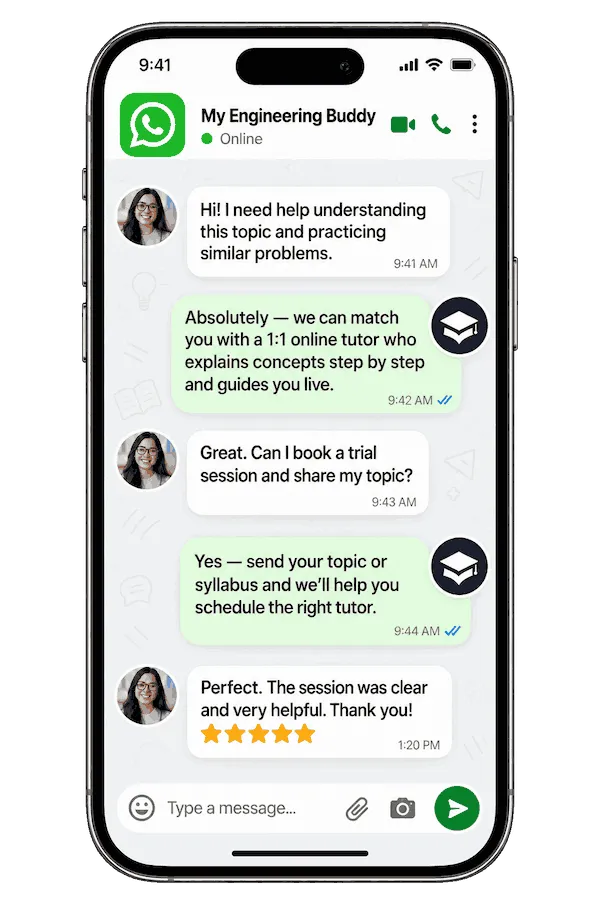
WhatsApp MEB for a quick quote — average response time under 1 minute.
Who This Bioengineering Tutoring Is For
Bioengineering spans a wide ability range — from students hitting a wall on transport phenomena in their second year, to PhD candidates working through computational tissue models. If the course is asking you to integrate biology with quantitative engineering methods and you’re not sure how to bridge that gap, this is for you.
- Undergraduate students struggling with biomechanics, biofluid dynamics, or cell biology modules
- Graduate students needing help with biomaterials characterisation, systems biology, or research methodology
- Students retaking after a failed first attempt — whether it’s a thermodynamics unit or a lab-report-heavy module
- Students at MIT, Johns Hopkins, Imperial College London, ETH Zurich, University of Toronto, TU Delft, or UNSW — where Bioengineering programmes are particularly demanding
- Students needing structured homework guidance without crossing academic lines
- Parents watching a child’s confidence drop alongside their Bioengineering grades
At MEB, we’ve found that Bioengineering students often hit the same wall: they understand the biology or they understand the engineering, but not how the two connect mathematically. That bridging is exactly where a good tutor earns their hourly rate.
1:1 Tutoring vs Self-Study vs AI vs YouTube vs Online Courses
Self-study works if you’re disciplined — but in Bioengineering, no textbook tells you why your specific model is wrong. AI tools explain concepts fast but can’t watch you work through a finite element mesh and spot where your boundary conditions collapsed. YouTube is excellent for overviews of fluid mechanics or cell signalling, but stops the moment your question gets course-specific. Online courses are structured, but their pace is fixed and their feedback is zero. With 1:1 tutoring at MEB, a tutor calibrated to your exact Bioengineering module catches errors live, fills prerequisite gaps in biology or calculus on the spot, and moves at your pace — not the cohort’s.
Outcomes: What You’ll Be Able To Do in Bioengineering
After structured 1:1 sessions, students can solve mass-transfer problems across biological membranes, analyse stress-strain relationships in soft tissue, model gene regulatory networks using differential equations, explain biomaterial surface interactions for implant design, and apply transport equations to blood flow in vessel geometries. These aren’t generic skills — every one of those is a specific exam or coursework deliverable in a Bioengineering programme.
Supporting a student through Bioengineering? MEB works directly with parents to set up sessions, track progress, and keep coursework on schedule. WhatsApp MEB — average response time is under a minute, 24/7.
“Based on feedback from 40,000+ sessions collected by MEB from 2022 to 2025, 58% of students improved by one full grade after approximately 20 hours of 1:1 tutoring in subjects like Bioengineering. A further 23% achieved at least a half-grade improvement.”
Source: MEB session feedback data, 2022–2025.
What We Cover in Bioengineering (Syllabus / Topics)
Bioengineering curricula vary by institution and level, but most programmes share a core set of technical pillars. MEB tutors are matched to your specific module, not a generic syllabus overview.
Biomechanics and Biofluids
- Continuum mechanics applied to biological tissues
- Stress, strain, and viscoelastic behaviour in soft and hard tissues
- Blood flow modelling: Navier-Stokes in vessel geometries
- Respiratory mechanics and lung compliance
- Cartilage and bone biomechanics under load
- Finite element methods for biological structures
Core texts: Fung’s Biomechanics, Truskey, Yuan & Deen’s Transport Phenomena in Biological Systems.
Biomaterials and Tissue Engineering
- Material-cell interactions: surface chemistry and protein adsorption
- Scaffold design: porosity, degradation, mechanical match
- Hydrogels, ceramics, and polymers for implant applications
- Stem cell biology and differentiation in engineered constructs
- FDA regulatory framework for biomaterials (overview level)
- In vitro characterisation methods: rheology, SEM, tensile testing
Core texts: Ratner et al. Biomaterials Science, Langer & Vacanti foundational papers, Williams’ Biomaterials and Biocompatibility.
Systems Biology and Biomedical Signals
- Gene regulatory networks: ODE models, stability analysis
- Metabolic flux analysis and stoichiometric modelling
- Signal transduction pathways: receptor kinetics, Hill equations
- Bioelectrical signals: ECG, EEG acquisition and processing
- Feedback control in physiological systems
- Synthetic biology design: logic gates, toggle switches, oscillators
Core texts: Alon’s An Introduction to Systems Biology, Enderle & Bronzino’s Introduction to Biomedical Engineering.

Students consistently tell us that the hardest part of Bioengineering isn’t any single topic — it’s being expected to move fluently between a biology lecture and a differential equations problem set in the same week. Our tutors are trained to make that switch feel natural.
The Biomedical Engineering Society provides career and curriculum resources relevant to students navigating Bioengineering and adjacent fields.
What a Typical Bioengineering Session Looks Like
The tutor opens by checking where the previous session ended — usually a specific topic like Michaelis-Menten kinetics or Darcy’s law in porous tissue scaffolds. If there’s a problem set due, the student shares it on screen and the tutor works through the first problem live, narrating every step using a digital pen-pad. Then the student attempts the next problem while the tutor watches and flags errors in real time — not after submission. By the end, the tutor assigns two or three targeted practice problems and notes the next topic. No session ends without the student knowing exactly what to do next and why. You can also get help with Biomedical Engineering tutoring if your coursework overlaps with clinical device design.
How MEB Tutors Help You with Bioengineering (The Learning Loop)
Diagnose: In the first session, the tutor works through a short problem set with you to identify exactly where understanding breaks — is it the underlying calculus, the biological terminology, or the engineering application? Most students are surprised by what actually gets flagged.
Explain: The tutor works through problems live, annotating diagrams of tissue cross-sections, metabolic pathways, or stress distribution maps on a digital pen-pad. You see every step, every assumption, every unit check.
Practice: You attempt the next problem while the tutor is present. This is not optional. Working through something yourself — even slowly — is what moves it from short-term recall to exam-day competence.
Feedback: Errors get corrected immediately, with an explanation of which step went wrong and why that step matters for marks. Students taking Chemical Engineering alongside Bioengineering will find the same feedback method applied to overlapping mass-transfer topics.
Plan: Each session ends with a clear topic progression — what gets covered next, what past-paper questions to attempt before then, and how close you are to the session goal.
Sessions run on Google Meet. The tutor uses a digital pen-pad or iPad with Apple Pencil. Before your first session, share your course outline, a recent assignment you struggled with, and your exam or submission date. The first session is diagnostic — every minute serves a purpose. Start with the $1 trial — 30 minutes of live tutoring that also functions as your first diagnostic.
Try your first session for $1 — 30 minutes of live 1:1 tutoring or one homework question explained in full. No registration. No commitment. WhatsApp MEB now and get matched within the hour.
Tutor Match Criteria (How We Pick Your Tutor)
Not every engineer can tutor Bioengineering. The field sits at the junction of three disciplines, and the tutor needs depth in all three. Here’s what MEB checks:
Subject depth: tutors hold degrees in Bioengineering, Biomedical Engineering, or a closely adjacent field — and are vetted on the specific module or research area you’re studying.
Tools: every tutor uses Google Meet and a digital pen-pad or iPad with Apple Pencil. No whiteboard photos. No typed solutions.
Time zone: matched to your region — US, UK, Gulf, Canada, or Australia — so sessions run at times that don’t wreck your sleep schedule.
Goals: whether you need exam-score improvement, conceptual depth for a research project, or structured homework support, the tutor is briefed on your goal before session one.
Unlike platforms where you fill out a form and wait, MEB responds in under a minute, 24/7. Tutor match takes under an hour. The $1 trial means you test before you commit. Everything runs over WhatsApp — no logins, no intake forms.
Study Plans (Pick One That Matches Your Goal)
Catch-up (1–3 weeks): for students behind on a specific module — biomechanics, cell biology, systems modelling — with a deadline or exam approaching. Intensive, gap-focused. Exam prep (4–8 weeks): structured revision across all exam components with past-paper practice built in. Weekly support: ongoing sessions aligned to your semester schedule, covering each module as it appears. The tutor builds the specific sequence after the first diagnostic session — no two students start in the same place. Students also working on Materials Science and Engineering alongside Bioengineering can have sessions coordinated across both subjects.
Pricing Guide
Bioengineering tutoring runs $20–$40/hr for most undergraduate modules. Graduate-level work — computational biology, advanced biomechanics, research methodology — runs up to $100/hr depending on tutor background and topic complexity. Rate factors include your level, the specialisation required, your timeline, and tutor availability.
Availability tightens significantly around end-of-semester submission windows and spring exam periods. Book before that crunch hits.
For students targeting top research programmes or positions at medical device firms or biotech companies, tutors with professional research or industry backgrounds are available at higher rates — share your specific goal and MEB will match the tier to your ambition.
Start with the $1 trial — 30 minutes, no registration, no commitment. WhatsApp MEB for a quick quote.
MEB has been matching students with specialist tutors since 2008 — across Engineering, Bioengineering, and 2,800+ other subjects. 18 years means the vetting process is tight and the tutor pool is deep.
Source: My Engineering Buddy, 2008–2025.
FAQ
Is Bioengineering hard?
Yes — it requires fluency in calculus, biology, chemistry, and engineering mechanics simultaneously. Most students find the cross-disciplinary load is the real challenge, not any single topic. A tutor who bridges all three domains makes the difference.
How many sessions are needed?
Most students see clear progress within 4–6 sessions. Closing a significant gap before a final exam typically takes 10–20 hours. The first diagnostic session tells the tutor exactly how to sequence the remaining time.
Can you help with homework and assignments?
MEB tutoring is guided learning — you understand the work, then submit it yourself. See our Academic Integrity policy and Why MEB page for full details on what we help with and what we don’t. We explain, you write.
Will the tutor match my exact syllabus or exam board?
Yes. Share your course outline, institution, and module name when you contact MEB. Tutors are matched to your specific programme — not a generic Bioengineering overview. Institution-specific content and assessment formats are taken into account.
What happens in the first session?
The tutor runs a diagnostic — working through a problem set with you to locate exactly where gaps are. By the end of the first session, you have a prioritised topic list and a clear plan for subsequent sessions.
Is online tutoring as effective as in-person?
For Bioengineering, online is often better — tutors can annotate circuit diagrams, tissue models, and stress plots live on screen with a digital pen-pad, which is harder to replicate on a physical whiteboard. Students report equivalent or better retention.
Can I get Bioengineering help at midnight or on weekends?
Yes. MEB operates across time zones and responds on WhatsApp 24/7. Tutors in overlapping time zones are matched to your schedule — including late-night sessions for Gulf and Asia-Pacific students.
What if I don’t like my assigned tutor?
Tell MEB on WhatsApp. A replacement is arranged, typically within the same day. The $1 trial exists specifically so you can test the fit before committing to a block of sessions.
Do Bioengineering tutors cover both wet-lab concepts and computational modelling?
Yes. MEB matches tutors to your specific module focus — whether that’s lab-based biomaterials work, mathematical modelling of gene networks, or finite element analysis of tissue. One tutor may not cover all three; MEB will clarify the match before your first session.
How do I know if my Bioengineering module needs a biology-leaning or engineering-leaning tutor?
Share your module title and a recent problem set. MEB reviews the content and matches accordingly. Modules heavy on transport phenomena, mechanics, or signals lean engineering; modules on cell biology, omics, or synthetic circuits lean biology. Many need both.
Do you offer group Bioengineering sessions?
MEB’s model is 1:1 only. Group sessions are not available — the diagnostic and pacing approach that makes sessions effective requires individual attention. If two students want to study together, they each book separately.
How do I get started?
Start with the $1 trial — 30 minutes of live tutoring or one homework question explained in full. WhatsApp MEB, get matched to a tutor, and start your trial session. Three steps. No forms to fill in.
Trust & Quality at My Engineering Buddy
Every MEB tutor in Bioengineering goes through a subject-specific screening process: degree verification, a live demo session evaluated by MEB, and ongoing review based on student feedback. Tutors are not accepted on qualifications alone — they have to demonstrate they can actually explain the material clearly under time pressure. Rated 4.8/5 across 40,000+ verified reviews on Google. That rating reflects 18 years of vetting, not a promotional campaign.
MEB tutoring is guided learning — you understand the work, then submit it yourself. For full details on what we help with and what we don’t, read our Academic Integrity policy and Why MEB.
MEB has served 52,000+ students across the US, UK, Canada, Australia, the Gulf, and Europe in 2,800+ subjects since 2008. Within Engineering, the platform covers Bioengineering alongside Mechanical Engineering tutoring, Electrical Engineering help, and Systems Engineering tutoring — all with the same tutor vetting standard. See our tutoring methodology for the full process.
MEB tutors are not freelancers who applied through a public form. They are screened, demo-tested, and matched to your specific module. That process has been the same since 2008.
Source: My Engineering Buddy, 2008–2025.
A common pattern our tutors observe is that Bioengineering students who struggle most are often very strong in one discipline — biology or maths — but haven’t yet learned to move between them under exam conditions. That’s a teachable skill. It usually takes 3–4 sessions to click.
Explore Related Subjects
Students studying Bioengineering often also need support in:
- Aerospace Engineering
- Civil Engineering
- Industrial Engineering
- Nuclear Engineering
- Mechatronics
- STEM
- Science
Next Steps
Getting started takes less than a minute. Here’s what to do:
- Share your module name, institution, and the topic or assignment you’re stuck on
- Share your time zone and availability — sessions run globally, 24/7
- MEB matches you with a verified Bioengineering tutor, usually within 24 hours
- The first session begins with a diagnostic — every minute is used on what you actually need
Before your first session, have ready: your course outline or syllabus, a recent problem set or assignment you struggled with, and your exam or submission deadline. The tutor handles the rest.
Visit www.myengineeringbuddy.com for more on how MEB works.
WhatsApp to get started or email [email protected].
Reviewed by Subject Expert
This page has been carefully reviewed and validated by our subject expert to ensure accuracy and relevance.