




~1 min
Average Reply Time
~1 hour
To Be Matched With A Tutor
30 Min Trial
75% Find Their Tutor On The 1st Trial
$20-35+/hr
Premium Yet Affordable Learning
Most students hit the same wall in Constraints: they set up the model correctly but can’t tell whether an infeasible solution means the problem is broken or just their bounds are wrong.
Constraints Tutor Online
Constraints, in operations research and mathematical optimization, defines the set of conditions a feasible solution must satisfy — inequalities, equalities, or bounds that restrict the decision variables in linear, integer, or nonlinear programming models.
MEB offers 1:1 online tutoring and homework help in 2800+ advanced subjects, including Constraints and the broader field of operations research tutoring. If you’re searching for a Constraints tutor near me, online sessions work just as well — often better, because the tutor can annotate your exact model live on screen. One session spent correcting how you’re reading your constraint matrix can change how you approach every problem after it.
- 1:1 online sessions tailored to your course syllabus and exam board
- Expert-verified tutors with subject-specific knowledge in optimization and OR
- Flexible time zones — US, UK, Canada, Australia, Gulf
- Structured learning plan built after a diagnostic session
- Ethical homework and assignment guidance — you understand before you submit
52,000+ students across the US, UK, Canada, Australia, and the Gulf have used MEB since 2008 — including students in Operations Research subjects like Constraints, linear programming, and convex optimization.
Source: My Engineering Buddy, 2008–2025.
How Much Does a Constraints Tutor Cost?
Most Constraints tutoring sessions run $20–$40/hr, depending on course level and topic complexity. Graduate-level or niche optimization topics can reach $100/hr. Not sure if it’s worth it? Start with the $1 trial — 30 minutes live or one homework question explained in full, no registration required.
| Level / Need | Typical Rate | What’s Included |
|---|---|---|
| Standard (most undergraduate levels) | $20–$35/hr | 1:1 sessions, homework guidance |
| Advanced / Graduate / Specialist | $35–$100/hr | Expert tutor, niche depth, research support |
| $1 Trial | $1 flat | 30 min live session or 1 homework question |
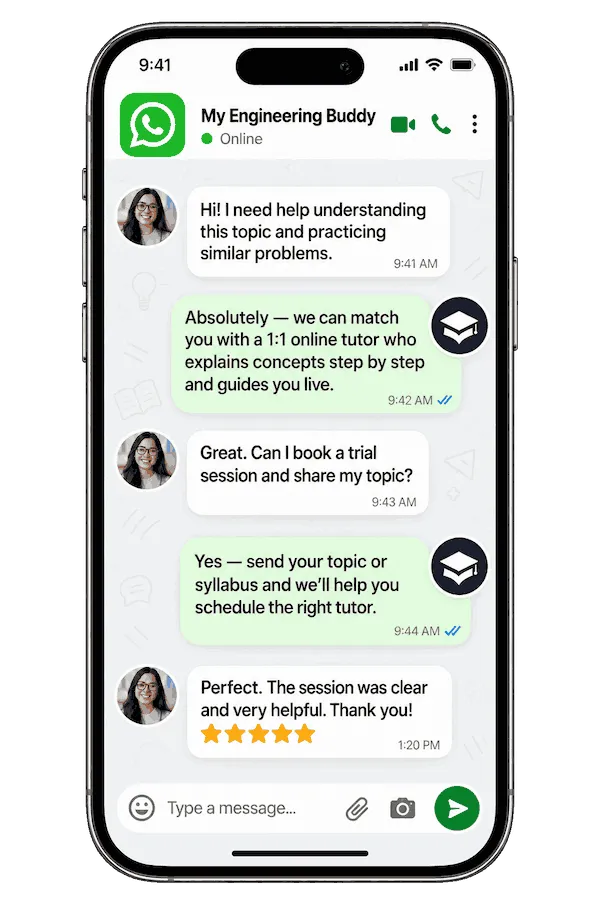
Tutor availability tightens significantly around semester finals and OR exam windows. WhatsApp MEB for a quick quote — average response time under 1 minute.
Who This Constraints Tutoring Is For
Constraints comes up in operations research, industrial engineering, management science, and applied mathematics courses. Students struggle most when they’re juggling multiple constraint types — binding vs. non-binding, equality vs. inequality — without a clear framework for what each means for the solution space.
- Undergraduate students in OR, engineering, or business analytics hitting feasibility problems they can’t debug
- Graduate students working through integer programming or nonlinear constraints in coursework or thesis models
- Students retaking after a failed first attempt who need to rebuild from the constraint formulation stage
- Students 4–6 weeks from an exam with significant gaps in duality, shadow prices, or sensitivity analysis
- Parents watching a student’s confidence drop as optimization problem sets pile up
- Students needing ethical homework and assignment guidance through dense constraint-based models
Students from institutions including MIT, Georgia Tech, Carnegie Mellon, Imperial College London, the University of Toronto, ETH Zürich, and the University of Melbourne have worked with MEB tutors on exactly these topics.
At MEB, we’ve found that students who struggle with Constraints aren’t usually weak at math — they haven’t been shown how to read what the constraints are actually telling them about the solution space. That shift in framing changes everything.
1:1 Tutoring vs Self-Study vs AI vs YouTube vs Online Courses
Self-study works if you’re disciplined, but Constraints errors are often subtle — a missed sign, a flipped inequality — and no textbook tells you where you went wrong. AI tools give fast explanations but can’t watch you set up a model live and catch the exact step where your reasoning breaks. YouTube covers LP constraint basics well but stops when you’re stuck on a degenerate solution or a specific dual constraint. Online courses are structured but fixed-pace, with no one to ask when your constraint matrix produces an unexpected result. With 1:1 tutoring through MEB, the tutor sees your actual formulation and corrects the error in real time — calibrated specifically to your course and constraint types.
Outcomes: What You’ll Be Able To Do in Constraints
After working with a Constraints tutor, you’ll be able to formulate multi-constraint LP and IP models from word problems without second-guessing your inequality directions. You’ll analyze binding and non-binding constraints to interpret shadow prices and their practical meaning for a given objective. You’ll solve feasibility and infeasibility cases by identifying which constraint is violated and how to correct it. You’ll apply constraint handling in nonlinear and integer programming contexts, explaining the trade-offs in relaxation and tightening. You’ll present sensitivity analysis results clearly, connecting right-hand-side ranging to real decision outcomes.
Based on feedback from 40,000+ sessions collected by MEB from 2022 to 2025, 58% of students improved by one full grade after approximately 20 hours of 1:1 tutoring in subjects like Constraints. A further 23% achieved at least a half-grade improvement.
Source: MEB session feedback data, 2022–2025.
Supporting a student through Constraints? MEB works directly with parents to set up sessions, track progress, and keep coursework on schedule. WhatsApp MEB — average response time is under a minute, 24/7.
What We Cover in Constraints (Syllabus / Topics)

Constraint Formulation and Types
- Translating word problems into inequality and equality constraints
- Non-negativity constraints and their role in LP feasible regions
- Binding vs. non-binding constraints and slack/surplus variables
- Redundant constraints and their effect on the solution set
- Constraint qualification conditions in nonlinear programming (KKT)
- Mixed-integer constraint structures and logical constraints
Recommended texts: Hillier & Lieberman Introduction to Operations Research; Rardin Optimization in Operations Research.
Feasibility, Infeasibility, and the Feasible Region
- Graphical analysis of constraint intersections in two-variable LP
- Identifying infeasible systems — conflicting constraints and empty feasible regions
- Unbounded solutions and missing constraints
- Corner-point (extreme-point) analysis and optimality
- Degeneracy and its implications for constraint handling
- Constraint relaxation and its effect on solution bounds
Recommended texts: Taha Operations Research: An Introduction; Bertsimas & Tsitsiklis Introduction to Linear Optimization.
Duality, Shadow Prices, and Sensitivity Analysis
- Primal-dual constraint relationships and complementary slackness
- Shadow prices (dual variables) — interpreting the marginal value of relaxing a constraint
- Right-hand-side ranging and allowable increase/decrease per constraint
- Sensitivity analysis on constraint coefficients
- Constraint interaction in multi-objective models
- Post-optimality analysis for constraint changes in real decision problems
Recommended texts: Winston Operations Research: Applications and Algorithms; Vanderbei Linear Programming: Foundations and Extensions.
What a Typical Constraints Session Looks Like
The tutor opens by checking the previous topic — usually shadow price interpretation or a constraint formulation the student flagged as unclear. From there, the student shares their current problem set on screen. The tutor uses a digital pen-pad to annotate the constraint matrix directly, walking through each inequality row by row. If the student set up an infeasible region, they identify exactly which constraint pair creates the conflict. The student then reworks the formulation while the tutor watches — not doing it for them, but catching the moment a sign flips incorrectly or a slack variable is mishandled. The session closes with a specific practice task: two constraint-formulation problems from past assignments, with the next topic — sensitivity analysis ranging — noted for the following session. You’ll need simplex method help lined up soon after.
How MEB Tutors Help You with Constraints (The Learning Loop)
Diagnose: In the first session, the tutor asks you to formulate a constraint set from scratch. This immediately shows whether the gap is in translating problem language, handling inequality directions, or applying non-negativity correctly. It’s faster and more honest than a quiz.
Explain: The tutor works through a live problem on the digital pen-pad — building the constraint matrix step by step, labeling each row, and connecting it to what the feasible region looks like. Not a lecture. A worked solution you watch being constructed.
Practice: You attempt the next problem while the tutor watches. The point isn’t for you to get it right immediately — it’s for the tutor to see where your reasoning drifts so they know exactly what to correct.
Feedback: The tutor marks the exact step where the error occurred and explains why that step costs marks. Students working on dynamic programming tutoring or discrete optimization help go through the same correction loop for their constraint sub-problems.
Plan: Before the session ends, the tutor sets the next topic — sensitivity analysis, duality, or integer constraint formulation — and confirms which past paper questions or homework problems to attempt before the next session.
Sessions run on Google Meet with a digital pen-pad or iPad + Apple Pencil for annotation. Before your first session, share your course syllabus or module outline, a past paper or homework set you struggled with, and your exam or assignment deadline. The tutor handles everything else. Whether you need a quick catch-up before an exam, structured revision over 4–8 weeks, or ongoing weekly support through the semester, the tutor maps the session plan after the first diagnostic. Start with the $1 trial — 30 minutes of live tutoring that also serves as your first diagnostic.
Try your first session for $1 — 30 minutes of live 1:1 tutoring or one homework question explained in full. No registration. No commitment. WhatsApp MEB now and get matched within the hour.
Tutor Match Criteria (How We Pick Your Tutor)
Not every OR tutor is the right fit for Constraints-heavy coursework. Here’s what MEB checks before assigning yours.
Subject depth: The tutor must have direct experience with the constraint types your course covers — LP, IP, or nonlinear — and familiarity with the specific exam board or university module structure if applicable.
Tools: Every tutor uses Google Meet plus a digital pen-pad or iPad with Apple Pencil. Annotating constraint matrices in real time is non-negotiable for this subject.
Time zone: Matched to your region — US, UK, Gulf, Canada, or Australia — so sessions don’t require anyone to work at 2am to make the slot work.
Goals: Whether you need exam-score improvement, conceptual depth in duality theory, assignment help with formulation problems, or support for a graduate-level research model, the tutor is matched to that specific target.
Unlike platforms where you fill out a form and wait, MEB responds in under a minute, 24/7. Tutor match takes under an hour. The $1 trial means you test before you commit. Everything runs over WhatsApp — no logins, no intake forms.
Study Plans (Pick One That Matches Your Goal)
The tutor builds the specific sequence after the diagnostic, but here are the most common patterns for Constraints students. Catch-up (1–3 weeks): targeted work on constraint formulation and feasibility before an upcoming exam. Exam prep (4–8 weeks): structured revision from formulation through sensitivity analysis, with past paper practice on constraint-heavy questions. Weekly support: ongoing sessions aligned to your semester schedule, keeping pace with new constraint types as they appear in coursework. Students also working on decision modelling help or MCDA/MCDM tutoring often run parallel plans across related modules.
Pricing Guide
Constraints tutoring starts at $20/hr for standard undergraduate coursework. Graduate-level topics — KKT conditions, nonlinear constraint programming, integer constraint relaxation — typically run $50–$100/hr depending on tutor background and timeline urgency.
Rate factors include course level, topic complexity, how close your exam or deadline is, and tutor availability. Slots fill fast in the four weeks before finals — if you’re working to a fixed exam date, book earlier than you think you need to.
For students targeting graduate programs or professional OR certifications at institutions like MIT, ETH Zürich, or Imperial College, tutors with research and industry optimization backgrounds are available at higher rates — share your specific goal and MEB will match the tier to your ambition.
Start with the $1 trial — 30 minutes, no registration, no commitment. WhatsApp MEB for a quick quote.
Students consistently tell us that the moment Constraints “clicks” isn’t when they solve a problem correctly — it’s when they can look at a constraint and immediately know whether it will bind at the optimum. That’s what 1:1 tutoring gets you to faster.
Source: My Engineering Buddy student feedback, 2022–2025.
FAQ
Is Constraints hard?
It’s conceptually manageable but technically unforgiving. Most students can set up simple LP constraints. The difficulty is in knowing what a constraint implies about the feasible region, shadow prices, and sensitivity — and catching small formulation errors before they propagate through the whole model.
How many sessions are needed to improve?
Students with gaps in formulation and feasibility typically need 6–10 sessions to work through constraint types, duality, and sensitivity analysis systematically. Students closer to exam readiness who need targeted practice often see meaningful improvement in 3–4 focused sessions.
Can you help with homework and assignments?
MEB tutoring is guided learning — you understand the work, then submit it yourself. The tutor walks through the constraint logic, explains where your formulation went wrong, and lets you correct it. See our Academic Integrity policy and Why MEB page for full details on what we help with and what we don’t.
Will the tutor match my exact syllabus or exam board?
Yes. Before the first session, share your course outline, module name, and any past paper or assignment. The tutor reviews it and structures the session around your exact constraint types — whether that’s LP for an intro OR course or nonlinear constraints in a graduate optimization module.
What happens in the first session?
The tutor asks you to formulate a constraint set from a problem prompt. This quickly shows where your gaps are — translating language, handling inequality directions, or applying non-negativity. From there, the session addresses the most urgent gap first. You leave with a specific practice task.
Is online tutoring as effective as in-person for Constraints?
For this subject, online is arguably better. The tutor can annotate your constraint matrix directly on screen, which is harder to do clearly on a whiteboard. Students working through LP tableaus or sensitivity ranges find digital pen-pad annotation more precise than anything done in person.
What’s the difference between a binding and a non-binding constraint, and why does it matter for exams?
A binding constraint holds as an equality at the optimum — its slack or surplus is zero. A non-binding constraint has leftover slack. Exam questions frequently ask you to identify which constraints bind, calculate shadow prices only for binding ones, and explain why relaxing a non-binding constraint changes nothing. Misclassifying them loses marks across multiple sub-parts.
Can I get Constraints help at midnight or on weekends?
Yes. MEB operates 24/7 across all major time zones. WhatsApp the team at any hour — average response is under a minute. Tutors in US, UK, Gulf, and Australian time zones are available, so weekend or late-night sessions before a Monday submission are straightforward to arrange.
What if I don’t like my assigned tutor?
Request a switch via WhatsApp. MEB reassigns without fuss — usually within the hour. The $1 trial is specifically designed so you can test the tutor match before committing to a full session block. If the fit isn’t right, MEB finds you someone better.
How do I find a Constraints tutor if I’m based outside the US?
MEB serves students in the UK, Canada, Australia, UAE, Saudi Arabia, Qatar, Germany, Netherlands, and across Europe. Time zone matching is handled at the tutor selection stage. WhatsApp MEB with your location and availability — the team matches from there.
Why do students fail Constraints problems even when they know the theory?
Usually because they never practice formulating constraints from scratch — only from pre-structured textbook problems. Exam questions embed the constraint information in scenario language, and translating that language correctly under time pressure is a separate skill from the algebra. Tutors train this translation step explicitly.
How do I get started?
Start with the $1 trial — 30 minutes of live 1:1 tutoring or one constraint problem explained in full. Three steps: WhatsApp MEB, get matched with a verified Constraints tutor, start your trial session. No forms, no waiting.
Trust & Quality at My Engineering Buddy
Every MEB tutor goes through subject-specific vetting — not just a CV check. Tutors in Constraints and related optimization subjects demonstrate live during a demo evaluation that they can formulate, solve, and explain constraint problems clearly at the level they’ll be teaching. Ongoing session feedback is reviewed to catch any tutor whose explanations aren’t landing. Rated 4.8/5 across 40,000+ verified reviews on Google.
MEB tutoring is guided learning — you understand the work, then submit it yourself. For full details on what we help with and what we don’t, read our Academic Integrity policy and Why MEB.
MEB has been serving students in 2,800+ subjects since 2008 — across the US, UK, Canada, Australia, Gulf, and Europe. Operations Research is one of MEB’s strongest subject areas, with active tutors covering game theory tutoring, Markov chains help, and inventory management tutoring alongside Constraints. The Cambridge Assessment International Education website is one useful reference point for students whose programmes include optimization and quantitative methods components.
A common pattern our tutors observe is that students who finally understand binding constraints don’t just perform better on that question — they revisit their earlier LP and IP problems and immediately spot where they were losing marks. One concept unlocks several chapters at once.
Explore Related Subjects
Students studying Constraints often also need support in:
- Genetic Algorithms
- Nash Equilibrium
- Simplex Method
- Linear Programming
- Convex Optimization
- Dynamic Programming
Next Steps
Ready to move forward? Here’s what to do:
- Share your course name, constraint types you’re working on, and your current timeline
- Share your availability and time zone — MEB matches tutors across US, UK, Gulf, Canada, and Australia
- MEB matches you with a verified Constraints tutor — usually within 24 hours
- The first session starts with a diagnostic so every minute is used on what actually needs fixing
Before your first session, have ready:
- Your course syllabus or module outline and exam board (if applicable)
- A recent past paper attempt or homework you struggled with
- Your exam or assignment deadline date — the tutor handles the rest
Our experience across thousands of sessions shows that students who come in with a specific problem — a constraint set they can’t make feasible, a shadow price they can’t interpret — make faster progress than those who arrive with a vague sense they “need to review OR.” Bring a real problem. The tutor will meet you there.
Visit www.myengineeringbuddy.com for more on how MEB works.
WhatsApp to get started or email [email protected].
Reviewed by Subject Expert
This page has been carefully reviewed and validated by our subject expert to ensure accuracy and relevance.




