




~1 min
Average Reply Time
~1 hour
To Be Matched With A Tutor
30 Min Trial
75% Find Their Tutor On The 1st Trial
$20-35+/hr
Premium Yet Affordable Learning
Hire The Best Game Theory Tutor


Most students don’t fail Game Theory because they’re bad at math. They fail because nobody ever showed them how to build the payoff matrix correctly — and by week four, the gap is too wide to close alone.
Game Theory Tutor Online
Game Theory is the mathematical study of strategic decision-making among rational agents, analyzing how players choose actions to maximize outcomes in competitive or cooperative settings. It equips students to model conflict, negotiation, and equilibrium across economics, engineering, and political science.
Finding a Game Theory tutor near me used to mean hoping someone local had a background in both economics and mathematics. MEB changed that. Our operations research tutoring network includes specialists in strategic modeling, Nash equilibrium, and mechanism design — available 1:1 online, matched to your exact course and time zone. One session can close the gap between confusion and clarity on mixed strategies. We won’t promise a grade — but we will show up prepared, on time, and ready to work through the exact problems you’re stuck on.
- 1:1 online sessions tailored to your course syllabus and exam board
- Expert-vetted tutors with subject-specific knowledge in strategic decision theory
- Flexible time zones — US, UK, Canada, Australia, Gulf
- Structured learning plan built after a diagnostic session
- Ethical homework and assignment guidance — you understand before you submit
52,000+ students across the US, UK, Canada, Australia, and the Gulf have used MEB since 2008 — including students in Operations Research subjects like Game Theory, Nash Equilibrium, and Decision Modelling and Analysis.
Source: My Engineering Buddy, 2008–2025.
How Much Does a Game Theory Tutor Cost?
Most Game Theory tutoring at MEB runs $20–$40/hr, covering undergraduate and graduate coursework. Advanced topics — auction theory, mechanism design, repeated games at PhD level — can reach $60–$100/hr. New students can start with the $1 trial: 30 minutes of live tutoring or one full homework question explained.
| Level / Need | Typical Rate | What’s Included |
|---|---|---|
| Standard (undergrad) | $20–$40/hr | 1:1 sessions, homework guidance |
| Advanced / Graduate | $40–$100/hr | Expert tutor, mechanism design, auction theory |
| $1 Trial | $1 flat | 30 min live session or 1 homework question |
Tutor availability tightens during semester finals and dissertation submission windows. Book early if you have a hard deadline.
WhatsApp MEB for a quick quote — average response time under 1 minute.
Who This Game Theory Tutoring Is For
Game Theory appears in economics, engineering, computer science, political science, and business programs. The students who reach out to MEB aren’t always struggling — some are sharp but racing a deadline. Most fit one of these profiles.
- Undergraduate economics or engineering students hitting the Nash equilibrium or extensive-form game sections for the first time
- Graduate students in management science, operations research, or policy programs where strategic modeling is core to coursework
- Students 4–6 weeks from a final exam with significant gaps still to close in dominant strategies, Bayesian games, or signaling
- Students retaking after a failed first attempt — particularly those who lost marks on mixed-strategy equilibria or backward induction
- PhD students needing support on mechanism design chapters or dissertation components involving auction theory
- Students at universities including MIT, LSE, University of Michigan, University of Toronto, ANU, and Tilburg University where Game Theory is a required core module
If you’re working through Gibbons, Osborne, or Fudenberg and Tirole and the proofs aren’t clicking, a 1:1 Game Theory tutor makes a measurable difference faster than re-reading the chapter alone.
At MEB, we’ve found that students who struggle with Game Theory usually aren’t missing math ability — they’re missing a clear mental model of what “rationality” means in a strategic setting. Once that clicks, the payoff matrices, the equilibria, and the backward induction all follow. That reframe often happens in a single session.
1:1 Tutoring vs Self-Study vs AI vs YouTube vs Online Courses
Self-study works if you’re disciplined — but Game Theory problems require feedback on your reasoning process, not just your answer. AI tools give fast definitions of Nash equilibrium but can’t identify why your specific payoff matrix setup is wrong. YouTube is solid for conceptual intros to dominant strategies and prisoner’s dilemmas, then stops when you need to walk through a Bayesian perfect equilibrium. Online courses move at a fixed pace that rarely matches your exam date. A 1:1 Game Theory tutor online from MEB works through your actual problem set, in your actual course, correcting errors in real time — not after you’ve already submitted.
Outcomes: What You’ll Be Able To Do in Game Theory
After working with an MEB Game Theory tutor, students consistently report being able to solve for Nash equilibria in both pure and mixed strategies without prompting, analyze extensive-form games using backward induction across multi-stage decision trees, model strategic interactions in oligopoly and auction settings with the correct payoff structure, explain the intuition behind dominant strategy elimination clearly enough to write it up for exam credit, and apply signaling and screening models to real-world contexts in economics and policy. These aren’t abstract goals — they map directly to the problem types that appear in mid-term and final assessments at most universities running Game Theory as a core module.
Based on feedback from 40,000+ sessions collected by MEB from 2022 to 2025, 58% of students improved by one full grade after approximately 20 hours of 1:1 tutoring in subjects like Game Theory. A further 23% achieved at least a half-grade improvement.
Source: MEB session feedback data, 2022–2025.
Try your first session for $1 — 30 minutes of live 1:1 tutoring or one homework question explained in full. No registration. No commitment. WhatsApp MEB now and get matched within the hour.
What We Cover in Game Theory (Syllabus / Topics)

Track 1: Foundational Strategic Analysis
- Normal-form games and payoff matrices
- Dominant and dominated strategies
- Iterated elimination of dominated strategies (IESDS)
- Pure strategy Nash equilibrium — identification and verification
- Mixed strategy Nash equilibrium — calculation and interpretation
- Best response correspondences and best response functions
- Zero-sum and constant-sum games
Core texts for this track include Osborne’s An Introduction to Game Theory and Gibbons’ Game Theory for Applied Economists.
Track 2: Dynamic and Extensive-Form Games
- Extensive-form representation — game trees and information sets
- Subgame perfect Nash equilibrium (SPNE)
- Backward induction in finite games
- Repeated games — finite and infinitely repeated, folk theorem
- Commitment, credibility, and strategic threats
- Dynamic programming connections in multi-stage games
- Bargaining models — Nash bargaining solution, alternating offers
Key references include Fudenberg and Tirole’s Game Theory and Osborne and Rubinstein’s A Course in Game Theory.
Track 3: Incomplete Information and Mechanism Design
- Bayesian games and Bayesian Nash equilibrium
- Signaling games — separating and pooling equilibria
- Screening models and adverse selection
- Mechanism design fundamentals — revelation principle, incentive compatibility
- Auction theory — first-price, second-price, and revenue equivalence
- Multi-criteria decision analysis in cooperative game contexts
- Cooperative game theory — Shapley value, core, and coalitional games
Standard references include Myerson’s Game Theory: Analysis of Conflict and Krishna’s Auction Theory.
Game Theory sits at the intersection of mathematics, economics, and decision science. MEB tutors cover the full spectrum — from payoff matrices in week two of an intro course to mechanism design in a graduate research seminar.
Source: My Engineering Buddy, 2008–2025.
What a Typical Game Theory Session Looks Like
The tutor opens by checking the previous topic — usually whether the student successfully solved for the mixed strategy equilibrium assigned last session. From there, the session moves to the current sticking point: often extensive-form game trees and why a particular subgame isn’t being identified correctly. The tutor draws the game tree live on a digital pen-pad, marks information sets, and walks through the backward induction step by step. The student then replicates the process on a fresh problem — same structure, different payoffs — while the tutor watches and corrects reasoning errors before they become habits. The session closes with a specific practice task: two or three problems from the problem set, a note on the next topic (Bayesian Nash equilibrium, typically), and a check-in time for the following session.
How MEB Tutors Help You with Game Theory (The Learning Loop)
Diagnose: In the first session, the tutor runs through three to four short problems spanning normal-form games, dominant strategy identification, and a basic extensive-form tree. This surfaces exactly where reasoning breaks down — whether it’s the payoff matrix setup, the equilibrium calculation, or the conceptual leap from pure to mixed strategies.
Explain: The tutor works through live examples on a digital pen-pad — not slides, not textbook scans. You watch the logic unfold in real time: why player two’s best response shifts when player one randomizes, why a threat isn’t credible in a subgame, why the revelation principle matters for mechanism design.
Practice: You attempt a parallel problem with the tutor present. No waiting until next week to find out you did it wrong. The tutor watches your process, not just your answer.
Feedback: Every step-level error gets named and corrected immediately. The tutor explains which part of the reasoning failed and why it would cost marks in an exam setting — not just that the final answer was off.
Plan: At the end of each session, the tutor sets the next topic in sequence, assigns specific problems, and notes what to review before the following session. You leave knowing exactly what to do next.
Sessions run over Google Meet with a digital pen-pad or iPad and Apple Pencil. Before your first session, share your course syllabus or module outline, a recent problem set or past paper you struggled with, and your exam or assignment deadline. The first session doubles as your diagnostic. Start with the $1 trial — 30 minutes of live tutoring that also serves as your first diagnostic.
Students consistently tell us that Game Theory becomes harder before it becomes easier — the moment they move from normal-form to extensive-form games, the abstraction level jumps. Our tutors plan for that transition deliberately, slowing down at exactly the point where self-study tends to race ahead.
Tutor Match Criteria (How We Pick Your Tutor)
Not every tutor who knows economics can teach Game Theory at graduate level. Here’s how MEB matches.
Subject depth: Tutors are matched to your specific level — intro undergraduate, advanced microeconomics, graduate theory, or dissertation support — and to your exam board or department’s approach (Nashian equilibrium analysis, mechanism design, cooperative theory).
Tools: Every Game Theory tutor at MEB uses Google Meet with a digital pen-pad or iPad and Apple Pencil. Drawing game trees and payoff matrices in real time is non-negotiable for this subject.
Time zone: Matched to your region — US, UK, Canada, Australia, Gulf — so sessions don’t require you to be up at 3am.
Goals: Whether you need exam score improvement, conceptual depth for a research seminar, or help completing a specific decision modelling assignment, the tutor is matched to that goal — not a generic “economics” profile.
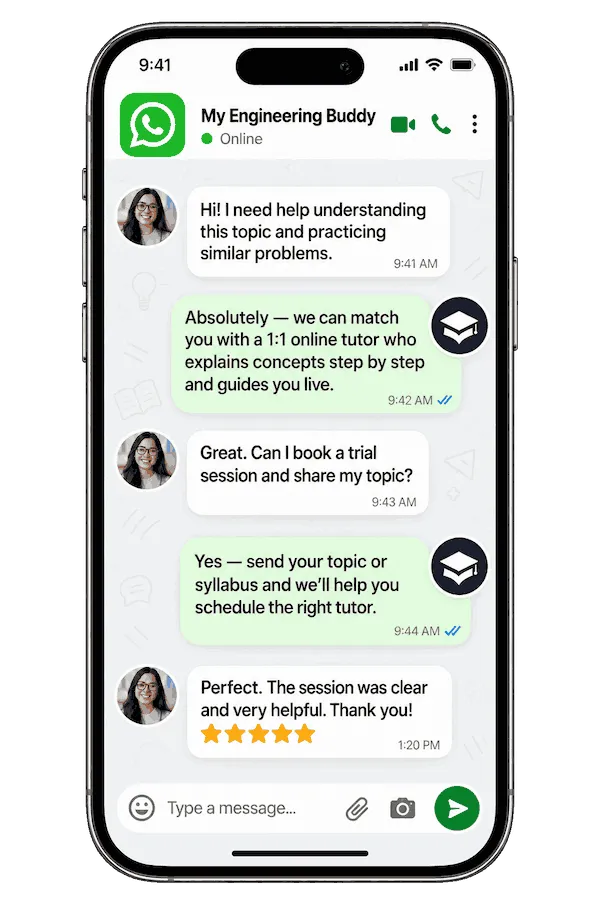
Unlike platforms where you fill out a form and wait, MEB responds in under a minute, 24/7. Tutor match takes under an hour. The $1 trial means you test before you commit. Everything runs over WhatsApp — no logins, no intake forms.
Study Plans (Pick One That Matches Your Goal)
After the diagnostic, your tutor builds the sequence. Most Game Theory students fall into one of three patterns: a catch-up sprint of one to three weeks closing gaps in payoff matrix construction, dominant strategies, and basic Nash equilibrium before an upcoming mid-term; a structured four-to-eight-week exam prep block working through all major topic areas with timed practice problems; or ongoing weekly support running alongside a semester, aligned to lecture topics and problem set deadlines. The tutor decides the specific sequence after seeing where your reasoning currently breaks down — not before.
Pricing Guide
Game Theory tutoring at MEB starts at $20/hr for standard undergraduate coursework. Graduate-level topics — auction theory, mechanism design, repeated games with discounting — typically run $40–$70/hr. Dissertation-level support with a research-active tutor can reach $100/hr.
Rate factors include your level, topic complexity, how close you are to a deadline, and tutor availability. Availability tightens sharply during university finals periods — if you have a fixed exam date, don’t wait until the week before.
For students targeting top graduate programs in economics or policy — LSE, Harvard Kennedy School, University of Chicago — tutors with active research backgrounds in strategic theory are available at higher rates. Share your specific goal and MEB will match the tier to your ambition.
Start with the $1 trial — 30 minutes, no registration, no commitment. WhatsApp MEB for a quick quote.
FAQ
Is Game Theory hard?
It’s genuinely challenging — not because the math is advanced, but because the logic is unfamiliar. Most students find the jump from normal-form to extensive-form games and then to incomplete information the steepest part. With a tutor working through the reasoning live, most students stabilize within three to four sessions.
How many sessions are needed?
Students closing a specific gap before an exam typically need four to eight sessions. Those building from scratch across a full module need ten to twenty hours, depending on how much of the course remains. The diagnostic session gives a clearer answer than any estimate made before it.
Can you help with homework and assignments?
MEB tutoring is guided learning — you understand the work, then submit it yourself. The tutor explains the method and works through similar examples so you can complete the assignment independently. See our Academic Integrity policy and Why MEB page for full details on what we help with and what we don’t.
Will the tutor match my exact syllabus or exam board?
Yes. When you message MEB, share your module name, university, and the specific topics you’re covering. The tutor is matched to your syllabus — whether that’s an intro microeconomics Game Theory module, a standalone graduate Game Theory course, or a dissertation chapter on mechanism design.
What happens in the first session?
The first session is a diagnostic. The tutor runs through a short problem set spanning the key topic areas to locate exactly where your reasoning breaks down. From that point, every subsequent session has a clear sequence — no time is wasted on topics you already have.
Is online tutoring as effective as in-person?
For Game Theory specifically, online tutoring with a digital pen-pad is arguably better than most in-person alternatives — the tutor can draw game trees, annotate payoff matrices, and mark up your working in real time on a shared screen. Students consistently report the visual clarity as a major benefit.
Do Game Theory courses at different universities cover the same material?
Not always. An introductory Game Theory module in an economics undergraduate program typically covers normal-form games, Nash equilibrium, and basic extensive-form games. A standalone graduate Game Theory course goes further — into Bayesian games, mechanism design, and auction theory. MEB tutors are matched to your specific course level and syllabus, not a generic curriculum.
What’s the difference between cooperative and non-cooperative Game Theory, and does MEB cover both?
Non-cooperative Game Theory — Nash equilibrium, dominant strategies, subgame perfection — is the core of most university modules. Cooperative theory covers coalition formation, the Shapley value, and the core. MEB covers both. Share which your course emphasizes and the tutor is matched accordingly.
Can you help at midnight or across unusual time zones?
Yes. MEB operates across US, UK, Canada, Australia, and Gulf time zones with tutors available outside standard business hours. Message on WhatsApp at any time — average response is under a minute. Session scheduling is handled directly, no booking platform required.
What if I don’t connect with my assigned tutor?
Request a different match. MEB reassigns without friction — message on WhatsApp and a new tutor is identified, usually within the hour. The $1 trial exists specifically so you can test the fit before committing to a block of sessions.
How do I get started?
Three steps: WhatsApp MEB with your course name, current topic, and exam date. MEB matches you with a verified Game Theory tutor — typically within the hour. Your first session is the $1 trial: 30 minutes of live tutoring or one full homework question explained from start to finish.
Trust & Quality at My Engineering Buddy
Every MEB Game Theory tutor goes through subject-specific screening — not just a general mathematics or economics filter. Tutors complete a live demo evaluation assessed for explanation quality, use of visual tools (game trees, payoff matrices, equilibrium diagrams), and ability to work through a student’s specific reasoning errors. Ongoing session feedback is reviewed systematically. Rated 4.8/5 across 40,000+ verified reviews on Google, MEB has served 52,000+ students since 2008 across the US, UK, Canada, Australia, Gulf, and Europe.
MEB tutoring is guided learning — you understand the work, then submit it yourself. For full details on what we help with and what we don’t, read our Academic Integrity policy and Why MEB.
MEB covers 2,800+ subjects across Operations Research and related disciplines — including linear programming tutoring, convex optimization help, and Markov chains tutoring. The same tutoring methodology that applies to Game Theory — diagnostic first, live worked problems, error-level feedback — runs across every subject on the platform. See our tutoring methodology for how the process works in detail.
Explore Related Subjects
Students studying Game Theory often also need support in:
Next Steps
Ready to get started? Here’s what to do:
- Share your module name, university, and the specific topics you’re stuck on
- Share your availability and time zone — sessions are matched to your schedule
- MEB matches you with a verified Game Theory tutor, usually within 24 hours
- Your first session opens with a diagnostic so every minute of tutoring is used well
Before your first session, have ready: your course syllabus or module outline, a recent problem set or past paper attempt you struggled with, and your exam or assignment deadline. The tutor handles the rest.
Visit www.myengineeringbuddy.com for more on how MEB works.
WhatsApp to get started or email [email protected].
Reviewed by Subject Expert
This page has been carefully reviewed and validated by our subject expert to ensure accuracy and relevance.




