~1 min
Average Reply Time
~1 hour
To Be Matched With A Tutor
30 Min Trial
75% Find Their Tutor On The 1st Trial
$20-35+/hr
Premium Yet Affordable Learning
Most students hit a wall at the pivot step. If you can set up a tableau but lose track of the basis variables mid-iteration, you’re not alone — and that’s exactly where a 1:1 Simplex Method tutor makes the difference.
Simplex Method Tutor Online
The Simplex Method is an iterative linear programming algorithm that moves along the vertices of a feasible polytope to find the optimal value of an objective function subject to linear constraints.
MEB offers 1:1 online tutoring and homework help in 2,800+ advanced subjects, including a full range of Operations Research tutoring topics. If you’ve searched for a Simplex Method tutor near me and found nothing local — or nothing that goes beyond surface-level explanation — MEB matches you with a verified expert who knows the algorithm cold. Sessions cover tableau construction, pivot selection, degeneracy, sensitivity analysis, and the Big-M and two-phase methods. You build real fluency, not just memorised steps.
- 1:1 online sessions tailored to your course syllabus and exam board
- Expert-verified tutors with graduate-level Operations Research backgrounds
- Flexible time zones — US, UK, Canada, Australia, Gulf covered
- Structured learning plan built after a diagnostic session
- Ethical homework and assignment guidance — you understand the work, then submit it yourself
52,000+ students across the US, UK, Canada, Australia, and the Gulf have used MEB since 2008 — including students in Operations Research subjects like the Simplex Method, Linear Programming, and Decision Modelling & Analysis.
Source: My Engineering Buddy, 2008–2025.
How Much Does a Simplex Method Tutor Cost?
Most Simplex Method sessions run $20–$40/hr. Advanced graduate-level work or tight-deadline specialist tutoring can reach up to $100/hr. You can test the service first with a $1 trial — 30 minutes of live tutoring or one full homework question explained step by step.
| Level / Need | Typical Rate | What’s Included |
|---|---|---|
| Undergraduate (most levels) | $20–$35/hr | 1:1 sessions, homework guidance |
| Graduate / Specialist | $35–$70/hr | Expert tutor, advanced topic depth |
| $1 Trial | $1 flat | 30 min live session or 1 homework question |
Tutor availability tightens around end-of-semester exam windows. If you’re within six weeks of a final, book early.
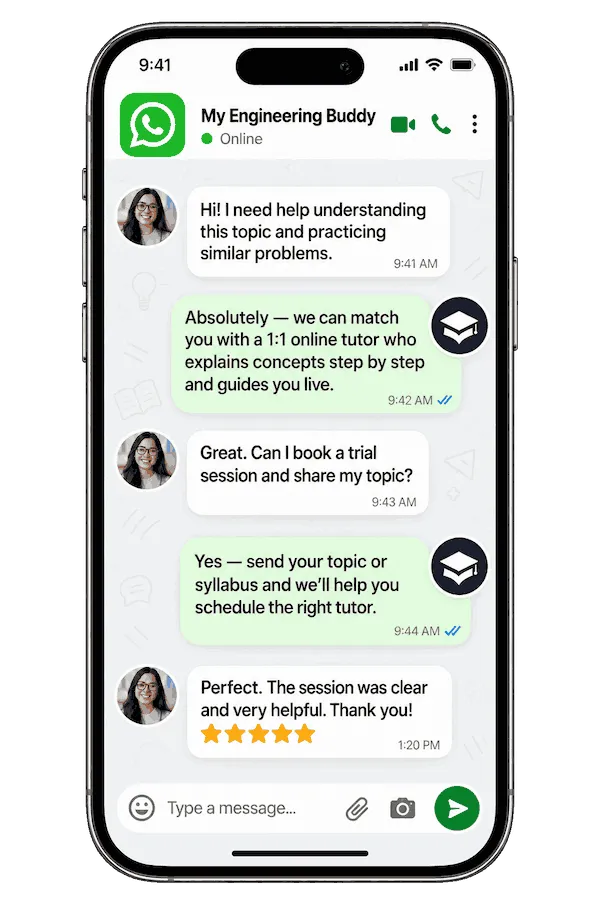
WhatsApp MEB for a quick quote — average response time under 1 minute.
Who This Simplex Method Tutoring Is For
Simplex Method tutoring at MEB is used by undergraduate engineering, mathematics, and business students, as well as graduate students in Operations Research, industrial engineering, and quantitative management programmes. The topics are technically demanding and the margin for error in problem sets is small.
- Students who can set up the initial tableau but keep making sign errors during pivot operations
- Students retaking after a failed first attempt in an OR or optimisation module
- Students with a university conditional offer depending on passing a quantitative methods course
- Students 4–6 weeks from a final exam with degeneracy, sensitivity analysis, or the two-phase method still to master
- Parents watching a student’s confidence drop as problem sets get longer and marking more granular
- Graduate students who need the Simplex Method for thesis work in supply chain, scheduling, or resource allocation modelling
Students studying at universities including MIT, Georgia Tech, Imperial College London, TU Delft, the University of Toronto, and ETH Zurich — where OR modules carry significant weight — have used MEB tutoring to close specific algorithmic gaps fast.
At MEB, we’ve found that most Simplex Method confusion comes down to one of three things: setting up the objective row incorrectly, choosing the wrong pivot column, or losing track of the basis after two or three iterations. Fix those three, and the rest of the algorithm clicks into place.
1:1 Tutoring vs Self-Study vs AI vs YouTube vs Online Courses
Self-study works if you’re disciplined, but the Simplex Method has enough procedural steps that a single unchecked habit compounds into consistent errors. AI tools give fast explanations but can’t watch you pivot a tableau and catch the moment you pick the wrong leaving variable. YouTube is useful for the first pass, but stops short when your specific problem has degeneracy or an unbounded solution. Online courses move at a fixed pace and won’t slow down for your particular sticking point. With MEB, a tutor watches you work through a real problem set, corrects the error in the moment, and adjusts the session plan based on where you actually are — not where the syllabus assumes you should be.
Outcomes: What You’ll Be Able To Do in Simplex Method
After working with a Simplex Method tutor at MEB, you’ll be able to set up and solve standard maximisation and minimisation problems from scratch, apply the Big-M method and the two-phase method to problems with artificial variables, identify when a solution is degenerate or unbounded and explain why, and perform sensitivity analysis to determine how changes in objective coefficients or right-hand-side values affect the optimal solution. You’ll also be able to interpret dual variables and shadow prices in the context of real resource-allocation problems — a skill that distinguishes students who merely execute the algorithm from those who understand what the solution means.
Based on feedback from 40,000+ sessions collected by MEB from 2022 to 2025, 58% of students improved by one full grade after approximately 20 hours of 1:1 tutoring in subjects like the Simplex Method. A further 23% achieved at least a half-grade improvement.
Source: MEB session feedback data, 2022–2025.
Supporting a student through Simplex Method? MEB works directly with parents to set up sessions, track progress, and keep coursework on schedule. WhatsApp MEB — average response time is under a minute, 24/7.
What We Cover in Simplex Method (Syllabus / Topics)
Core Algorithm and Tableau Mechanics
- Standard form conversion — slack, surplus, and artificial variables
- Initial basic feasible solution setup
- Pivot column selection (most negative coefficient / Bland’s rule)
- Minimum ratio test and pivot row identification
- Row operations and updated tableau construction
- Optimality conditions and termination criteria
- Recognising unbounded, infeasible, and degenerate solutions
Core textbooks include Hillier & Lieberman’s Introduction to Operations Research and Bazaraa, Jarvis & Sherali’s Linear Programming and Network Flows — both standard across US and UK OR programmes.
Extended Methods — Big-M and Two-Phase
- Big-M method: penalising artificial variables in the objective function
- Two-phase approach: Phase I feasibility, Phase II optimisation
- Comparison of both methods — when each is preferable
- Handling equality and greater-than-or-equal constraints
- Cycling and anti-cycling rules (Bland’s rule, lexicographic method)
- Revised Simplex Method for larger-scale problems
Taha’s Operations Research: An Introduction and Winston’s Operations Research: Applications and Algorithms both cover these methods with worked examples used across undergraduate and MBA programmes.
Sensitivity Analysis and Duality
- Ranging on objective function coefficients
- Right-hand-side ranging and shadow prices
- Dual problem formulation from the primal
- Complementary slackness conditions
- Economic interpretation of dual variables in resource allocation
- Post-optimality analysis for real-world decision modelling
Luenberger & Ye’s Linear and Nonlinear Programming is commonly used at graduate level alongside Chvátal’s Linear Programming for rigorous duality theory coverage.

What a Typical Simplex Method Session Looks Like
The tutor opens by checking where the previous session ended — usually the minimum ratio test or the first full pivot — and asks you to reproduce one step from memory before anything new is introduced. From there, you work through a live problem: the tutor sets up the initial tableau on a shared screen using a digital pen-pad, then hands control to you for the next pivot. When you pick the wrong entering variable, the tutor doesn’t correct it immediately — they ask you to check the optimality condition again and spot the error yourself. After two or three full iterations, the session moves to sensitivity analysis: you’re given a completed optimal tableau and asked what happens to the solution if a cost coefficient shifts by 10%. Concrete practice task assigned at the close — usually two full problems from your problem set using the Big-M method — and the next session topic (duality) is noted so you can skim the relevant chapter first.
How MEB Tutors Help You with Simplex Method (The Learning Loop)
Diagnose: In the first session, the tutor identifies the exact step where your process breaks down — whether that’s standard form conversion, the ratio test, or reading the final tableau. Most students arrive thinking the whole algorithm is unclear. Usually it’s one or two specific steps.
Explain: The tutor works through a full problem on a digital pen-pad, narrating every decision — why this column, why this row, what the updated basis means. You watch the algorithm run in real time, not just read about it.
Practice: You take over. The tutor watches you attempt the next problem and stays quiet until you’re stuck or make a procedural error — that silence is deliberate, not absent.
Feedback: Errors are corrected step by step with an explanation of the logic failure, not just the arithmetic fix. You understand why the pivot was wrong, not just what the right answer is. That distinction matters at exam time when problems are unfamiliar.
Plan: Each session ends with a clear next topic — Big-M one week, two-phase the next, sensitivity analysis after — so progress isn’t random. The tutor tracks where you are against your exam or assignment deadline.
Sessions run over Google Meet with a digital pen-pad or iPad and Apple Pencil. Before your first session, share your course outline or syllabus, a recent problem set or past paper attempt, and your exam or submission date. The first session starts with a short diagnostic before any new material is introduced. Start with the $1 trial — 30 minutes of live tutoring that also serves as your first diagnostic.
Try your first session for $1 — 30 minutes of live 1:1 tutoring or one homework question explained in full. No registration. No commitment. WhatsApp MEB now and get matched within the hour.
Tutor Match Criteria (How We Pick Your Tutor)
Not every OR tutor is strong on Simplex Method at the level your course demands. MEB matches on four criteria.
Subject depth: tutors hold graduate degrees in Operations Research, industrial engineering, applied mathematics, or a closely related field, with verified experience teaching the Simplex Method at the level you’re studying — undergraduate problem sets and PhD-level sensitivity analysis are handled by different people.
Tools: every tutor works over Google Meet with a digital pen-pad or iPad and Apple Pencil — essential for showing tableau work step by step.
Time zone: matched to your region, whether you’re in the US, UK, Gulf, Canada, or Australia.
Goals: exam score improvement, conceptual depth, assignment completion, or dissertation-level OR modelling — the match accounts for what you actually need.
Unlike platforms where you fill out a form and wait, MEB responds in under a minute, 24/7. Tutor match takes under an hour. The $1 trial means you test before you commit. Everything runs over WhatsApp — no logins, no intake forms.
MEB has operated since 2008 across the US, UK, Canada, Australia, and the Gulf — 18 years of matching students with subject-specific tutors across Convex Optimization tutoring, Dynamic Programming help, and dozens of related OR topics.
Source: My Engineering Buddy, 2008–2025.
Study Plans (Pick One That Matches Your Goal)
A Simplex Method tutor at MEB builds your session sequence after the first diagnostic, but most students fall into one of three patterns. Catch-up (1–3 weeks): you’re behind on tableau mechanics and have an assignment or test coming fast — sessions focus on the algorithm core and one or two problem types only. Exam prep (4–8 weeks): structured revision across all Simplex Method components — core algorithm, Big-M, two-phase, sensitivity analysis, and duality — mapped to your specific exam date. Ongoing weekly support: one session per week aligned to your lecture schedule, covering problem sets and coursework as they arise through the semester.
Pricing Guide
Simplex Method tutoring runs $20–$40/hr for most undergraduate and taught-postgraduate levels. Niche graduate work, dissertation support, or sessions requiring a tutor with professional OR consultancy experience can reach up to $100/hr. Rate factors include the level of the topic, how much ground needs to be covered, your timeline, and tutor availability at your preferred hours.
For students targeting top-ranked engineering or business programmes — including those requiring OR proficiency for graduate admissions or professional certification — tutors with research or applied industry backgrounds in linear programming and optimisation are available at higher rates. Share your specific goal and MEB will match the tier to it.
Availability tightens in April–May and November–December around final exam periods. If you’re in one of those windows, act fast.
Start with the $1 trial — 30 minutes, no registration, no commitment. WhatsApp MEB for a quick quote.
Students consistently tell us that the hardest part of Simplex Method isn’t the arithmetic — it’s knowing when the algorithm has actually finished. A tutor who has marked hundreds of exam scripts knows exactly where those termination errors appear, and fixes them before you walk into the exam room.
FAQ
Is the Simplex Method hard?
It’s procedurally demanding rather than conceptually abstract. The individual steps — ratio test, pivot, row operations — are learnable. The difficulty is keeping track of the basis across multiple iterations without error. Most students get it solid within three to five focused sessions.
How many sessions do I need?
Students with a single assignment due typically need two to three sessions. Those revising for a full OR exam covering Simplex Method, Big-M, two-phase, and sensitivity analysis usually need eight to twelve hours across four to six weeks. The tutor sets a realistic plan after the diagnostic.
Can you help with homework and assignments?
MEB tutoring is guided learning — you understand the work, then submit it yourself. The tutor walks through the method with you, you attempt the problems, and errors are corrected with explanation. See our Academic Integrity policy and Why MEB page for full details on what we help with and what we don’t.
Will the tutor match my exact syllabus or exam board?
Yes. Before the first session you share your course outline, textbook, and any past papers or problem sets. The tutor works to your specific syllabus — not a generic OR curriculum. Different programmes weight sensitivity analysis, duality, or the two-phase method differently, and the tutor adjusts accordingly.
What happens in the first session?
The tutor runs a short diagnostic — usually one or two problems — to identify exactly where your process breaks down. From there, the session moves to the highest-priority gap. You won’t spend time on material you already have solid. The diagnostic also produces a session plan for subsequent weeks.
Is online tutoring as effective as in-person for Simplex Method?
For tableau-based work, yes — often more so. The tutor annotates directly on screen with a digital pen-pad, which is clearer than a whiteboard for showing row operations step by step. You can pause, zoom in, and scroll back through the worked example in the same session.
Can I get Simplex Method help at midnight or on weekends?
MEB operates 24/7 across time zones. Students in the Gulf, Australia, or the US West Coast regularly book late-night or weekend sessions. WhatsApp MEB at any hour — average response time is under one minute.
What if I don’t like my assigned tutor?
Say so over WhatsApp and MEB reassigns you — usually within a few hours. The $1 trial is partly designed so you can assess fit before committing to a block of sessions. No awkward cancellations, no penalties.
Do you cover the Revised Simplex Method and interior-point methods too?
Yes. The Revised Simplex Method and an introduction to interior-point approaches — including barrier methods — are covered for students whose courses go beyond the standard tableau algorithm. Share your syllabus and the tutor will confirm scope in the first session.
What’s the difference between the Big-M method and the two-phase method, and which should I focus on?
Both handle artificial variables introduced for equality and ≥ constraints. Big-M adds a large penalty coefficient; two-phase separates feasibility from optimisation. Most exam boards test both. Your tutor will check which your course emphasises and prioritise accordingly — they’re not interchangeable in all exam contexts.
How do I get started?
Three steps: WhatsApp MEB, get matched with a verified Simplex Method tutor — usually within the hour — then start your $1 trial. Thirty minutes of live tutoring or one full homework question explained step by step, no registration required.
Can Simplex Method tutoring help with sensitivity analysis and dual problem formulation?
Yes — and these are among the most commonly tutored topics. Reading shadow prices, ranging on coefficients, and setting up the dual from a primal tableau are all covered. Many students find these harder than the core algorithm itself; the tutor addresses them directly with real past-paper problems from your programme.
Trust & Quality at My Engineering Buddy
Every MEB tutor goes through subject-specific vetting: academic credentials are verified, a live demo session is evaluated before anyone teaches on the platform, and ongoing student feedback is reviewed after every engagement. Tutors covering Simplex Method and OR topics hold degrees in mathematics, engineering, or operations research at postgraduate level or above — not general maths backgrounds. Rated 4.8/5 across 40,000+ verified reviews on Google.
MEB tutoring is guided learning — you understand the work, then submit it yourself. For full details on what we help with and what we don’t, read our Academic Integrity policy and Why MEB.
MEB has been serving students in the US, UK, Canada, Australia, Gulf, and Europe across 2,800+ subjects since 2008. Operations Research is one of MEB’s strongest subject areas — including Discrete Optimization help, Game Theory tutoring, and Constraints tutoring for students across engineering, business, and applied mathematics programmes. See the MEB tutoring methodology for how sessions are structured and quality is maintained.
Our experience across thousands of OR sessions shows that students who attempt at least one full problem set between sessions progress twice as fast as those who treat tutoring as their only practice time. The session accelerates learning — it doesn’t replace it.
Explore Related Subjects
Students studying the Simplex Method often also need support in:
- Markov Chains
- Inventory Management
- Genetic Algorithms
- Nash Equilibrium
- Multi-Criteria Decision Making and Analysis (MCDA/MCDM)
Next Steps
When you WhatsApp MEB, have the following ready:
- Your course outline or syllabus (or the specific textbook and chapter)
- A recent problem set attempt or past paper question you struggled with
- Your exam or assignment deadline and your time zone
MEB matches you with a verified Simplex Method tutor — usually within 24 hours, often within the hour. The first session starts with a diagnostic so every minute is used on what actually needs work.
Visit www.myengineeringbuddy.com for more on how MEB works.
WhatsApp to get started or email [email protected].
Reviewed by Subject Expert
This page has been carefully reviewed and validated by our subject expert to ensure accuracy and relevance.