Contact MEB Today To Get The Best
Decision Modelling & Analysis Tutoring Online
Email: [email protected]



~1 min
Average Reply Time
~1 hour
To Be Matched With A Tutor
30 Min Trial
75% Find Their Tutor On The 1st Trial
$20-35+/hr
Premium Yet Affordable Learning
Hire The Best Decision Modelling & Analysis Tutor


Most students don’t fail Decision Modelling & Analysis because the concepts are impossible — they fail because nobody showed them when to use a decision tree versus a Markov chain under uncertainty.
Decision Modelling & Analysis Tutor Online
Decision Modelling & Analysis is a quantitative discipline covering structured approaches — including decision trees, linear programming, simulation, and stochastic models — to evaluate options and allocate resources under uncertainty across business, engineering, and policy contexts.
Finding a reliable Decision Modelling & Analysis tutor near me is harder than it sounds — this is a subject that sits at the intersection of mathematics, probability, and operational strategy, and most generalist tutors don’t go deep enough. MEB has matched students with specialist Decision Modelling & Analysis tutors online since 2008, working across graduate programmes, MBA courses, and undergraduate operations research modules in the US, UK, Canada, Australia, and the Gulf. One session on the right topic can shift a grade. A structured plan across six to eight weeks can shift everything.
- 1:1 online sessions tailored to your exact course, syllabus, and exam board
- Expert-verified tutors with subject-specific knowledge in optimisation, simulation, and decision analysis
- Flexible time zones — US, UK, Canada, Australia, Gulf
- Structured learning plan built after a diagnostic session
- Ethical homework and assignment guidance — you understand the work, then submit it yourself
52,000+ students across the US, UK, Canada, Australia, and the Gulf have used MEB since 2008 — including students in Operations Research subjects like Decision Modelling & Analysis, Linear Programming, and Dynamic Programming.
Source: My Engineering Buddy, 2008–2025.
How Much Does a Decision Modelling & Analysis Tutor Cost?
Rates run $20–$40/hr for most undergraduate and taught-master’s levels. Specialist topics — stochastic optimisation, advanced simulation, or research-level work — can reach $100/hr. The $1 trial gives you 30 minutes of live tutoring or one full homework question explained before you commit to anything.
| Level / Need | Typical Rate | What’s Included |
|---|---|---|
| Undergraduate (most levels) | $20–$35/hr | 1:1 sessions, homework guidance |
| Graduate / MBA / Specialist | $35–$100/hr | Expert tutor, niche depth, research support |
| $1 Trial | $1 flat | 30 min live session or 1 homework question |
Tutor availability tightens during end-of-semester and final exam periods — particularly November–December and April–May. Book early if your deadline is within four weeks.
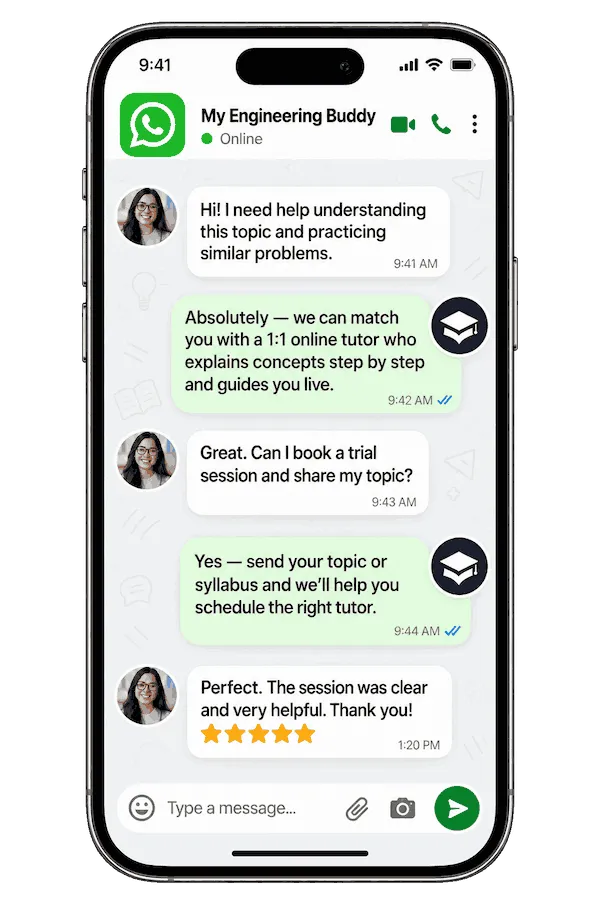
WhatsApp MEB for a quick quote — average response time under 1 minute.
Who This Decision Modelling & Analysis Tutoring Is For
This subject attracts students from engineering, business, economics, and computer science backgrounds — but the same sticking points appear across all of them. Expected value calculations, sensitivity analysis, and formulating a real problem as a solvable model are where most students lose marks.
- Undergraduate students in operations research, management science, or industrial engineering
- MBA and MSc students hitting quantitative modules for the first time
- Students retaking after a failed first attempt — particularly those who passed the theory but struggled on applied problem sets
- Students with a coursework or project submission deadline approaching and specific gaps still open
- Students who need MCDA/MCDM tutoring alongside core decision modelling
- Parents supporting a student through a demanding quantitative programme at universities such as MIT, LSE, Imperial College London, University of Toronto, or ETH Zurich
If you’ve stared at a sensitivity report in Excel Solver and had no idea what the shadow prices were telling you — this tutoring is for you. Start with the $1 trial and get a diagnostic read within the first 30 minutes.
1:1 Tutoring vs Self-Study vs AI vs YouTube vs Online Courses
Self-study works if you’re disciplined, but Decision Modelling & Analysis problem sets punish gaps quietly — you won’t know you’ve modelled a constraint wrong until the exam. AI tools explain concepts fast but can’t watch you set up a sensitivity table and catch the moment you misread the objective function. YouTube covers the theory clearly; it stops when your specific problem doesn’t match the example. Online courses are structured but fixed-pace — they won’t slow down for the one topic where you’re losing all your marks. 1:1 tutoring with MEB is live, calibrated to your exact course, and corrects errors in real time — including the ones you didn’t know you were making.
Outcomes: What You’ll Be Able To Do in Decision Modelling & Analysis
After working with an MEB tutor, you’ll be able to model multi-stage decisions using decision trees with accurate expected value calculations, apply sensitivity analysis to identify which variables actually change the optimal solution, and formulate linear and integer programming problems from written problem descriptions — not just solve pre-built ones. You’ll also be able to explain simulation output (mean, variance, confidence intervals) at a level that satisfies exam markers, and present a defensible recommendation from a MCDM analysis without losing marks to vague justification.
Based on feedback from 40,000+ sessions collected by MEB from 2022 to 2025, 58% of students improved by one full grade after approximately 20 hours of 1:1 tutoring in subjects like Decision Modelling & Analysis. A further 23% achieved at least a half-grade improvement.
Source: MEB session feedback data, 2022–2025.
Students consistently tell us that the moment things click in Decision Modelling & Analysis isn’t when they learn a new formula — it’s when they finally understand which model to reach for in an unseen problem. That’s what a diagnostic session reveals, and what every session after it builds toward.
What We Cover in Decision Modelling & Analysis (Syllabus / Topics)

Decision Analysis & Uncertainty
- Decision trees: structuring multi-stage problems, rolling back expected values
- Utility theory and risk attitudes (risk-neutral, risk-averse, risk-seeking)
- Sensitivity analysis: one-way, two-way, and tornado diagrams
- Bayes’ theorem applied to decision revision with new information
- Value of perfect and imperfect information (EVPI, EVII)
- Markov chain models for sequential decisions under uncertainty
Core texts include Clemen & Reilly’s Making Hard Decisions and Raiffa & Schlaifer’s Applied Statistical Decision Theory.
Optimisation Models
- Linear programming: formulation, graphical solution, and simplex method
- Integer and mixed-integer programming for discrete decisions
- Network models: shortest path, minimum spanning tree, max-flow problems
- Constraint formulation: identifying binding vs non-binding constraints and dual prices
- Convex optimisation for continuous, differentiable objective functions
- Goal programming for multi-objective problems
Key references: Hillier & Lieberman’s Introduction to Operations Research and Winston’s Operations Research: Applications and Algorithms.
Simulation & Multi-Criteria Methods
- Monte Carlo simulation: generating input distributions, running trials, interpreting output
- Discrete-event simulation concepts and queueing models
- AHP (Analytic Hierarchy Process) for structured pairwise comparison
- TOPSIS and weighted scoring methods for discrete alternative selection
- Sensitivity testing in simulation: varying parameters and assessing robustness
- Game theory applied to competitive decision environments
Supporting texts: Law’s Simulation Modeling and Analysis and Belton & Stewart’s Multiple Criteria Decision Analysis.
What a Typical Decision Modelling & Analysis Session Looks Like
The tutor opens by checking where you got stuck since the last session — often it’s the formulation stage of a dynamic programming problem or interpreting a dual-price report from an LP solution. From there, you and the tutor work through a problem on screen: the tutor writes out the model structure on a digital pen-pad while you follow the logic, then you replicate the setup on your own sheet and explain each step back. For simulation questions, you’ll run a small Monte Carlo in Excel together, reading the output distribution and identifying what changes if you shift an assumption. The session closes with a specific practice problem set for the next 48 hours and a note on which topic comes next.
How MEB Tutors Help You with Decision Modelling & Analysis (The Learning Loop)
Diagnose: In the first session, the tutor asks you to attempt a formulation problem cold. This reveals whether your difficulty is mathematical (algebra, probability), conceptual (model selection, constraint logic), or presentational (structuring the answer for marks). Most students have all three — in different proportions.
Explain: The tutor works through live examples using a digital pen-pad — not slides, not a textbook page. You watch the decision tree get built branch by branch, or see a sensitivity table completed with a running commentary on what each number means for the decision.
Practice: You attempt the next problem with the tutor present. Not watching — present. They don’t intervene until you’ve made a genuine attempt, which is how the gaps surface.
Feedback: The tutor goes through every step where marks would be lost. In Decision Modelling & Analysis, those losses are specific: wrong rollback direction, missing a dominance check, failing to state the optimal decision at each node. You learn exactly where the points went and why.
Plan: Each session ends with a written list of what’s covered, what’s next, and what you’re practising before the following session. The Society for Industrial and Applied Mathematics (SIAM) regularly highlights that structured problem-solving practice — not passive re-reading — drives lasting quantitative skill. That’s the method MEB uses.
Sessions run over Google Meet. The tutor uses a digital pen-pad or iPad with Apple Pencil. Before your first session, share your course syllabus or module outline, a recent past paper or problem set you struggled with, and your exam or coursework deadline. The first session covers the diagnostic and the first priority topic. Start with the $1 trial — 30 minutes of live tutoring that also serves as your first diagnostic.
Try your first session for $1 — 30 minutes of live 1:1 tutoring or one homework question explained in full. No registration. No commitment. WhatsApp MEB now and get matched within the hour.
Tutor Match Criteria (How We Pick Your Tutor)
Every tutor goes through a subject-specific screening process — not a general aptitude check.
Subject depth: Tutors are matched by the specific area of Decision Modelling & Analysis your course covers — LP and sensitivity analysis for one student, Monte Carlo simulation for another. Level and exam board are confirmed before matching.
Tools: All tutors work over Google Meet with a digital pen-pad or iPad and Apple Pencil. Quantitative subjects don’t work on a whiteboard — you need to see working built step by step.
Time zone: Matched to your region — US, UK, Gulf, Canada, or Australia. Evening and weekend slots are available across all zones.
Goals: Whether you need exam preparation, assignment support, conceptual depth, or research-level modelling help, the tutor match accounts for it. Unlike platforms where you fill out a form and wait, MEB responds in under a minute, 24/7. Tutor match takes under an hour. The $1 trial means you test before you commit. Everything runs over WhatsApp — no logins, no intake forms.
Study Plans (Pick One That Matches Your Goal)
Catch-up (1–3 weeks): for students with specific gaps — a topic they missed or consistently lose marks on. Sessions focus on that topic only until it’s solid. Exam prep (4–8 weeks): structured revision working through every examinable area in priority order, with past-paper practice built in from week two. Weekly support: ongoing sessions aligned to your semester timetable and coursework deadlines. After the diagnostic, the tutor maps the exact sequence — there’s no off-the-shelf plan that works for everyone in this subject.
Pricing Guide
Most Decision Modelling & Analysis tutoring runs $20–$40/hr. Graduate and MBA-level work, stochastic optimisation, or research-project support can reach $100/hr depending on tutor expertise and topic complexity. Rate factors include your level, the specific topics covered, your timeline, and tutor availability.
For students targeting top-ranked MBA programmes or competitive MSc places at institutions such as Wharton, LBS, or INSEAD, tutors with professional operations research or management consulting backgrounds are available at higher rates — share your specific goal and MEB will match the tier to your ambition.
Availability shrinks fast in the six weeks before final exams and major coursework deadlines. Start early if you can. Start with the $1 trial — 30 minutes, no registration, no commitment. WhatsApp MEB for a quick quote.
A common pattern our tutors observe is that students arrive knowing the formulas but having never built a model from scratch from a written problem statement. That’s the gap. Two or three sessions of structured formulation practice — starting from a blank page — tend to close it faster than re-reading notes ever will.
FAQ
Is Decision Modelling & Analysis hard?
It’s harder than it looks on paper. The maths is rarely advanced, but translating a real-world problem into a valid model — and then interpreting the solution — trips up most students. With a tutor working through formulations alongside you, the logic clicks faster than working from a textbook alone.
How many sessions are needed?
Students with a single gap — say, sensitivity analysis or decision-tree rollback — often need three to five sessions. A full exam prep programme across all examinable topics runs eight to twelve sessions over four to six weeks. The diagnostic in session one gives a clearer answer specific to your course.
Can you help with homework and assignments?
Yes. MEB tutoring is guided learning — you understand the work, then submit it yourself. The tutor explains the method, works through the logic with you, and checks your reasoning. See our Academic Integrity policy and Why MEB page for full details on what we help with and what we don’t.
Will the tutor match my exact syllabus or exam board?
Yes. Before matching, MEB confirms your course, institution, and the specific topics your programme covers. Decision Modelling & Analysis varies significantly between business school, engineering, and computer science programmes — the tutor match accounts for that variation.
What happens in the first session?
The tutor starts with a short diagnostic — usually one formulation problem attempted cold — to identify exactly where your gaps are. From there, the session moves directly into the highest-priority topic. You won’t spend 45 minutes on introductions. The diagnostic and first topic are both covered in one session.
Is online tutoring as effective as in-person?
For quantitative subjects like Decision Modelling & Analysis, screen-sharing and a digital pen-pad are often more useful than a physical whiteboard — you can zoom in on a sensitivity table, annotate a decision tree in real time, and save the worked solution. Most students find the format better once they’ve tried it.
Can I get Decision Modelling & Analysis help at midnight?
Yes. MEB operates across time zones, with tutors available in the US, UK, Gulf, and Asia-Pacific regions. WhatsApp MEB at any hour — the average response time is under a minute, and a tutor can often be matched for a same-day or next-morning session.
What if I don’t like my assigned tutor?
Request a switch. It’s common — tutor-student fit matters in a quantitative subject where communication style affects how well the modelling logic lands. MEB will rematch you without any issue. The $1 trial exists specifically so you can test the fit before committing to a block of sessions.
How do I get started?
Three steps: WhatsApp MEB, get matched with a verified Decision Modelling & Analysis tutor (usually within the hour), then start your $1 trial — 30 minutes of live tutoring or one homework question fully explained. No registration form, no payment commitment beyond the dollar.
Do Decision Modelling & Analysis courses differ between business school and engineering programmes?
Significantly. Business school versions typically emphasise decision trees, expected utility, and MCDM methods with a strategy framing. Engineering and OR programmes go deeper into LP, integer programming, simulation, and stochastic modelling. MEB matches the tutor to your specific programme — not a generic syllabus.
What software is used in Decision Modelling & Analysis courses, and can a tutor help with it?
Most courses use Excel Solver, @RISK, TreePlan, or Arena for simulation. Some graduate programmes use Python or R for optimisation and Monte Carlo work. MEB tutors cover the software alongside the theory — so if your problem set requires Solver sensitivity output or @RISK distributions, the tutor works through that directly.
Trust & Quality at My Engineering Buddy
Every MEB tutor is screened through a subject-specific vetting process: a live demo session, review of academic credentials, and ongoing feedback monitoring from students. Tutors covering Decision Modelling & Analysis hold degrees in operations research, management science, industrial engineering, applied mathematics, or closely related fields — many also carry professional experience in consulting, logistics, or quantitative analysis. Rated 4.8/5 across 40,000+ verified reviews on Google.
MEB tutoring is guided learning — you understand the work, then submit it yourself. For full details on what we help with and what we don’t, read our Academic Integrity policy and Why MEB.
MEB has served 52,000+ students across the US, UK, Canada, Australia, the Gulf, and Europe in 2,800+ subjects since 2008. Within Operations Research, that includes students working on inventory management tutoring, Nash equilibrium help, and Decision Modelling & Analysis at undergraduate through doctoral level. Read more about how sessions are structured at MEB’s tutoring methodology page.
Explore Related Subjects
Students studying Decision Modelling & Analysis often also need support in:
At MEB, we’ve found that students who share their course outline before the first session make faster progress — the tutor arrives knowing exactly which model types are examinable and which software the course uses. It takes two minutes to send, and it changes what happens in the first 30 minutes.
Next Steps
Before your first session, have ready: your exam board and syllabus (or course outline), a recent past paper attempt or homework you struggled with, and your exam or deadline date. The tutor handles the rest.
- Share your module or exam board, the hardest topic so far, and your current timeline
- Share your availability and time zone
- MEB matches you with a verified Decision Modelling & Analysis tutor — usually within 24 hours
- First session starts with a diagnostic so every minute is used well
Visit www.myengineeringbuddy.com for more on how MEB works.
WhatsApp to get started or email [email protected].
Reviewed by Subject Expert
This page has been carefully reviewed and validated by our subject expert to ensure accuracy and relevance.