~1 min
Average Reply Time
~1 hour
To Be Matched With A Tutor
30 Min Trial
75% Find Their Tutor On The 1st Trial
$20-35+/hr
Premium Yet Affordable Learning
Convex Optimization problems look solvable — until you’re staring at a KKT condition at midnight with three assignments due.
Convex Optimization Tutor Online
Convex Optimization is a branch of mathematical optimization studying the minimization of convex functions over convex sets. It underpins machine learning, signal processing, and operations research, equipping students to formulate and solve constrained optimization problems rigorously.
MEB provides 1:1 online tutoring and homework help in 2800+ advanced subjects — including Convex Optimization and the broader field of operations research tutoring. If you’ve searched for a Convex Optimization tutor near me, you’re in the right place. Our tutors work through duality theory, gradient methods, and solver implementation at your exact course level — no generic overviews, no wasted sessions.
- 1:1 online sessions tailored to your syllabus and course outline
- Expert-verified tutors with graduate-level subject knowledge
- Flexible time zones — US, UK, Canada, Australia, Gulf
- Structured learning plan built after a diagnostic session
- Ethical homework and assignment guidance — you understand before you submit
52,000+ students across the US, UK, Canada, Australia, and the Gulf have used MEB since 2008 — including students in Operations Research subjects like Convex Optimization, linear programming tutoring, and discrete optimization.
Source: My Engineering Buddy, 2008–2025.
How Much Does a Convex Optimization Tutor Cost?
Most Convex Optimization sessions run $20–$40/hr depending on level and topic complexity. Graduate and research-level work goes up to $100/hr. The $1 trial gives you 30 minutes of live tutoring or one full homework question explained — before you commit to anything.
| Level / Need | Typical Rate | What’s Included |
|---|---|---|
| Undergraduate (core modules) | $20–$35/hr | 1:1 sessions, homework guidance |
| Graduate / Research-level | $40–$100/hr | Expert tutor, advanced depth |
| $1 Trial | $1 flat | 30 min live session or 1 HW question |
Tutor availability tightens around semester finals and dissertation submission windows. Book early if your deadline is within four weeks.
WhatsApp MEB for a quick quote — average response time under 1 minute.
Who This Convex Optimization Tutoring Is For
This isn’t an introductory linear algebra refresher. Convex Optimization tutoring at MEB is for students who are already in the course and running into real problems — duality gaps they can’t close, projected gradient steps they can’t verify, or CVX/CVXPY code that produces unexpected results.
- Undergraduate students in engineering, mathematics, or computer science taking an optimization module
- Masters and PhD students applying convex methods to machine learning, control theory, or signal processing research
- Students 4–6 weeks from an exam with significant gaps still to close in topics like strong duality or interior-point methods
- Students retaking after a failed first attempt — particularly those who passed calculus but struggled when Lagrangians and constraint qualifications appeared
- Students at universities including MIT, Stanford, Carnegie Mellon, ETH Zurich, Imperial College London, TU Delft, and University of Toronto where convex optimization features heavily in engineering and CS curricula
- Students needing homework guidance on problem sets drawn from Boyd & Vandenberghe or Bertsekas
At MEB, we’ve found that students who struggle with Convex Optimization usually don’t have a calculus problem — they have a conceptual gap around what convexity actually means geometrically. Fix that understanding first, and the algebra starts making sense within two or three sessions.
1:1 Tutoring vs Self-Study vs AI vs YouTube vs Online Courses
Self-study works if you’re disciplined — but Convex Optimization has enough notation-heavy theory that most students hit a wall without feedback. AI tools give fast symbolic explanations but can’t catch the logical error in your duality proof live. YouTube covers gradient descent clearly but stops when you need to implement ADMM for a specific problem structure. Online courses are paced for the average student, not your exam date. With a 1:1 Convex Optimization tutor at MEB, every session is calibrated to your exact syllabus, your current gaps, and the specific solver or proof technique your course demands.
Outcomes: What You’ll Be Able To Do in Convex Optimization
After working with an MEB tutor, students can solve constrained optimization problems using KKT conditions with confidence, analyze the strong and weak duality of specific problem formulations, model real engineering or ML problems as disciplined convex programs, explain why a function or feasible set is or is not convex using precise definitions, and apply CVX or CVXPY to implement and verify solutions computationally. These aren’t abstract goals — they map directly to problem set questions, exam prompts, and research applications.
Based on feedback from 40,000+ sessions collected by MEB from 2022 to 2025, 58% of students improved by one full grade after approximately 20 hours of 1:1 tutoring in subjects like Convex Optimization. A further 23% achieved at least a half-grade improvement.
Source: MEB session feedback data, 2022–2025.
Try your first session for $1 — 30 minutes of live 1:1 tutoring or one homework question explained in full. No registration. No commitment. WhatsApp MEB now and get matched within the hour.
What We Cover in Convex Optimization (Syllabus / Topics)

Convex Sets, Functions, and Problem Formulation
- Convex sets: definitions, examples, operations preserving convexity
- Convex functions: first- and second-order conditions, sublevel sets
- Quasiconvex and log-convex functions
- Standard problem forms: LP, QP, SOCP, SDP
- Disciplined convex programming (DCP) rules and CVX/CVXPY implementation
- Modeling real problems as convex programs — ML regularization, portfolio optimization
Primary texts: Boyd & Vandenberghe Convex Optimization (Cambridge University Press); Bertsekas Convex Optimization Theory. MIT OpenCourseWare materials via MIT OpenCourseWare align closely with this track.
Duality Theory and Optimality Conditions
- Lagrangian function, Lagrange dual function, dual problem
- Weak and strong duality; Slater’s condition
- KKT conditions: stationarity, primal feasibility, dual feasibility, complementary slackness
- Sensitivity analysis and geometric interpretation of duality
- Constraint qualifications and their role in KKT validity
- Saddle-point interpretation and minimax problems
Primary texts: Boyd & Vandenberghe Convex Optimization; Rockafellar Convex Analysis. Students needing simplex method help often take this track alongside LP duality.
Algorithms and Numerical Methods
- Gradient descent: convergence rates, step size selection, Lipschitz conditions
- Projected gradient and proximal gradient methods
- Newton’s method and quasi-Newton approaches (L-BFGS)
- Interior-point methods: barrier method, central path
- ADMM (Alternating Direction Method of Multipliers) — structure and convergence
- Subgradient methods for non-smooth problems
- Stochastic gradient descent and its convex convergence guarantees
Primary texts: Nesterov Lectures on Convex Optimization; Parikh & Boyd Proximal Algorithms. Students building towards dynamic programming tutoring often encounter shared convergence theory here.
What a Typical Convex Optimization Session Looks Like
The tutor opens by checking where the previous session ended — usually a KKT derivation or a CVX implementation task. If there’s a problem set question on the table, the student shares their screen and walks through their current attempt. The tutor uses a digital pen-pad to annotate the working in real time: marking where the argument breaks down, whether the constraint qualification was actually checked, or why the dual variable has the sign it does. The student then reattempts the step while the tutor watches. Before closing, the tutor sets a specific practice problem — often one that isolates the exact sub-skill that caused the error — and notes the next topic for the following session, typically moving from duality to interior-point methods or algorithm convergence proofs.
How MEB Tutors Help You with Convex Optimization (The Learning Loop)
Diagnose: In the first session, the tutor asks the student to attempt a problem from their current homework or a past exam question. This reveals exactly where the gap is — whether it’s the definition of convexity, the mechanics of Lagrangian construction, or translating a real problem into a disciplined convex program.
Explain: The tutor works through a parallel problem live on a digital pen-pad, narrating every step. For Convex Optimization, this usually means showing the geometry of a constraint set alongside the algebra — connecting the picture to the proof.
Practice: The student attempts a similar problem with the tutor present. No moving on until the reasoning is solid, not just the answer.
Feedback: The tutor identifies every step where marks would be lost — missing a constraint qualification check, skipping the complementary slackness argument, or using CVX without verifying DCP compliance. Each error is corrected with an explanation of why it matters.
Plan: The session ends with a clear next topic, a specific practice task, and an honest assessment of whether the student is on track for their exam or submission deadline.
Sessions run on Google Meet. The tutor uses a digital pen-pad or iPad with Apple Pencil for real-time annotation. Before the first session, share your course syllabus or problem set, a recent piece of work you found difficult, and your exam or submission date. The first session covers a diagnostic problem, then moves directly into the topics where you’re losing marks. Start with the $1 trial — 30 minutes of live tutoring that also serves as your first diagnostic.
Students consistently tell us that Convex Optimization clicks when the tutor slows down on the geometry — drawing the feasible set, the objective contours, and showing physically where the optimum lives before touching the algebra. That visual anchor changes everything.
Tutor Match Criteria (How We Pick Your Tutor)
Not every strong mathematician makes a strong Convex Optimization tutor. MEB matches on four specific criteria.
Subject depth: Tutors have graduate-level knowledge of convex analysis, duality theory, and numerical optimization — not just familiarity with the Boyd & Vandenberghe text. We confirm they can handle the specific topics your course covers, including constraints tutoring and solver implementation.
Tools: Every tutor works on Google Meet with a digital pen-pad or iPad and Apple Pencil. No whiteboard approximations — students see full worked derivations in real time.
Time zone: Matched to your region. US, UK, Gulf, Canada, Australia — all covered, including late-evening slots.
Goals: The match considers whether you need exam score improvement, conceptual depth on a specific topic like ADMM or SDP, assignment guidance, or research-level support for a thesis chapter.
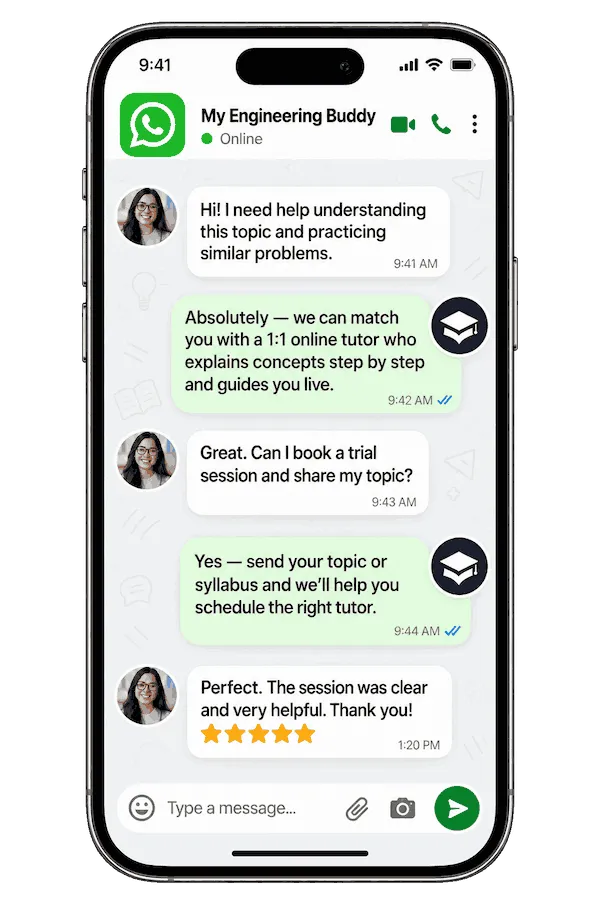
Unlike platforms where you fill out a form and wait, MEB responds in under a minute, 24/7. Tutor match takes under an hour. The $1 trial means you test before you commit. Everything runs over WhatsApp — no logins, no intake forms.
Study Plans (Pick One That Matches Your Goal)
After the diagnostic session, the tutor builds a specific sequence — but here’s how most students approach it. Catch-up (1–3 weeks): students behind on duality theory or algorithm convergence, closing gaps before a problem set or midterm. Exam prep (4–8 weeks): structured revision covering all tracks — convex sets, KKT conditions, and numerical methods — mapped to a specific exam date. Weekly support: ongoing sessions aligned to semester pacing, covering each new topic as it’s introduced in lectures. The tutor determines the exact sequence after your first session.
Pricing Guide
Standard Convex Optimization tutoring runs $20–$40/hr for undergraduate and taught-masters modules. Research-level work — thesis support, advanced semidefinite programming, or custom algorithm implementation — runs up to $100/hr. Rate factors include topic complexity, the tutor’s background, and your timeline.
For students targeting top engineering or CS graduate programs, or working on research that involves optimization at a professional level, tutors with academic research or industry backgrounds in operations research and machine learning are available at higher rates — share your specific goal and MEB will match the tier to your ambition.
Availability tightens significantly during December and April exam periods. If your deadline is within six weeks, book sooner rather than later.
Start with the $1 trial — 30 minutes, no registration, no commitment. WhatsApp MEB for a quick quote.
FAQ
Is Convex Optimization hard?
Yes, for most students. The difficulty comes from three places at once: abstract mathematical definitions, proof-based derivations, and practical implementation in tools like CVX. Students strong in calculus still struggle when duality and constraint qualifications appear. It gets manageable with the right structure.
How many sessions are needed?
Students closing specific topic gaps typically need 4–8 sessions. Students working through an entire semester of Convex Optimization from scratch usually need 15–25 sessions spread over 8–12 weeks. The tutor gives a clearer estimate after the diagnostic.
Can you help with homework and assignments?
MEB tutoring is guided learning — you understand the work, then submit it yourself. The tutor explains the method, works through a parallel example, and checks your reasoning. See our Academic Integrity policy and Why MEB page for full details on what we help with and what we don’t.
Will the tutor match my exact syllabus or exam board?
Yes. Share your course outline or university module guide when you first contact MEB. The tutor is matched to your specific syllabus — whether that’s a Boyd & Vandenberghe-based graduate course, a CS optimization module, or an engineering elective with a different emphasis.
What happens in the first session?
The tutor starts with a diagnostic problem from your current material. This takes 15–20 minutes and reveals exactly where you’re losing marks. The remaining time goes directly into the highest-priority gap. You leave with a clear plan and a specific practice task.
Is online tutoring as effective as in-person?
For a notation-heavy subject like Convex Optimization, yes — often more so. The tutor annotates derivations in real time on a digital pen-pad, and you can share your own working on screen instantly. Students consistently report that the live annotation makes proofs easier to follow than a static textbook.
What’s the difference between Convex Optimization and general nonlinear programming?
Convex Optimization is a special case where both the objective and feasible set are convex — this guarantees that any local minimum is global, and enables powerful duality results and efficient algorithms. General nonlinear programming lacks these guarantees, making it significantly harder to solve reliably.
Do I need to know CVX or CVXPY before sessions start?
No prior solver experience is required. The tutor introduces CVX or CVXPY as part of the session when your course requires it, explains disciplined convex programming rules, and walks through implementation alongside the mathematical formulation. Most students pick it up within one or two sessions.
Can you help with Convex Optimization at midnight or on weekends?
Yes. MEB tutors span multiple time zones and late-evening or weekend slots are available across US, UK, Gulf, and Australian time zones. WhatsApp MEB at any hour — average response time is under one minute.
How does strong duality relate to KKT conditions, and why do students confuse them?
Strong duality guarantees zero duality gap under Slater’s condition. KKT conditions are necessary and sufficient for optimality when strong duality holds. Students confuse them because both involve the Lagrangian — but they answer different questions. The tutor covers this distinction in the first or second session.
How do I get started?
Three steps: WhatsApp MEB with your course details, get matched with a verified Convex Optimization tutor — usually within an hour — then start the $1 trial. Thirty minutes live or one homework question explained in full. No registration required.
Can you help with Convex Optimization applications in machine learning, like regularization or SVM formulations?
Yes. MEB tutors regularly work on ML-adjacent Convex Optimization problems — Lasso and ridge regression as QPs, SVM as a constrained convex program, and neural network training via stochastic gradient methods. Share your specific application and the tutor is matched accordingly. Students working on MCDA/MCDM tutoring and related decision science often tackle similar applied formulations.
Trust & Quality at My Engineering Buddy
Every MEB tutor goes through subject-specific screening before taking a session. That means a live demo evaluation on Convex Optimization topics — not just a CV review — followed by ongoing session feedback scoring. Tutors hold graduate degrees in mathematics, engineering, computer science, or operations research, and many have research or industry experience applying convex methods. Rated 4.8/5 across 40,000+ verified reviews on Google. Students working on decision modelling and analysis help and game theory tutoring are matched through the same process.
MEB tutoring is guided learning — you understand the work, then submit it yourself. For full details on what we help with and what we don’t, read our Academic Integrity policy and Why MEB.
MEB has served 52,000+ students across the US, UK, Canada, Australia, the Gulf, and Europe in 2,800+ subjects since 2008. Operations Research — including Convex Optimization, discrete optimization help, and genetic algorithms tutoring — is one of MEB’s strongest subject families. Find out more about how tutors are selected at our tutoring methodology page.
A common pattern our tutors observe is that students arrive knowing the definition of a convex function but unable to apply the second-order condition to a specific function in front of them. That gap between theory and execution is exactly what 1:1 sessions are designed to close — fast.
Explore Related Subjects
Students studying Convex Optimization often also need support in:
Next Steps
Before your first session, have ready: your course syllabus or module outline, a recent problem set or homework question you struggled with, and your exam or submission deadline. The tutor handles the rest.
- Share your exam board or university module, your hardest current topic, and your timeline
- Share your availability and time zone
- MEB matches you with a verified Convex Optimization tutor — usually within 24 hours
- First session starts with a diagnostic so every minute is used well
Visit www.myengineeringbuddy.com for more on how MEB works.
WhatsApp to get started or email [email protected].
Reviewed by Subject Expert
This page has been carefully reviewed and validated by our subject expert to ensure accuracy and relevance.