Contact MEB Today To Get The Best
Multi-Criteria Decision Making and Analysis MCDA/MCDM Tutoring Online
Email: [email protected]



~1 min
Average Reply Time
~1 hour
To Be Matched With A Tutor
30 Min Trial
75% Find Their Tutor On The 1st Trial
$20-35+/hr
Premium Yet Affordable Learning
Hire The Best Multi-Criteria Decision Making and Analysis MCDA/MCDM Tutor


Most students hit a wall when they realize MCDA/MCDM isn’t just theory — it’s 12 competing methods, each with a different logic, and your assignment wants you to justify why you picked one over the others.
Multi-Criteria Decision Making and Analysis MCDA/MCDM Tutor Online
Multi-Criteria Decision Making and Analysis (MCDA/MCDM) is a branch of operations research tutoring that structures decisions involving multiple conflicting objectives, using methods such as AHP, TOPSIS, and ELECTRE to rank and select among alternatives.
If you’re looking for an MCDA/MCDM tutor online, MEB connects you with specialists who know the difference between compensatory and non-compensatory methods, can work through weighted scoring models with you step by step, and will match your exact course materials. Whether you’re wrestling with pairwise comparison matrices or trying to normalise a decision matrix correctly, a 1:1 session cuts through the confusion faster than any textbook. Search for a MCDA/MCDM tutor near me and you’ll find MEB — available across every time zone, 24/7.
- 1:1 online sessions tailored to your course syllabus and assignment brief
- Expert-verified tutors with postgraduate-level knowledge of decision science
- Flexible time zones — US, UK, Canada, Australia, Gulf covered
- Structured learning plan built after a diagnostic session
- Ethical homework and assignment guidance — you understand the work, then submit it yourself
52,000+ students across the US, UK, Canada, Australia, and the Gulf have used MEB since 2008 — including students in Operations Research subjects like Multi-Criteria Decision Making and Analysis MCDA/MCDM, Decision Modelling & Analysis, and linear programming.
Source: My Engineering Buddy, 2008–2025.
How Much Does a Multi-Criteria Decision Making and Analysis MCDA/MCDM Tutor Cost?
Most MCDA/MCDM tutoring sessions run $20–$40/hr. Graduate-level work — dissertation support, multi-attribute utility theory, or complex group decision models — can reach $60–$100/hr depending on tutor specialisation. The $1 trial gets you 30 minutes of live tutoring or one full assignment question explained, with no registration required.
| Level / Need | Typical Rate | What’s Included |
|---|---|---|
| Undergraduate (most courses) | $20–$40/hr | 1:1 sessions, homework guidance, method walkthroughs |
| Postgraduate / Research | $40–$100/hr | Dissertation support, MAUT, fuzzy MCDM, expert tutor |
| $1 Trial | $1 flat | 30 min live session or one full homework question |
Availability tightens at semester end and around dissertation submission windows. Book early if your deadline is within four weeks.
WhatsApp MEB for a quick quote — average response time under 1 minute.
Who This Multi-Criteria Decision Making and Analysis MCDA/MCDM Tutoring Is For
MCDA/MCDM appears across engineering management, business analytics, urban planning, environmental science, and operations research programmes. It looks manageable until you’re asked to compare AHP consistency ratios or defend your choice of TOPSIS over VIKOR in a written report.
- Undergraduate students in engineering, management, or OR modules encountering MCDM for the first time
- Postgraduate and MBA students using MCDA in dissertation research or capstone projects
- Students retaking after a failed first attempt who need a cleaner grip on method selection logic
- PhD researchers applying fuzzy MCDM or group decision-making frameworks to real datasets
- Students 4–6 weeks from submission with gaps in weighting methods or sensitivity analysis still to close
- Parents watching a student’s confidence drop as assignment grades fall despite hours of effort
Students come from universities across the US, UK, Canada, Australia, and the Gulf — including programmes at institutions like MIT, University of Michigan, Imperial College London, University of Toronto, University of Melbourne, and TU Delft.
1:1 Tutoring vs Self-Study vs AI vs YouTube vs Online Courses
Self-study works if you already understand which method fits which problem type — most students don’t, not at first. AI tools generate method explanations but can’t spot why your consistency ratio is above 0.1 or why your normalisation step is off. YouTube covers AHP basics well and stops there. Online courses follow a fixed sequence that may not match your assignment deadline. 1:1 MCDM tutoring with MEB is calibrated to your exact course: the tutor works through your actual decision matrix, corrects errors live, and explains the reasoning your marker expects to see.
Outcomes: What You’ll Be Able To Do in Multi-Criteria Decision Making and Analysis MCDA/MCDM
After focused 1:1 MCDA/MCDM tutoring, you’ll be able to apply AHP pairwise comparison correctly and verify your consistency ratio sits below the 0.1 threshold. You’ll analyse alternatives using TOPSIS, calculating separation measures from ideal and negative-ideal solutions without skipping steps. You’ll model multi-attribute utility functions and explain the trade-offs between compensatory and non-compensatory aggregation. You’ll present a structured decision analysis report that justifies method selection, not just outputs results. You’ll solve sensitivity analysis questions confidently — showing how weight changes shift the final ranking.
At MEB, we’ve found that students struggle most with MCDA/MCDM not because the maths is hard, but because they’ve never been shown how to choose between methods. Once a tutor walks through the decision logic — not just the formula — the rest falls into place quickly.
Based on feedback from 40,000+ sessions collected by MEB from 2022 to 2025, 58% of students improved by one full grade after approximately 20 hours of 1:1 tutoring in subjects like Multi-Criteria Decision Making and Analysis MCDA/MCDM. A further 23% achieved at least a half-grade improvement.
Source: MEB session feedback data, 2022–2025.
What We Cover in Multi-Criteria Decision Making and Analysis MCDA/MCDM (Syllabus / Topics)

Track 1: Foundations and Weighting Methods
- Problem structuring: identifying criteria, alternatives, and decision context
- Criterion weighting: direct weighting, rank-order methods, swing weighting
- Analytic Hierarchy Process (AHP): pairwise comparison matrices and eigenvector derivation
- Consistency ratio calculation and what to do when CR exceeds 0.1
- Weighted sum model (WSM) and weighted product model (WPM)
- Simple additive weighting (SAW) applied to real case data
Core texts: Saaty, The Analytic Hierarchy Process; Belton & Stewart, Multiple Criteria Decision Analysis: An Integrated Approach.
Track 2: Ranking and Outranking Methods
- TOPSIS: normalisation, weighted matrix, ideal and negative-ideal solutions, closeness coefficient
- VIKOR: compromise ranking and the Q, S, R index calculations
- ELECTRE I, II, and III: concordance/discordance matrices and outranking relations
- PROMETHEE I and II: preference functions, net flow scores, GAIA plane interpretation
- Comparing compensatory vs non-compensatory methods — when each is appropriate
- Method selection justification for written reports and dissertations
Core texts: Figueira, Greco & Ehrgott, Multiple Criteria Decision Analysis: State of the Art Surveys; Dyer, MAUT — Multiattribute Utility Theory.
Track 3: Advanced and Applied MCDM
- Fuzzy MCDM: triangular and trapezoidal fuzzy numbers, fuzzy AHP and fuzzy TOPSIS
- Group decision making: aggregating preferences across multiple decision-makers
- Multi-attribute utility theory (MAUT): utility functions, trade-off analysis
- Sensitivity analysis: weight perturbation, rank reversal, robustness testing
- GIS-based MCDA applications in environmental and spatial planning contexts
- Software implementation: working with Excel, Python (scikit-criteria), or MATLAB for MCDM
Core texts: Triantaphyllou, Multi-Criteria Decision Making Methods: A Comparative Study; Greco et al., Robust Ordinal Regression.
What a Typical Multi-Criteria Decision Making and Analysis MCDA/MCDM Session Looks Like
The tutor opens by checking where you got to with the consistency ratio from last time — whether the pairwise matrix holds or needs adjustment. From there, you and the tutor work through the current problem on screen: building a decision matrix, applying the correct normalisation method, and stepping through TOPSIS or ELECTRE calculations together. The tutor uses a digital pen-pad to annotate each step. You replicate the calculation or explain the reasoning back — whichever surfaces the gap faster. By the end of the session, you have a concrete practice task (usually a parallel problem from your course materials) and a clear note on which method or concept gets covered next.
How MEB Tutors Help You with Multi-Criteria Decision Making and Analysis MCDA/MCDM (The Learning Loop)
Diagnose: In the first session, the tutor asks you to walk through a decision problem you’ve already attempted. This reveals immediately whether the gap is in method selection, the maths, the interpretation, or the written justification — all four fail in different ways.
Explain: The tutor works through a live example using a digital pen-pad — building the matrix on screen, annotating each transformation, and naming the decision at every step. You see exactly where the logic sits, not just the result.
Practice: You attempt a parallel problem with the tutor present. No watching. No copying. You work it through and the tutor observes where you hesitate or branch incorrectly.
Feedback: Errors are corrected step by step. The tutor explains why a particular normalisation choice loses marks, or why a consistency ratio above threshold invalidates the whole AHP output — not just that it’s wrong.
Plan: At session end, the tutor sets the next topic and a specific task. Progress is tracked across sessions so nothing is revisited unnecessarily and no gap is left unaddressed.
Sessions run on Google Meet. The tutor uses a digital pen-pad or iPad with Apple Pencil for annotation. Before your first session, share your course outline or assignment brief, any past work you’ve already attempted, and your submission date. The first session covers a diagnostic problem and maps the remaining sessions to your deadline. Start with the $1 trial — 30 minutes of live tutoring that also serves as your first diagnostic.
Students consistently tell us that MCDA/MCDM clicked only when someone showed them the decision behind the method — not just the formula. That’s what 1:1 tutoring delivers that a textbook or lecture recording can’t.
Tutor Match Criteria (How We Pick Your Tutor)
Not every tutor who knows operations research knows MCDA/MCDM at the depth your course requires. MEB matches on four specific criteria.
Subject depth: Tutors are matched by method coverage — a student working on fuzzy AHP gets a different tutor than one working on basic WSM. Postgraduate and dissertation-level work goes to tutors with research or applied industry experience in decision science.
Tools: Every tutor works on Google Meet with a digital pen-pad or iPad and Apple Pencil — so the session looks like a live worked example, not a screen share of a PDF.
Time zone: Matched to your region. US, UK, Gulf, Canada, and Australia are all covered with tutors available across time slots.
Goals: A student fixing a specific assignment error gets a different session structure than a PhD candidate building a complete MAUT framework for a research paper. The tutor match reflects that difference.
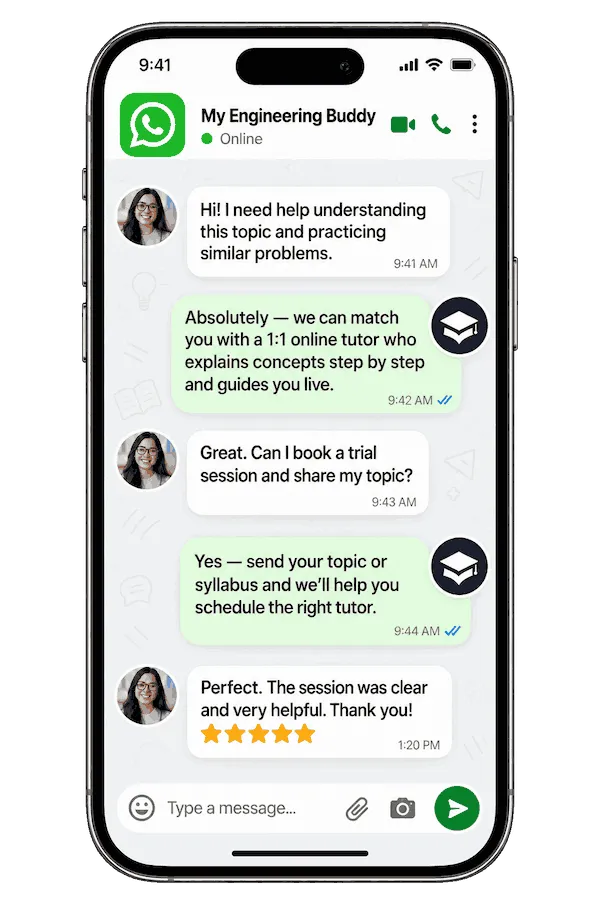
Unlike platforms where you fill out a form and wait, MEB responds in under a minute, 24/7. Tutor match takes under an hour. The $1 trial means you test before you commit. Everything runs over WhatsApp — no logins, no intake forms.
Study Plans (Pick One That Matches Your Goal)
The tutor maps the session sequence after the diagnostic, but here’s how most students structure their time. A catch-up plan (1–3 weeks) focuses on the one or two methods causing the most damage to your assignment grade, fast. An exam prep plan (4–8 weeks) works through the full method set systematically, with past-paper practice built in. Weekly support runs alongside your semester, aligned to your coursework deadlines and lecture schedule. The tutor adjusts the sequence after every session based on what’s changed.
Pricing Guide
MCDA/MCDM tutoring starts at $20/hr for standard undergraduate support. Graduate-level sessions — particularly fuzzy MCDM, group decision modelling, or dissertation support — typically run $40–$100/hr depending on tutor background and topic complexity. Rate factors include your level, the specific methods involved, your deadline, and tutor availability.
Availability tightens significantly during semester-end and dissertation submission periods. If your deadline is within six weeks, book sooner rather than later.
For students targeting top programmes in engineering management, systems engineering, or business analytics at institutions that treat MCDM as a core competency, tutors with applied research and professional consulting backgrounds are available at higher rates — share your specific goal and MEB will match the tier to your needs.
Start with the $1 trial — 30 minutes, no registration, no commitment. WhatsApp MEB for a quick quote.
The RAND Corporation has applied multi-criteria analysis to policy and defence decisions for decades — the same structured reasoning sits at the core of every MCDA/MCDM course, whether you’re in engineering, business, or public policy.
Source: RAND Corporation.
FAQ
Is MCDA/MCDM hard?
It’s not the maths that trips students — it’s method selection. Knowing when to use TOPSIS versus ELECTRE, and why, is what most courses actually test. Once that logic is clear, the calculations follow. A tutor can close that gap in two or three sessions.
How many sessions are needed?
Most students working on a single assignment need two to four sessions. Students covering the full subject over a semester typically run weekly sessions across eight to twelve weeks. After the diagnostic, the tutor gives you a specific session estimate tied to your deadline and current gaps.
Can you help with homework and assignments?
Yes. MEB tutoring is guided learning — you understand the work, then submit it yourself. The tutor explains the method, walks through the logic, and checks your approach. See our Academic Integrity policy and Why MEB page for full details on what we help with and what we don’t.
Will the tutor match my exact syllabus or exam board?
Yes. Before the first session, share your course outline or assignment brief. The tutor works from your materials — your notation, your method set, your weighting conventions — not a generic MCDM textbook that may use different terminology or structure.
What happens in the first session?
The tutor starts with a diagnostic: a decision problem you work through live, or a past assignment you walk them through. This identifies exactly where the gap is — method selection, calculation steps, or written justification — and the remaining sessions are planned from there.
Is online tutoring as effective as in-person?
For a quantitative, method-heavy subject like MCDA/MCDM, online is often better. The tutor annotates decision matrices and formula steps on screen in real time. You can share your spreadsheet or Python output directly. There’s no whiteboard smudging or lost work between sessions.
What’s the difference between AHP and TOPSIS, and which should I use?
AHP structures the decision hierarchy and derives weights through pairwise comparison. TOPSIS then ranks alternatives by closeness to an ideal solution using those weights. Many assignments use both in sequence — AHP for weighting, TOPSIS for ranking. Your tutor will confirm what your specific course or assignment requires.
Can a tutor help me with fuzzy MCDM or fuzzy AHP?
Yes. Fuzzy MCDM — including fuzzy AHP and fuzzy TOPSIS with triangular or trapezoidal fuzzy numbers — is a common postgraduate and dissertation-level topic. MEB has tutors with research-level experience in fuzzy decision models. Share your framework and the tutor is matched accordingly.
Can I get MCDA/MCDM help at midnight?
Yes. MEB operates 24/7 across all time zones. WhatsApp MEB any time — median response is under a minute. If your submission is tomorrow morning and you’ve hit a wall on your consistency ratio or normalisation step, message now and get matched within the hour.
What if I don’t like my assigned tutor?
Request a change immediately — no explanation needed. MEB matches a different tutor, usually within hours. The $1 trial exists precisely so you can test the match before committing to a longer plan. Fit matters, and MEB won’t lock you into a tutor that isn’t working.
How do I get started?
Three steps: WhatsApp MEB, get matched with a verified MCDA/MCDM tutor — usually within the hour — then start your $1 trial. Thirty minutes of live tutoring or one full homework question explained. No registration, no upfront commitment. The tutor handles the rest from there.
Do you cover MCDM software like Python’s scikit-criteria or MATLAB decision toolboxes?
Yes. Tutors can work through decision modelling and analysis in Python (scikit-criteria, PyDecision), Excel-based MCDM templates, and MATLAB. If your assignment requires a specific tool, mention it when you WhatsApp — the tutor match accounts for software familiarity.
Trust & Quality at My Engineering Buddy
Every MEB tutor goes through subject-specific screening before taking sessions. That includes a live demo evaluation on their declared subject area, a review of their academic and professional background, and ongoing session feedback monitoring. Tutors covering MCDA/MCDM are assessed specifically on their ability to explain method selection, not just run calculations. Rated 4.8/5 across 40,000+ verified reviews on Google.
MEB tutoring is guided learning — you understand the work, then submit it yourself. For full details on what we help with and what we don’t, read our Academic Integrity policy and Why MEB.
MEB has served 52,000+ students across the US, UK, Canada, Australia, the Gulf, and Europe since 2008, covering 2,800+ subjects. Operations Research is one of MEB’s strongest subject families — including game theory tutoring, convex optimization help, and dynamic programming tutoring. If your programme touches any of these alongside MCDA/MCDM, MEB covers the full range.
Our experience across thousands of sessions shows that MCDA/MCDM students who bring their actual assignment to the first session — not a generic practice problem — make faster progress. The tutor can pinpoint exactly where the reasoning breaks down.
Explore Related Subjects
Students studying Multi-Criteria Decision Making and Analysis MCDA/MCDM often also need support in:
- Constraints
- Discrete Optimization
- Genetic Algorithms
- Inventory Management
- Markov Chains
- Nash Equilibrium
- Simplex Method
Next Steps
Getting started takes less than two minutes. Here’s what to do:
- Share your course name, the specific MCDM methods you’re working on, and your submission or exam date
- Share your time zone and availability — morning, evening, weekend, any combination
- MEB matches you with a verified tutor — usually within 24 hours, often within the hour
- First session opens with a diagnostic so every minute is spent on your actual gaps
Before your first session, have ready:
- Your course outline or assignment brief (syllabus page, marking rubric if available)
- A recent past attempt or homework question you struggled with
- Your exam or submission deadline date
The tutor handles the rest. Visit www.myengineeringbuddy.com for more on how MEB works.
WhatsApp to get started or email [email protected].
Reviewed by Subject Expert
This page has been carefully reviewed and validated by our subject expert to ensure accuracy and relevance.