

Contact MEB Today To Get The Best
ER (Entity Relationship) Diagrams Tutoring Online
Email: [email protected]



~1 min
Average Reply Time
~1 hour
To Be Matched With A Tutor
30 Min Trial
75% Find Their Tutor On The 1st Trial
$20-35+/hr
Premium Yet Affordable Learning
Most students who fail an ER diagram assignment draw the shapes right but get the cardinality wrong. Every time.
ER (Entity Relationship) Diagrams Tutor Online
An ER (Entity Relationship) diagram is a visual schema tool used in database design to model entities, attributes, and relationships. It equips students to plan relational database structures before writing SQL or implementing a DBMS.
If you’re searching for an ER Diagrams tutor near me, MEB connects you with verified 1:1 online ER Diagrams tutors who know exactly where students lose marks — weak cardinality notation, missing primary keys, unnormalised tables. Whether you’re in a Computer Science course at undergraduate level or a graduate database module, your tutor will work directly from your assignment brief, your schema, your exam board. One session can close the gap between a partial model and a complete, defensible one.
- 1:1 online sessions tailored to your specific course or DBMS syllabus
- Expert-verified tutors with real database design and CS experience
- Flexible time zones — US, UK, Canada, Australia, Gulf
- Structured learning plan built after a diagnostic session
- Ethical homework and assignment guidance — you understand the work, then submit it yourself
52,000+ students across the US, UK, Canada, Australia, and the Gulf have used MEB since 2008 — including students in Computer Science subjects like ER Diagrams, Database Design, and Normalization.
Source: My Engineering Buddy, 2008–2025.
How Much Does an ER Diagrams Tutor Cost?
Most ER Diagrams tutoring sessions run $20–$40/hr. Graduate-level or specialist database design work can reach $70–$100/hr depending on complexity. Not sure if it’s worth it? Start with the $1 trial — 30 minutes of live tutoring or one assignment question explained in full, before you commit to anything.
| Level / Need | Typical Rate | What’s Included |
|---|---|---|
| Standard (most undergrad levels) | $20–$35/hr | 1:1 sessions, schema review, homework guidance |
| Advanced / Graduate | $35–$100/hr | Expert tutor, complex DBMS, thesis-level modelling |
| $1 Trial | $1 flat | 30 min live session or one homework question solved |
Availability tightens significantly around end-of-semester database coursework deadlines. Book early if your submission is within two weeks.
WhatsApp MEB for a quick quote — average response time under 1 minute.
Who This ER Diagrams Tutoring Is For
ER diagram problems tend to show up at the worst moment — three days before a database design assignment is due and the schema still doesn’t make sense. This tutoring is built for students who need the concept to click, not just the answer.
- Undergraduate CS students stuck on entity identification, cardinality notation, or weak entity sets
- Graduate students modelling complex schemas for course projects or thesis databases
- Students retaking a database module after a failed first attempt — common pattern, fixable with the right session sequence
- Students working through DBMS coursework who need ER diagrams as a prerequisite step
- Students at universities like MIT, Georgia Tech, Carnegie Mellon, University of Edinburgh, University of Toronto, UNSW, and TU Delft — all of which run database design as a core CS unit
- Anyone who has tried YouTube tutorials and still can’t explain why a ternary relationship differs from two binary ones
The $1 trial gives you a risk-free way to find out whether 1:1 tutoring is what you actually need.
1:1 Tutoring vs Self-Study vs AI vs YouTube vs Online Courses
Self-study works if you’re disciplined — but ER diagrams have notational rules that feel arbitrary until someone explains the logic behind them. AI tools give fast answers but can’t look at your specific schema and tell you exactly where your cardinality is wrong. YouTube covers Chen notation and crow’s foot in good overviews, then stops when you’re stuck on a specific many-to-many decomposition. Online courses move at a fixed pace — if ER diagrams are week three and you’re already behind, the course won’t wait. With MEB, a 1:1 online ER Diagrams tutor looks at your actual diagram, your actual brief, and fixes the actual problem — live, in the session.
Outcomes: What You’ll Be Able To Do in ER Diagrams
After working with an MEB ER Diagrams tutor, students consistently report that specific modelling tasks that previously felt ambiguous become systematic. You’ll be able to identify entity sets and distinguish them from attributes in ambiguous real-world scenarios. You’ll model one-to-one, one-to-many, and many-to-many relationships correctly using both Chen and crow’s foot notation. You’ll apply participation and cardinality constraints without second-guessing. You’ll convert a completed ER diagram into a clean relational schema ready for normalisation and SQL implementation. And you’ll explain your design choices in a viva or written component — which many students can’t do even when the diagram itself is correct.
Based on feedback from 40,000+ sessions collected by MEB from 2022 to 2025, 58% of students improved by one full grade after approximately 20 hours of 1:1 tutoring in subjects like ER Diagrams. A further 23% achieved at least a half-grade improvement.
Source: MEB session feedback data, 2022–2025.
At MEB, we’ve found that students who draw a conceptually correct ER diagram but lose marks almost always lost them on cardinality or participation constraints — not the entities themselves. That’s a notation problem, not a knowledge problem. Two sessions usually close it.
What We Cover in ER Diagrams (Syllabus / Topics)

Track 1: Foundations of ER Modelling
- Entity types, entity sets, and instance distinction
- Attribute types: simple, composite, multivalued, derived
- Key attributes and candidate keys
- Weak entities and identifying relationships
- Relationship types, roles, and recursive relationships
- Chen notation vs crow’s foot notation — when each is required
- Participation constraints: total vs partial
Core textbook: Ramez Elmasri & Shamkant Navathe, Fundamentals of Database Systems (7th ed.); Silberschatz, Korth & Sudarshan, Database System Concepts (7th ed.).
Track 2: Advanced Modelling and Schema Conversion
- Ternary and higher-order relationships
- Specialisation, generalisation, and aggregation (EER diagrams)
- Mapping ER diagrams to relational schemas
- Handling many-to-many relationships with junction tables
- Functional dependencies and first steps toward normalisation
- Common design errors: redundancy, missing keys, over-normalisation
- Tool-based modelling: Lucidchart, Draw.io, MySQL Workbench, dbdiagram.io
Core textbook: C.J. Date, An Introduction to Database Systems (8th ed.); Connolly & Begg, Database Systems: A Practical Approach (6th ed.).
Track 3: ER Diagrams in Context — DBMS Integration
- Translating ER models into SQL CREATE TABLE statements
- Foreign key constraints derived from ER relationships
- ER diagrams for relational database implementation projects
- Using ER diagrams in data warehousing and dimensional modelling
- Review of ER models in exam-style questions (timed, open-book, viva)
Core textbook: Ramakrishnan & Gehrke, Database Management Systems (3rd ed.); course notes from your specific university module.
What a Typical ER Diagrams Session Looks Like
The tutor starts by checking what you covered last time — usually whether your entity-attribute distinctions from the previous session held up when you tried to apply them. Then you share your current diagram or assignment brief on screen. The tutor looks at it for about two minutes without saying anything, then starts asking targeted questions: “Why did you make PhoneNumber an entity rather than an attribute?” or “Where’s your identifying relationship for this weak entity?” You work through the problem together — the tutor uses a digital pen-pad to annotate your diagram in real time, marking cardinality symbols, redrawing relationship diamonds, showing exactly what a correct crow’s foot constraint looks like next to a wrong one. You replicate the correction and explain your reasoning back. The session closes with one specific practice task — typically a small real-world scenario like a library system or an online store — with the next session topic confirmed before you log off.
How MEB Tutors Help You with ER Diagrams (The Learning Loop)
Diagnose: In the first session, the tutor identifies which specific ER concept is failing — most commonly it’s cardinality notation, weak entity handling, or the translation step from diagram to relational schema. The diagnostic usually takes 15–20 minutes and shapes everything that follows.
Explain: The tutor works through a live example on the digital pen-pad — not a textbook slide, but a fresh scenario matched to your course level. You watch the modelling decision happen in real time and ask questions mid-draw.
Practice: You attempt a parallel problem while the tutor watches. No hints until you’ve committed to an approach. This is where the real learning happens — not during explanation, but during your first independent attempt under observation.
Feedback: The tutor goes through your attempt step by step. Where cardinality is wrong, you see exactly why — which constraint rule was violated, which mark scheme criterion wasn’t met, and what the correct version looks like beside your version.
Plan: At the end of each session, the tutor notes the next topic and sets a specific task — often one ER diagram scenario to complete before the next session, using tools like Lucidchart or Draw.io.
Sessions run on Google Meet with a digital pen-pad or iPad and Apple Pencil. Before your first session, have your assignment brief, any past diagram attempts, and your submission deadline ready to share. Start with the $1 trial — 30 minutes of live ER Diagrams tutoring that doubles as your first diagnostic.
Students consistently tell us that the moment ER diagrams finally make sense is when they stop thinking about the shapes and start thinking about the rules. Cardinality is a constraint, not a label. Once that clicks, the rest follows fast.
Tutor Match Criteria (How We Pick Your Tutor)
Not every database tutor is the right fit for every student. Here’s what MEB checks before a match is confirmed.
Subject depth: Tutors are matched by specific ER diagram experience — undergraduate DBMS, graduate-level database design, or EER and schema conversion work. The syllabus and exam board determine who gets assigned.
Tools: All tutors use Google Meet with a digital pen-pad or iPad and Apple Pencil — essential for annotating schemas and diagrams in real time.
Time zone: Matched to your region — US, UK, Gulf, Canada, or Australia — so session times work for your schedule, not just the tutor’s.
Goals: Whether you need to pass a coursework assignment, close a gap before finals, or build a clean schema for a thesis database, the tutor is briefed on your specific goal before session one.
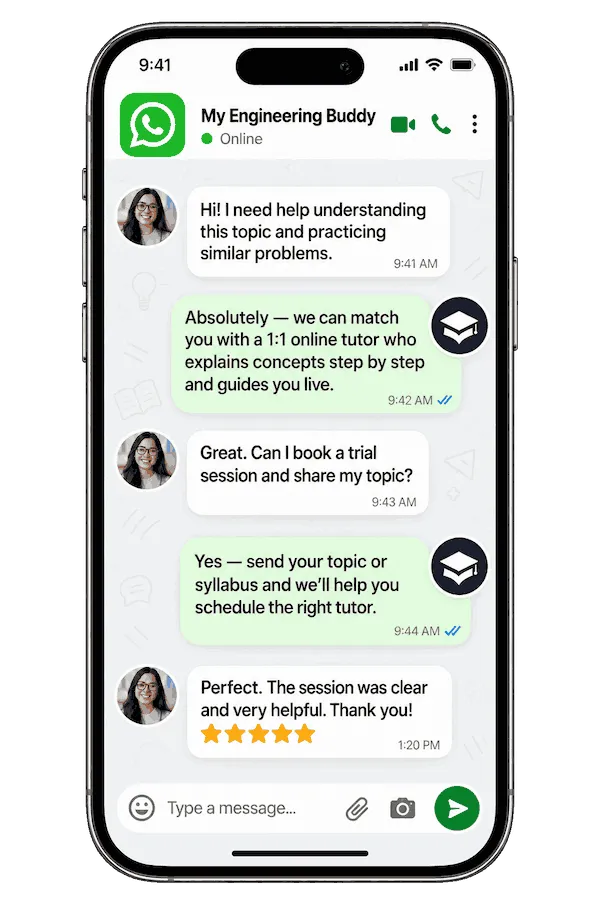
Unlike platforms where you fill out a form and wait, MEB responds in under a minute, 24/7. Tutor match takes under an hour. The $1 trial means you test before you commit. Everything runs over WhatsApp — no logins, no intake forms.
Pricing Guide
ER Diagrams tutoring starts at $20/hr for most undergraduate levels. Graduate coursework and complex EER modelling work typically runs $50–$100/hr depending on tutor depth and timeline. Rate factors include your course level, how much schema complexity is involved, your deadline, and tutor availability at your time zone.
Availability tightens hard in the final two weeks of semester. If your database assignment deadline is approaching, don’t assume a spot is open — check now.
For students targeting top CS programmes at research universities or building a portfolio for data engineering roles, tutors with professional database architecture backgrounds are available at higher rates. Share your goal and MEB will match the tier to what you actually need.
Start with the $1 trial — 30 minutes, no registration, no commitment. WhatsApp MEB for a quick quote.
FAQ
Is ER diagram modelling hard?
The concepts are logical, but the notation is easy to apply wrong. Most students get entity sets and attributes quickly. Cardinality constraints, weak entities, and the conversion to relational schema are where marks are reliably lost without specific guidance.
How many sessions will I need?
For a single assignment with clear gaps, 2–3 sessions usually covers it. For a full database design module across a semester, 8–12 sessions spread over the term gives students enough practice to handle exam-style questions independently.
Can you help with ER diagram homework and assignments?
MEB tutoring is guided learning — you understand the work, then submit it yourself. The tutor explains the concept, works through examples, and helps you reason through your own diagram. See our Academic Integrity policy and Why MEB page for full details on what we help with and what we don’t.
Will the tutor match my exact syllabus or exam board?
Yes. Tutors are matched to your specific course, whether that’s a university DBMS module using Elmasri & Navathe, an information systems course using UML-style ER notation, or a graduate schema design unit. Share your course outline before the first session.
What happens in the first session?
The tutor runs a 15–20 minute diagnostic — asking you to walk through a past diagram or explain a concept — to identify exactly where the model breaks down. The rest of the session targets that gap directly, with a practice problem before you finish.
Is online ER Diagrams tutoring as effective as in-person?
For diagram-based subjects, online is often better. The tutor annotates your schema directly on screen using a pen-pad, and you can share your Lucidchart or Draw.io file live. No whiteboard photo delays. The feedback loop is faster than most in-person sessions.
What’s the difference between Chen notation and crow’s foot, and which should I learn?
Chen notation uses diamonds for relationships and is common in university database theory courses. Crow’s foot is standard in industry tools like MySQL Workbench and dbdiagram.io. Your tutor will work in whichever notation your assignment or exam board requires — and explain the mapping between them if needed.
My ER diagram keeps failing normalisation — is that an ER problem or a normalisation problem?
Usually both. ER diagrams that fail 3NF often have redundant attributes or incorrectly merged entities. The tutor diagnoses where the model broke down before the normalisation step, then walks you through the fix at the ER level first before moving to relational schema.
Can I get ER Diagrams help at midnight?
Yes. MEB operates 24/7 across time zones. WhatsApp the team at any hour — assignment deadlines don’t keep office hours. Average response time is under a minute. Tutor availability at specific late-night slots varies, so message early when you can.
What if I don’t like my assigned tutor?
Request a swap. MEB re-matches without fuss. The $1 trial exists precisely so you can test the fit before committing to a block of sessions. If the first match isn’t right, the team finds another within hours.
Do you cover EER (Extended ER) diagrams as well?
Yes. EER concepts — specialisation, generalisation, aggregation, and category types — are covered by tutors who work at graduate database design level. If your course uses EER notation, mention it when you message MEB so the right tutor is matched from the start.
How do I get started?
Start with the $1 trial — 30 minutes of live ER Diagrams tutoring or one homework question explained in full. Three steps: WhatsApp MEB, get matched within the hour, start your trial session. No registration required.
Trust & Quality at My Engineering Buddy
Every MEB tutor goes through a structured screening process — subject-specific vetting, a live demo session, and an ongoing review cycle based on student feedback. For ER Diagrams and database subjects, tutors hold degrees in Computer Science, Information Systems, or related fields, and many have professional experience in database architecture or software engineering. Rated 4.8/5 across 40,000+ verified reviews on Google.
MEB tutoring is guided learning — you understand the work, then submit it yourself. For full details on what we help with and what we don’t, read our Academic Integrity policy and Why MEB.
MEB has served 52,000+ students across the US, UK, Canada, Australia, the Gulf, and Europe since 2008 — across 2,800+ subjects. Computer Science is one of MEB’s strongest subject areas, with tutors covering everything from DBMS tutoring and relational databases help to data warehousing tutoring and advanced schema design. The tutoring methodology is built around diagnosis, practice, and feedback — not passive explanation.
MEB tutors work from your actual assignment brief, not a generic syllabus. If your course uses a specific notation or schema tool, the tutor adapts to it — not the other way around. That’s the difference between a tutor and a tutorial.
Source: My Engineering Buddy, 2008–2025.
A common pattern our tutors observe is that students who struggle with ER diagrams have never been asked to justify a design decision out loud. The moment a tutor asks “why did you make that an attribute and not an entity?”, the gap becomes visible — and fixable.
Explore Related Subjects
Students studying ER Diagrams often also need support in:
Next Steps
Getting started takes under two minutes. Share your exam board or course outline, the component you’re most stuck on, and your deadline. Share your time zone and availability — MEB matches you with a verified ER Diagrams tutor, usually within 24 hours.
Before your first session, have ready:
- Your course syllabus or assignment brief
- A past diagram attempt or homework question you struggled with
- Your submission deadline or exam date
The tutor handles the rest. First session starts with a diagnostic so every minute is used well.
Visit www.myengineeringbuddy.com for more on how MEB works.
WhatsApp to get started or email [email protected].
Try your first session for $1 — 30 minutes of live 1:1 tutoring or one homework question explained in full. No registration. No commitment.
WhatsApp MEB now
and get matched within the hour.
Reviewed by Subject Expert
This page has been carefully reviewed and validated by our subject expert to ensure accuracy and relevance.




