




~1 min
Average Reply Time
~1 hour
To Be Matched With A Tutor
30 Min Trial
75% Find Their Tutor On The 1st Trial
$20-35+/hr
Premium Yet Affordable Learning
Most students who struggle with Normalization don’t have a logic problem — they have a dependency problem. They can name 3NF but can’t spot a transitive dependency in a table they’ve never seen before.
Normalization Tutor Online
Normalization is a database design process that organizes relational tables to eliminate redundancy and dependency anomalies. It applies structured rules — called normal forms (1NF through BCNF and beyond) — equipping students to design efficient, consistent databases.
If you’re searching for a Normalization tutor near me, MEB’s 1:1 online tutoring and homework help in Computer Science covers every normal form, functional dependency, and schema decomposition problem you’ll face — from undergraduate DBMS courses to graduate-level database design. Your tutor works through your exact assignment, exam question, or course syllabus. One session can clarify what three lectures didn’t.
- 1:1 online sessions tailored to your course syllabus and exam board
- Expert-verified tutors with database and CS subject-specific knowledge
- Flexible time zones — US, UK, Canada, Australia, Gulf
- Structured learning plan built after a diagnostic session
- Ethical homework and assignment guidance — you understand before you submit
52,000+ students across the US, UK, Canada, Australia, and the Gulf have used MEB since 2008 — including students in Computer Science subjects like Normalization, Database Design, and DBMS.
Source: My Engineering Buddy, 2008–2025.
How Much Does a Normalization Tutor Cost?
Most Normalization tutoring sessions run $20–$40/hr. Graduate-level or advanced schema design work can go up to $100/hr. Not sure if it’s worth it? Start with the $1 trial — 30 minutes of live 1:1 tutoring or one homework question explained in full, no registration required.
| Level / Need | Typical Rate | What’s Included |
|---|---|---|
| Standard (most undergrad levels) | $20–$35/hr | 1:1 sessions, homework guidance |
| Advanced / Graduate / Specialist | $35–$100/hr | Expert tutor, niche depth, schema projects |
| $1 Trial | $1 flat | 30 min live session or 1 homework question |
Tutor availability tightens during end-of-semester exam periods. Book ahead if your DBMS or database design exam is within four weeks.
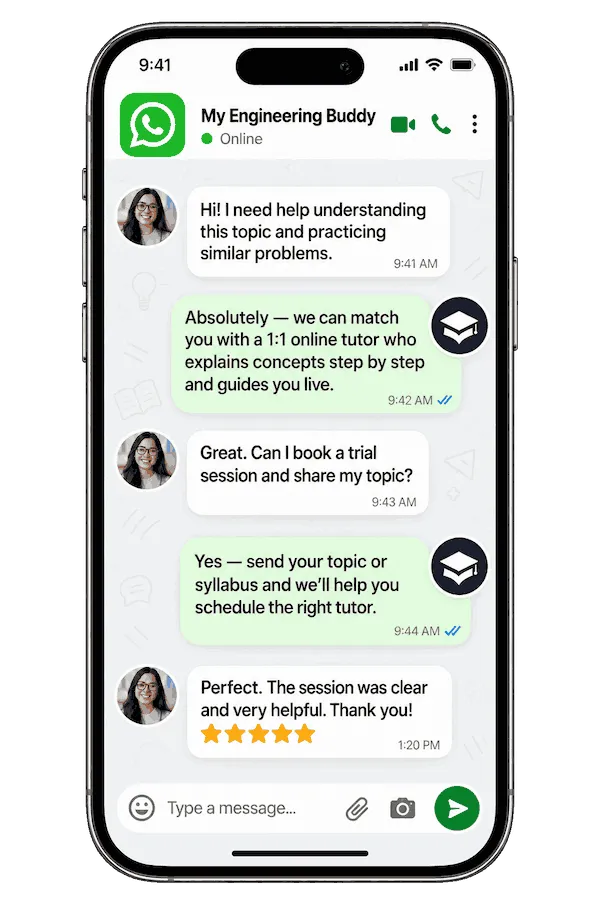
WhatsApp MEB for a quick quote — average response time under 1 minute.
Who This Normalization Tutoring Is For
Normalization sits in nearly every undergraduate CS and information systems programme. It trips students up not because it’s complex — but because it’s taught abstractly and then tested concretely. If you can recite the rules but freeze on an unseen schema, this is for you.
- Undergrad CS or IS students stuck on 2NF, 3NF, or BCNF decompositions
- Students who passed the theory lectures but can’t apply normal forms to new tables
- Students retaking after a failed first attempt in a DBMS or database module
- Students with a university conditional offer depending on their database grade
- Graduate students tackling advanced schema design, multivalued dependencies, or 4NF/5NF
- Students at institutions like MIT, Stanford, Carnegie Mellon, University of Toronto, University of Edinburgh, UNSW, or TU Delft — wherever your database course sits
Whether you need help with a single assignment or a full-semester catch-up, MEB matches you with a tutor who knows your level and your course.
1:1 Tutoring vs Self-Study vs AI vs YouTube vs Online Courses
Self-study works if you’re disciplined — but Normalization requires feedback the moment you apply a rule incorrectly. AI tools give fast definitions of 3NF, but they can’t diagnose why your specific decomposition is losing data. YouTube covers the theory well and stops the moment your schema doesn’t match the example. Online courses are structured but fixed-pace, with no one to catch the exact mistake you keep repeating. With a 1:1 Relational Databases and Normalization tutor from MEB, your errors are caught in real time — and the correction sticks because it’s tied to your actual table, not a generic example.
Outcomes: What You’ll Be Able To Do in Normalization
After working with an MEB Normalization tutor, you’ll be able to identify and eliminate partial dependencies in 2NF, spot transitive dependencies and decompose tables correctly into 3NF, apply BCNF where 3NF is insufficient, and explain your reasoning — not just produce an answer. You’ll analyze functional dependencies in schemas you’ve never seen, model real-world data accurately from a written specification, and write decomposition steps that hold up to examiner scrutiny. These aren’t generic database skills. They’re the specific moves that separate a passing grade from a strong one.
Supporting a student through Normalization? MEB works directly with parents to set up sessions, track progress, and keep coursework on schedule. WhatsApp MEB — average response time is under a minute, 24/7.
Based on feedback from 40,000+ sessions collected by MEB from 2022 to 2025, 58% of students improved by one full grade after approximately 20 hours of 1:1 tutoring in subjects like Normalization. A further 23% achieved at least a half-grade improvement.
Source: MEB session feedback data, 2022–2025.
What We Cover in Normalization (Syllabus / Topics)

Functional Dependencies and First Normal Form (1NF)
- Identifying functional dependencies (FDs) in a relation
- Full vs partial functional dependencies
- Atomic values and eliminating repeating groups for 1NF
- Candidate keys, primary keys, and superkeys
- Armstrong’s axioms — reflexivity, augmentation, transitivity
- Closure of attribute sets and finding all implied FDs
Core texts: Ramakrishnan & Gehrke Database Management Systems (3rd ed.); Silberschatz, Korth & Sudarshan Database System Concepts (7th ed.).
Second and Third Normal Form (2NF and 3NF)
- Detecting and removing partial dependencies for 2NF
- Detecting transitive dependencies for 3NF
- Lossless-join decomposition — how to split tables without losing data
- Dependency-preserving decomposition
- Canonical covers and minimal sets of FDs
- Synthesis algorithm for achieving 3NF
Core texts: Elmasri & Navathe Fundamentals of Database Systems (7th ed.); Connolly & Begg Database Systems (6th ed.).
BCNF, 4NF, and Beyond
- Boyce–Codd Normal Form — when 3NF isn’t enough
- Decomposition into BCNF and the lossless-join trade-off
- Multivalued dependencies and Fourth Normal Form (4NF)
- Join dependencies and Fifth Normal Form (5NF / PJNF)
- Domain-Key Normal Form (DKNF) — theoretical grounding
- Denormalization — when and why to reverse normalization in production systems
Core texts: Date An Introduction to Database Systems (8th ed.); Ramakrishnan & Gehrke Database Management Systems.
At MEB, we’ve found that students who struggle with BCNF almost always have an unresolved gap at 2NF — they moved on before the partial-dependency step clicked. The fix is rarely starting over. It’s going back one step and working through two or three unseen schemas until the pattern becomes automatic.
What a Typical Normalization Session Looks Like
The tutor opens by checking your last topic — usually where partial or transitive dependencies tripped you up. You share your current assignment or a past exam question on screen. The tutor works through the schema step by step using a digital pen-pad, annotating the functional dependencies directly on your table. You replicate the decomposition on your own while the tutor watches. If you stall on BCNF or get the closure calculation wrong, it’s corrected immediately — not at the end. The session closes with a specific practice schema set for you to attempt before next time, and the next topic noted. Get ER diagram tutoring added to the same session if your assignment covers both schema design and entity-relationship modelling.
How MEB Tutors Help You with Normalization (The Learning Loop)
Diagnose: In the first session, the tutor gives you an unseen schema and watches you work through it. This reveals exactly where the process breaks down — whether it’s identifying candidate keys, computing attribute closures, or knowing when BCNF decomposition loses dependency preservation.
Explain: The tutor works through a parallel example on a digital pen-pad, narrating each decision. You see the reasoning, not just the answer. For database design help, this means watching how a tutor moves from a messy unnormalized schema to a clean BCNF decomposition in real time.
Practice: You attempt the next schema yourself while the tutor stays present. No leaving you to struggle alone. If you hit a wall, a prompt — not the answer — comes first.
Feedback: The tutor explains step by step where marks were lost and why. “You got the FDs right but computed the closure incorrectly” is specific. That specificity is what changes the next attempt.
Plan: The session ends with the next two or three topics mapped out, a schema to try independently, and a note on which normal form to target next. Progress is tracked across sessions.
Sessions run over Google Meet. The tutor uses a digital pen-pad or iPad with Apple Pencil. Before your first session, send over your course syllabus or module guide, any past papers or practice questions you’ve attempted, and your exam or submission date. Start with the $1 trial — 30 minutes of live tutoring that also serves as your first diagnostic.
Students consistently tell us that the moment Normalization clicks isn’t when someone explains the rule — it’s when they successfully decompose a schema they’ve never seen before, entirely on their own. We structure every session to get you to that moment as fast as possible.
Tutor Match Criteria (How We Pick Your Tutor)
Not every database tutor is the right fit for every student. Here’s what MEB checks before the match.
Subject depth: Tutors are vetted on their working knowledge of functional dependencies, decomposition algorithms, and normal forms up to 5NF — not just 3NF theory. If you’re tackling database transactions or advanced schema constraints alongside Normalization, that’s matched too.
Tools: Every tutor uses Google Meet with a digital pen-pad or iPad plus Apple Pencil. No whiteboard screenshots. Real-time annotation only.
Time zone: Matched to your region — US, UK, Gulf, Canada, Australia. No 3 a.m. compromise sessions.
Goals: Whether you need to pass a specific exam paper, complete a graded assignment, or understand Normalization deeply for a dissertation, the tutor is briefed on your goal before session one.
Unlike platforms where you fill out a form and wait, MEB responds in under a minute, 24/7. Tutor match takes under an hour. The $1 trial means you test before you commit. Everything runs over WhatsApp — no logins, no intake forms.
Study Plans (Pick One That Matches Your Goal)
After the first diagnostic session, your tutor builds a specific sequence. For most students, three plans cover it: a one-to-three-week catch-up for students behind on their DBMS module with an exam approaching; a four-to-eight-week structured revision block working through all normal forms with past-paper practice at each stage; or ongoing weekly sessions aligned to your semester timetable, covering each database topic as your course introduces it. The tutor sets the pace after seeing where you actually are — not where you think you are.
Pricing Guide
Normalization tutoring starts at $20/hr for standard undergraduate-level sessions. Graduate courses, advanced schema theory, or tight turnaround on assignments can push rates to $100/hr. Rate factors include level, topic complexity, timeline, and tutor availability.
Availability shrinks fast in the four weeks before end-of-semester DBMS exams. If your exam is coming up, don’t wait.
For students targeting competitive postgraduate programmes at universities like ETH Zurich, Imperial College London, or the University of Melbourne where database design is a core competency, tutors with professional database architecture and industry experience are available at higher rates — share your specific goal and MEB will match the tier to your ambition.
Start with the $1 trial — 30 minutes, no registration, no commitment. WhatsApp MEB for a quick quote.
MEB has covered 2,800+ subjects since 2008. In database and Computer Science subjects, students most often pair Normalization sessions with help in Stored Procedures and OLAP — topics that appear in the same course or exam paper.
Source: My Engineering Buddy, 2008–2025.
FAQ
Is Normalization hard?
It’s not algorithmically complex — but it requires consistent application of rules to schemas you haven’t seen before. Most students find 1NF and 2NF manageable but stall at BCNF. The fix is practice with unseen schemas, not re-reading the theory.
How many sessions are needed?
Students with specific gaps — say, BCNF decomposition or computing canonical covers — often clear them in two to four sessions. A full Normalization module from scratch typically takes eight to twelve sessions, depending on starting level and how much practice you do between sessions.
Can you help with homework and assignments?
Yes. MEB tutoring is guided learning — you understand the work, then submit it yourself. See our Academic Integrity policy and Why MEB page for full details on what we help with and what we don’t.
Will the tutor match my exact syllabus or exam board?
Yes. Share your course code, module guide, or exam board before the first session. Tutors are briefed on your specific requirements. Normalization content varies between universities and programmes — the tutor adapts to yours, not a generic syllabus.
What happens in the first session?
The tutor gives you an unseen schema and watches you work through it. This diagnostic identifies exactly where your process breaks — key identification, FD analysis, or decomposition logic. The remainder of session one addresses the most critical gap directly.
Is online tutoring as effective as in-person?
For Normalization, yes. The subject is diagrammatic and notation-heavy — a digital pen-pad on Google Meet replicates a whiteboard session exactly. Most MEB students report that the ability to record and replay the session is an advantage over in-person tutoring.
What’s the difference between 3NF and BCNF, and why does it matter for my exam?
Every relation in BCNF is in 3NF, but not vice versa. BCNF is stricter and always achieves lossless decomposition — but can lose dependency preservation. Many exam papers test this trade-off directly. Your tutor will walk through cases where each applies and how to justify the choice.
Can I get Normalization help at midnight?
Yes. MEB operates 24/7 across time zones. WhatsApp MEB at any hour — a tutor or coordinator responds in under a minute on average. Late-night help before a morning submission is one of the most common requests MEB handles.
Do you offer group Normalization sessions?
No. Every session is 1:1. Group sessions dilute the diagnostic precision that makes MEB effective — you’d spend half the session on another student’s gap, not yours. Private sessions are the only format MEB offers.
How do I find a Normalization tutor in my city?
You don’t need to. MEB tutors work with students in the US, UK, Canada, Australia, and the Gulf entirely online. City location is irrelevant — time zone is all that matters, and MEB matches on that.
Should I learn Normalization before or after ER diagrams?
Most programmes teach ER diagrams first — they give you the conceptual model before Normalization formalizes the rules. If you’re struggling with ER diagram tutoring and Normalization simultaneously, MEB can address both in the same session block.
How do I get started?
Start with the $1 trial — 30 minutes of live 1:1 tutoring or one Normalization question explained in full. Three steps: WhatsApp MEB, get matched with a verified tutor within the hour, then start your trial session. No registration, no commitment.
Trust & Quality at My Engineering Buddy
Every MEB tutor is screened through subject-specific vetting, a live demo evaluation, and ongoing session feedback review. Tutors hold relevant degrees and, for database subjects, professional or research experience in schema design, data modelling, or relational systems. Rated 4.8/5 across 40,000+ verified reviews on Google. Get DBMS tutoring from the same vetted pool.
MEB tutoring is guided learning — you understand the work, then submit it yourself. For full details on what we help with and what we don’t, read our Academic Integrity policy and Why MEB.
MEB has served 52,000+ students across the US, UK, Canada, Australia, the Gulf, and Europe in 2,800+ subjects since 2008. In Computer Science, the most-requested database subjects include Normalization, Data Warehousing tutoring, and OLTP help. Whether you’re at an early undergraduate or postgraduate level, the vetting process is the same.
MEB’s tutoring methodology — diagnostic first, then targeted practice with immediate feedback — is described in detail on the MEB Tutoring Methodology page. It’s the same structure applied to every Normalization session.
Source: My Engineering Buddy.
Try your first session for $1 — 30 minutes of live 1:1 tutoring or one homework question explained in full. No registration. No commitment. WhatsApp MEB now and get matched within the hour.
Explore Related Subjects
Students studying Normalization often also need support in:
- Algorithms
- Data Structures and Algorithms (DSA)
- Object-Oriented Programming (OOP)
- Data Lakes
- Information Systems
- Big-O Notation
- Design Patterns
Next Steps
Have these ready when you message: your exam board or course module name, the specific normal form or topic you’re stuck on, and your exam or submission date.
- Share your syllabus or module guide and your toughest past paper attempt
- Share your time zone and available hours
- MEB matches you with a verified Normalization tutor — usually within an hour
Before your first session, have ready: your exam board and syllabus (or course outline), a recent past paper attempt or homework question you struggled with, and your exam or deadline date. The tutor handles the rest.
Visit www.myengineeringbuddy.com for more on how MEB works.
WhatsApp to get started or email [email protected].
Reviewed by Subject Expert
This page has been carefully reviewed and validated by our subject expert to ensure accuracy and relevance.




