




~1 min
Average Reply Time
~1 hour
To Be Matched With A Tutor
30 Min Trial
75% Find Their Tutor On The 1st Trial
$20-35+/hr
Premium Yet Affordable Learning
Hire The Best Data Warehousing Tutor




Most students who struggle with Data Warehousing aren’t weak at databases — they’ve never seen a star schema built from scratch, live, with someone explaining every decision.
Data Warehousing Tutor Online
Data Warehousing is the process of collecting, storing, and managing large volumes of structured data from multiple sources in a central repository, designed to support analytical queries, business intelligence reporting, and decision-making at scale.
If you’ve searched for a Data Warehousing tutor near me, you already know the problem: most online resources explain what a data warehouse is without showing you how to build one, query one, or defend your design choices in an exam or project review. MEB connects you with a 1:1 online Data Warehousing tutor who has worked at the level you’re studying — whether that’s an undergraduate database course, a graduate-level BI module, or a professional certification track. Sessions are live, structured, and tied to your exact syllabus or project brief. You won’t just follow along — you’ll be able to work independently by the end.
- 1:1 online sessions tailored to your course outline or exam syllabus
- Expert-verified tutors with hands-on data engineering and BI backgrounds
- Flexible time zones — US, UK, Canada, Australia, Gulf
- Structured learning plan built after a diagnostic session
- Ethical homework and assignment guidance — you understand the work before you submit it
52,000+ students across the US, UK, Canada, Australia, and the Gulf have used MEB since 2008 — including students in Computer Science subjects like Data Warehousing, Database Management Systems, and OLAP.
Source: My Engineering Buddy, 2008–2025.
How Much Does a Data Warehousing Tutor Cost?
Most Data Warehousing tutoring sessions run $20–$40/hr. Graduate-level or specialist data engineering work can reach $60–$100/hr depending on the topic and tutor background. New students can start with the $1 trial — 30 minutes of live tutoring or one homework question explained in full.
| Level / Need | Typical Rate | What’s Included |
|---|---|---|
| Undergraduate / Standard | $20–$35/hr | 1:1 sessions, homework guidance, schema design |
| Graduate / Specialist | $40–$100/hr | Expert tutor, advanced ETL, BI architecture |
| $1 Trial | $1 flat | 30 min live session or one full question explained |
Tutor availability tightens around semester project deadlines and finals periods — book early if your submission date is within three weeks.
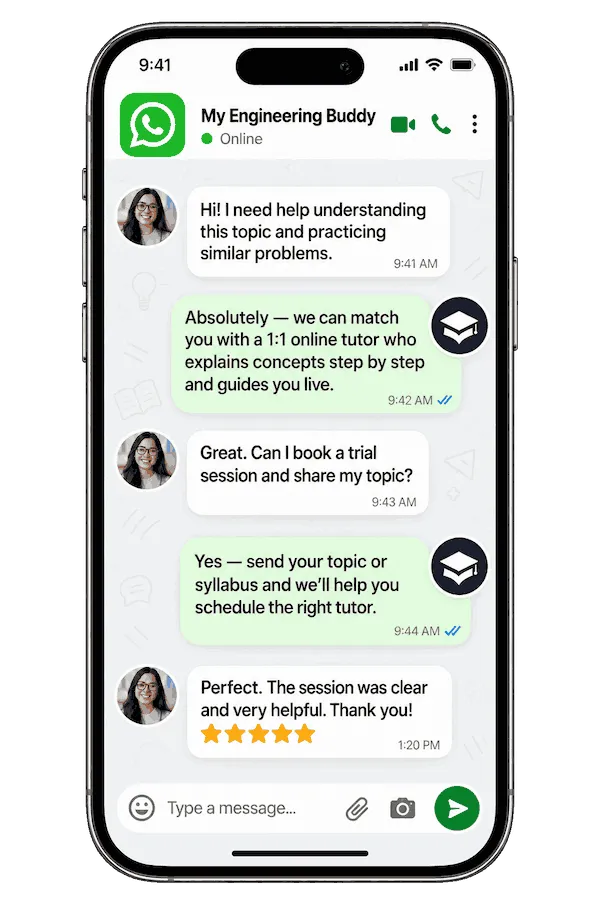
WhatsApp MEB for a quick quote — average response time under 1 minute.
Who This Data Warehousing Tutoring Is For
Data Warehousing sits at the intersection of database theory, query optimisation, and system architecture. Students often hit a wall when abstract concepts like dimensional modelling meet actual SQL and tool implementation. This service is built for people who need someone to close that gap — fast.
- Undergraduate CS or Information Systems students covering data warehouse modules
- Graduate students working on BI-heavy coursework or thesis components involving ETL pipelines
- Students retaking after a failed first attempt at a database or data systems exam
- Students with a university conditional offer depending on this grade
- Professionals pursuing certifications in data engineering, cloud BI, or analytics platforms
- Parents watching a student’s confidence drop alongside their project grades
Students from institutions including MIT, Carnegie Mellon, University of Toronto, University of Melbourne, Imperial College London, TU Delft, and NYU have used MEB for data systems support.
1:1 Tutoring vs Self-Study vs AI vs YouTube vs Online Courses
Self-study works if you’re disciplined, but schema design errors don’t correct themselves. AI tools give fast definitions — they can’t watch you write a flawed ETL script and tell you exactly where the logic breaks. YouTube is great for overviews of star schemas and slowly changing dimensions, but it stops when your specific project query misfires. Online courses are structured, but they move at a fixed pace regardless of where you’re stuck. With a 1:1 Data Warehousing tutor from MEB, the session is calibrated to your exact assignment, course stack, or exam question type — and errors get caught before they cost marks.
Outcomes: What You’ll Be Able To Do in Data Warehousing
After working with an MEB Data Warehousing tutor, you’ll be able to design a dimensional model from a business requirement — including fact tables, dimension tables, and appropriate grain. You’ll apply star and snowflake schema structures correctly and explain the trade-offs between them. You’ll write and optimise SQL queries against a data warehouse, including aggregate functions and window functions used in analytical reporting. You’ll analyse ETL pipeline logic, identify transformation bottlenecks, and present your data warehouse design clearly in an exam or project defence. You’ll model slowly changing dimensions (SCDs) and explain Type 1, Type 2, and Type 3 approaches with precision.
Based on feedback from 40,000+ sessions collected by MEB from 2022 to 2025, 58% of students improved by one full grade after approximately 20 hours of 1:1 tutoring in subjects like Data Warehousing. A further 23% achieved at least a half-grade improvement.
Source: MEB session feedback data, 2022–2025.
At MEB, we’ve found that Data Warehousing students almost always struggle with the same thing first: they understand relational databases but have never been asked to think about read-optimised design before. Once a tutor walks through one real schema end-to-end, the conceptual block clears fast.
What We Cover in Data Warehousing (Syllabus / Topics)

Track 1: Warehouse Architecture and Data Modelling
- Data warehouse architecture: Inmon vs Kimball approaches
- Star schema: fact tables, dimension tables, grain definition
- Snowflake schema: normalisation trade-offs and when to use it
- Slowly changing dimensions (SCD): Type 1, 2, and 3 with implementation examples
- Conformed dimensions and the enterprise data warehouse bus matrix
- Data mart design: subject-oriented, integrated, time-variant
- Bridge tables and many-to-many fact relationships
Key references: Kimball & Ross, The Data Warehouse Toolkit (3rd ed.); Inmon, Building the Data Warehouse (4th ed.).
Track 2: ETL Pipelines and Data Integration
- ETL vs ELT: when each approach makes sense
- Extraction strategies: full load, incremental load, change data capture (CDC)
- Data cleansing and transformation: null handling, type casting, deduplication
- Staging areas and their role in the pipeline
- Loading strategies: insert, upsert, truncate-and-reload
- Common ETL tool concepts: scheduling, lineage, error handling
- Data quality validation and testing patterns
Key references: Vassiliadis, A Survey of Extract-Transform-Load Technology; Kimball & Caserta, The Data Warehouse ETL Toolkit.
Track 3: OLAP, Querying, and Business Intelligence
- OLAP vs OLTP distinctions: design goals, query patterns, indexing strategies
- OLAP operations: slice, dice, roll-up, drill-down, pivot
- Analytical SQL: GROUP BY extensions, ROLLUP, CUBE, GROUPING SETS
- Window functions: ROW_NUMBER, RANK, LAG, LEAD, running totals
- Materialised views and query performance optimisation
- Columnar storage and compression in modern cloud warehouses
- BI reporting concepts: dashboards, KPIs, data visualisation layers
Key references: Chaudhuri & Dayal, “An Overview of Data Warehousing and OLAP Technology” (ACM SIGMOD Record); OLAP tutoring pages for deeper drill-down practice.
Students who need support in related areas often also work with MEB on database design help, normalization tutoring, and relational databases assignment help.
Platforms, Tools & Textbooks We Support
Data Warehousing courses at the undergraduate and graduate level regularly involve specific platforms. MEB tutors are familiar with the tools students actually use in coursework and projects.
- Amazon Redshift, Google BigQuery, Snowflake (cloud data warehouses)
- Microsoft Azure Synapse Analytics
- Apache Hive and Spark SQL for large-scale analytical queries
- dbt (data build tool) for SQL-based transformation pipelines
- Talend, Informatica, and Apache NiFi concepts (ETL tooling)
- SQL Server Analysis Services (SSAS) for multidimensional models
- Tableau and Power BI as the BI reporting layer
What a Typical Data Warehousing Session Looks Like
The tutor opens by checking your previous topic — usually a schema design task or an ETL stage you were refining. From there, you and the tutor work through a live problem on screen: building a star schema from a raw business requirement, writing a ROLLUP query against a sales fact table, or tracing a slowly changing dimension through Type 2 logic. The tutor uses a digital pen-pad to annotate the design decisions as they’re made — you replicate the steps in your own environment and explain the reasoning back. By the end, the tutor sets a concrete task: a fresh schema brief, a query optimisation challenge, or two exam-style questions on the next topic. The next session starts by reviewing that work before moving forward.
How MEB Tutors Help You with Data Warehousing (The Learning Loop)
Diagnose: In the first session, the tutor identifies exactly where your understanding breaks down — whether that’s schema normalisation, ETL logic, SQL window functions, or the conceptual gap between OLAP and OLTP. This shapes every subsequent session.
Explain: The tutor works through live examples using a digital pen-pad — drawing entity-relationship diagrams, tracing data through a pipeline stage, building a fact table from a realistic business scenario. Nothing is abstract.
Practice: You attempt the same type of problem with the tutor present. This is where the real learning happens — not watching, but doing, with immediate feedback available.
Feedback: The tutor corrects errors step by step, explains why a particular schema choice would lose marks or cause query performance issues, and shows what the correct answer looks like and why.
Plan: At the end of each session, the tutor maps the next topic in your sequence, sets a targeted practice task, and notes where you’ll pick up next time. Nothing is ad hoc.
Sessions run over Google Meet with a digital pen-pad or iPad and Apple Pencil. Before your first session, share your course outline or assignment brief, any past homework you found difficult, and your exam or project deadline. The first session starts with a diagnostic — no time is wasted on topics you already know. Start with the $1 trial — 30 minutes of live tutoring that also serves as your first diagnostic.
Students consistently tell us that the moment things shift for them in Data Warehousing is when they stop thinking in rows and start thinking in analytical query patterns. A good tutor engineers that shift deliberately — usually within the first two sessions.
Tutor Match Criteria (How We Pick Your Tutor)
Not every database expert is a strong data warehousing tutor. Here’s what MEB checks before making a match.
Subject depth: Tutors are matched on the specific level and topic area — undergraduate BI modules, graduate ETL architecture, or certification-track cloud warehousing. The tutor must have worked with the same tools and at the same conceptual level you’re operating at.
Tools: Every tutor uses Google Meet with a digital pen-pad or iPad and Apple Pencil — because schema design and query logic need to be drawn, not just described.
Time zone: Tutors are matched to your region — US, UK, Gulf, Canada, or Australia — so sessions happen at hours that don’t cost you sleep.
Goals: Whether you need to pass an exam, complete a project, or close a specific conceptual gap, the tutor is briefed on your actual target before session one.
Unlike platforms where you fill out a form and wait, MEB responds in under a minute, 24/7. Tutor match takes under an hour. The $1 trial means you test before you commit. Everything runs over WhatsApp — no logins, no intake forms.
Study Plans (Pick One That Matches Your Goal)
The tutor builds a specific session sequence after the diagnostic, but here are the three patterns that fit most Data Warehousing students. Catch-up (1–3 weeks): for students with a project deadline or exam approaching and identifiable gaps to close. Exam prep (4–8 weeks): structured topic-by-topic revision covering schema design, ETL, and OLAP querying with past paper practice woven in. Weekly support: ongoing sessions aligned to your semester schedule, keeping pace with lectures and coursework deadlines throughout the term.
Pricing Guide
Standard Data Warehousing tutoring runs $20–$40/hr for most undergraduate and taught graduate courses. Niche areas — advanced ETL architecture, cloud data platform design, or research-level data modelling — can reach $100/hr depending on tutor background and session complexity.
Rate factors include your course level, the specific topics involved, how close your deadline is, and tutor availability. Slots fill fast in the final three weeks before semester project submissions.
For students targeting roles at top data engineering firms or admission to advanced analytics programmes, MEB has tutors with professional industry backgrounds in data architecture and BI — share your specific goal and we’ll match the right tier.
Start with the $1 trial — 30 minutes, no registration, no commitment. WhatsApp MEB for a quick quote.
MEB tutors come with professional data engineering and BI backgrounds — not just academic credentials. When your exam question involves a real-world warehouse design decision, that distinction matters.
Source: My Engineering Buddy, tutor screening records, 2008–2025.
FAQ
Is Data Warehousing hard?
It’s conceptually dense if you approach it as an extension of standard database courses — which it isn’t. Dimensional modelling, ETL logic, and OLAP query design each require a different way of thinking. With a tutor who has done this work professionally, the concepts land faster than they do from a textbook alone.
How many sessions are needed?
Most students need 6–12 sessions to cover core topics solidly. Targeted exam prep over 4–8 weeks typically requires 8–10 sessions. Students with a specific assignment gap can often close it in 2–4 focused sessions depending on the topic.
Can you help with homework and assignments?
Yes — MEB tutoring is guided learning. The tutor explains the concept, works through a similar example, and then you produce your own work and submit it yourself. MEB does not do assignments on behalf of students. See our Academic Integrity policy and Why MEB page for full details on what we help with and what we don’t.
Will the tutor match my exact syllabus or exam board?
Yes. Before the first session, you share your course outline, university, or exam specification. The tutor is briefed on the specific topics, tools, and assessment format. No time is spent on content outside your scope.
What happens in the first session?
The tutor runs a short diagnostic — asking you to explain a concept, work through a sample problem, or review a past assignment together. This identifies exactly where the gaps are and sets the topic sequence for every session that follows. Nothing is generic.
Is online tutoring as effective as in-person?
For Data Warehousing specifically, online is often better. The tutor can share schema diagrams, annotate SQL live, and switch between your environment and theirs on screen. A digital pen-pad replaces a whiteboard without losing anything. The format suits technical subjects well.
What’s the difference between a data warehouse and a data lake, and can MEB help with both?
A data warehouse stores structured, pre-modelled data optimised for SQL queries and reporting. A data lakes tutor covers raw, schema-on-read storage suited for diverse data types. MEB tutors cover both — and the architectural decision between them is a common exam and project question.
Can you help with cloud-based data warehouses like Snowflake, BigQuery, or Redshift?
Yes. A growing share of university projects and professional certifications now require hands-on work in cloud platforms. MEB tutors with direct experience in Snowflake, Google BigQuery, and Amazon Redshift are available — share your specific platform when you reach out.
Do you offer group Data Warehousing sessions?
No. All MEB sessions are 1:1. Group sessions reduce the diagnostic precision that makes tutoring effective — you can’t calibrate a session to one student’s exact gap when three students are present. Every MEB session is built around one student’s specific needs.
Can I get Data Warehousing help at midnight?
Yes. MEB operates across time zones 24/7. Reach out over WhatsApp at any hour — the average response time is under a minute. Tutors are matched to your time zone, and sessions can be arranged at short notice when your deadline doesn’t allow for a scheduled slot days in advance.
What if I’m stuck specifically on SQL for analytical queries, not schema design?
That’s a common split. Many students understand the warehouse structure but struggle with window functions, CUBE queries, or performance tuning. Tell the tutor your specific gap and the session focuses there — you don’t need to re-cover dimensional modelling basics if that’s already solid.
How do I get started?
Start with the $1 trial: 30 minutes of live tutoring or one question explained in full. Three steps — WhatsApp MEB, get matched within the hour, start your trial session. No registration required, no commitment beyond the first session.
Trust & Quality at My Engineering Buddy
Every MEB tutor goes through a subject-specific vetting process — not a generic screening. For Data Warehousing, that means demonstrated knowledge of dimensional modelling, ETL design, and analytical SQL, plus a live demo session evaluated before the tutor joins the platform. Tutors hold degrees in Computer Science, Information Systems, Data Engineering, or related fields, and many have direct industry experience in BI or data architecture roles. Rated 4.8/5 across 40,000+ verified reviews on Google. Ongoing session feedback is reviewed — tutors who don’t perform are removed, not reassigned.
MEB tutoring is guided learning — you understand the work, then submit it yourself. For full details on what we help with and what we don’t, read our Academic Integrity policy and Why MEB.
MEB has served 52,000+ students across the US, UK, Canada, Australia, the Gulf, and Europe in 2,800+ subjects since 2008. Within Computer Science, subjects like distributed systems tutoring, cloud computing help, and information systems tutoring sit alongside Data Warehousing as areas where MEB has deep tutor coverage. See our tutoring methodology for how sessions are structured and quality is maintained.
MEB has been running since 2008. That’s 17 years of tutor feedback, session data, and subject coverage refinement. For a field like Data Warehousing — where tools and architectures shift fast — experience with what students actually struggle with is not a small thing.
Source: My Engineering Buddy, platform records, 2008–2025.
A common pattern our tutors observe is that students arrive knowing SQL but not knowing how to think about it analytically. The shift from transactional queries to warehouse queries — grouping, rolling up, comparing across time — is where most of the confusion lives. That’s the gap we close first.
Explore Related Subjects
Students studying Data Warehousing often also need support in:
- Stored Procedures
- Transactions
- ER (Entity-Relationship) Diagrams
- High Performance Computing (HPC)
- Parallel Computing
- Distributed Algorithms
- Design Patterns
Next Steps
Here’s what to have ready when you reach out:
- Your course outline, exam specification, or project brief
- A recent homework attempt or schema design you found difficult
- Your exam date, project deadline, or next submission
Share your availability and time zone — MEB will match you with a verified Data Warehousing tutor, usually within 24 hours. The first session starts with a diagnostic so every minute is spent on the gaps that matter most.
Visit www.myengineeringbuddy.com for more on how MEB works.
WhatsApp to get started or email [email protected].
Try your first session for $1 — 30 minutes of live 1:1 tutoring or one homework question explained in full. No registration. No commitment.
WhatsApp MEB now
and get matched within the hour.
Reviewed by Subject Expert
This page has been carefully reviewed and validated by our subject expert to ensure accuracy and relevance.




