




~1 min
Average Reply Time
~1 hour
To Be Matched With A Tutor
30 Min Trial
75% Find Their Tutor On The 1st Trial
$20-35+/hr
Premium Yet Affordable Learning
Your OLTP assignments keep failing on transaction isolation, and your tutor has never touched a real database system. That’s not a you problem.
OLTP Tutor Online
OLTP (Online Transaction Processing) is a database computing category that manages high-volume, real-time transactional workloads — INSERT, UPDATE, DELETE operations — used in banking, retail, and enterprise systems requiring ACID compliance and concurrent user support.
Finding a qualified OLTP tutor online who actually understands transaction isolation levels, locking mechanisms, and ACID properties is harder than it sounds. MEB has matched students across Computer Science and database systems with verified tutors since 2008. If you’ve been searching for an OLTP tutor near me, the location doesn’t matter — our tutors work live over Google Meet and cover every time zone from the US to the Gulf. One session can close gaps that weeks of re-reading haven’t touched.
- 1:1 online sessions tailored to your exact course syllabus and database system
- Expert-verified tutors with hands-on OLTP and DBMS knowledge
- Flexible scheduling across US, UK, Canada, Australia, and Gulf time zones
- Structured learning plan built after a diagnostic of your weakest areas
- Ethical homework and assignment guidance — you understand the work, then submit it yourself
52,000+ students across the US, UK, Canada, Australia, and the Gulf have used MEB since 2008 — including students in Computer Science subjects like OLTP, Database Management Systems, and Relational Databases.
Source: My Engineering Buddy, 2008–2025.
How Much Does an OLTP Tutor Cost?
Most OLTP tutoring sessions run $20–$40/hr depending on level and topic depth. Graduate-level or enterprise-systems work can reach $100/hr. A $1 trial gets you 30 minutes of live 1:1 tutoring or one full homework question explained — no registration required.
| Level / Need | Typical Rate | What’s Included |
|---|---|---|
| Standard (undergrad level) | $20–$35/hr | 1:1 sessions, homework guidance, ACID and concurrency basics |
| Advanced / Specialist | $35–$70/hr | Expert tutor, distributed OLTP, performance tuning, graduate depth |
| $1 Trial | $1 flat | 30 min live session or one homework question with full explanation |
Tutor slots fill fast during semester deadlines and finals weeks. Book early if you have a fixed submission date.
WhatsApp MEB for a quick quote — average response time under 1 minute.
Who This OLTP Tutoring Is For
This isn’t a course for beginners who’ve never opened a database. It’s for students who are already in a database systems module, a computer science programme, or a data engineering course — and hitting a wall on the harder material.
- Undergraduate CS students struggling with transaction management, isolation levels, or concurrency control assignments
- Graduate students building or benchmarking OLTP systems for research or coursework
- Students retaking a database systems exam after a failed first attempt — gaps in ACID and locking are the most common reason
- Students at MIT, Stanford, Carnegie Mellon, University of Toronto, Imperial College London, ETH Zurich, TU Delft, or AUS whose database courses move faster than lectures allow
- Working engineers who need to bridge theoretical OLTP knowledge with production system requirements
- Students with a coursework or project submission deadline approaching and incomplete schema design or SQL logic
If the $1 trial reveals a clean foundation, one or two sessions may be all you need. If there are real gaps, the tutor maps a session plan after that first diagnostic.
1:1 Tutoring vs Self-Study vs AI vs YouTube vs Online Courses
Self-study works if you can diagnose your own errors — most students can’t, especially with isolation anomalies and deadlock scenarios. AI tools explain concepts quickly but can’t run your actual query, spot your specific schema flaw, or watch you reason through a phantom read. YouTube covers the surface — two-phase locking in 12 minutes, nothing when your transaction log behaviour confuses you. Online courses move at a fixed pace with no one checking whether you’ve actually understood serialisability before moving on. With a 1:1 OLTP tutor at MEB, the session is calibrated to your exact assignment, your exam board’s expected depth, and the specific failure you brought in that day.
Outcomes: What You’ll Be Able To Do in OLTP
After consistent sessions, you’ll be able to model and implement a normalised OLTP schema from a real-world business case. You’ll analyse concurrency conflicts — dirty reads, non-repeatable reads, phantom reads — and explain which isolation level prevents each. Apply two-phase locking and timestamp ordering correctly in exam scenarios. Write and optimise SQL transactions that satisfy ACID properties under concurrent load. Present a rollback and recovery strategy for a system failure, referencing WAL (write-ahead logging) and checkpoint mechanisms with accuracy.
Supporting a student through OLTP? MEB works directly with parents to set up sessions, track progress, and keep coursework on schedule. WhatsApp MEB — average response time is under a minute, 24/7.
Based on feedback from 40,000+ sessions collected by MEB from 2022 to 2025, 58% of students improved by one full grade after approximately 20 hours of 1:1 tutoring in subjects like OLTP. A further 23% achieved at least a half-grade improvement.
Source: MEB session feedback data, 2022–2025.
What We Cover in OLTP (Syllabus / Topics)

Track 1: Transaction Fundamentals and ACID Properties
- ACID properties: atomicity, consistency, isolation, durability — definitions and exam applications
- Transaction states: active, partially committed, committed, failed, aborted
- Commit and rollback operations in SQL
- Savepoints and nested transactions
- WAL (write-ahead logging) and crash recovery
- Checkpointing strategies and their trade-offs
Core texts: Ramakrishnan & Gehrke Database Management Systems (3rd ed.), Silberschatz, Korth & Sudarshan Database System Concepts (7th ed.).
Track 2: Concurrency Control and Isolation Levels
- Concurrency anomalies: dirty read, non-repeatable read, phantom read
- SQL isolation levels: READ UNCOMMITTED, READ COMMITTED, REPEATABLE READ, SERIALIZABLE
- Two-phase locking (2PL): basic, strict, rigorous variants
- Timestamp ordering and Thomas Write Rule
- Optimistic concurrency control (OCC) — validation phase logic
- Deadlock detection, prevention, and resolution strategies
- Multiversion concurrency control (MVCC)
Core texts: Weikum & Vossen Transactional Information Systems, Gray & Reuter Transaction Processing: Concepts and Techniques.
Track 3: OLTP Schema Design and Performance
- Normalisation through 3NF and BCNF for OLTP workloads
- Index design for high-frequency read/write operations
- Row-store vs column-store trade-offs in OLTP vs OLAP contexts
- Stored procedures and triggers in transactional systems
- Connection pooling and session management
- Benchmarking: TPC-C benchmark structure and metrics
Core texts: Date An Introduction to Database Systems (8th ed.), Bernstein & Newcomer Principles of Transaction Processing (2nd ed.).
At MEB, we’ve found that students who arrive confused about isolation levels almost always have the same root problem: they’ve memorised the anomaly names without ever working through a concrete schedule of transactions. One session with a live example on a digital pen-pad — walking through each step of a dirty read in real time — tends to clear months of confusion in under 30 minutes.
What a Typical OLTP Session Looks Like
The tutor opens by checking what happened in the previous session — usually a concurrency control problem or a schema design task you attempted independently. From there, the session moves to whatever is live: maybe it’s a deadlock scenario from your assignment, or the isolation level question from last week’s quiz that you got wrong. The tutor writes out the transaction schedule on a digital pen-pad, walks through the conflict serializability check step by step, and then hands it back to you — you explain each step out loud. If you hesitate on a step, that’s where the tutor goes deeper. The session closes with a specific problem to attempt before the next meeting, and the next topic is named so there’s no ambiguity about what comes next.
How MEB Tutors Help You with OLTP (The Learning Loop)
Diagnose: In the first session, the tutor gives you a short set of problems — a transaction schedule to check for serializability, a schema with a concurrency flaw, a recovery scenario. The answers reveal exactly where the understanding breaks down: isolation levels, locking order, ACID edge cases, or schema-level errors.
Explain: The tutor works through a live example on the digital pen-pad. For OLTP, this means drawing the transaction timeline, marking lock acquisitions and releases, and showing precisely where a dirty read occurs or where two-phase locking prevents a conflict.
Practice: You attempt a parallel problem with the tutor present. No Googling, no hints until you’ve committed to an answer. The discomfort is intentional — that’s where learning locks in.
Feedback: The tutor goes through your reasoning step by step. For database assignments, this means identifying exactly which line of your SQL breaks the atomicity requirement, or why your isolation level choice doesn’t prevent phantom reads.
Plan: Each session ends with a named next topic, a specific practice problem, and a realistic timeline. If your exam is in four weeks, the plan reflects that — not a generic 12-week curriculum.
Sessions run over Google Meet with a digital pen-pad or iPad and Apple Pencil. Before your first session, share your course syllabus or assignment brief, a recent piece of work you struggled with, and your deadline. Start with the $1 trial — 30 minutes of live tutoring that also functions as your first diagnostic.
Students who work through OLTP concurrency problems live — rather than re-reading notes — consistently close the gap between knowing the definition and applying it correctly under exam conditions. The difference is a tutor who can stop you mid-step.
Source: MEB tutor observation across database systems sessions, 2022–2025.
Try your first session for $1 — 30 minutes of live 1:1 tutoring or one homework question explained in full. No registration. No commitment. WhatsApp MEB now and get matched within the hour.
Tutor Match Criteria (How We Pick Your Tutor)
Not every database tutor understands OLTP at the depth graduate coursework or systems programming requires. MEB matches on four criteria.
Subject depth: The tutor must have demonstrable knowledge of your specific area — transaction management, concurrency control, schema design for high-write workloads — not just general SQL. For OLTP, this typically means a CS or data engineering background with hands-on systems experience. Get Data Structures and Algorithms help from tutors with the same rigour.
Tools: Every tutor uses Google Meet with a digital pen-pad or iPad and Apple Pencil — essential for drawing transaction schedules and lock diagrams in real time.
Time zone: Matched to your region — US, UK, Gulf, Canada, or Australia. No scheduling friction.
Goals: Whether you need to pass one assignment, close gaps before finals, or build deep systems knowledge for a research project, the tutor is briefed on your objective before session one.
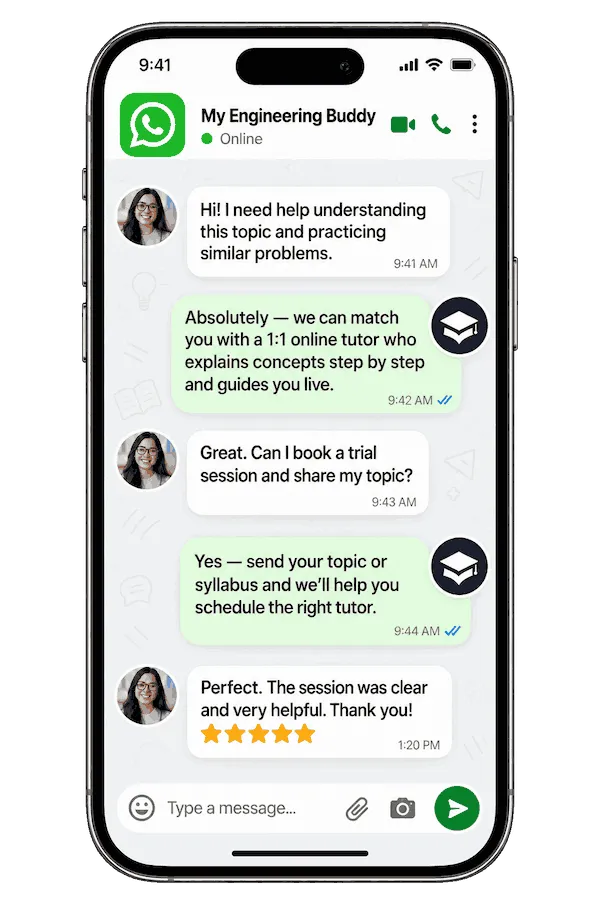
Unlike platforms where you fill out a form and wait, MEB responds in under a minute, 24/7. Tutor match takes under an hour. The $1 trial means you test before you commit. Everything runs over WhatsApp — no logins, no intake forms.
Study Plans (Pick One That Matches Your Goal)
Catch-up (1–3 weeks): you’re behind on concurrency control or ACID mechanics and have an assignment or quiz approaching — the tutor focuses on your exact gap, nothing else. Exam prep (4–8 weeks): structured revision through transaction theory, isolation levels, schema design, and recovery strategies, with past-paper or assignment practice built in. Weekly support: ongoing sessions aligned to your module’s lecture schedule, with homework and lab guidance each week. The tutor sets the specific sequence after the first diagnostic — no generic roadmap.
Pricing Guide
OLTP tutoring runs $20–$40/hr for most undergraduate and taught-master’s levels. Specialist tutors covering distributed OLTP, TPC-C benchmarking, or production system design are available up to $100/hr. Rate factors: level, topic complexity, how close your deadline is, and tutor availability in your time zone.
Slots are limited during semester end and finals periods. If you have a specific deadline, book now rather than two weeks from now.
For students targeting graduate programmes at top CS departments or roles at companies running high-throughput transaction systems, tutors with professional systems engineering backgrounds are available at higher rates — share your goal and MEB matches the tier to your ambition.
Start with the $1 trial — 30 minutes, no registration, no commitment. WhatsApp MEB for a quick quote.
OLTP is one of the most assignment-heavy topics in database systems curricula — transaction schedules, lock compatibility matrices, isolation anomaly identification. A tutor who has marked these assignments knows exactly where students lose points.
Source: MEB tutor panel observation, 2022–2025.
Students consistently tell us that the hardest OLTP concepts — phantom reads, serialisability testing, MVCC — feel abstract until they see them applied to a real transaction log. Our tutors don’t explain the theory twice. They show it once, then make you explain it back. That switch is where understanding becomes reliable.
FAQ
Is OLTP hard?
OLTP itself isn’t a single course — it’s a topic within database systems that students find hard because it demands both theoretical precision (isolation levels, serializability proofs) and practical SQL skill simultaneously. Most students struggle with concurrency anomalies and locking, not the basic transaction concepts.
How many sessions are needed?
Students with one or two specific gaps — like isolation levels or deadlock resolution — often close them in 3–5 sessions. If you need full coverage of transaction theory, concurrency control, and schema design, 10–15 hours gives you solid exam-ready depth.
Can you help with homework and assignments?
Yes. MEB tutoring is guided learning — you understand the work, then submit it yourself. The tutor explains the concept, walks through a similar example, and you apply it independently. See our Academic Integrity policy and Why MEB page for full details on what we help with and what we don’t.
Will the tutor match my exact syllabus or exam board?
Yes. Share your course outline, textbook, or assignment brief before the first session. The tutor is matched to your specific module — whether that’s a CS undergraduate database course, a data engineering graduate module, or a systems programming unit that touches OLTP design.
What happens in the first session?
The tutor runs a short diagnostic — a transaction schedule to analyse, a schema to critique, or an isolation level problem. This takes 10–15 minutes and reveals exactly where your understanding breaks down. The remaining time goes directly to the highest-priority gap.
Is online tutoring as effective as in-person?
For database systems topics like OLTP, online is often better — the tutor can annotate transaction timelines on a digital pen-pad, share SQL environments, and replay steps on screen. Students at universities across the US and UK consistently report that the live annotation makes concurrency concepts click faster than classroom explanations.
Can I get OLTP help at midnight?
Yes. MEB operates 24/7 with tutors across multiple time zones. WhatsApp MEB at any hour — the average response time is under a minute. Midnight sessions are common for students in the US or Gulf working against morning deadlines.
What is the difference between OLTP and OLAP, and does MEB cover both?
OLTP handles real-time, high-volume transactional workloads — inserts, updates, deletes. OLAP tutoring covers analytical query workloads over large datasets. Many database courses assess both. MEB tutors cover the distinction, the schema differences (row-store vs column-store), and exam questions that test your ability to choose the right architecture for a given scenario.
My exam includes serialisability and precedence graphs — can the tutor cover that?
That’s one of the most commonly assessed OLTP topics and a frequent source of lost marks. The tutor works through precedence graph construction, cycle detection, and conflict/view serializability testing step by step. By the end of two sessions, most students can construct and evaluate any schedule the exam throws at them.
Do you offer group OLTP sessions?
MEB specialises in 1:1 sessions — not group classes. Group tutoring dilutes the diagnostic precision that makes 1:1 work. If you’re studying with a classmate, you can each book separately, and tutors can be briefed to coordinate pacing if needed.
How do I get started?
Three steps: WhatsApp MEB, describe your course, assignment, or exam date — you’re matched with a verified tutor, usually within an hour. Your first session is the $1 trial — 30 minutes of live tutoring or one complete question explained. No forms, no registration.
How do I find an OLTP tutor in my city?
You don’t need to. MEB tutors work online over Google Meet and cover every major time zone. Students in New York, London, Dubai, Toronto, and Sydney all access the same pool of verified tutors. Location is not a constraint — availability is. Book early if your deadline is close.
Trust & Quality at My Engineering Buddy
Every MEB tutor goes through subject-specific screening before taking a session. For OLTP and database systems, that means demonstrating depth in transaction theory and concurrency control — not just general SQL knowledge. Tutors complete a live demo evaluation and are reviewed after every session based on student feedback. Rated 4.8/5 across 40,000+ verified reviews on Google. Operating Systems tutoring and Distributed Systems help go through the same vetting process.
MEB tutoring is guided learning — you understand the work, then submit it yourself. For full details on what we help with and what we don’t, read our Academic Integrity policy and Why MEB.
MEB has served 52,000+ students across the US, UK, Canada, Australia, Gulf, and Europe in 2,800+ subjects since 2008. Computer Science subjects — including OLTP, Database Design tutoring, and Transactions help — are among the most frequently requested. See our tutoring methodology for how sessions are structured from diagnostic through to progress review.
Explore Related Subjects
Students studying OLTP often also need support in:
- Normalization
- Stored Procedures
- Data Warehousing
- Data Lakes
- ER Entity Relationship Diagrams
- Concurrent Programming
- Encryption Decryption
Next Steps
When you WhatsApp MEB, have these ready:
- Your course outline or exam board, and the specific OLTP topic or assignment you’re working on
- A recent piece of work — a transaction schedule, schema design, or SQL assignment — that you struggled with
- Your exam or submission deadline and your current time zone
MEB matches you with a verified OLTP tutor, usually within 24 hours. The first session starts with a diagnostic so every minute is used on what actually matters.
Before your first session, have ready: your exam board and syllabus or course outline, a recent past paper attempt or homework you struggled with, and your exam or deadline date. The tutor handles the rest.
Visit www.myengineeringbuddy.com for more on how MEB works.
WhatsApp to get started or email [email protected].
Reviewed by Subject Expert
This page has been carefully reviewed and validated by our subject expert to ensure accuracy and relevance.




