




~1 min
Average Reply Time
~1 hour
To Be Matched With A Tutor
30 Min Trial
75% Find Their Tutor On The 1st Trial
$20-35+/hr
Premium Yet Affordable Learning
Most students don’t fail Class Diagrams because they can’t code — they fail because they can’t translate real-world logic into a clean, defensible diagram structure.
Class Diagrams Tutor Online
A class diagram is a UML structural diagram showing a system’s classes, attributes, methods, and relationships — including inheritance, association, aggregation, and composition — used to model object-oriented software design before or during implementation.
If you’re searching for a Class Diagrams tutor near me, MEB gives you 1:1 online tutoring and homework help in Computer Science and its subfields — including Class Diagrams — matched to your exact course, institution, and timeline. Tutors work through your specific diagrams with you. You leave understanding the logic, not just copying a template.
- 1:1 online sessions tailored to your course syllabus and software engineering module
- Expert-verified tutors with hands-on UML and object-oriented design experience
- Flexible time zones — US, UK, Canada, Australia, Gulf
- Structured learning plan built after a diagnostic session
- Ethical homework and assignment guidance — you understand before you submit
52,000+ students across the US, UK, Canada, Australia, and the Gulf have used MEB since 2008 — including students in Computer Science subjects like Class Diagrams, Object-Oriented Programming, and Design Patterns.
Source: My Engineering Buddy, 2008–2025.
How Much Does a Class Diagrams Tutor Cost?
Most Class Diagrams sessions run $20–$40/hr. Graduate-level or niche software architecture work can reach $100/hr. Not sure if it’s worth it? Start with the $1 trial — 30 minutes live or one homework question explained in full — before committing to anything.
| Level / Need | Typical Rate | What’s Included |
|---|---|---|
| Standard (most undergrad levels) | $20–$35/hr | 1:1 sessions, homework guidance |
| Advanced / Graduate / Specialist | $35–$70/hr | Expert tutor, software architecture depth |
| $1 Trial | $1 flat | 30 min live session or 1 homework question |
Tutor availability tightens around semester submission deadlines and final exams. Early booking matters.
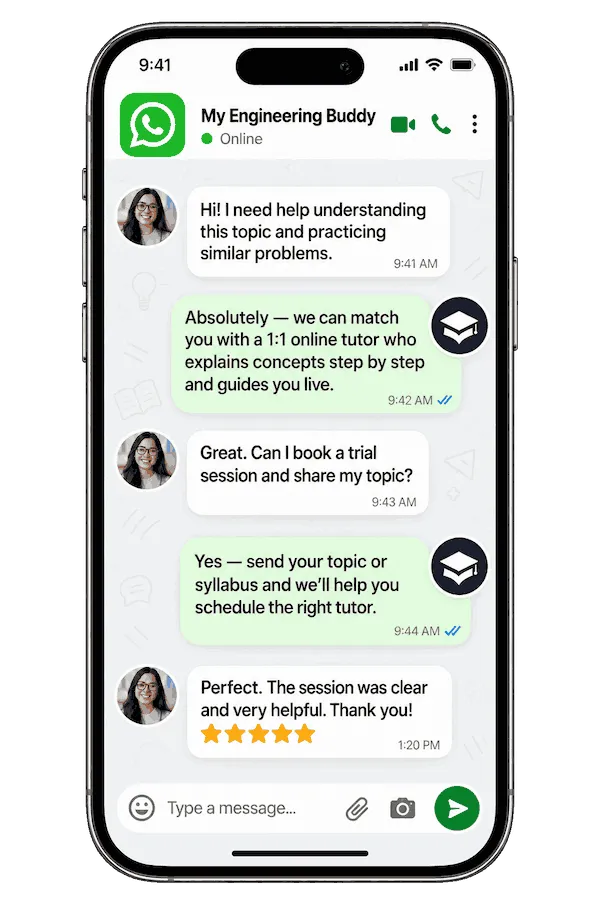
WhatsApp MEB for a quick quote — average response time under 1 minute.
Who This Class Diagrams Tutoring Is For
Class Diagrams trips up students at every level — from second-year CS undergrads drawing their first UML model to graduate students designing multi-layered enterprise architectures. The problem is almost always the same: the theory makes sense in isolation, but applying it to a real system with inheritance chains, multiplicity constraints, and interface abstractions is a different challenge entirely.
- Undergraduate CS students stuck on object-oriented design assignments
- Graduate students modelling complex systems for software engineering coursework
- Students with a coursework submission deadline approaching and significant gaps still to close
- Students who passed coding modules but are failing the design and architecture components
- Parents supporting a student whose confidence has dropped as their UML grades slip
- Self-taught developers wanting structured understanding of UML for professional or certification purposes
MEB tutors have worked with students at institutions including MIT, Carnegie Mellon, University of Toronto, Imperial College London, University of Melbourne, ETH Zurich, and TU Delft — though tutoring is available regardless of institution.
Need help before a deadline? The $1 trial gets you matched and started today.
1:1 Tutoring vs Self-Study vs AI vs YouTube vs Online Courses
Self-study works if you have clear feedback — most Class Diagrams learners don’t. AI tools generate diagrams fast but can’t spot why your inheritance structure is logically flawed. YouTube covers the basics well but stops when your specific assignment has ambiguous requirements. Online courses teach UML in sequence but won’t adapt to the diagram you’re stuck on right now. 1:1 tutoring with MEB means a tutor reviews your actual Class Diagram, identifies where the relationships break down, and corrects your reasoning live — not after the fact.
Outcomes: What You’ll Be Able To Do in Class Diagrams
After working with an MEB Class Diagrams tutor, you’ll be able to model a full object-oriented system from a plain-English problem statement — identifying classes, attributes, and methods without prompting. You’ll apply association, aggregation, composition, and inheritance correctly across different scenarios, including abstract classes and interfaces. You’ll explain multiplicity constraints (1..*, 0..1, and so on) in your own words and defend your design choices in a viva or written assessment. You’ll spot and fix the most common errors — wrongly placed navigability arrows, confused aggregation vs composition, and redundant inheritance — before a marker does.
Try your first session for $1 — 30 minutes of live 1:1 tutoring or one homework question explained in full. No registration. No commitment. WhatsApp MEB now and get matched within the hour.
Based on feedback from 40,000+ sessions collected by MEB from 2022 to 2025, 58% of students improved by one full grade after approximately 20 hours of 1:1 tutoring in subjects like Class Diagrams. A further 23% achieved at least a half-grade improvement.
Source: MEB session feedback data, 2022–2025.
What We Cover in Class Diagrams (Syllabus / Topics)

Track 1: UML Fundamentals and Class Structure
- Class notation: name compartment, attribute compartment, method compartment
- Visibility modifiers: public (+), private (−), protected (#), package (~)
- Attribute types, default values, and derived attributes
- Method signatures: parameters, return types, static members
- Abstract classes and interfaces in UML notation
- Stereotypes and constraints (OCL basics)
Core textbooks: Booch, Rumbaugh & Jacobson, The Unified Modeling Language User Guide; Fowler, UML Distilled (3rd ed.).
Track 2: Relationships and Multiplicity
- Association vs dependency — when each applies and how to draw them
- Unidirectional vs bidirectional association and navigability arrows
- Aggregation (hollow diamond) vs composition (filled diamond): the ownership question
- Inheritance (generalisation) hierarchies and correct arrow direction
- Interface realisation and how it differs from inheritance
- Multiplicity notation: 1, *, 0..1, 1..*, m..n — reading and writing correctly
- Association classes for many-to-many relationships with attributes
Core textbooks: Larman, Applying UML and Patterns (3rd ed.); Rumbaugh, Jacobson & Booch, The Unified Modeling Language Reference Manual.
Track 3: Design Application and System Modelling
- Translating requirements and use cases into class structures
- Mapping design patterns (Singleton, Factory, Observer) onto class diagrams
- Connecting class diagrams to ER diagrams and database schemas
- Refactoring a class diagram: identifying poor cohesion and tight coupling
- Package diagrams and organising large systems into namespaces
- Using tools: Lucidchart, draw.io, PlantUML, StarUML, Visual Paradigm
Core textbooks: Martin, Clean Architecture; Gamma et al., Design Patterns: Elements of Reusable Object-Oriented Software.
Students consistently tell us that the aggregation vs composition distinction is the single most misunderstood concept in Class Diagrams work. At MEB, we’ve found that spending 20 minutes on one well-chosen real-world example — a Car owning its Engine vs borrowing a Driver — clears it up faster than any textbook passage.
What a Typical Class Diagrams Session Looks Like
The tutor opens by checking the previous topic — usually the relationship type the student struggled with last time, such as aggregation vs composition or incorrect multiplicity. From there, student and tutor work through the current assignment together on screen: the student shares their draft diagram and the tutor annotates directly, asking why a particular arrow was drawn that way or why an attribute sits on one class rather than another. The tutor uses a digital pen-pad throughout, drawing corrected versions in real time. If the student is modelling a library system or an online shopping cart — two common assignment scenarios — the tutor walks through the full translation from problem statement to finished diagram, then asks the student to replicate the reasoning on a similar problem independently. The session closes with a specific practice task, such as remodelling the same system using a different design pattern, and the next topic is noted so session two starts without reset time.
How MEB Tutors Help You with Class Diagrams (The Learning Loop)
Diagnose: In the first session, the tutor identifies exactly where your class diagram breaks down — whether that’s misapplied inheritance, wrong navigability, confused aggregation with composition, or an inability to extract classes from a problem statement. This isn’t a generic quiz. It’s based on your actual work.
Explain: The tutor works through a corrected version live, using a digital pen-pad or iPad with Apple Pencil. You see the reasoning, not just the answer. Every decision — why this class owns that attribute, why composition fits here and aggregation doesn’t — is spoken aloud.
Practice: You attempt a parallel problem while the tutor watches. Mistakes are caught in the moment. That immediate correction is what self-study and AI tools can’t replicate.
Feedback: The tutor explains why marks were likely lost — not just what was wrong. In most CS departments, the marking rubric penalises logical errors in relationships more heavily than surface notation errors. Your tutor knows this.
Plan: Next topics are sequenced based on what’s due and where your gaps are largest. Students targeting OOP tutoring alongside Class Diagrams get a joined-up plan, not two disconnected threads.
Sessions run on Google Meet with a shared screen. Before your first session, have your assignment brief, any draft diagrams, and your module’s marking rubric ready. First session starts with the diagnostic and moves into live work within the first ten minutes. Start with the $1 trial — 30 minutes of live tutoring that also serves as your first diagnostic.
A common pattern our tutors observe is that students who struggle with Class Diagrams have usually understood data structures and algorithms well but have never been taught how to think in terms of system structure rather than execution flow. One session reframing that distinction changes everything.
Source: My Engineering Buddy tutor observation data, 2022–2025.
Tutor Match Criteria (How We Pick Your Tutor)
Not every CS tutor can teach Class Diagrams well. Here’s what MEB screens for specifically.
Subject depth: Tutors must demonstrate working knowledge of UML 2.x notation, object-oriented design principles, and at least one major diagramming tool. Tutors who only know coding are not matched to UML assignments.
Tools: Every tutor uses Google Meet with a digital pen-pad or iPad and Apple Pencil. No whiteboards held up to cameras.
Time zone: Matched to your region — US, UK, Gulf, Canada, or Australia. No scheduling lag.
Goals: Whether you need exam-grade diagrams, conceptual understanding for a viva, or help with a multi-week software engineering project, the tutor is selected to match that specific aim. Students also getting help with database design or algorithms get a tutor who can span those areas without switching contacts.
Unlike platforms where you fill out a form and wait, MEB responds in under a minute, 24/7. Tutor match takes under an hour. The $1 trial means you test before you commit. Everything runs over WhatsApp — no logins, no intake forms.
Study Plans (Pick One That Matches Your Goal)
After the diagnostic, your tutor builds the sequence. Three common structures: Catch-up (1–3 weeks) — students who have fallen behind on a UML or software design module with a submission close; Exam prep (4–8 weeks) — structured sessions covering every assessable diagram type before finals; Weekly support — ongoing sessions aligned to your semester timetable, covering each week’s new content before it stacks up. The tutor adjusts pacing based on your submission dates and the complexity of your course’s design requirements.
Pricing Guide
Class Diagrams tutoring starts at $20/hr for standard undergraduate-level work. Graduate-level software architecture and UML modelling for complex systems can reach $70–$100/hr depending on the tutor’s professional background. Rate factors include your module level, the complexity of the system being modelled, your timeline, and tutor availability.
For students targeting positions at top software engineering firms or pursuing postgraduate research in system design, tutors with professional software architecture backgrounds are available at higher rates — share your specific goal and MEB will match the tier to your ambition.
Demand for Class Diagrams help spikes at semester end. Availability shrinks fast in those windows.
Start with the $1 trial — 30 minutes, no registration, no commitment. WhatsApp MEB for a quick quote.
At MEB, we’ve found that students who attempt at least one full diagram from scratch — without looking at examples — before their first session make faster progress. The tutor can see exactly where the reasoning breaks down. A blank attempt tells us more than a half-copied one.
FAQ
Is Class Diagrams hard?
It’s not technically hard — the notation is learnable in a few hours. The difficulty is conceptual: most students confuse structural thinking with procedural thinking. When you understand what a class diagram is modelling and why, the notation follows naturally. A tutor accelerates that shift significantly.
How many sessions are needed?
Students with one specific assignment typically need 2–4 sessions. Students covering the full UML module for exams usually benefit from 8–12. The diagnostic in session one gives you an honest estimate based on your actual gaps — not a sales pitch for more sessions.
Can you help with homework and assignments?
MEB tutoring is guided learning — you understand the work, then submit it yourself. The tutor explains the logic, works through examples, and helps you reason through your diagram. See our Academic Integrity policy and Why MEB page for full details on what we help with and what we don’t.
Will the tutor match my exact syllabus or exam board?
Yes. Before matching, you share your course outline or assignment brief. Tutors are selected based on familiarity with your specific module’s requirements — whether that’s a particular UML tool, notation standard, or assessment format your department uses.
What happens in the first session?
The tutor reviews your existing work or asks targeted questions to identify where your understanding breaks down. From there, the session moves into live problem-solving. You leave with a concrete practice task and a plan for the next session — not a list of things to read.
Is online tutoring as effective as in-person?
For Class Diagrams, online is often better. The tutor annotates your diagram directly on screen, draws corrections with a digital pen-pad, and can share reference examples instantly. There’s no whiteboard-squinting or camera-angle problem. Most students report sessions feel more focused than in-person alternatives.
Can I get Class Diagrams help at midnight?
Yes. MEB operates 24/7. WhatsApp response time averages under a minute regardless of time zone. If you’re in the US, UK, Gulf, or Australia and need a tutor at 11pm the night before a submission, that’s a normal request — not an exception.
What if I don’t like my assigned tutor?
Request a switch over WhatsApp. No forms, no waiting. MEB re-matches you with a different tutor, typically within the hour. The $1 trial exists precisely so you can test the match before committing to paid sessions.
Do you support specific UML tools like PlantUML or Lucidchart?
Yes. Tutors can work with you inside PlantUML, Lucidchart, draw.io, StarUML, Visual Paradigm, or any tool your course requires. If your assignment specifies a particular tool, mention it when you WhatsApp MEB and we’ll match accordingly.
What’s the difference between a class diagram and an ER diagram — and can MEB help with both?
A class diagram models object-oriented software structure; an ER diagram models relational database structure. They overlap in concepts but differ in purpose and notation. MEB tutors can cover both, and if your course requires you to translate between them, a tutor who knows both is matched to your sessions.
How do I get started?
WhatsApp MEB, share your course details and what you’re stuck on, and you’ll be matched with a verified Class Diagrams tutor — usually within the hour. First session starts with a diagnostic. The $1 trial covers 30 minutes of live tutoring or one homework question explained in full. Three steps: WhatsApp → matched → start trial.
Can you help with UML class diagrams for design pattern assignments specifically?
Yes. Design pattern assignments — Singleton, Factory Method, Observer, Strategy, and others — are among the most common Class Diagrams requests MEB receives. Tutors walk through the structural logic of each pattern in diagram form, then help you apply the correct one to your specific problem scenario.
Trust & Quality at My Engineering Buddy
Every MEB tutor goes through subject-specific screening before taking sessions. That includes a live demo evaluation in their declared subject, degree verification, and review of professional or academic background in software engineering or a directly related field. Tutors who pass the initial screen are monitored through ongoing student feedback — low-rated tutors are removed, not reassigned. Rated 4.8/5 across 40,000+ verified reviews on Google.
MEB tutoring is guided learning — you understand the work, then submit it yourself. For full details on what we help with and what we don’t, read our Academic Integrity policy and Why MEB.
MEB has served 52,000+ students across the US, UK, Canada, Australia, the Gulf, and Europe in 2,800+ subjects since 2008. Computer Science is one of our largest subject areas — tutors cover everything from concurrent programming tutoring to distributed systems help, with Class Diagrams sitting at the centre of the object-oriented design cluster. If your course spans multiple CS modules, MEB can cover them without you needing to find separate tutors. Read more about how we match tutors and run sessions at our tutoring methodology page.
Our experience across thousands of sessions shows that the students who close the largest gaps in Class Diagrams are the ones who bring a genuine attempt to session one — even a wrong one. Something on the page is always better than a blank start.
Source: My Engineering Buddy tutor observation, 2022–2025.
Explore Related Subjects
Students studying Class Diagrams often also need support in:
- Automata Theory
- Compiler Design
- DBMS (Database Management Systems)
- Information Systems
- Operating Systems
- Software Engineering
- Normalization
- Relational Databases
Next Steps
Getting started takes less than two minutes. Here’s what to do:
- Share your exam board or course module, the component you’re most stuck on, and your deadline or exam date
- Share your availability and time zone — MEB matches across US, UK, Gulf, Canada, and Australia
- MEB matches you with a verified Class Diagrams tutor — usually within 24 hours, often faster
- First session starts with a diagnostic so every minute is used well
Before your first session, have ready:
- Your course outline or assignment brief (and your department’s UML notation guide if one exists)
- A recent past attempt or homework diagram you struggled with
- Your submission or exam date
The tutor handles the rest. Visit www.myengineeringbuddy.com for more on how MEB works.
WhatsApp to get started or email [email protected].
Reviewed by Subject Expert
This page has been carefully reviewed and validated by our subject expert to ensure accuracy and relevance.




