~1 min
Average Reply Time
~1 hour
To Be Matched With A Tutor
30 Min Trial
75% Find Their Tutor On The 1st Trial
$20-35+/hr
Premium Yet Affordable Learning
Hire The Best Food Biotechnology Tutor

Fermentation kinetics tripping you up? Downstream processing making no sense six weeks before finals? You’re not alone — and that’s exactly where a 1:1 Food Biotechnology tutor makes the difference.
Food Biotechnology Tutor Online
Food Biotechnology applies biological systems, living organisms, and molecular techniques to food production, preservation, and safety — equipping students to analyse fermentation, genetic modification, enzyme technology, and bioprocessing across undergraduate and graduate courses.
MEB offers 1:1 online tutoring and homework help in 2800+ advanced subjects, including Food Biotechnology and the broader field of chemical engineering tutoring. If you’ve searched for a Food Biotechnology tutor near me, you’ve found a better option — live, online, matched within an hour. Our tutors work with your exact syllabus, your course materials, and your deadline. No generic slides.
- 1:1 online sessions tailored to your course syllabus and exam board
- Expert-verified tutors with Food Biotechnology and bioprocessing backgrounds
- Flexible time zones — US, UK, Canada, Australia, Gulf
- Structured learning plan built after a diagnostic session
- Ethical homework and assignment guidance — you understand the work before you submit
52,000+ students across the US, UK, Canada, Australia, and the Gulf have used MEB since 2008 — including students in Chemical Engineering subjects like Food Biotechnology, Food Science tutoring, and Reaction Engineering help.
Source: My Engineering Buddy, 2008–2025.
How Much Does a Food Biotechnology Tutor Cost?
Most Food Biotechnology tutoring sessions run $20–$40/hr depending on level and topic complexity. Graduate-level bioprocessing or research-support sessions can reach $100/hr. Not sure yet? Start with the $1 trial — 30 minutes live or one full homework question explained.
| Level / Need | Typical Rate | What’s Included |
|---|---|---|
| Undergraduate (most modules) | $20–$35/hr | 1:1 sessions, homework guidance |
| Advanced / Graduate Level | $35–$100/hr | Expert tutor, niche depth, research support |
| $1 Trial | $1 flat | 30 min live session or 1 homework question |
Tutor availability tightens sharply in April–May and November–December. Book early if you have an exam window coming up.
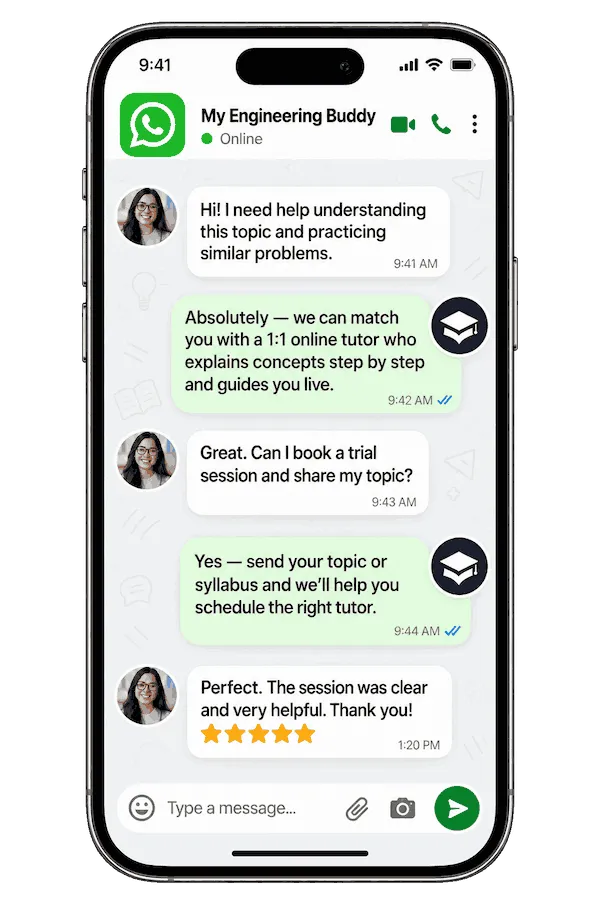
WhatsApp MEB for a quick quote — average response time under 1 minute.
Who This Food Biotechnology Tutoring Is For
Food Biotechnology sits at the intersection of microbiology, biochemistry, and engineering — and most students hit a wall at some point. Whether it’s the maths in bioreactor design or the conceptual leap from lab-scale to industrial-scale fermentation, the gaps can compound fast.
- Undergraduate students in Food Science, Bioengineering, or Chemical Engineering programmes taking a dedicated Food Biotechnology module
- Graduate students working on fermentation optimisation, enzyme kinetics, or genetically modified organism (GMO) regulatory frameworks
- Students retaking after a failed first attempt — especially where downstream processing or mass balance calculations were the sticking point
- Students with a university conditional offer depending on this grade
- Researchers needing a conceptual refresh on bioprocessing for a thesis chapter or lab rotation
- Students at universities including MIT, UC Davis, Wageningen, University of Reading, Cornell, and the University of Queensland where Food Biotechnology modules are embedded in core engineering or science degrees
If you need Food Processing homework help alongside your biotech work, MEB covers that too.
At MEB, we’ve found that students who struggle with Food Biotechnology usually don’t have a knowledge problem — they have a sequencing problem. Enzyme kinetics makes no sense if the underlying biochemistry wasn’t solid. We start there, not where the lecturer left off.
1:1 Tutoring vs Self-Study vs AI vs YouTube vs Online Courses
Self-study works if you’re disciplined, but there’s no one to catch a wrong assumption about substrate inhibition before it costs you marks. AI tools give fast definitions — they can’t watch you set up a mass balance incorrectly and step in. YouTube covers fermentation overviews well; it stops when your specific bioreactor design question starts. Online courses are structured but move at one pace regardless of where you are. With a 1:1 online Food Biotechnology tutor from MEB, sessions are live, calibrated to your exact module, and errors get corrected before they become habits.
Outcomes: What You’ll Be Able To Do in Food Biotechnology
After consistent 1:1 sessions, students can solve bioreactor mass and energy balances without prompting, analyse enzyme kinetics data and apply Michaelis-Menten models correctly, explain genetic modification techniques and their regulatory implications in written assessments, apply downstream processing principles to separation and purification problems, and present fermentation process design decisions with clear justification in coursework submissions.
These aren’t vague goals. They map directly to the types of exam questions and lab reports that determine your final grade in a Food Biotechnology course.
Based on feedback from 40,000+ sessions collected by MEB from 2022 to 2025, 58% of students improved by one full grade after approximately 20 hours of 1:1 tutoring in subjects like Food Biotechnology. A further 23% achieved at least a half-grade improvement.
Source: MEB session feedback data, 2022–2025.
Try your first session for $1 — 30 minutes of live 1:1 tutoring or one homework question explained in full. No registration. No commitment. WhatsApp MEB now and get matched within the hour.
What We Cover in Food Biotechnology (Syllabus / Topics)

Microbiology and Fermentation Technology
- Microbial growth kinetics — batch, fed-batch, and continuous culture
- Fermentation process design: substrate, product, and oxygen transfer
- Yeast, bacterial, and fungal systems used in food production
- Bioreactor types — stirred tank, airlift, packed bed
- Sterilisation methods and contamination control
- Scale-up considerations from lab to pilot to industrial scale
Core texts: Bioprocess Engineering Principles by Doran; Fermentation Microbiology and Biotechnology by El-Mansi et al.
Enzyme Technology and Biochemical Engineering
- Enzyme kinetics — Michaelis-Menten, inhibition models, Km and Vmax determination
- Immobilised enzyme systems and industrial applications
- Enzyme production, purification, and stability
- Biochemical reaction pathways relevant to food systems
- Mass and energy balances in enzymatic processes
- Energy and mass balance tutoring for bioprocess contexts
Core texts: Enzyme Technology by Chaplin and Bucke; Biochemical Engineering Fundamentals by Bailey and Ollis.
Genetic Modification, Food Safety, and Downstream Processing
- Recombinant DNA technology and genetically modified organisms in food
- CRISPR and gene editing: principles and food industry applications
- Regulatory frameworks for GMO foods — EU, US FDA/USDA, Codex Alimentarius
- Food safety risk assessment and HACCP integration with biotech processes
- Downstream processing: centrifugation, filtration, chromatography, and drying
- Functional foods, nutraceuticals, and novel protein sources
Core texts: Food Biotechnology by Khachatourians and Arora; Separation Process Principles by Seader and Henley. See also research published in Nature Biotechnology for current industry developments.
Students often come to MEB having memorised the Michaelis-Menten equation without understanding what it predicts — or why substrate inhibition flips the curve. One session on enzyme kinetics with a tutor who can draw it live changes that.
Source: My Engineering Buddy tutor observations, 2008–2025.
What a Typical Food Biotechnology Session Looks Like
The tutor opens by checking the previous topic — usually fermentation kinetics or an enzyme calculation the student attempted between sessions. From there, the session moves to the current sticking point: often bioreactor design or downstream separation problems. The tutor works through the problem on a digital pen-pad, narrating each step, then asks the student to replicate the reasoning — not just the answer. If the student can’t explain why substrate concentration affects the reaction rate, that’s where the session stays until they can. The session closes with a specific practice task — two or three problems of increasing difficulty — and the next topic is noted before logging off.
How MEB Tutors Help You with Food Biotechnology (The Learning Loop)
Diagnose: In the first session, the tutor identifies exactly where understanding breaks down — whether that’s Monod kinetics, mass balance setup, or interpreting a downstream processing flowsheet. They don’t assume; they ask you to work through something and watch.
Explain: The tutor works through problems live using a digital pen-pad. No pre-made slides. If bioreactor oxygen transfer rates aren’t clicking, they build the concept from scratch using your course notation and your textbook’s conventions.
Practice: You attempt problems with the tutor present. Pausing to explain your reasoning out loud is part of the method — it surfaces wrong assumptions that a written answer hides.
Feedback: Every error is traced to its root. Dropped a unit in a mass balance? The tutor shows you the exact step. Misapplied inhibition kinetics? They show you why the model breaks down at high substrate concentrations.
Plan: After each session, the tutor maps the next topic and sets the practice sequence. You know what’s coming and why it comes in that order.
Sessions run on Google Meet with a digital pen-pad or iPad and Apple Pencil. Before your first session, share your course outline or module handbook, a recent assignment or past exam question you struggled with, and your exam or submission deadline. Start with the $1 trial — 30 minutes of live tutoring that also serves as your first diagnostic. Whether you need a quick catch-up before finals, structured revision over 4–8 weeks, or weekly support through the semester, the tutor maps the session plan after that first diagnostic.
Students consistently tell us that the biggest shift in Food Biotechnology comes when they stop treating fermentation and enzyme topics as separate and start seeing them as one continuous process design problem. That connection usually happens in session three or four.
Tutor Match Criteria (How We Pick Your Tutor)
Every match is based on four things.
Subject depth: The tutor’s background must cover your specific area — fermentation engineering, enzyme technology, GMO regulatory science, or downstream processing — not just general biochemistry.
Tools: Every Food Biotechnology tutor uses Google Meet plus a digital pen-pad or iPad with Apple Pencil. Bioprocess diagrams and kinetic graphs need to be drawn live — not described.
Time zone: Matched to your region. US, UK, Gulf, Canada, and Australia students all get viable session windows.
Goals: Whether you need to pass a specific exam, finish a coursework assignment on bioreactor design, or build conceptual depth for a research project, the tutor brief reflects that.
Unlike platforms where you fill out a form and wait, MEB responds in under a minute, 24/7. Tutor match takes under an hour. The $1 trial means you test before you commit. Everything runs over WhatsApp — no logins, no intake forms.
Study Plans (Pick One That Matches Your Goal)
If you’re three weeks out with gaps in fermentation kinetics and downstream processing, the tutor runs a focused catch-up — highest-yield topics first. For students with a fixed exam date 4–8 weeks away, sessions follow a structured revision sequence tied to past paper patterns. Ongoing weekly support works alongside your semester schedule, aligned to assignment deadlines and lab report submissions. The tutor builds the specific sequence after the diagnostic — you don’t need to know what order to cover things in.
Pricing Guide
Standard Food Biotechnology tutoring runs $20–$40/hr for most undergraduate modules. Graduate-level sessions — particularly those covering advanced bioprocess design, regulatory frameworks, or research thesis support — are available up to $100/hr. Rate factors include level, topic complexity, how tight the timeline is, and tutor availability.
For students targeting positions in food technology firms, pharmaceutical bioprocessing, or graduate programmes at institutions like Wageningen, Cornell, or UC Davis, tutors with industry or research backgrounds in fermentation and bioprocess engineering are available at higher rates. Share your specific goal and MEB will match the tier to your ambition.
Availability is limited during peak exam periods — April–May and November–December fill up fastest. Start with the $1 trial — 30 minutes, no registration, no commitment. WhatsApp MEB for a quick quote.
Food Biotechnology sits in a narrow overlap between engineering and life sciences. Most tutoring platforms don’t have specialists who can handle both the biochemistry and the process engineering side in the same session. MEB does.
Source: My Engineering Buddy, 2008–2025.
FAQ
Is Food Biotechnology hard?
It’s not the hardest subject in Chemical Engineering, but it combines quantitative bioprocess engineering with molecular biology — two areas most students haven’t studied together before. The maths in enzyme kinetics and bioreactor design trips most students up first. These are fixable problems with the right tutor.
How many sessions are needed?
Most students see a meaningful improvement in one specific topic area — enzyme kinetics or fermentation balances, for example — within three to five sessions. Covering a full module from gaps to exam-ready typically takes 10–20 hours depending on starting level and how many topics need work.
Can you help with homework and assignments?
MEB tutoring is guided learning — you understand the work, then submit it yourself. The tutor explains the method, works through a similar problem, and checks your reasoning. See our Academic Integrity policy and Why MEB page for full details on what we help with and what we don’t.
Will the tutor match my exact syllabus or exam board?
Yes. Before the first session, share your module handbook or course outline. The tutor works from your materials — not a generic Food Biotechnology curriculum. Specific units from Wageningen, UC Davis, University of Reading, or any other institution are all covered the same way.
What happens in the first session?
The tutor runs a short diagnostic — usually asking you to work through a past question or explain a concept from recent lectures. This shows exactly where the gaps are. The remainder of the session starts closing the most urgent one. You don’t waste time on things you already know.
Is online tutoring as effective as in-person?
For a calculation-heavy subject like Food Biotechnology, yes — provided the tutor uses a digital pen-pad. Drawing fermentation curves, enzyme kinetics graphs, and process flow diagrams live on screen replicates what a whiteboard session delivers. MEB tutors all work this way.
Can you help at midnight or over a weekend?
Yes. MEB operates 24/7. Students in the US, Gulf, and Australia regularly schedule late-night or weekend sessions. WhatsApp MEB at any time — the average first response is under a minute, and tutors can often start within the same day.
What’s the difference between Food Biotechnology and Food Science at the tutoring level?
Food Science covers sensory properties, nutrition, and food chemistry broadly. Food Biotechnology focuses specifically on biological processes — fermentation, enzyme technology, genetic modification, and bioprocessing — with more engineering content. Tutoring sessions for each subject follow different paths, and MEB matches accordingly. Get Food Science tutoring or Food Biotechnology tutoring — or both if your course spans both areas.
Do you cover GMO regulation and food safety frameworks, not just the science?
Yes. Many Food Biotechnology courses include assessments on EU GMO directives, US FDA/USDA approval pathways, and Codex Alimentarius standards. MEB tutors can walk through both the regulatory logic and how to structure a written answer that scores marks on these topics.
How do I get started?
Three steps: WhatsApp MEB with your subject, level, and deadline. You’ll be matched with a verified Food Biotechnology tutor — usually within 24 hours. The first session is the $1 trial: 30 minutes live or one full question explained. No registration required.
What if my tutor isn’t the right fit?
Tell MEB via WhatsApp. A replacement match happens fast — usually the same day. The $1 trial exists specifically so you test the fit before committing to a full session block. No pressure, no contracts.
Can a Food Biotechnology tutor help with my lab report or thesis chapter?
Yes — tutors can help you understand the underlying bioprocessing concepts, interpret your experimental results, and structure your analysis correctly. You write and submit the work. The tutor helps you make sense of what the data is telling you, particularly for fermentation runs, enzyme assays, or downstream yield calculations.
Trust & Quality at My Engineering Buddy
Every MEB tutor goes through subject-specific vetting — a live demo session, degree and experience verification, and ongoing review based on student feedback. Tutors covering Food Biotechnology hold degrees in Chemical Engineering, Bioengineering, Food Science, or closely related disciplines, often with industry or research backgrounds in fermentation, bioprocessing, or food safety. Rated 4.8/5 across 40,000+ verified reviews on Google.
MEB tutoring is guided learning — you understand the work, then submit it yourself. For full details on what we help with and what we don’t, read our Academic Integrity policy and Why MEB.
MEB has been serving students across the US, UK, Canada, Australia, the Gulf, and Europe since 2008 — in 2,800+ subjects including Chemical Engineering, food preservation tutoring, and separation processes help. If you need support with the broader process engineering side of your course, molecular engineering tutoring and reaction engineering tutoring are also available through MEB.
Our experience across thousands of sessions shows that Food Biotechnology students who bring a specific unsolved problem to the first session — not just a vague “I don’t get it” — make faster progress. The more specific your question, the more we can do in 30 minutes.
Explore Related Subjects
Students studying Food Biotechnology often also need support in:
- Chemical Process Safety
- Electrochemical Engineering
- Transport Phenomena — Momentum, Heat and Mass
- Aspen Plus
- Combustion Engineering
- Electrochemistry
- Chemical Process Calculation, Control and Equipment Design
Next Steps
When you WhatsApp MEB, have these ready:
- Your exam board or university module name, and the topics giving you the most trouble
- Your availability and time zone
- Your exam date or assignment deadline
Before your first session, have ready: your course outline or module handbook, a recent past paper attempt or homework question you struggled with, and your exam or deadline date. The tutor handles the rest.
MEB matches you with a verified Food Biotechnology tutor — usually within 24 hours. The first session starts with a diagnostic so every minute is used well.
Visit www.myengineeringbuddy.com for more on how MEB works.
WhatsApp to get started or email [email protected].
Reviewed by Subject Expert
This page has been carefully reviewed and validated by our subject expert to ensure accuracy and relevance.