




~1 min
Average Reply Time
~1 hour
To Be Matched With A Tutor
30 Min Trial
75% Find Their Tutor On The 1st Trial
$20-35+/hr
Premium Yet Affordable Learning
Most students dropping marks in GCSE PE aren’t unfit — they can’t explain why the heart rate rises or what slow-twitch fibres do under exam conditions.
GCSE Physical Education Tutor Online
GCSE Physical Education is a UK school-level qualification covering sport science, anatomy, physiology, health, training principles, and physical performance, assessed by AQA, Edexcel, or OCR, equipping students with both practical competence and theoretical knowledge.
If you’re searching for a GCSE Physical Education tutor near me, MEB offers fully online 1:1 sessions matched to your exact exam board — AQA, Edexcel, or OCR — covering every written component and the theory behind your practical performance. Our GCSE tutoring platform has been helping students close grade gaps since 2008. One good tutor, working through your actual weak spots, changes the trajectory fast.
- 1:1 online sessions tailored to your specific exam board and syllabus
- Expert-verified tutors with GCSE PE subject knowledge across all boards
- Flexible time zones — US, UK, Canada, Australia, Gulf
- Structured learning plan built after a diagnostic session
- Ethical homework and assignment guidance — you understand the work, then submit it yourself
52,000+ students across the US, UK, Canada, Australia, and the Gulf have used MEB since 2008 — including students in GCSE subjects like GCSE Physical Education, GCSE Biology tutoring, and GCSE Psychology.
Source: My Engineering Buddy, 2008–2025.
How Much Does a GCSE Physical Education Tutor Cost?
Most GCSE PE sessions run $20–$40/hr. The $1 trial gets you 30 minutes of live tutoring or one full question explained — no registration required, no commitment.
| Level / Need | Typical Rate | What’s Included |
|---|---|---|
| Standard GCSE PE | $20–$35/hr | 1:1 sessions, theory & written paper guidance |
| Advanced / Specialist | $35–$70/hr | Expert tutor, sport science depth, NEA support |
| $1 Trial | $1 flat | 30 min live session or 1 homework question explained |
Tutor availability tightens sharply in April and May. If your exam is coming up, book early.
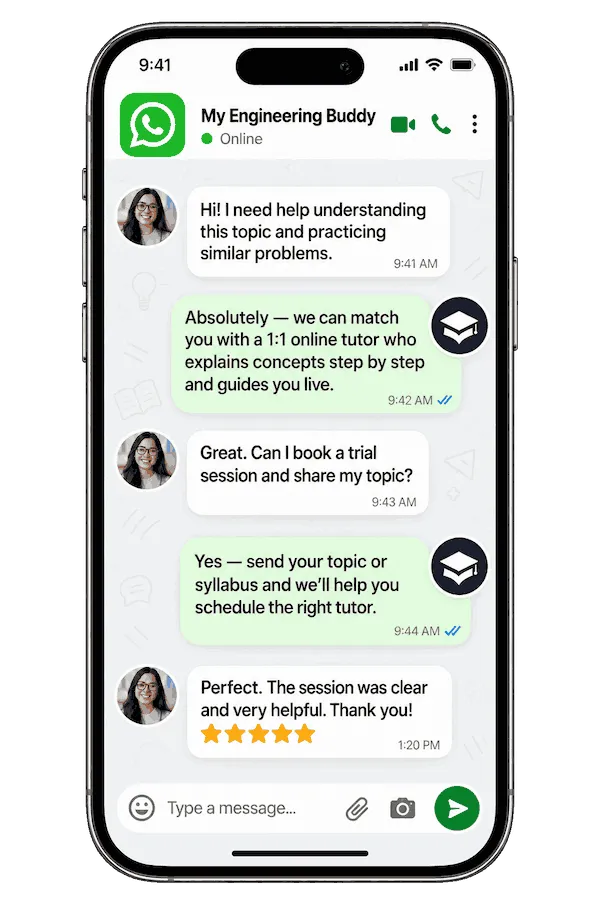
WhatsApp MEB for a quick quote — average response time under 1 minute.
Who This GCSE Physical Education Tutoring Is For
GCSE PE theory catches a lot of students off guard. The practical side feels manageable, but the written papers — applied anatomy, training principles, socio-cultural influences — require the same exam technique as any other academic subject.
- Students dropping marks on Component 1 or Component 2 written papers despite strong practical performance
- Students with a university conditional offer depending on this grade
- Parents watching a child’s confidence drop alongside their grades — especially when the gap between practical ability and written scores widens
- Students 4–6 weeks from the exam with significant theory gaps still to close
- Students struggling with the NEA (Non-Examined Assessment) and how to analyse performance effectively
- Home-educated students preparing for GCSE PE as a standalone qualification
Students studying GCSE PE alongside GCSE Combined Science help often find that anatomy and physiology overlaps make both subjects easier when tackled together.
If you need the $1 trial to test the waters before committing to a full package, that works too — start there.
1:1 Tutoring vs Self-Study vs AI vs YouTube vs Online Courses
Self-study works if you’re disciplined, but GCSE PE theory requires precise exam phrasing — self-marking rarely catches where you’re losing marks. AI tools explain concepts quickly but can’t read your actual answer and tell you why the examiner would mark it down. YouTube covers the cardiac output equation well enough; it stops when you need to apply it to a specific training scenario in a 6-mark question. Online courses move at a fixed pace regardless of which components you’re weakest on. With MEB’s 1:1 GCSE Physical Education tutoring, the tutor sees your actual work, corrects your exam language in real time, and builds sessions around the components where you’re dropping marks — not the ones you already know.
Outcomes: What You’ll Be Able To Do in GCSE Physical Education
After working with an online GCSE Physical Education tutor, students write confident, mark-scheme-accurate answers on applied anatomy — naming muscles, explaining fibre types, tracing the pathway of a nerve impulse under pressure. They analyse training principles like FITT and progressive overload in context, not just as definitions. They explain how the cardiovascular system responds to different exercise intensities with the precision the examiner expects. They apply socio-cultural factors — commercialisation, media influence, participation barriers — to real examples in the 9-mark extended questions. Students also approach the performance analysis section of the NEA with a structured framework, not guesswork.
Supporting a student through GCSE Physical Education? MEB works directly with parents to set up sessions, track progress, and keep coursework on schedule. WhatsApp MEB — average response time is under a minute, 24/7.
Based on feedback from 40,000+ sessions collected by MEB from 2022 to 2025, 58% of students improved by one full grade after approximately 20 hours of 1:1 tutoring in subjects like GCSE Physical Education. A further 23% achieved at least a half-grade improvement.
Source: MEB session feedback data, 2022–2025.
What We Cover in GCSE Physical Education (Syllabus / Topics)
Coverage maps to AQA (8582), Edexcel (1PE0), and OCR (J587) specifications. Your tutor confirms your exact board and paper structure in the first session.
Applied Anatomy and Physiology
- Skeletal system — bone types, joint structures, movement planes
- Muscular system — major muscles, fibre types (Type I, IIa, IIx), recruitment
- Cardiovascular system — heart structure, cardiac output, blood pressure, vasodilation
- Respiratory system — mechanics of breathing, gaseous exchange, oxygen debt
- The short-term and long-term effects of exercise on each body system
- Neuromuscular control — motor unit, the stretch reflex, proprioception basics
Core texts: AQA GCSE Physical Education (Kirk et al., Hodder Education), Edexcel GCSE PE (Hartigan, Pearson). Tutors supplement with board-specific mark schemes and past paper questions.
Physical Training and Health
- Principles of training — FITT, specificity, progressive overload, reversibility, tedium
- Methods of training — interval, continuous, circuit, weight, plyometric, Fartlek
- Components of fitness — definitions and how each is tested (e.g. Harvard Step, Illinois Agility)
- Goal-setting using SMART targets and training programme design
- Injury prevention, warm-up and cool-down rationale
- Health, fitness, and well-being — physical, emotional, social dimensions
- Lifestyle factors affecting performance: diet, sleep, drugs, alcohol
Reference text: OCR GCSE Physical Education (Bray et al., Hodder Education). Past paper mark schemes from the relevant exam board are used in every revision session.
Sport, Society, and Culture
- Commercialisation of sport — media, sponsorship, the golden triangle
- Participation barriers — age, gender, ethnicity, disability, socioeconomic factors
- Ethical issues — performance-enhancing drugs, violence, fair play
- The role of national governing bodies and government sport policy
- Technology in sport — Hawk-Eye, VAR, wearables, biomechanical analysis
- Sporting values — Olympics, Paralympics, amateurism vs professionalism
This section rewards students who can link concepts to current examples. Tutors work through extended-answer technique here, including how to structure 9-mark responses.

At MEB, we’ve found that GCSE PE students who can explain applied anatomy in their own words — before being shown the mark scheme — almost always outperform those who memorise definitions. The tutor’s job is to get you to that point, not to feed you answers.
What a Typical GCSE Physical Education Session Looks Like
The tutor opens by checking what happened since the last session — usually a past paper question on cardiovascular response to exercise or a section of the training principles topic. From there, you work through a specific component together: the tutor writes on a digital pen-pad while you watch, then you attempt the same question and talk through your reasoning out loud. If your answer on slow-twitch fibre recruitment misses the mark, the tutor shows you exactly which phrase cost the marks and what the examiner expected to see instead. Sessions on the socio-cultural paper often involve annotating exam answers in real time. The session closes with a concrete task — usually two or three targeted past paper questions — and the next topic is noted for follow-up. No filler. Every minute is mapped to your exam.
How MEB Tutors Help You with GCSE Physical Education (The Learning Loop)
Diagnose: In the first session, the tutor asks you to attempt a short written response — often a 6-mark question from a past paper — and identifies where the marks are being dropped. Common findings: missing command word responses, imprecise anatomical terminology, underdeveloped socio-cultural analysis.
Explain: The tutor works through the topic live, using a digital pen-pad to annotate diagrams of the cardiovascular system, label muscle groups, or map training principles against a sample programme. Nothing is assumed from a textbook you may or may not have read.
Practice: You attempt questions with the tutor present — not after the session. This is where most students find the tutor immediately catches the errors that self-study never surfaces.
Feedback: Step-by-step correction with the mark scheme in view. The tutor explains why each phrase gains or loses marks, not just whether the answer was right.
Plan: At the end of every session, the tutor maps what comes next — which component needs another pass, when to move to full paper practice, how the NEA analysis fits into the revision sequence.
Sessions run on Google Meet with a digital pen-pad or iPad and Apple Pencil. Before your first session, have your exam board, a recent past paper attempt, and your exam date ready. The first session acts as a diagnostic and covers the highest-priority topic before it ends. Start with the $1 trial — 30 minutes of live tutoring that also serves as your first diagnostic.
Students consistently tell us that the moment GCSE PE theory clicks is when they stop treating it as sport knowledge and start treating it as a science exam. The vocabulary matters. The structure of the answer matters. That shift usually happens within two or three sessions.
MEB tutors cover the full GCSE PE written paper range — applied anatomy, training principles, and socio-cultural topics — matched to AQA, Edexcel, and OCR specifications, with every session built around your actual exam board’s mark scheme.
Source: My Engineering Buddy, 2008–2025.
Tutor Match Criteria (How We Pick Your Tutor)
Not every tutor who knows sport science can explain the cardiac output formula clearly to a 15-year-old under exam pressure. MEB matches on specifics.
Subject depth: Tutors are matched to your exact exam board — AQA, Edexcel, or OCR — and the specific components you’re weakest on, whether that’s applied anatomy or the extended socio-cultural questions.
Tools: Every tutor works with Google Meet and a digital pen-pad or iPad with Apple Pencil — essential for annotating anatomy diagrams and written paper responses live.
Time zone: Matched to your region — UK, US, Gulf, Canada, or Australia — so sessions run at hours that don’t wreck your sleep.
Goals: Whether you need to close a grade gap before May, maintain steady progress through the year, or improve a specific paper component, the match reflects your actual target.
Unlike platforms where you fill out a form and wait, MEB responds in under a minute, 24/7. Tutor match takes under an hour. The $1 trial means you test before you commit. Everything runs over WhatsApp — no logins, no intake forms.
Study Plans (Pick One That Matches Your Goal)
Your tutor builds the exact sequence after the diagnostic, but here’s how most GCSE PE students approach it. Catch-up (1–3 weeks): intensive focus on the highest-mark components — usually applied anatomy and training principles — with daily past paper practice. Exam prep (4–8 weeks): structured revision covering all three topic areas, with full paper attempts in the final two weeks. Weekly support: ongoing sessions aligned to your school’s teaching schedule and NEA deadlines, maintaining pace through the year. Students preparing for GCSE Psychology tutoring alongside PE often share the weekly support structure across both subjects effectively.
Pricing Guide
GCSE PE tutoring runs $20–$40/hr for standard exam board preparation. Tutors with sport science degrees or professional coaching backgrounds — useful for students targeting the highest grade bands or needing deep NEA support — are available at higher rates up to $100/hr. Share your specific goal and MEB matches the rate to what you actually need.
Rate factors include your exam board, which components you’re focusing on, how close the exam is, and tutor availability. April and May are the busiest months — availability drops fast.
For students targeting top sixth-form or A Level PE progression, tutors with performance analysis and sport science backgrounds are available at premium rates — share your goal and MEB will find the right match.
Start with the $1 trial — 30 minutes, no registration, no commitment. WhatsApp MEB for a quick quote.
Try your first session for $1 — 30 minutes of live 1:1 tutoring or one homework question explained in full. No registration. No commitment. WhatsApp MEB now and get matched within the hour.
FAQ
Is GCSE Physical Education hard?
The practical component is manageable for most students. The written papers are harder than people expect — applied anatomy and physiology requires precise scientific language, and the 9-mark socio-cultural questions require structured argument. Students often underestimate the theory load until the exam is close.
How many sessions are needed?
Most students close a full grade gap in 10–20 hours of targeted 1:1 work. Students starting 4–6 weeks before the exam typically need 8–12 sessions focused on their two or three weakest components. The tutor sets the plan after the first diagnostic session.
Can you help with homework and assignments?
Yes. MEB tutoring is guided learning — you understand the work, then submit it yourself. This applies to written homework, practice questions, and NEA preparation. See our Academic Integrity policy and Why MEB page for full details on what we help with and what we don’t.
Will the tutor match my exact syllabus or exam board?
Yes. GCSE PE varies by board — AQA 8582, Edexcel 1PE0, and OCR J587 have different paper structures and component weightings. Your tutor is matched to your specific board and uses that board’s mark schemes and past papers throughout every session.
What happens in the first session?
The tutor asks you to attempt a short past paper question cold — usually from the component where you’re dropping the most marks. This diagnostic takes about 10 minutes and tells the tutor exactly where to start. The rest of the first session covers the highest-priority topic before it ends.
Is online tutoring as effective as in-person?
For GCSE PE theory, yes — the written papers are entirely screen-friendly. The tutor annotates anatomy diagrams and marks up your written answers live via digital pen-pad on Google Meet. Many students find they focus better in a quiet space at home than in a classroom or shared study area.
What’s the difference between the AQA, Edexcel, and OCR GCSE PE exams?
AQA splits into two written papers — applied anatomy/physiology and socio-cultural/sports psychology. Edexcel includes a performance analysis component. OCR uses a different weighting for practical and written work. Your tutor checks your exact specification in the first session and builds the plan around it.
Can a tutor help with the GCSE PE NEA (Non-Examined Assessment)?
Yes. The NEA requires written analysis of performance — your own or another performer’s. Tutors help you structure the analysis using the correct evaluation framework, build the vocabulary the mark scheme rewards, and review drafts so your submission reflects the standard your practical ability deserves.
Can I get GCSE Physical Education help at midnight or on weekends?
Yes. MEB operates 24/7 across time zones. Students in the UK, Gulf, and Australia regularly book late-evening or weekend sessions. WhatsApp MEB at any hour — average response time is under a minute and a tutor can often be matched the same day.
Do you offer group GCSE Physical Education sessions?
No. Every session is 1:1. Group sessions don’t allow the tutor to correct your specific exam phrasing or work through the components you personally drop marks on. The 1:1 format is the reason the results differ from a revision class.
How do I get started?
Three steps: WhatsApp MEB with your exam board and the topics you’re struggling with. MEB matches you to a verified tutor — usually within the hour. Start with the $1 trial: 30 minutes of live tutoring or one full question explained. No forms, no waiting.
Trust & Quality at My Engineering Buddy
Every GCSE PE tutor on MEB goes through subject-specific screening — not a generic interview. Tutors demonstrate live on a digital pen-pad, answer applied anatomy questions under the same conditions your student faces, and are rated after every session. Rated 4.8/5 across 40,000+ verified reviews on Google. Tutors with sport science degrees, coaching qualifications, and direct GCSE examining experience are prioritised for this subject. Ongoing feedback review means underperforming tutors are removed — not reassigned.
MEB tutoring is guided learning — you understand the work, then submit it yourself. For full details on what we help with and what we don’t, read our Academic Integrity policy and Why MEB.
MEB has served 52,000+ students across the US, UK, Canada, Australia, the Gulf, and Europe since 2008, covering 2,800+ subjects. Within the GCSE category, that includes students working on GCSE Physics tutoring, GCSE Chemistry help, and GCSE Physical Education. Every subject page is staffed by tutors who know that specific syllabus — not generalists filling in. Read more about our approach at MEB’s tutoring methodology.
MEB has operated since 2008 with a single model: one tutor, one student, one subject — matched to the exact exam board, the exact syllabus, and the exact grade gap that needs closing before the exam date.
Source: My Engineering Buddy, 2008–2025.
A common pattern our tutors observe is that GCSE PE students arrive knowing the content but unable to translate it into mark-winning language. The difference between a grade 5 and a grade 7 answer on a 9-mark question is almost always structure and vocabulary — not knowledge.
Explore Related Subjects
Students studying GCSE Physical Education often also need support in:
- GCSE Biology
- GCSE Food Preparation and Nutrition
- GCSE Health and Social Care
- GCSE Sociology
- GCSE Statistics
- GCSE Geography
Next Steps
Here’s what to do right now:
- Share your exam board (AQA, Edexcel, or OCR), your hardest component, and how much time you have before the exam
- Share your availability and time zone
- MEB matches you with a verified GCSE PE tutor — usually within 24 hours, often within the hour
- First session starts with a diagnostic so every minute is used on what actually matters
Before your first session, have ready:
- Your exam board and the specific papers or components you’re targeting
- A recent past paper attempt or a piece of homework you struggled with
- Your exam date or NEA submission deadline
The tutor handles the rest. Visit www.myengineeringbuddy.com for more on how MEB works.
WhatsApp to get started or email [email protected].
Reviewed by Subject Expert
This page has been carefully reviewed and validated by our subject expert to ensure accuracy and relevance.




