




~1 min
Average Reply Time
~1 hour
To Be Matched With A Tutor
30 Min Trial
75% Find Their Tutor On The 1st Trial
$20-35+/hr
Premium Yet Affordable Learning
Most students who struggle with GCSE Music don’t lack ability — they’ve never had someone sit with them through the listening paper, bar by bar.
GCSE Music Tutor Online
GCSE Music is a UK qualification, typically graded 9–1, assessing students in performance, composition, and appraising. Offered by AQA, Edexcel, OCR, and WJEC, it equips students to read, analyse, create, and evaluate music across a range of genres and traditions.
If you’ve searched for a GCSE Music tutor near me, MEB offers 1:1 online tutoring and homework help matched to your specific exam board and syllabus — whether that’s AQA, Edexcel, OCR, or WJEC. Our tutors cover performance technique, composition coursework, and the appraising paper in a single structured plan built around your actual deadline. Part of the broader GCSE tutoring offer at MEB, where 52,000+ students have been helped since 2008.
- 1:1 online sessions tailored to your board’s syllabus and NEA requirements
- Expert-verified tutors with specialist music knowledge and performance backgrounds
- Flexible time zones — US, UK, Canada, Australia, Gulf
- Structured learning plan built after a first diagnostic session
- Ethical homework and assignment guidance — you understand the work, then submit it yourself
52,000+ students across the US, UK, Canada, Australia, and the Gulf have used MEB since 2008 — including students in GCSE subjects like GCSE Music, GCSE Drama, and GCSE Art and Design.
Source: My Engineering Buddy, 2008–2025.
How Much Does a GCSE Music Tutor Cost?
Most GCSE Music sessions run at $20–$40/hr. If you need a tutor with conservatoire-level performance experience or specialist NEA composition support, rates can reach $70/hr. New students can start with a $1 trial — 30 minutes of live tutoring or one full homework question explained from first note to final bar.
| Level / Need | Typical Rate | What’s Included |
|---|---|---|
| Standard GCSE (most boards) | $20–$35/hr | 1:1 sessions, appraising & theory guidance |
| Advanced / NEA Specialist | $35–$70/hr | Composition coaching, performance prep, niche board depth |
| $1 Trial | $1 flat | 30 min live session or one homework question explained in full |
Tutor availability tightens significantly in April and May, when Year 11 students are finalising NEA submissions and revising for written papers. Book early if your exam window is close.
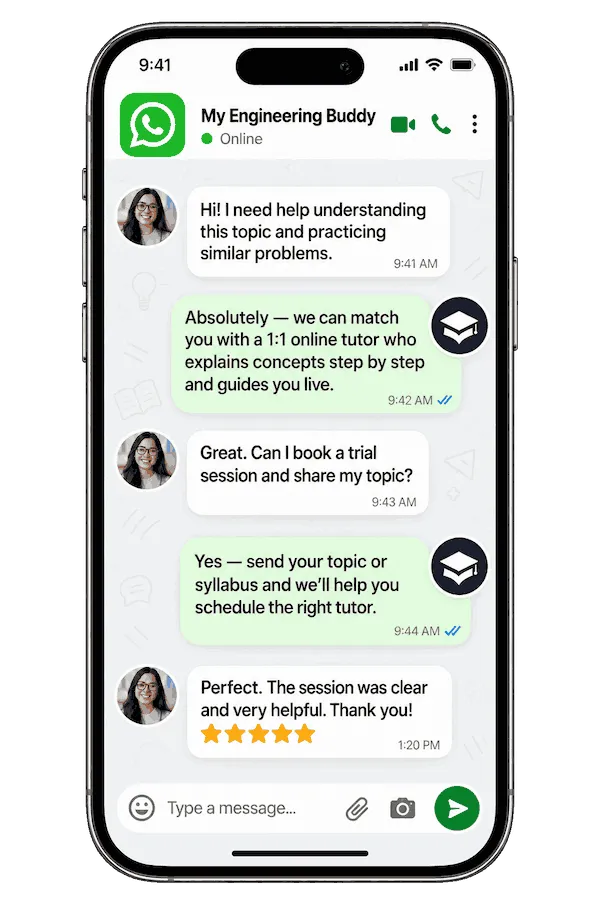
WhatsApp MEB for a quick quote — average response time under 1 minute.
Who This GCSE Music Tutoring Is For
GCSE Music draws in students with very different gaps. Some are strong performers but lose marks on the appraising paper. Others compose well but can’t articulate what they’ve written in the required musical terminology. Some need all three components rescued at once.
- Students who can play their instrument but freeze on the listening and appraising questions
- Students whose composition NEA is underway but lacks structural coherence or stylistic accuracy
- Students with a coursework or NEA submission deadline approaching and significant gaps still to close
- Students retaking after a failed first attempt, needing a board-specific revision plan
- Students aiming for grade 7–9 who want to push beyond “safe” answers in the appraising paper
- Parents watching a child’s confidence drop alongside their grades as the NEA deadline nears
Students preparing for A Level Music at schools including those following Edexcel or AQA pathways often tell us GCSE is where the foundation breaks. Getting it right here changes what’s possible later. You can also get GCSE English Literature help or GCSE History tutoring through MEB if you’re managing multiple subjects at once.
At MEB, we’ve found that GCSE Music students almost always underestimate how many marks the appraising component carries — and overestimate how much raw musical talent compensates for gaps in technical vocabulary and analytical structure.
1:1 Tutoring vs Self-Study vs AI vs YouTube vs Online Courses
Self-study works if you’re disciplined, but there’s no one to catch an error in your harmonic analysis before it becomes a habit. AI tools can explain musical concepts quickly but can’t listen to your composition draft or identify why your appraising answer drops marks. YouTube covers set works at a high level — it stops short when you’re stuck on a specific passage in “Peripetie” or “Electric Counterpoint.” Online courses follow a fixed pace with no adjustment for your weakest component. 1:1 tutoring with MEB is live, calibrated to your exact board and set works, and corrects gaps in real time. For GCSE Music specifically, where three components have completely different skill demands, that personalisation is what closes the gap.
Outcomes: What You’ll Be Able To Do in GCSE Music
After working through sessions with an MEB tutor, students can analyse set works with the board-specific vocabulary needed to score in the top mark bands — not just describe what they hear. They apply compositional techniques like ground bass, imitation, and word-painting with structural intent rather than guesswork. Students explain how tonality, texture, and instrumentation function across the Areas of Study their board specifies. They present compositions with a written commentary that holds up under teacher moderation. Most importantly, they approach the appraising paper without panic — because the listening skills are practised, not assumed.
Supporting a student through GCSE Music? MEB works directly with parents to set up sessions, track progress, and keep NEA coursework on schedule. WhatsApp MEB — average response time is under a minute, 24/7.
Based on feedback from 40,000+ sessions collected by MEB from 2022 to 2025, 58% of students improved by one full grade after approximately 20 hours of 1:1 tutoring in subjects like GCSE Music. A further 23% achieved at least a half-grade improvement.
Source: MEB session feedback data, 2022–2025.
What We Cover in GCSE Music (Syllabus / Topics)
Coverage is mapped to your specific board. AQA, Edexcel, OCR, and WJEC each specify different set works and Areas of Study. Your tutor works from your actual syllabus document — not a generic overview. The Higher Education Statistics Agency data on arts and music enrolment trends confirms sustained demand for GCSE Music as a gateway qualification — tutors are briefed on board-specific shifts each academic year.
Component 1: Performing
- Solo performance preparation — technique, dynamics, phrasing, and mark-scheme targets
- Ensemble performance strategy — communication, timing, and role within the group
- Recording submission guidance — what examiners listen for
- Building a performance programme that meets the minimum duration requirement
- Addressing specific technical weaknesses on the student’s own instrument
Recommended resources include the board-specific performance mark scheme and, for technique development, ABRSM grade syllabi relevant to the student’s instrument.
Component 2: Composing (NEA)
- Composing to a set brief — understanding the brief’s constraints and how to meet them
- Free composition — developing a musical idea with structural coherence
- Using compositional devices: ostinato, sequence, modulation, imitation, word-painting
- Notation — staff notation or lead sheet depending on genre requirements
- Written commentary — explaining compositional decisions in correct musical terminology
- Revision of draft compositions with tutor feedback before submission
Useful references include the Edexcel GCSE Music Composition Guide and the AQA composition mark descriptor sheet for Bands 1–4.
Component 3: Appraising (Listening Exam)
- Set work analysis — AQA (Beethoven, Purcell, Schoenberg, Buckley, Afro Celt Sound System), Edexcel, OCR, and WJEC equivalents
- Unfamiliar music questions — identifying features from Areas of Study under timed conditions
- Musical elements: melody, harmony, tonality, rhythm, texture, structure, timbre, dynamics
- Exam technique: how to use musical vocabulary for marks, not description
- Past paper practice with mark-scheme walkthrough
- Dictation and rhythmic notation if required by the board
Core revision texts include the CGP GCSE Music Complete Revision and Practice guide and the Edexcel GCSE Music Listening Tests workbook by Pearson.

What a Typical GCSE Music Session Looks Like
The tutor opens by checking the previous session’s task — usually a past appraising question or a draft section of the composition NEA. If the student worked through a set work analysis of “Peripetie” by Schoenberg, the tutor asks them to talk through what they wrote before looking at the mark scheme together. From there, the session moves to the live work: the tutor and student go through an unfamiliar excerpt question on screen, with the tutor annotating the score or writing out key terms using a digital pen-pad as the student responds. The student then replicates the analytical process on a second excerpt independently. The session closes with a concrete task — one past appraising question under timed conditions, or the next eight bars of the composition draft — and the next session’s focus is agreed before signing off.
How MEB Tutors Help You with GCSE Music (The Learning Loop)
Diagnose: In the first session, the tutor identifies which of the three components is losing the most marks. For most students, it’s the appraising paper — specifically the unfamiliar music questions, where vague answers cost marks even when the student has heard the musical feature they’re trying to describe.
Explain: The tutor works through live examples using a digital pen-pad, annotating scores or writing out harmonic reductions in real time on Google Meet. Composition techniques like augmentation, contrary motion, or pedal point are demonstrated on screen — not just named.
Practice: The student attempts the next question or passage with the tutor present. For composition, they work on the next section of the NEA draft and receive immediate feedback on whether it meets the brief’s requirements.
Feedback: The tutor explains exactly where marks were dropped and why — linking errors to the mark-band descriptors the examiner uses. This is different from simply saying “add more detail.”
Plan: Each session ends with a clear next topic and a measurable task. The tutor tracks progress across all three components and adjusts the plan if the NEA deadline or exam date changes.
Sessions run over Google Meet with a digital pen-pad or iPad and Apple Pencil. Before the first session, share your exam board, your current NEA draft if you have one, and any past paper or practice appraising question you found difficult. The first session acts as your diagnostic — which means you get useful work done from minute one. Start with the $1 trial — 30 minutes of live tutoring that also serves as your first diagnostic.
Students consistently tell us that the moment GCSE Music clicks is when they stop describing music and start analysing it — when they write “a perfect cadence in G major closing the phrase” instead of “it sounds finished.” That shift is teachable. It usually takes two or three sessions.
Tutor Match Criteria (How We Pick Your Tutor)
Not every music tutor knows every board’s set works. MEB matches on specifics.
Subject depth: Tutors are matched to your exact board — AQA, Edexcel, OCR, or WJEC — and are familiar with that board’s current set works and Areas of Study, not last year’s.
Tools: Every tutor works on Google Meet with a digital pen-pad or iPad and Apple Pencil. Score annotation and live composition editing happen on screen.
Time zone: Matched to your region — UK, US, Canada, Australia, or Gulf — so sessions don’t land at inconvenient hours.
Goals: Whether the priority is the NEA composition deadline, the appraising paper, or performance technique, the tutor’s background is matched to that specific component first.
Unlike platforms where you fill out a form and wait, MEB responds in under a minute, 24/7. Tutor match takes under an hour. The $1 trial means you test before you commit. Everything runs over WhatsApp — no logins, no intake forms.
Study Plans (Pick One That Matches Your Goal)
The tutor builds the specific sequence after the first diagnostic session. Broadly: a catch-up plan (1–3 weeks) targets students who are behind on NEA work or have a specific set work they haven’t covered. An exam prep plan (4–8 weeks) runs structured appraising practice and composition review leading to the exam date. Weekly ongoing support works alongside the school timetable — covering each component as it becomes the immediate priority. If you’re also sitting GCSE English or GCSE Mathematics at the same time, MEB can coordinate tutors across subjects.
Pricing Guide
GCSE Music tutoring starts at $20/hr for standard sessions covering appraising, theory, and composition guidance. Specialist NEA composition tutors with conservatoire or professional performance backgrounds are available from $50–$70/hr — share your specific brief and exam board and MEB will match the right tier.
Rate factors: exam board, NEA complexity, how close the deadline is, and tutor availability. Availability drops sharply in the April–May window when NEA submissions and written exams converge. Book ahead of that period.
For students targeting A Level Music at selective sixth forms, or planning music-related degree pathways, tutors with conservatoire performance or professional composition backgrounds are available at higher rates — share your specific goal and MEB will match the tier to your ambition.
Start with the $1 trial — 30 minutes, no registration, no commitment. WhatsApp MEB for a quick quote.
MEB has served students since 2008 across 2,800+ subjects — including GCSE Music, GCSE Art and Design tutoring, and GCSE Media Studies help. Tutors are active practitioners and subject specialists, not generalists.
Source: My Engineering Buddy, 2008–2025.
FAQ
Is GCSE Music hard?
It depends on your background. Students with strong instrumental skills often struggle with the appraising paper and the technical vocabulary required. Students who are analytical find the composition NEA difficult without a formal theory foundation. The three components demand three genuinely different skill sets — which is where 1:1 support pays off most.
How many sessions are needed?
Most students see measurable progress in 6–10 sessions. Students using MEB for full exam prep — covering all three components — typically work for 15–20 hours across a term. The tutor sets a target after the first diagnostic session based on your current level and available time.
Can you help with homework and assignments?
Yes. MEB tutoring is guided learning — you understand the work, then submit it yourself. For composition NEA, tutors explain the brief, give feedback on drafts, and help you develop your own musical ideas. See our Academic Integrity policy and Why MEB page for full details on what we help with and what we don’t.
Will the tutor match my exact syllabus or exam board?
Yes. AQA, Edexcel, OCR, and WJEC each have different set works and mark schemes. Your tutor is matched to your specific board and is familiar with the current year’s set works — not a generic overview. Share your board and year group when you contact MEB.
What happens in the first session?
The tutor runs a short diagnostic — one appraising question, a look at any composition draft you have, and a conversation about where marks are being lost. By the end of the first session you have a clear priority list and a plan for the next two to three sessions.
Is online tutoring as effective as in-person?
For GCSE Music theory, appraising, and composition support, yes. The digital pen-pad and screen sharing replicate what a teacher does at a desk. For instrument technique, it depends — most technical feedback translates well over video, though acoustics vary. Most students prefer the flexibility of online sessions for exam prep work.
Can I get GCSE Music help at midnight or over a weekend?
Yes. MEB operates 24/7 over WhatsApp. If you have a composition deadline the next day or an appraising question you can’t work through on a Sunday evening, contact MEB and a tutor will be matched, often within the hour. Time zone availability varies but late-night sessions are common.
What if I don’t like my assigned tutor?
Tell MEB over WhatsApp and a different tutor is matched, usually within a few hours. The $1 trial exists precisely so you can test the tutor before committing to a longer plan. No pressure, no contracts.
What’s the difference between AQA and Edexcel GCSE Music?
The main differences are in set works and Areas of Study. AQA uses eight set works across four areas; Edexcel specifies set works tied to six areas of study and includes a music for film focus. OCR and WJEC have their own structures. Your tutor covers your board’s exact requirements — tell MEB which board when you get in touch.
How do I prepare for the GCSE Music unfamiliar music question?
The unfamiliar music question rewards students who can apply musical vocabulary — tonality, texture, structure, timbre — to music they’ve never heard. MEB tutors practise this with past exam extracts under timed conditions, then work through the mark scheme together so students understand why certain answers earn full marks and others don’t.
Do you offer group GCSE Music sessions?
MEB specialises in 1:1 sessions, not group classes. The reason is straightforward — the three GCSE Music components each require completely different support, and what helps one student in the appraising paper is rarely what another student needs for their composition NEA. One tutor, one student, one focused plan.
How do I get started?
Start with the $1 trial — 30 minutes of live 1:1 tutoring or one homework question explained in full. Three steps: WhatsApp MEB, get matched to a tutor (usually within the hour), and begin your trial session. No registration, no commitment beyond that first dollar.
Try your first session for $1 — 30 minutes of live 1:1 tutoring or one homework question explained in full. No registration. No commitment.
WhatsApp MEB now
and get matched within the hour.
Trust & Quality at My Engineering Buddy
Every MEB tutor goes through a live demo evaluation before being accepted — not a CV review, a real teaching session. Tutors are assessed on subject depth, explanation clarity, and how they handle a student who gives a wrong answer. For GCSE Music, that means demonstrable knowledge of the current set works, ability to annotate a score live, and fluency with mark-band descriptors across all three components. Rated 4.8/5 across 40,000+ verified reviews on Google.
MEB tutoring is guided learning — you understand the work, then submit it yourself. For full details on what we help with and what we don’t, read our Academic Integrity policy and Why MEB.
MEB has been running since 2008, serving 52,000+ students across the US, UK, Canada, Australia, the Gulf, and Europe in 2,800+ subjects. GCSE subjects — including GCSE Music, GCSE Physics tutoring, and GCSE Chemistry help — are among the most consistently requested. Tutors are vetted per subject, not hired as generalists. You can read more about how tutors are selected at MEB’s tutoring methodology page.
18 years. 52,000+ students. A 4.8/5 rating from 40,000+ verified reviews. MEB has been the 1:1 online tutor for students who need it to work — not just try it.
Source: My Engineering Buddy, 2008–2025.
Explore Related Subjects
Students studying GCSE Music often also need support in:
Next Steps
Here’s what to do right now:
- Share your exam board (AQA, Edexcel, OCR, or WJEC), your weakest component, and your exam or NEA deadline
- Share your availability and time zone
- MEB matches you with a verified GCSE Music tutor — usually within an hour
- Your first session starts with a diagnostic so every minute counts
Before your first session, have ready: your exam board and syllabus (or the set works list), a recent past appraising question or composition draft you struggled with, and your exam or NEA submission date. The tutor handles the rest.
Visit www.myengineeringbuddy.com for more on how MEB works.
WhatsApp to get started or email [email protected].
Reviewed by Subject Expert
This page has been carefully reviewed and validated by our subject expert to ensure accuracy and relevance.




