




~1 min
Average Reply Time
~1 hour
To Be Matched With A Tutor
30 Min Trial
75% Find Their Tutor On The 1st Trial
$20-35+/hr
Premium Yet Affordable Learning
Most students who struggle with GCSE Religious Studies aren’t confused by religion — they’re confused by the mark scheme. Knowing what the examiner wants for a 12-mark evaluation question is a skill. It can be taught.
GCSE Religious Studies Tutor Online
GCSE Religious Studies is a formally examined qualification assessed by AQA, Edexcel, OCR, and WJEC, covering religious beliefs, practices, and ethical themes. It develops students’ ability to construct arguments, evaluate perspectives, and apply religious teachings to contemporary issues.
Finding a reliable GCSE Religious Studies tutor near me — one who actually knows the AQA or Edexcel mark scheme rather than just the topic — is harder than it sounds. MEB provides 1:1 online GCSE tutoring across all GCSE subjects, matched to your exact exam board, paper structure, and current grade target. One session focused on how to structure a 12-mark answer can close more of the gap than a week of unguided revision.
- 1:1 online sessions mapped to your AQA, Edexcel, OCR, or WJEC syllabus
- Expert-verified tutors with subject-specific knowledge of RS content and mark schemes
- Flexible time zones — US, UK, Canada, Australia, Gulf
- Structured learning plan built after a diagnostic session
- Ethical homework and assignment guidance — you understand the work before you submit it
52,000+ students across the US, UK, Canada, Australia, and the Gulf have used MEB since 2008 — including students in GCSE subjects like GCSE Religious Studies, GCSE History tutoring, and GCSE Sociology tutoring.
Source: My Engineering Buddy, 2008–2025.
How Much Does a GCSE Religious Studies Tutor Cost?
Rates run $20–$40/hr for most GCSE levels. Specialist tutors for higher-attainment students or short-notice exam prep may reach $60/hr. The $1 trial gives you 30 minutes of live 1:1 tutoring — enough to cover one full mark-scheme question with explanation — before you commit to anything.
| Level / Need | Typical Rate | What’s Included |
|---|---|---|
| Standard GCSE | $20–$35/hr | 1:1 sessions, mark-scheme guidance, homework support |
| Higher-attainment / short-notice prep | $35–$60/hr | Expert tutor, targeted exam technique, rapid gap-fill |
| $1 Trial | $1 flat | 30 min live session or one full homework question explained |
Tutor availability tightens significantly in April and May. If your exams are within eight weeks, don’t wait to book.
WhatsApp MEB for a quick quote — average response time under 1 minute.
Who This GCSE Religious Studies Tutoring Is For
This tutoring is built for students who know the content but keep losing marks, and for those who haven’t yet found a way into the subject at all. Both problems are fixable with the right session structure.
- Students scoring in the 4–5 range who want to push into 6–9 territory
- Students with a university conditional offer depending on this grade
- Students 4–6 weeks from their RS exam with the 12-mark evaluation questions still not clicking
- Students unsure whether to take Christianity, Islam, or a thematic study route — and what that means for revision
- GCSE Citizenship Studies students who also carry RS and need support across both
- Parents watching a child’s confidence drop alongside their grades
Students who progress to A Level Philosophy and Ethics, Theology degrees at institutions like Durham, Edinburgh, King’s College London, or St Andrews often credit their GCSE RS foundation. Starting well here matters.
1:1 Tutoring vs Self-Study vs AI vs YouTube vs Online Courses
Self-study works if you’re disciplined — but RS mark schemes reward a specific essay structure that most students never discover on their own. AI tools give fast content summaries but can’t read your draft and tell you exactly where you’d drop marks. YouTube covers themes well and stops the moment your question gets specific. Online courses move at a fixed pace regardless of which papers you’re weakest on. 1:1 tutoring with MEB is live, calibrated to your AQA or Edexcel paper, and corrects your argument structure and point-evidence-explain technique in real time — the things that actually move grades in GCSE Religious Studies.
Outcomes: What You’ll Be Able To Do in GCSE Religious Studies
After working with an MEB tutor, students can write a coherent 12-mark evaluation of a religious or ethical viewpoint, applying sources of authority correctly and presenting a reasoned counterargument. They can explain Christian and Islamic beliefs on topics like life after death or crime and punishment with the precision the mark scheme requires. They can apply ethical theories — utilitarianism, natural law, situation ethics — to modern dilemmas without confusing them. They can analyse divergent views within a religion, not just between religions. And they can manage time across a two-paper exam without running out of space on the questions that carry the most marks.
Supporting a student through GCSE Religious Studies? MEB works directly with parents to set up sessions, track progress, and keep coursework on schedule. WhatsApp MEB — average response time is under a minute, 24/7.
Based on feedback from 40,000+ sessions collected by MEB from 2022 to 2025, 58% of students improved by one full grade after approximately 20 hours of 1:1 tutoring in subjects like GCSE Religious Studies. A further 23% achieved at least a half-grade improvement.
Source: MEB session feedback data, 2022–2025.
What We Cover in GCSE Religious Studies (Syllabus / Topics)
MEB tutors cover all major exam boards — AQA, Edexcel (Pearson), OCR, and WJEC. Sessions are built around your specific paper combination, not a generic RS curriculum. The AQA specification is the most common in England; your tutor will confirm the exact papers and weighting before your first full session.
Religious Beliefs and Practices
- Christian beliefs: the nature of God, creation, Jesus Christ, salvation, afterlife
- Islamic beliefs: Tawhid, prophethood, holy books, angels, life after death
- Jewish beliefs and practices (OCR/WJEC variant tracks)
- Buddhist teachings on suffering, the Eightfold Path, and impermanence
- Practices: worship, prayer, pilgrimage, festivals, and rites of passage across traditions
- Divergent views within Christianity and Islam (e.g. Catholic vs Protestant, Sunni vs Shia)
- Use of sources of authority: scripture, tradition, reason, experience
Key texts: AQA GCSE Religious Studies A (Hodder Education), Edexcel GCSE Religious Studies (Pearson), WJEC GCSE Religious Studies (Illuminate Publishing).
Thematic Studies in Ethics and Society
- Relationships and families: marriage, divorce, gender equality, sexual ethics
- Crime and punishment: causes of crime, aims of punishment, forgiveness, capital punishment
- Peace and conflict: just war theory, holy war, pacifism, terrorism, nuclear weapons
- Human rights and social justice: equality, poverty, prejudice, discrimination
- Life and death: abortion, euthanasia, sanctity of life, quality of life
- Religion and science: creation vs evolution, environmental ethics, stewardship
Key texts: OCR GCSE Religious Studies B Philosophy and Applied Ethics (Hodder), Illuminate Publishing WJEC RS Thematic Studies.
Exam Technique and Mark-Scheme Strategy
| Question Type | Marks | Examiner Expectation |
|---|---|---|
| Multiple choice / 1-mark recall | 1 | Accurate retrieval of key term or belief |
| Describe / Outline (4-mark) | 4 | Two developed points with supporting detail |
| Explain / Analyse (5-mark) | 5 | Two or three explained reasons, religious terms used accurately |
| Evaluate (12-mark) | 12 | Balanced argument, multiple perspectives, justified conclusion |
- Point-Evidence-Explain-Link (PEEL) structure for 5-mark and 12-mark answers
- How to use sacred texts as evidence without quoting incorrectly
- Handling “non-religious viewpoints” in evaluation questions
- Time allocation across a 1hr 45min paper
Key resources: past papers and mark schemes from AQA, Edexcel, OCR, and WJEC exam board websites.

At MEB, we’ve found that the biggest RS grade jumps come from students who finally understand what “evaluate” means on a mark scheme — not from students who simply know more religious content. Content knowledge and exam technique are two separate skills. Both need deliberate practice.
What a Typical GCSE Religious Studies Session Looks Like
The tutor opens by checking your last attempted 12-mark question — usually a topic like capital punishment or euthanasia — and identifies where marks were dropped: missing counterargument, weak use of sources of authority, or an underdeveloped conclusion. From there, the session moves to a live worked answer on screen, with the tutor annotating a model response using a digital pen-pad so you can see exactly how points are built and linked. You then attempt the same question type on a different topic — peace and conflict, for example — while the tutor watches and corrects in real time. The session closes with one targeted practice task: a full 12-mark answer to complete independently, ready to review next time.
How MEB Tutors Help You with GCSE Religious Studies (The Learning Loop)
Diagnose: In the first session, the tutor reviews a recent past paper attempt or homework answer. They identify the specific pattern — wrong question type structure, missing religious terminology, conflating two ethical theories — rather than giving generic feedback.
Explain: The tutor works through a model answer live, using a digital pen-pad to annotate the structure, show where evidence fits, and demonstrate how a justified conclusion earns the top mark band. You see the reasoning, not just the result.
Practice: You attempt the next question while the tutor is present. No waiting until homework to find out you did it wrong again.
Feedback: The tutor goes step by step through what you wrote — marking it against the actual criteria, explaining why a point earns two marks instead of one, and flagging where religious vocabulary is used imprecisely.
Plan: Before the session ends, the tutor maps the next topic and sets a specific task. Progress is tracked across sessions so nothing gets revisited unnecessarily and nothing gets missed.
All sessions run over Google Meet. The tutor uses a digital pen-pad or iPad with Apple Pencil for live annotation. Before your first session, share your exam board (AQA, Edexcel, OCR, or WJEC), your weakest paper or topic, and any past paper you’ve already attempted. Start with the $1 trial — 30 minutes of live tutoring that also serves as your first diagnostic. Whether you need a quick catch-up before the exam, structured revision over 4–8 weeks, or ongoing weekly support through the semester, the tutor maps the session plan after that first session.
Students consistently tell us that RS feels abstract until someone sits with them and shows them how a top-band answer is actually built — sentence by sentence. Once they see the structure, the mark scheme stops feeling arbitrary and starts feeling manageable.
MEB tutors have covered every AQA RS component combination since 2008 — from Christianity and Islam paired papers to the full range of thematic studies — working with students from secondary schools across the UK, Australia, and international schools in the Gulf.
Source: My Engineering Buddy, 2008–2025.
Tutor Match Criteria (How We Pick Your Tutor)
Not every RS tutor can teach every exam board. MEB matches on specifics, not just subject area.
Subject depth: Tutors are verified against the specific exam board and paper combination — AQA Component 1 and 2, Edexcel Area of Study A, OCR Paper 1 Philosophy, and so on. A tutor who knows AQA well may not know WJEC format well, and MEB accounts for that distinction.
Tools: Every tutor uses Google Meet with a digital pen-pad or iPad and Apple Pencil for live annotation. No session is just talking at a screen.
Time zone: Matched to your region — UK, US, Gulf, Canada, or Australia. Sessions happen at times that don’t require a student to be exhausted.
Goals: Exam grade target, specific weak components, homework completion, or coursework deadlines — the tutor’s approach shifts based on what you actually need from the sessions.
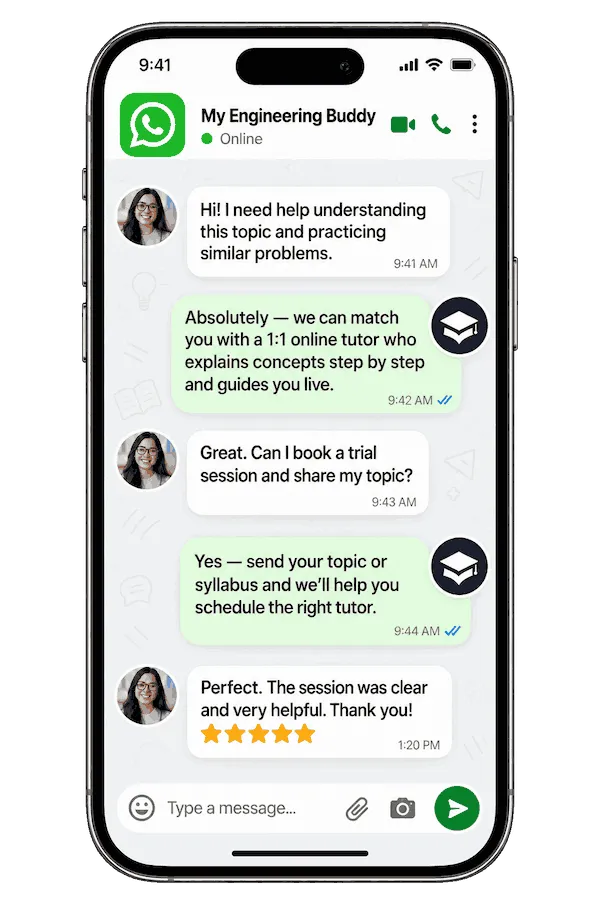
Unlike platforms where you fill out a form and wait, MEB responds in under a minute, 24/7. Tutor match takes under an hour. The $1 trial means you test before you commit. Everything runs over WhatsApp — no logins, no intake forms.
Pricing Guide
Most GCSE Religious Studies sessions run $20–$40/hr. Short-notice bookings or tutors with professional theology or philosophy backgrounds may reach $60/hr. Rate factors include your exam board, how close the exam is, and which components need the most work.
Availability drops sharply in the April–May exam window. If you’re within eight weeks of your papers, book early.
For students targeting top grades at highly selective sixth forms or schools where RS is a prerequisite for A Level Philosophy, tutors with academic backgrounds in theology, ethics, or philosophy of religion are available at higher rates — share your specific goal and MEB will match the tier to your ambition.
Start with the $1 trial — 30 minutes, no registration, no commitment. WhatsApp MEB for a quick quote.
Try your first session for $1 — 30 minutes of live 1:1 tutoring or one homework question explained in full. No registration. No commitment.
WhatsApp MEB now
and get matched within the hour.
FAQ
Is GCSE Religious Studies hard?
RS rewards a specific essay skill — building a balanced, evidence-based argument — more than memorisation alone. Students who struggle have usually never been shown how the 12-mark mark scheme works. Once that structure clicks, grades move quickly.
How many sessions are needed?
Most students see a clear grade improvement within 8–12 sessions. Students close to their exam with one specific weak component — usually the 12-mark evaluation questions — often see measurable change in 4–6 targeted sessions. The tutor sets expectations after the first diagnostic.
Can you help with homework and assignments?
MEB tutoring is guided learning — you understand the work, then submit it yourself. If you have a homework essay on capital punishment or a practice exam answer, the tutor explains the marking criteria and helps you understand where your argument needs strengthening. See our Academic Integrity policy and Why MEB page for full details on what we help with and what we don’t.
Will the tutor match my exact syllabus or exam board?
Yes. AQA, Edexcel, OCR, and WJEC are all covered. When you contact MEB, share your exam board and paper combination. The tutor matched to you will know that specific syllabus — not just the subject in general.
What happens in the first session?
The tutor reviews something you’ve already attempted — a past paper answer or homework question. They identify the gap, work through a model answer with you, and set one concrete task for before the next session. No wasted time settling in.
Is online tutoring as effective as in-person?
For RS, the core skill is written argument construction, which translates well online. Live annotation over Google Meet with a digital pen-pad is often clearer than writing on paper next to a student. The feedback loop is identical — the location isn’t what determines effectiveness.
What’s the difference between AQA, Edexcel, OCR, and WJEC RS papers?
AQA covers two religions in depth plus thematic studies. Edexcel uses Areas of Study with a slightly different evaluation structure. OCR splits into Philosophy of Religion and Applied Ethics papers. WJEC is used primarily in Wales with its own content units. Your tutor is matched to your specific board.
Which religion should I choose for my GCSE RS component?
Most exam boards require one or two religion options alongside thematic studies. AQA students typically study Christianity and one other — Islam is the most commonly chosen second religion in England. Your tutor can discuss which combination suits your existing knowledge and maximises your scoring potential before you finalise anything.
Do I need to be religious to do well in GCSE Religious Studies?
No. The exam assesses your ability to explain and evaluate religious views, not hold them. Tutors work with students from all backgrounds — including those with no personal religious belief — to build the analytical and writing skills the mark scheme requires.
Can I get GCSE Religious Studies help at short notice before my exam?
Yes. MEB tutors are available across time zones, including evenings and weekends. WhatsApp MEB and a tutor can typically be matched within an hour, even in April or early May. Focused pre-exam sessions on your weakest component are one of the most common requests.
How do I find a GCSE Religious Studies tutor if I’m not in the UK?
MEB works with students in the US, Canada, Australia, Gulf, and Europe — many attending British international schools or following UK-based home education curricula. Sessions run online over Google Meet, matched to your time zone. Location is not a barrier.
How do I get started?
WhatsApp MEB, share your exam board and weakest topic, and you’ll be matched with a verified tutor — usually within the hour. The first session is the $1 trial: 30 minutes of live tutoring or one homework question explained in full. Three steps: WhatsApp, match, start.
Trust & Quality at My Engineering Buddy
Every MEB tutor goes through subject-specific screening before taking a session. That includes a live demo evaluation, not just a CV review. Tutors covering GCSE RS are assessed on their knowledge of specific exam boards and their ability to explain mark-scheme logic — not just religious content. Rated 4.8/5 across 40,000+ verified reviews on Google, MEB has been running since 2008 across 2,800+ subjects. Ongoing session feedback is used to flag tutors whose students aren’t progressing and reassign students when a match isn’t working.
MEB tutoring is guided learning — you understand the work, then submit it yourself. For full details on what we help with and what we don’t, read our Academic Integrity policy and Why MEB.
MEB serves students in the US, UK, Canada, Australia, Gulf, and Europe across 2,800+ subjects — including the full range of GCSE Psychology tutoring, GCSE English Literature tutoring, and GCSE Philosophy help alongside Religious Studies. If a student is sitting multiple humanities GCSEs, MEB can coordinate tutors across subjects under one account.
MEB’s tutoring methodology is built on a diagnose-explain-practice-feedback loop — the same structure applied in every GCSE RS session, from beliefs and practices to thematic ethics papers.
Source: My Engineering Buddy, 2008–2025.
Explore Related Subjects
Students studying GCSE Religious Studies often also need support in:
- GCSE Philosophy
- GCSE Citizenship Studies
- GCSE English
- GCSE Media Studies
- GCSE Drama
- GCSE Classical Greek
- GCSE Latin
Next Steps
Before your first session, have ready: your exam board and syllabus (AQA, Edexcel, OCR, or WJEC), a recent past paper attempt or homework question you struggled with, and your exam date or deadline. The tutor handles the rest.
- Share your exam board, hardest component (beliefs, practices, or a specific thematic study), and current timeline
- Share your availability and time zone
- MEB matches you with a verified GCSE RS tutor — usually within 24 hours
The first session starts with a diagnostic so every minute counts from the start.
Visit www.myengineeringbuddy.com for more on how MEB works.
WhatsApp to get started or email [email protected].
Reviewed by Subject Expert
This page has been carefully reviewed and validated by our subject expert to ensure accuracy and relevance.




