




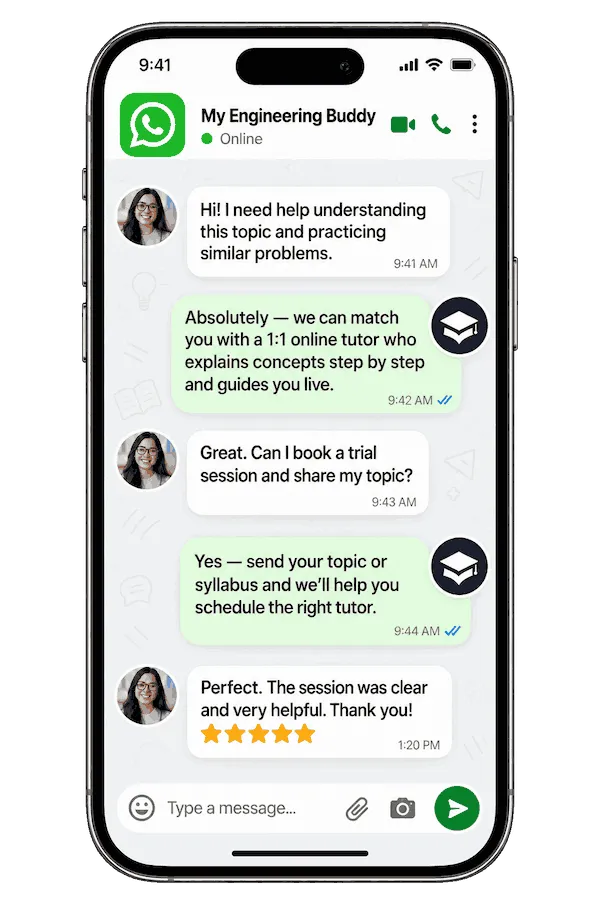
~1 min
Average Reply Time
~1 hour
To Be Matched With A Tutor
30 Min Trial
75% Find Their Tutor On The 1st Trial
$20-35+/hr
Premium Yet Affordable Learning
Stuck on Magics support structures or build orientation? Most students hit the same wall — and a 30-minute session fixes what hours of forum-scrolling can’t.
Materialise Magics Tutor Online
Materialise Magics is a professional data preparation and STL editing software used in additive manufacturing and 3D printing workflows. It equips users to repair mesh files, generate support structures, and optimise build platforms for industrial printing processes.
Finding a qualified Materialise Magics tutor online matters when you’re working through STL repair, support generation, or build platform setup for the first time — or the fifth time with a deadline looming. MEB connects you with expert tutors across the broader Computer-Aided Design field who know Magics inside out. If you’re searching for a Materialise Magics tutor near me, online 1:1 sessions eliminate geography entirely. You get the same tutor, same screen, same pen-pad walkthrough — wherever you are.
- 1:1 online sessions tailored to your specific Magics workflow and project
- Expert-verified tutors with hands-on additive manufacturing experience
- Flexible time zones — US, UK, Canada, Australia, Gulf
- Structured learning plan built after a diagnostic session
- Guided project support — we explain, you build and submit
52,000+ students across the US, UK, Canada, Australia, and the Gulf have used MEB since 2008 — including engineers working in Computer-Aided Design subjects like Materialise Magics, SolidWorks, and CATIA.
Source: My Engineering Buddy, 2008–2025.
How Much Does a Materialise Magics Tutor Cost?
Most Materialise Magics tutoring sessions run $20–$40/hr. Specialist tutors with industrial AM backgrounds may charge up to $100/hr. New students can start with the $1 trial — 30 minutes live or one full project question explained, no registration required.
| Level / Need | Typical Rate | What’s Included |
|---|---|---|
| Standard (most levels) | $20–$35/hr | 1:1 sessions, project guidance |
| Advanced / Industrial Specialist | $35–$100/hr | Expert tutor, niche AM depth |
| $1 Trial | $1 flat | 30 min live session or 1 project Q |
Tutor availability tightens during semester project deadlines and industrial certification windows. Book early if your timeline is fixed.
WhatsApp MEB for a quick quote — average response time under 1 minute.
Who This Materialise Magics Tutoring Is For
Magics draws in a specific type of learner — someone who already has some 3D modelling background but hits a wall when the software pushes back. This tutoring is for people who need more than a YouTube walkthrough.
- Undergraduate and postgraduate students in mechanical, biomedical, or manufacturing engineering using Magics for final-year or research projects
- Students with a university conditional offer or lab requirement depending on demonstrating Magics proficiency
- Design engineers new to additive manufacturing workflows who need to get productive fast
- Students whose confidence has dropped after repeated failed build simulations or mesh repair errors
- Professionals preparing for Materialise certification or internal company sign-off on AM processes
- Anyone working with computer-aided manufacturing pipelines who needs Magics to feed correctly into downstream production
Students at institutions including MIT, Delft, Imperial College London, RMIT, Georgia Tech, the University of Michigan, and ETH Zurich have used MEB to get unstuck on Magics projects. The $1 trial is the lowest-risk way to find out if this works for you.
1:1 Tutoring vs Self-Study vs AI vs YouTube vs Online Courses
Self-study works if you have the time and a complete file set to experiment on — but Magics errors don’t self-explain. AI tools give fast text answers; they can’t open your STL, read your error log, or catch a flipped normal in real time. YouTube covers the basics well and stops there. Online courses step through features in a fixed sequence that rarely matches your actual project problem. 1:1 tutoring with MEB is live, screen-shared, and calibrated to the exact Magics module giving you trouble — support trees, mesh repair, build platform layout, or something more specific.
Outcomes: What You’ll Be Able To Do in Materialise Magics
After working with an MEB tutor, you’ll be able to apply Magics’ mesh repair tools to fix non-manifold geometry, flipped normals, and shell errors without losing model fidelity. You’ll analyse support structure placement for metal and polymer builds, balancing overhang support against material waste. You’ll model build platform layouts that optimise part orientation, nesting density, and print time. You’ll explain your preparation decisions to supervisors or print technicians in the language of the AM workflow. You’ll solve new file types and printer configurations independently — because the tutor shows you the logic, not just the click path.
Based on feedback from 40,000+ sessions collected by MEB from 2022 to 2025, students working 1:1 on Materialise Magics consistently report faster file preparation times, fewer failed builds, and greater confidence presenting AM workflows to supervisors or clients. Progress varies by starting level and project complexity.
Source: MEB session feedback data, 2022–2025.
Try your first session for $1 — 30 minutes of live 1:1 tutoring or one project question explained in full. No registration. No commitment. WhatsApp MEB now and get matched within the hour.
What We Cover in Materialise Magics (Syllabus / Topics)

Track 1: STL File Repair and Mesh Preparation
- Importing and diagnosing STL, OBJ, and AMF file formats
- Identifying and fixing non-manifold edges, open shells, and inverted normals
- Using the Magics Fix Wizard and manual repair tools
- Surface smoothing and noise reduction without geometry distortion
- Boolean operations and part merging for multi-body assemblies
- Exporting repaired files for FDM, SLS, SLA, and metal AM systems
Key references: Materialise Magics Reference Manual (Materialise NV); Gebhardt, Additive Manufacturing: 3D Printing for Prototyping and Manufacturing (Hanser, 2016).
Track 2: Support Structure Generation
- Overhang analysis and automatic support placement
- Manual support editing — adding, removing, and reshaping struts and blocks
- Differentiating support strategies for FDM, SLA, and metal powder bed fusion
- Minimising contact marks and post-processing effort
- Tree supports vs lattice supports: when each is appropriate
- Validating support structures against printer-specific build rules
Key references: Gibson, Rosen & Stucker, Additive Manufacturing Technologies (Springer, 2021); Magics Support Generation Guide (Materialise NV).
Track 3: Build Platform Setup and Job Preparation
- Part orientation strategies to minimise staircase effect and support volume
- Nesting and packing multiple parts on a single build platform
- Slicing parameters and layer thickness settings by material class
- Machine profile configuration for EOS, Stratasys, and 3D Systems printers
- Generating build reports and machine-ready output files
- Cost and time estimation using Magics’ built-in analysis tools
Key references: Hopkinson, Hague & Dickens, Rapid Manufacturing (Wiley, 2006); Thompson et al., Design for Additive Manufacturing (CIRP Annals, 2016).
Platforms, Tools & Textbooks We Support
Materialise Magics is the primary platform. Tutors also support connected workflows including computer-aided engineering tools that feed geometry into Magics, such as Siemens NX, CATIA, and SolidWorks for pre-export geometry cleanup. Session tools: Google Meet with screen share, digital pen-pad or iPad + Apple Pencil for annotation directly on your Magics workspace.
- Materialise Magics (all current versions)
- Materialise e-Stage (automated support generation module)
- Materialise Build Processor
- SolidWorks / CATIA / Siemens NX (for upstream geometry prep)
- GrabCAD, Thingiverse, and internal CAD repositories (file sourcing)
- EOS, Stratasys, and 3D Systems printer interfaces (output validation)
What a Typical Materialise Magics Session Looks Like
The tutor opens by checking where the previous session left off — typically the mesh repair stage or a support structure the student flagged as problematic. You share your screen in Google Meet and open the file together. The tutor walks through the specific issue live: for mesh repair, that means running the diagnostics panel, reading the error list, and fixing each class of error in order. For support generation, the tutor adjusts overhang thresholds and walks through the logic of each placement decision while you replicate the steps. The digital pen-pad goes onto your screen to annotate directly. Session ends with a clear task: repair this shell, re-orient this part, or generate supports for a defined overhang angle — ready to review next time.
How MEB Tutors Help You with Materialise Magics (The Learning Loop)
Diagnose: In the first session, the tutor opens your file or a comparable sample and identifies exactly where the workflow is breaking down — whether that’s import errors, mesh quality, support logic, or build platform strategy. No guessing. The problem is on screen.
Explain: The tutor works through the fix live using Magics’ own tools, narrating every decision. Why this repair sequence. Why this support density. Why this orientation over the alternative. The pen-pad annotates your actual file.
Practice: You replicate the same steps on a second file or a modified version of the same one. The tutor watches and corrects in real time — before a bad habit becomes a workflow assumption.
Feedback: Errors get traced to their root cause. A failed mesh repair is rarely random — the tutor identifies whether it’s a CAD export setting, a Boolean operation residue, or a surface continuity issue upstream, and explains what to do differently.
Plan: Each session ends with a clear topic for next time. Whether you’re working toward a university project submission, a Materialise certification, or an industrial print deadline, the tutor maps the sequence so you’re not just fixing today’s file — you’re building the skill to handle the next one.
Sessions run on Google Meet with screen sharing and a digital pen-pad. Before your first session, have your STL or CAD file ready, along with any error messages Magics has thrown and your project brief or build specification. The first session doubles as your diagnostic. Start with the $1 trial — 30 minutes of live tutoring that also serves as your first diagnostic.
At MEB, we’ve found that most Magics problems students bring to a first session share one root cause: the file was exported from the CAD tool with settings that don’t suit additive manufacturing. Fixing that early changes everything downstream.
Tutor Match Criteria (How We Pick Your Tutor)
Not every CAD tutor knows Magics. MEB matches specifically on:
Subject depth: The tutor must have hands-on Materialise Magics experience — ideally in the same material class (polymer FDM, SLS, or metal PBF) as your project.
Tools: Every tutor runs sessions on Google Meet with a digital pen-pad or iPad + Apple Pencil for direct annotation on your files.
Time zone: Matched to your region — US, UK, Gulf, Canada, or Australia. No scheduling friction.
Goals: The tutor is briefed on whether you’re closing a gap for a university deadline, building toward Materialise certification, or integrating Magics into a wider Siemens NX or Creo workflow.
Unlike platforms where you fill out a form and wait, MEB responds in under a minute, 24/7. Tutor match takes under an hour. The $1 trial means you test before you commit. Everything runs over WhatsApp — no logins, no intake forms.
Students who struggle with Magics aren’t struggling with 3D printing. They’re struggling with mesh topology — a concept no software tutorial explains clearly. That’s where a 1:1 Materialise Magics tutor makes the real difference.
Source: MEB tutor feedback aggregate, 2022–2025.
Pricing Guide
Materialise Magics tutoring starts at $20/hr for standard undergraduate-level project support. Graduate-level or industrial AM specialist sessions run $35–$100/hr depending on the complexity of the print process and tutor background.
Rate factors: your level, the specific Magics module, whether you need support with upstream CAD conversion alongside Magics prep, and tutor availability. Availability shrinks fast around semester project deadlines.
For students targeting top engineering programmes or industrial AM roles at companies with rigorous certification requirements, MEB can match tutors with professional production background at higher rates — share your goal and MEB will match the tier.
Start with the $1 trial — 30 minutes, no registration, no commitment. WhatsApp MEB for a quick quote.
Students consistently tell us that the $1 trial session resolves more than they expected — because the tutor arrives knowing what Magics problems look like, not just what the software manual says. That first 30 minutes is doing real work.
FAQ
Is Materialise Magics hard to learn?
The interface is manageable. The hard part is understanding why mesh errors occur and how to fix them without breaking geometry elsewhere. Students typically hit that wall within the first two or three files. A tutor gets you past it in one session.
How many sessions do most students need?
For a single project — fixing a file, setting up supports, and preparing a build platform — two to four sessions covers it. For broader Magics proficiency across multiple workflows or material types, six to ten sessions builds solid independent capability.
Can you help with projects and portfolio work?
Yes. MEB provides guided project support — the tutor explains the method and logic, and you apply it to your own files and submit your own work. MEB tutoring is guided learning; you understand the work, then submit it yourself. See our Academic Integrity policy and Why MEB page for full details on what we help with and what we don’t.
Will the tutor match my exact software version and printer setup?
Yes. When you WhatsApp MEB, share your Magics version, the printer system you’re preparing files for (FDM, SLS, metal PBF), and your project brief. MEB matches a tutor with directly relevant experience — not a generic CAD tutor.
What happens in the first session?
The tutor opens your file or a comparable sample, runs a diagnostic through Magics’ analysis tools, and identifies the exact issues. You leave with a repaired or progressed file and a clear plan for the next session. No introductory filler.
Are online Materialise Magics sessions as effective as in-person?
Yes — screen sharing in Google Meet with pen-pad annotation gives the tutor direct access to your actual file. In-person tutoring rarely offers that. Every error is visible on screen in real time, which is more useful than sitting beside someone at a shared desk.
Can I get Materialise Magics help at midnight or on weekends?
MEB operates 24/7. WhatsApp response time averages under a minute regardless of time zone. Tutors are available across US, UK, Gulf, and Australia time zones — deadline panic included.
What’s the difference between Magics and e-Stage, and can you help with both?
Magics handles mesh repair, manual support generation, and build preparation. e-Stage is Materialise’s automated support module for resin-based systems, generating tree supports without manual placement. MEB tutors cover both — and explain when each is the right tool for your print process.
Do MEB tutors cover Materialise Magics used in biomedical applications?
Yes. Magics is widely used for patient-specific implants, anatomical models, and surgical guides. MEB has tutors with biomedical AM backgrounds who understand both the software workflow and the accuracy tolerances specific to medical-grade printing.
What if I don’t connect with my assigned tutor?
WhatsApp MEB and request a different match. It happens. No friction, no forms, no waiting — usually resolved within the same day. The priority is that the tutoring works, not that the first match sticks.
How do I get started?
Start with the $1 trial: 30 minutes of live Magics tutoring or one full project question explained. Three steps: WhatsApp MEB with your file type and goal, get matched within an hour, start the trial session. That’s it.
Trust & Quality at My Engineering Buddy
Every MEB tutor goes through subject-specific vetting — not a general skills test. For Materialise Magics, that means demonstrated experience with STL repair, support generation, and build preparation in at least one industrial AM process. Tutors complete a live demo session before being approved and are reviewed on an ongoing basis through student feedback. Rated 4.8/5 across 40,000+ verified reviews on Google.
MEB provides guided learning support. All project work is produced and submitted by the student. For full details on what we help with and what we don’t, read our Academic Integrity policy and Why MEB.
MEB has served 52,000+ students across 2,800+ subjects since 2008, across the US, UK, Canada, Australia, the Gulf, and Europe. In the Computer-Aided Design field, that includes students working on Fusion 360 tutoring, HyperMesh help, and Materialise Magics — all supported by tutors with direct software experience. Learn more about our approach at MEB’s tutoring methodology.
Explore Related Subjects
Students studying Materialise Magics often also need support in:
Next Steps
When you contact MEB, have these ready:
- Your Magics version, the file type you’re working with, and the printer or AM process it’s going to
- Your availability and time zone
- Your project brief, deadline, or certification goal
Before your first session, have ready: your STL or CAD source file, any error messages Magics has thrown, and your exam or project deadline date. The tutor handles the rest.
MEB matches you with a verified Materialise Magics tutor — usually within 24 hours. The first session starts with a diagnostic so every minute counts.
Visit www.myengineeringbuddy.com for more on how MEB works.
WhatsApp to get started or email [email protected].
Reviewed by Subject Expert
This page has been carefully reviewed and validated by our subject expert to ensure accuracy and relevance.




