




~1 min
Average Reply Time
~1 hour
To Be Matched With A Tutor
30 Min Trial
75% Find Their Tutor On The 1st Trial
$20-35+/hr
Premium Yet Affordable Learning
Hire The Best OpenCV Tutor


Stuck on contour detection at 11pm with a submission due tomorrow? That’s exactly when MEB’s OpenCV tutors pick up.
OpenCV Tutor Online
OpenCV (Open Source Computer Vision Library) is an open-source programming library used to build real-time image processing, computer vision, and machine learning applications in Python and C++, equipping developers to detect, track, and analyse visual data programmatically.
MEB connects you with a verified OpenCV tutor online who knows the library inside out — from basic pixel manipulation to deep learning integration with TensorFlow and PyTorch. Whether you’re wrestling with a university computer vision assignment or building a real-world pipeline for your capstone project, searching for an OpenCV tutor near me ends here. Our tutors work within your exact course structure, whether that’s a graduate computer vision module, an undergraduate image processing course, or a self-directed project. One session can close the gap between a broken pipeline and a working result. As part of our broader computer science tutoring offer, OpenCV sits inside a connected ecosystem of support.
- 1:1 online sessions tailored to your specific course, dataset, and codebase
- Expert-verified tutors with hands-on OpenCV and Python/C++ experience
- Flexible scheduling across US, UK, Canada, Australia, and Gulf time zones
- Structured learning plan built after a diagnostic session with your tutor
- Guided project support — we explain the logic, you write and submit the code
52,000+ students across the US, UK, Canada, Australia, and the Gulf have used MEB since 2008 — including students in Computer Science subjects like OpenCV, TensorFlow, and object-oriented programming.
Source: My Engineering Buddy, 2008–2025.
How Much Does an OpenCV Tutor Cost?
Most OpenCV tutoring sessions run at $20–$40/hr. Advanced topics — GPU-accelerated pipelines, custom neural network integration, or CUDA-based processing — can reach up to $100/hr depending on tutor expertise. The $1 trial gets you 30 minutes of live 1:1 tutoring or a full explanation of one homework question, so you test the fit before spending more.
| Level / Need | Typical Rate | What’s Included |
|---|---|---|
| Standard (undergrad / project work) | $20–$35/hr | 1:1 sessions, project guidance |
| Advanced / Specialist (grad, research) | $35–$100/hr | Expert tutor, deep technical depth |
| $1 Trial | $1 flat | 30 min live session or 1 project question |
Tutor availability tightens fast around semester submission deadlines. Book early if your project is due within two weeks.
WhatsApp MEB for a quick quote — average response time under 1 minute.
Who This OpenCV Tutoring Is For
OpenCV trips up students at every level — from undergraduates hitting their first cv2.findContours() error to PhD students debugging a real-time object tracking pipeline. MEB works with all of them.
- Undergraduate students in computer vision, image processing, or robotics modules
- Graduate and Masters students building OpenCV-based capstone or thesis projects
- Students whose project pipeline is broken and the submission deadline is days away
- Students retaking a failed first attempt at a computer vision course and needing to rebuild fundamentals properly
- Researchers integrating OpenCV with deep learning frameworks for published work
- Professionals applying OpenCV in industrial inspection, medical imaging, or autonomous systems
Students at universities including MIT, Stanford, Carnegie Mellon, Georgia Tech, the University of Toronto, Imperial College London, ETH Zurich, and UNSW have come to MEB when their computer vision coursework stalled. If your course uses OpenCV, MEB has a tutor who knows it. The $1 trial means there’s no reason to keep staring at a broken script alone.
At MEB, we’ve found that the students who fall behind in OpenCV almost never misunderstand the maths — they misunderstand what the library is actually doing to the image array at each step. Once a tutor walks through that once, live, the rest starts clicking.
1:1 Tutoring vs Self-Study vs AI vs YouTube vs Online Courses
Self-study works if you can debug your own errors — most beginners can’t. AI tools like ChatGPT explain code fast but can’t watch you misinterpret a colour space conversion in real time. YouTube covers the basics well and stops there. Online courses give you structure but not a tutor who looks at your actual dataset. DSA and image processing both reward the same thing: live correction the moment reasoning goes wrong. That’s what 1:1 OpenCV tutoring with MEB delivers — calibrated to your codebase, your error, your deadline.
Outcomes: What You’ll Be Able To Do in OpenCV
After working with an MEB OpenCV tutor, you’ll be able to apply image preprocessing pipelines — resizing, filtering, thresholding — confidently and without copy-pasting code you don’t understand. You’ll solve feature detection problems using SIFT, ORB, or Harris corner detection and explain why you chose one over another. You’ll analyse and debug real-time video streams using VideoCapture, frame-by-frame. You’ll model object detection workflows that connect OpenCV with deep learning back-ends. You’ll present your project pipeline to a panel or submit it to a marker knowing every line does what you say it does.
Based on feedback from 40,000+ sessions collected by MEB from 2022 to 2025, 58% of students improved by one full grade after approximately 20 hours of 1:1 tutoring in subjects like OpenCV. A further 23% achieved at least a half-grade improvement.
Source: MEB session feedback data, 2022–2025.

What We Cover in OpenCV (Topics)
Core Image Processing
- Reading, writing, and displaying images with
imread,imwrite,imshow - Colour space conversions: BGR to RGB, HSV, grayscale, LAB
- Geometric transformations: rotation, scaling, affine and perspective warps
- Filtering: Gaussian blur, median filter, bilateral filter, Sobel and Laplacian edges
- Morphological operations: erosion, dilation, opening, closing
- Thresholding: global, adaptive, Otsu’s method
- Histogram equalisation and CLAHE for contrast enhancement
Key references: Learning OpenCV 4 by Kaehler & Bradski; Programming Computer Vision with Python by Jan Erik Solem; official OpenCV Python documentation.
Feature Detection and Object Tracking
- Corner detection: Harris, Shi-Tomasi
- Keypoint descriptors: SIFT, SURF, ORB, BRIEF
- Feature matching: BFMatcher, FLANN-based matching, homography estimation
- Contour detection and shape analysis:
findContours,drawContours, bounding boxes - Object tracking algorithms: MeanShift, CamShift, KCF, CSRT trackers
- Optical flow: Lucas-Kanade, Farneback dense optical flow
- Background subtraction: MOG2, KNN subtractors for moving object detection
Key references: Computer Vision: Algorithms and Applications by Szeliski (2nd ed.); Multiple View Geometry in Computer Vision by Hartley & Zisserman; OpenCV contrib modules documentation.
Deep Learning Integration and Applied Pipelines
- Loading pre-trained models with
cv2.dnn: YOLO, SSD, ResNet, MobileNet - Running inference on images and video with
dnn.readNetandblobFromImage - Connecting OpenCV pipelines with TensorFlow and PyTorch models
- Face detection and recognition: Haar cascades, DNN face detector, facial landmark detection
- Pose estimation and skeleton detection using MediaPipe with OpenCV
- Camera calibration, stereo vision, and 3D reconstruction
- Deploying OpenCV applications on Raspberry Pi, Jetson Nano, and cloud endpoints
Key references: Deep Learning for Computer Vision with Python by Adrian Rosebrock; Mastering OpenCV 4 by Nalpantidis et al.; Bureau of Labor Statistics data on computer vision roles in engineering occupations at the Bureau of Labor Statistics.
Platforms, Tools & Textbooks We Support
OpenCV sessions at MEB are built around your actual environment. Tutors work across Python 3.x with OpenCV 4.x, C++ OpenCV projects, Jupyter Notebooks, Google Colab, VS Code, and PyCharm. GPU-accelerated setups using CUDA-enabled OpenCV builds are covered at advanced rates. Tutors are also comfortable with OpenCV contrib modules, Raspberry Pi camera modules, and integration with ROS (Robot Operating System) for robotics applications.
- Python 3.x + OpenCV 4.x (pip and conda environments)
- C++ OpenCV (CMake builds, linking, debugging)
- Google Colab and Jupyter Notebooks
- VS Code, PyCharm, CLion
- CUDA-enabled OpenCV builds
- OpenCV contrib (extra modules)
- ROS + OpenCV integration
- Raspberry Pi and Jetson Nano deployment
What a Typical OpenCV Session Looks Like
The tutor opens by checking where the previous topic — say, contour detection or homography — landed. They ask you to run your current script and share your screen. If it throws an error, you work through it together: not the tutor fixing it, but the tutor asking you what each line is supposed to do. From there you move into the session’s core — maybe feature matching with ORB, or connecting a YOLO inference pipeline to a live webcam feed. The tutor uses a digital pen-pad to annotate image arrays, draw transformation diagrams, or trace through pixel coordinate logic in real time. You replicate the logic yourself, in your environment, before the session ends. The tutor sets a concrete task — run the same pipeline on a different image class, or add a confidence threshold filter — and flags the next topic for next time.
How MEB Tutors Help You with OpenCV (The Learning Loop)
Diagnose: In the first session, the tutor reviews your current code, identifies where conceptual gaps are driving errors — whether that’s misunderstanding NumPy array shapes, colour channel ordering, or incorrect use of coordinate systems — and maps a session sequence from there.
Explain: The tutor works through live examples on a digital pen-pad, drawing image transformation diagrams and annotating code line by line. No lecture. The explanation is built around your actual problem, not a generic tutorial.
Practice: You write or modify code with the tutor present. When you get stuck, the tutor asks a question rather than giving the answer. That’s what builds retention.
Feedback: Every error gets a root cause, not just a fix. If you misread the contour hierarchy or pass the wrong dtype into a filter, the tutor explains why it failed, what the function expected, and how to catch that class of error yourself next time.
Plan: Each session closes with a named next topic, a practice task, and a check on your deadline. The tutor tracks what’s been covered and adjusts if your exam or submission date shifts.
Sessions run over Google Meet. The tutor uses a digital pen-pad or iPad with Apple Pencil for visual annotation. Before your first session, share your course outline or project brief, a recent script or error log, and your submission or exam date. The first session is diagnostic — by the end of it, you’ll have a working session plan and at least one concrete thing fixed. Start with the $1 trial — 30 minutes of live tutoring that also serves as your first diagnostic.
Try your first session for $1 — 30 minutes of live 1:1 tutoring or one homework question explained in full. No registration. No commitment. WhatsApp MEB now and get matched within the hour.
Tutor Match Criteria (How We Pick Your Tutor)
Not every strong programmer is a strong OpenCV tutor. MEB matches on specifics.
Subject depth: Tutors are matched to your level — undergraduate image processing, graduate computer vision research, or applied deployment — and to your specific library version and language (Python vs C++).
Tools: Every tutor uses Google Meet with screen sharing and a digital pen-pad or iPad with Apple Pencil. No generic video calls without visual annotation capability.
Time zone: Matched to your region — US, UK, Gulf, Canada, or Australia. Late-night sessions are available.
Goals: Whether you need to pass a graded assignment, complete a capstone, or prepare for a technical interview involving computer vision, the tutor is matched to that specific goal.
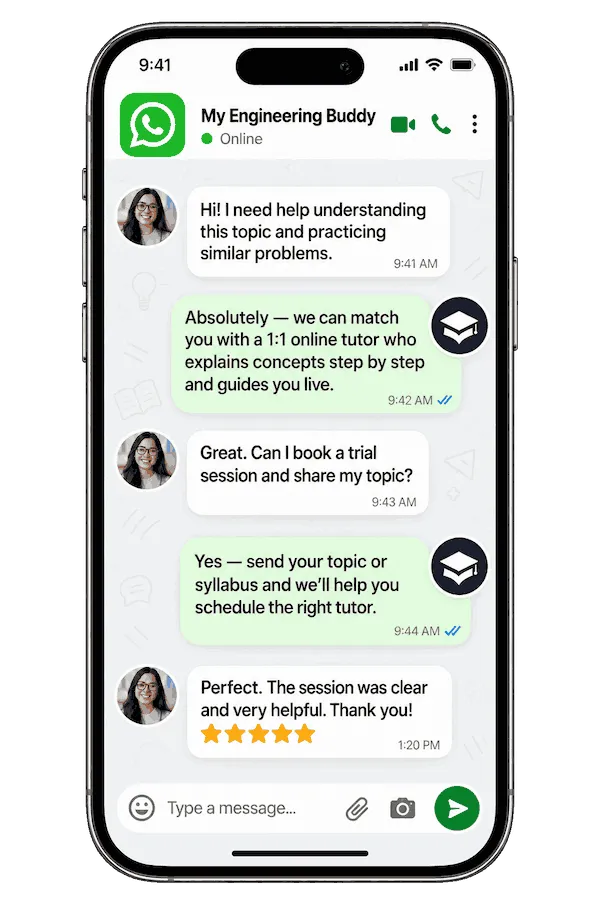
Unlike platforms where you fill out a form and wait, MEB responds in under a minute, 24/7. Tutor match takes under an hour. The $1 trial means you test before you commit. Everything runs over WhatsApp — no logins, no intake forms.
MEB has matched students with computer networking tutors, operating systems tutors, and OpenCV specialists — often within the same day the student first makes contact.
Source: My Engineering Buddy, 2008–2025.
Pricing Guide
OpenCV tutoring starts at $20/hr for standard undergraduate-level sessions. Graduate-level work, real-time systems, GPU pipeline debugging, and research-level computer vision run $40–$100/hr depending on tutor background and topic complexity. Rate also varies by your timeline — urgent sessions booked within 24 hours may carry a short-notice premium.
Availability narrows around semester-end submission windows. If your deadline is in the next two weeks, reach out now rather than later.
For students targeting roles at companies like Google DeepMind, NVIDIA, or Apple’s Vision Pro team — or publishing computer vision research — tutors with professional industry or research backgrounds are available at higher rates. Share your specific goal and MEB will match the tier to your ambition.
Start with the $1 trial — 30 minutes, no registration, no commitment. WhatsApp MEB for a quick quote.
Students consistently tell us that the biggest surprise about MEB is that the tutor already understood their specific OpenCV error before the session started — because they’d described it over WhatsApp on the way to the session. That kind of pre-session prep is standard here, not exceptional.
FAQ
Is OpenCV hard to learn?
OpenCV is hard when you don’t understand what it’s doing to the underlying image array. The library is large, the documentation is dense, and small mistakes — wrong colour channels, incorrect dtype — produce silent failures. With a tutor, those sticking points get cleared fast.
How many sessions will I need?
Most students see meaningful project progress in 3–5 sessions. Students rebuilding fundamentals or completing a full computer vision module typically work over 10–20 hours. The first session diagnostic gives you an honest estimate specific to your starting point and deadline.
Can you help with OpenCV practice exercises?
MEB tutoring is guided learning — you understand the work, then submit it yourself. The tutor explains what a function does, why your code is failing, and how to fix it. You write and submit the final code. See our Academic Integrity policy and Why MEB page for full details on what we help with and what we don’t.
Will the tutor match my exact syllabus or exam board?
Yes. Before the first session, share your course outline, assignment brief, or project spec. The tutor works within that structure — not a generic OpenCV curriculum. If your course uses a specific OpenCV version or requires C++ rather than Python, that’s matched too.
What happens in the first session?
The tutor reviews your current code or course position, identifies the root gaps, and builds a session plan. You’ll leave the first session with at least one concrete problem solved and a clear sequence for what comes next. The $1 trial session is this diagnostic.
Is online OpenCV tutoring as effective as in-person?
For code-based subjects, yes — often more so. Screen sharing means the tutor sees your exact environment, your exact error, your exact output. The digital pen-pad adds annotation that a whiteboard can’t match remotely. Students at MIT, Imperial, and ETH regularly work with MEB tutors online with strong results.
Can I get OpenCV help at midnight or on weekends?
Yes. MEB operates 24/7. WhatsApp MEB any time — tutors are available across time zones, including late-night slots for US West Coast, Gulf, and Australian students. Response time under a minute is standard, not a guarantee, but it holds most of the time.
What if Python isn’t my language — do you support C++ OpenCV?
Yes. MEB has tutors for both Python and C++ OpenCV. If your course requires C++ with CMake builds, linking against OpenCV shared libraries, or debugging segmentation faults in C++ image pipelines, that’s covered. Specify your language when you message.
Do you help with OpenCV projects that use deep learning — YOLO, SSD, or custom models?
Yes. Integrating pre-trained models via cv2.dnn, connecting OpenCV capture pipelines to TensorFlow or PyTorch inference, and running YOLO on live video streams are all covered. Tutors with deep learning backgrounds are available at the higher rate tier — share your project spec and MEB will match accordingly.
How do I know if my OpenCV problem is too niche for MEB?
Describe it over WhatsApp. MEB covers stereo vision, camera calibration, 3D reconstruction, optical flow on embedded hardware, medical image segmentation, and OpenCV-ROS integration. If it’s within the OpenCV ecosystem, there’s almost certainly a tutor for it. You’ll know within minutes of messaging.
How do I get started?
Start with the $1 trial — 30 minutes of live tutoring or one project question explained in full. Three steps: WhatsApp MEB, get matched with an OpenCV tutor (usually within the hour), start your trial session. No registration required, no commitment beyond the dollar.
Trust & Quality at My Engineering Buddy
Every MEB tutor goes through subject-specific vetting — not just a CV check. OpenCV tutors are assessed on live problem-solving: they demonstrate they can debug a broken pipeline, explain image transformation logic clearly, and adapt to different course levels. MEB has collected feedback on over 40,000 sessions. Tutors who don’t perform to standard don’t stay on the platform. Rated 4.8/5 across 40,000+ verified reviews on Google. The platform has been running since 2008 — 18 years of subject-specific tutor matching, not a directory of freelancers.
MEB tutoring is guided learning — you understand the work, then submit it yourself. For full details on what we help with and what we don’t, read our Academic Integrity policy and Why MEB.
MEB serves students across the US, UK, Canada, Australia, the Gulf, and Europe in 2,800+ subjects. Within Computer Science, that includes algorithms tutoring, cybersecurity help, and parallel computing support — alongside OpenCV and the full computer vision stack. See our tutoring methodology for how session structure and tutor matching work in practice.
Explore Related Subjects
Students studying OpenCV often also need support in:
- Digital Logic Design
- High Performance Computing
- Design Patterns
- Distributed Systems
- Memory Management & Allocation
- Graph Algorithms
- Cloud Computing
Next Steps
Getting started takes under two minutes.
- Share your course outline or project brief, your hardest current blocker, and your deadline
- Share your time zone and preferred session windows
- MEB matches you with a verified OpenCV tutor — usually within the hour
- First session starts with a diagnostic so every minute is used well
Before your first session, have ready: your course outline or assignment brief, a recent script or error log you’ve been stuck on, and your submission or exam date. The tutor handles the rest.
Visit www.myengineeringbuddy.com for more on how MEB works.
WhatsApp to get started or email [email protected].
Reviewed by Subject Expert
This page has been carefully reviewed and validated by our subject expert to ensure accuracy and relevance.




