




~1 min
Average Reply Time
~1 hour
To Be Matched With A Tutor
30 Min Trial
75% Find Their Tutor On The 1st Trial
$20-35+/hr
Premium Yet Affordable Learning
Most sculpture students hit the same wall: they can visualize the form, but can’t yet make the material do what their mind is telling it to. A good tutor fixes that gap fast.
Sculpture Tutor Online
Sculpture is the three-dimensional art of shaping materials — stone, clay, metal, wood, or mixed media — through additive, subtractive, or assemblage methods, developing spatial reasoning, technical craft, and formal visual language.
MEB offers 1:1 online tutoring and homework help in 2,800+ advanced subjects, including Sculpture at undergraduate, A Level, IB, and art foundation level. Whether you’re working on a portfolio critique, a formal critique essay, or a studio project brief, a sculpture tutor near me — available online, matched to your time zone — can help you build faster than studio time alone. Our fine arts tutoring covers the full creative disciplines, and Sculpture sits at the centre of that offer.
- 1:1 online sessions tailored to your course syllabus and studio brief
- Expert-verified tutors with subject-specific knowledge in 3D form and materials
- Flexible time zones — US, UK, Canada, Australia, Gulf
- Structured learning plan built after a diagnostic session
- Ethical homework and assignment guidance — you understand the work, then submit it yourself
52,000+ students across the US, UK, Canada, Australia, and the Gulf have used MEB since 2008 — including students in Fine Arts subjects like Sculpture, painting, and drawing.
Source: My Engineering Buddy, 2008–2025.
How Much Does a Sculpture Tutor Cost?
Most sculpture tutoring sessions run $20–$40/hr depending on level and topic complexity. If you’re not sure whether MEB is the right fit, the $1 trial gives you 30 minutes of live 1:1 tutoring — or a full explanation of one homework question — before you commit to anything.
| Level / Need | Typical Rate | What’s Included |
|---|---|---|
| Standard (most levels) | $20–$35/hr | 1:1 sessions, assignment guidance |
| Advanced / Specialist | $35–$70/hr | Expert tutor, portfolio and critique depth |
| $1 Trial | $1 flat | 30 min live session or 1 homework question |
Tutor availability tightens around portfolio submission deadlines and end-of-term critique periods. Book early if your deadline is within four weeks.
WhatsApp MEB for a quick quote — average response time under 1 minute.
Who This Sculpture Tutoring Is For
Sculpture tutoring at MEB covers a wide range of students — from art foundation applicants building their first portfolio to undergraduates at institutions like the Rhode Island School of Design, Central Saint Martins, OCAD University, Sydney College of the Arts, and Parsons School of Design. If you’re working toward a formal critique, a written contextual essay, or a 3D studio project, this is built for you.
- Foundation and A Level students preparing a portfolio submission for art school applications
- IB Visual Arts students developing a comparative study or process portfolio
- Undergraduate sculpture majors working through materials, form, and conceptual development briefs
- Students retaking after a failed first attempt at a studio or written critique module
- Students with a university conditional offer depending on their portfolio grade
- Parents watching a child’s confidence drop alongside their studio output
If you need a 1:1 art tutor who can work through both the physical making process and the written critical analysis that accompanies it, MEB has that covered. The $1 trial is the lowest-risk way to test the match.
1:1 Tutoring vs Self-Study vs AI vs YouTube vs Online Courses
Self-study works if you’re disciplined, but sculpture has no feedback loop — you can spend three weeks on a piece heading in the wrong direction. AI tools explain concepts quickly but can’t look at your maquette and tell you why the proportions feel wrong. YouTube is useful for technique overviews; it stops when your specific brief throws a curveball. Online courses move at a fixed pace with no room to dwell on the bit that’s actually blocking you. 1:1 tutoring with MEB is live, calibrated to your exact syllabus and studio brief, and corrects errors — in form, in critical writing, in conceptual framing — in the session itself. For sculpture specifically, having someone who can engage with your work and your written statement together makes the difference between a passable submission and a strong one.
Outcomes: What You’ll Be Able To Do in Sculpture
After working with an MEB sculpture tutor, students can analyze a three-dimensional form using the language of mass, void, surface, and spatial relationship — not just describe what something looks like. They can apply additive and subtractive methods with intention, rather than working by instinct and hoping the result holds up in a critique. Students learn to write a coherent contextual analysis that connects their own practice to an art-historical lineage — the kind of written statement that selectors at competitive art schools read carefully. They present finished work in a critique with structured reasoning behind each decision, not just aesthetic preference. They also develop the ability to solve material and structural problems before they become costly studio mistakes.
Supporting a student through Sculpture? MEB works directly with parents to set up sessions, track progress, and keep coursework on schedule. WhatsApp MEB — average response time is under a minute, 24/7.
Based on feedback from 40,000+ sessions collected by MEB from 2022 to 2025, 58% of students improved by one full grade after approximately 20 hours of 1:1 tutoring in subjects like Sculpture. A further 23% achieved at least a half-grade improvement.
Source: MEB session feedback data, 2022–2025.
What We Cover in Sculpture (Syllabus / Topics)

Track 1: Materials, Methods, and Making
- Additive techniques: modelling in clay, wax, and plaster; armature construction
- Subtractive techniques: stone and wood carving, relief cutting, reduction in foam and plaster
- Assemblage and mixed media: welding basics, found object construction, casting and mould-making
- Surface treatment: patination, finishing, painting on three-dimensional forms
- Structural problem-solving: balance, load-bearing, scale considerations
- Material testing and maquette development before full-scale execution
Core references include The Sculpture Reference by Arthur Williams and Lanteri’s Modelling and Sculpting the Human Figure.
Track 2: Critical Context and Art History for Sculptors
- Key movements: Modernism, Minimalism, Process Art, Land Art, Post-Minimalism
- Seminal figures: Rodin, Brancusi, Giacometti, Hepworth, Serra, Bourgeois, Koons
- Reading and writing formal analysis of three-dimensional work
- Connecting your own practice to a broader critical and historical framework
- Contextual essays and artist statements: structure, argument, and citation
- Comparative study skills for IB Visual Arts and A Level Art written components
Useful texts include Sculpture Today by Judith Collins and Theories of Modern Art by Chipp. Get further context from the Oxford University Press Very Short Introductions series, which covers art movements relevant to sculpture study.
Track 3: Portfolio Development and Critique Preparation
- Developing a sustained body of work around a theme or material investigation
- Documenting process: photography of work in progress, annotated sketchbooks
- Presenting work in a formal critique: verbal articulation of intent and method
- Self-evaluation and peer critique frameworks used at foundation and degree level
- Art school application portfolio strategy: selection, sequencing, and presentation
- Written personal statement support aligned to portfolio content
Reference: Art School Confidential by Daniel Clowes (for culture) and institutional portfolio guides from Central Saint Martins and RISD.
What a Typical Sculpture Session Looks Like
The tutor opens by checking what you worked on since the last session — usually a specific material experiment, a maquette development task, or a section of your critical essay. From there, the session moves into the main problem. If you’re stuck on how your form reads in space, the tutor will ask you to describe it verbally and then share images of the work on screen; they’ll use a digital pen-pad to annotate directly over your photographs, marking where the mass-void relationship breaks down or where the surface treatment is working against the form. If the issue is your written contextual statement, the tutor reads it with you and works through the argument line by line — not correcting it for you, but identifying where your reasoning drops out. The session ends with a concrete task: one material test, one paragraph revised to a specified brief, or one reference artist to research before the next meeting. Nothing vague. You leave knowing exactly what to do next.
At MEB, we’ve found that sculpture students make the fastest progress when sessions alternate between making problems and writing problems — not because they’re separate, but because fluency in one feeds directly into the other. Students who can articulate what a form is doing are better at controlling what the form does.
How MEB Tutors Help You with Sculpture (The Learning Loop)
Diagnose: In the first session, the tutor identifies where you actually are — not where your syllabus says you should be. For sculpture, that means looking at existing work, reading your process documentation, and asking direct questions about what’s confusing you: is it the making, the conceptual framing, or the written analysis?
Explain: The tutor works through the problem live. If it’s a formal analysis question, they annotate an image of a sculpture on screen and walk through mass, plane, contour, and surface treatment in sequence — not as definitions, but as things your eye can actually track.
Practice: You attempt the task with the tutor present. For making decisions, that might mean describing how you’d approach a material problem. For written work, it means drafting a sentence or paragraph live and getting a response before you move on.
Feedback: Step-by-step. The tutor tells you what’s working, what isn’t, and why a critique panel would respond the way they would. No vague positivity. Specific, targeted correction.
Plan: Every session ends with a clear next step and a topic for the following session. Progress is tracked across sessions so no gap gets revisited unnecessarily.
Sessions run on Google Meet. The tutor uses a digital pen-pad or iPad with Apple Pencil to annotate your work directly. Before your first session, share your brief or assignment description, a few images of recent work, and your submission deadline. Start with the $1 trial — 30 minutes of live tutoring that also serves as your first diagnostic.
Students consistently tell us that the hardest part of sculpture isn’t the making — it’s knowing whether what you’ve made is communicating what you intended. That’s a gap a tutor can close in one session. Not by telling you the answer, but by asking the right question about the work in front of you.
Tutor Match Criteria (How We Pick Your Tutor)
MEB doesn’t assign tutors randomly. Every match is built around four criteria.
Subject depth: The tutor must have formal training or professional practice in sculpture specifically — not just a general fine arts background. Level matters: an IB Visual Arts tutor is matched differently from one working with a BA Honours student.
Tools: All tutors work on Google Meet with a digital pen-pad or iPad and Apple Pencil. Annotating 3D work over a live video call requires the right setup — we verify this before matching.
Time zone: Matched to your region — US, UK, Gulf, Canada, or Australia. Sessions run at hours that actually work for your schedule.
Goals: Whether you need help with a studio project, a critical essay, portfolio development, or exam preparation, the tutor assigned has done that type of work before.
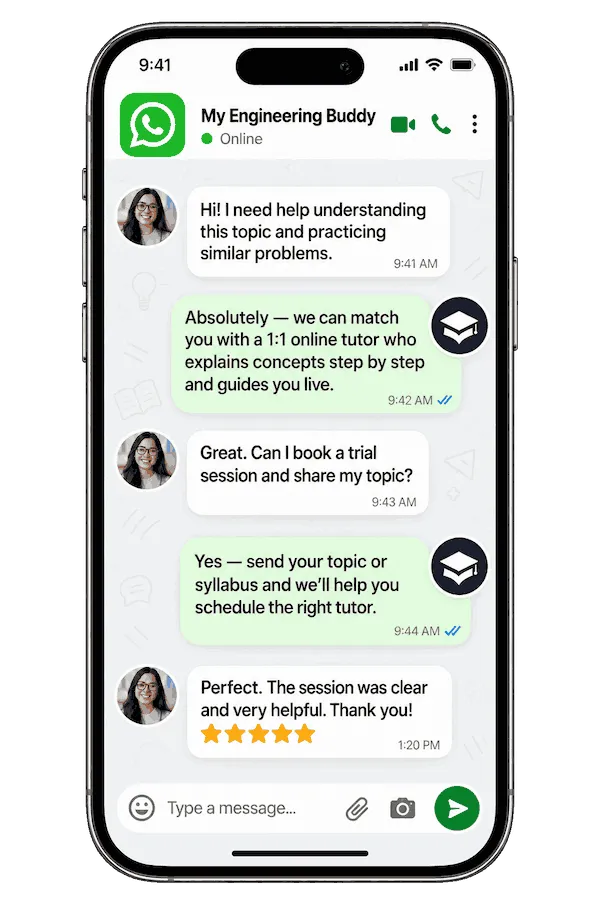
Unlike platforms where you fill out a form and wait, MEB responds in under a minute, 24/7. Tutor match takes under an hour. The $1 trial means you test before you commit. Everything runs over WhatsApp — no logins, no intake forms.
Study Plans (Pick One That Matches Your Goal)
Tutor builds the specific sequence after a diagnostic, but most sculpture students fall into one of three plans. Catch-up (1–3 weeks): students behind on a studio brief or critical essay with a hard submission deadline. Exam and portfolio prep (4–8 weeks): structured revision and portfolio refinement ahead of a specific assessment date. Weekly ongoing support: regular sessions aligned to semester pacing — useful for students who want consistent feedback throughout a unit. The tutor maps the session plan after the first diagnostic and adjusts it as the work develops.
Pricing Guide
Sculpture tutoring at MEB runs $20–$40/hr for most levels. Graduate and specialist work — including MFA-level critique, advanced casting and fabrication, or professional portfolio development — runs up to $100/hr. Rate factors include level, topic complexity, your deadline, and tutor availability.
For students targeting competitive fine arts programmes at institutions like the Slade, RISD, or RMIT, tutors with professional studio and exhibition backgrounds are available at higher rates — share your specific goal and MEB will match the tier to where you’re trying to get to.
Availability tightens in the weeks before major portfolio submission windows. Book early if your deadline is under a month away.
Start with the $1 trial — 30 minutes, no registration, no commitment. WhatsApp MEB for a quick quote.
MEB has served 52,000+ students since 2008 across 2,800+ subjects — rated 4.8/5 from 40,000+ reviews. For sculpture students, that track record means tutors who’ve seen the specific failure patterns before and know how to correct them.
Source: My Engineering Buddy, 2008–2025.
FAQ
Is sculpture hard?
It’s demanding in two distinct ways: the physical making requires patience and material knowledge, while the written and critical components require genuine art-historical fluency. Most students find one easier than the other. A tutor helps you bring the weaker side up to speed without sacrificing the stronger one.
How many sessions are needed?
Students with a specific gap — one essay component, one material problem — often resolve it in 3–5 sessions. Students building a full portfolio or preparing for a major critique typically benefit from 10–20 hours across a term. The tutor gives you a realistic estimate after the first diagnostic.
Can you help with homework and assignments?
Yes — including critical essays, contextual studies, artist statements, and written analysis components. MEB tutoring is guided learning — you understand the work, then submit it yourself. See our Academic Integrity policy and Why MEB page for full details on what we help with and what we don’t.
Will the tutor match my exact syllabus or exam board?
Yes. MEB tutors are matched to your specific programme — IB Visual Arts, A Level Art, foundation diploma, or undergraduate module. If you’re working to a specific brief from a named institution, share it before your first session and the tutor prepares accordingly.
What happens in the first session?
The tutor runs a diagnostic: reviews your existing work, reads your brief or assignment description, and asks direct questions about where you’re stuck. By the end of the first session, you have a clear picture of the gap and a plan for closing it. It’s 30 minutes well spent.
Is online tutoring as effective as in-person for sculpture?
For studio work, live annotation over shared images on Google Meet covers most of what in-person does — the tutor can mark up your photographs, point to specific formal problems, and walk you through solutions in real time. For written critique and essay components, online is just as effective as sitting in a room together.
Can you help with my IB Visual Arts comparative study or process portfolio?
Yes. MEB tutors work through both components: the comparative study requires structured art-historical argument, and the process portfolio needs documented development work with clear written annotation. Both are areas where 1:1 feedback makes a measurable difference to the final submission.
What if my sculpture brief is highly specific to my course?
Share the brief before your first session. Sculpture briefs vary widely — from open material investigations to tightly constrained conceptual prompts. MEB tutors read the specific brief and build the session around it, not around a generic curriculum assumption. Specificity is the point of 1:1 work.
Can you help with both the studio work and the written critical essay?
Yes — and most sculpture students need both. The tutor can work across studio problem-solving, formal analysis writing, contextual research, and critique preparation in the same block of sessions. You don’t need two different tutors for the making and the writing.
Do you offer help with sculpture for art school portfolio applications?
Yes. Portfolio development for competitive art school applications — selecting and sequencing work, writing the personal statement, preparing for portfolio review interviews — is one of the most common reasons sculpture students come to MEB. Tutors with admissions knowledge at foundation and undergraduate level are available.
Can I get Sculpture help at midnight or on weekends?
Yes. MEB operates 24/7 across all major time zones. WhatsApp a message and you’ll typically have a response in under a minute, any time of day or night, including weekends. Tutor availability varies, but late-evening and weekend slots are consistently available.
How do I get started?
Three steps: WhatsApp MEB, get matched with a verified sculpture tutor — usually within the hour — and start your $1 trial. That’s 30 minutes of live 1:1 tutoring or one full question explained. No registration. No commitment. You decide after whether to continue.
Trust & Quality at My Engineering Buddy
Every MEB tutor goes through a structured screening process: application review, subject knowledge assessment, and a live demo session evaluated by an experienced MEB reviewer. Tutors are selected based on formal qualifications in their discipline — sculpture tutors hold fine arts degrees, MFA credentials, or equivalent professional practice — and ongoing session feedback keeps standards accountable. Rated 4.8/5 across 40,000+ verified reviews on Google.
MEB tutoring is guided learning — you understand the work, then submit it yourself. For full details on what we help with and what we don’t, read our Academic Integrity policy and Why MEB.
MEB has been serving students in the US, UK, Canada, Australia, the Gulf, and Europe since 2008 — across 2,800+ subjects including art history tutoring, printmaking help, and illustration tutoring. The platform was built for students in advanced academic and creative disciplines who need more than a generic homework service. Read about our tutoring methodology to understand how sessions are structured from diagnostic through to final submission.
Since 2008, MEB has matched students to subject-specific tutors — not generalists. For sculpture, that means a tutor who knows the difference between a formal analysis and a personal response, and who can tell you which one your brief is actually asking for.
Source: My Engineering Buddy, 2008–2025.
Try your first session for $1 — 30 minutes of live 1:1 tutoring or one homework question explained in full. No registration. No commitment. WhatsApp MEB now and get matched within the hour.
Explore Related Subjects
Students studying Sculpture often also need support in:
Next Steps
When you WhatsApp MEB, share three things: your exam board or course name, the component you’re finding hardest right now, and your submission or exam date. That’s enough to get you matched.
Share your availability and time zone — tutors are available across US, UK, Gulf, Canada, and Australia hours.
MEB matches you with a verified tutor, usually within 24 hours. Often faster.
Before your first session, have ready:
- Your course brief, exam board, or syllabus document
- Images of recent work or a recent assignment you struggled with
- Your submission or exam deadline date
The tutor handles the rest. First session starts with a diagnostic so every minute is used well.
Visit www.myengineeringbuddy.com for more on how MEB works.
WhatsApp to get started or email [email protected].
Reviewed by Subject Expert
This page has been carefully reviewed and validated by our subject expert to ensure accuracy and relevance.




