




~1 min
Average Reply Time
~1 hour
To Be Matched With A Tutor
30 Min Trial
75% Find Their Tutor On The 1st Trial
$20-35+/hr
Premium Yet Affordable Learning
Hire The Best Photography Tutor


Most photography students hit the same wall: technically correct shots that still look flat. Understanding why takes a tutor who can look at your actual image and tell you exactly what went wrong.
Photography Tutor Online
Photography is the art and technique of capturing light to create still or moving images, encompassing exposure control, composition, colour theory, and post-processing — equipping practitioners with both technical precision and visual storytelling skills.
MEB connects you with a 1:1 online Photography tutor who works through your specific images, your course brief, or your portfolio goals — not a generic curriculum. If you’ve searched for a Photography tutor near me and found mostly local studios with waiting lists, MEB is the alternative: live sessions over Google Meet, matched to your time zone, starting from $20/hr. Our fine arts tutoring platform covers the full spectrum from technical camera craft to artistic development.
- 1:1 online sessions tailored to your course brief, portfolio, or personal project
- Expert-verified tutors with working knowledge of camera systems, editing software, and visual theory
- Flexible time zones — US, UK, Canada, Australia, Gulf
- Structured learning plan built after a diagnostic session
- Structured practice plans and progress tracking between sessions
52,000+ students across the US, UK, Canada, Australia, and the Gulf have used MEB since 2008 — including students in Fine Arts subjects like Photography, digital art, and illustration.
Source: My Engineering Buddy, 2008–2025.
How Much Does a Photography Tutor Cost?
Most Photography sessions run $20–$40/hr. Specialist areas — medium format film, commercial studio lighting, advanced Lightroom/Capture One workflows — may reach $60–$80/hr. The $1 trial gets you 30 minutes live or one specific question answered in full.
| Level / Need | Typical Rate | What’s Included |
|---|---|---|
| Foundation / Hobbyist | $20–$35/hr | 1:1 sessions, exposure basics, composition guidance |
| Advanced / Portfolio | $35–$70/hr | Expert tutor, editing workflows, portfolio critique |
| $1 Trial | $1 flat | 30 min live session or one image/question explained |
Tutor availability tightens around portfolio submission deadlines — particularly October–November and March–April. Book early if you have a fixed deadline.
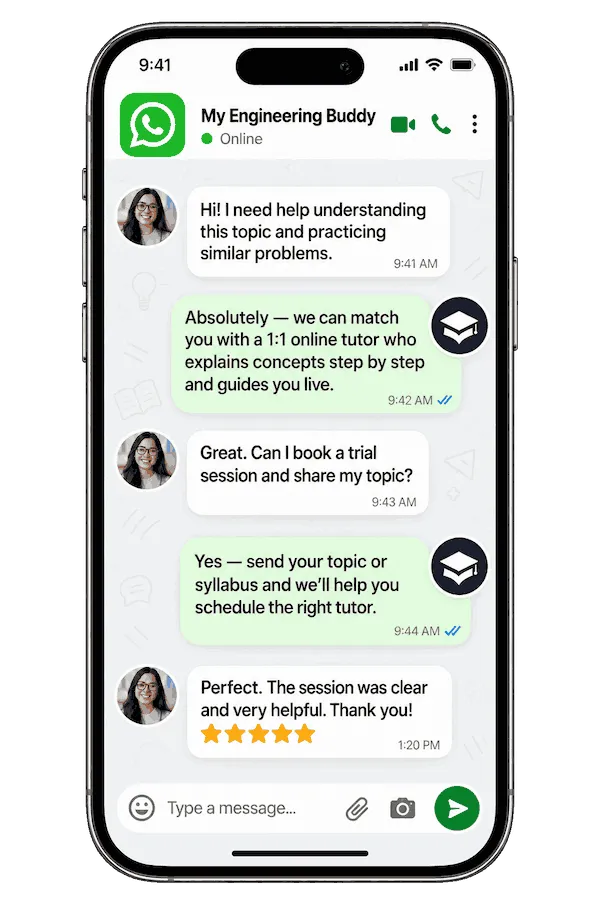
WhatsApp MEB for a quick quote — average response time under 1 minute.
Who This Photography Tutoring Is For
Photography attracts students at very different stages. Some are chasing a university art foundation offer. Others are working photographers who want to tighten a specific skill. Most fall somewhere in between — technically capable but unsure how to push their work forward.
- Students building a portfolio for university art or design programmes at institutions like RISD, Central Saint Martins, Parsons, OCAD, or Emily Carr
- Students whose portfolio has been rejected once and need specific feedback before reapplying
- Early undergraduates in photography or visual arts programmes falling behind on project briefs
- Hobbyists who have hit a plateau and want structured guidance rather than YouTube rabbit holes
- Students with a coursework or portfolio submission deadline approaching and significant gaps still to close
- Parents watching a student’s creative confidence drop alongside their grades in a foundation art course
Sessions are structured around practice, skill progression, and image review — not passive instruction. You shoot, you share, your tutor responds to what’s actually in front of them.
Supporting a student through Photography? MEB works directly with parents to set up sessions, track progress, and keep coursework on schedule. WhatsApp MEB — average response time is under a minute, 24/7.
1:1 Tutoring vs Self-Study vs AI vs YouTube vs Online Courses
Self-study works if you’re disciplined, but no one tells you why your histogram looks fine and your image still feels wrong. AI tools explain concepts fast but can’t look at your photograph and give you real feedback. YouTube is excellent for technique overviews and stops cold when you’re stuck on a specific editing decision. Online courses move at a fixed pace with no critique of your actual work. With MEB, a tutor looks at your images directly, identifies the pattern behind repeated mistakes, and corrects it in the session — not three modules later.
Outcomes: What You’ll Be Able To Do in Photography
After working with an MEB Photography tutor, you’ll apply manual exposure — aperture, shutter speed, ISO — deliberately rather than by guessing. You’ll analyse a scene for light direction, subject placement, and background separation before pressing the shutter. You’ll explain your creative choices in a portfolio statement or crit. You’ll present a cohesive body of work that reads as intentional, not accidental. You’ll solve common post-processing problems in Lightroom or Capture One without relying on presets.
Based on feedback from 40,000+ sessions collected by MEB from 2022 to 2025, students working 1:1 on Photography consistently report noticeably stronger technical control and greater confidence presenting their work in portfolio reviews and crits. Progress varies by starting level and practice frequency.
Source: MEB session feedback data, 2022–2025.
Try a session early — even if your deadline feels far off. The $1 trial doubles as your first real diagnostic.
What We Cover in Photography (Topics)

Camera Craft & Technical Foundations
- Exposure triangle: aperture, shutter speed, ISO — manual control
- Metering modes and when each is reliable
- Focusing systems: single, continuous, zone/manual override
- Lens choice — focal length, depth of field, compression
- White balance and colour temperature in-camera
- Shooting RAW vs JPEG and what each decision costs you in post
- Understanding histograms and avoiding clipped highlights
Core texts: Understanding Exposure by Bryan Peterson; The Digital Photography Book by Scott Kelby. Tutors also work with your specific camera manual when needed.
Composition, Light & Visual Language
- Rule of thirds, leading lines, framing — and when to break them
- Natural light direction: golden hour, overcast, harsh midday
- Artificial and studio lighting: continuous vs strobe, key and fill ratios
- Colour relationships and emotional tone in an image
- Negative space, subject isolation, and visual weight
- Genre-specific visual conventions: portrait, landscape, documentary, street
Recommended reading: Ways of Seeing by John Berger; Light: Science and Magic by Fil Hunter, Steven Biver, and Paul Fuqua. See also the Library of Congress photography collections for historical visual reference.
Post-Processing & Portfolio Development
- Lightroom Classic: raw develop workflow, local adjustments, colour grading
- Capture One: tethering, skin tone tools, layers
- Retouching basics in Photoshop: healing, frequency separation, dodge and burn
- Sequencing and editing a body of work for coherence
- Writing an artist statement and presenting work in a crit
- Print preparation: resolution, colour profiles, soft proofing
- Building an online portfolio: platform choice, image sizing, metadata
Tutors reference: The Photographer’s Eye by Michael Freeman; Adobe’s official Lightroom documentation. digital art tutoring sessions often complement Photography work at the post-processing stage.
At MEB, we’ve found that Photography students make the fastest progress when they arrive at each session with images they actually shot that week — not stock photos or exercises. Your tutor can diagnose a real pattern in your work in ten minutes. Generic exercises take three sessions to reveal the same thing.
What a Typical Photography Session Looks Like
The tutor opens by checking what you shot since last session — specifically whether you applied the depth-of-field control or light-reading exercise from the previous week. You share your screen or upload three to five images directly into the session chat. The tutor annotates over your images using a digital pen-pad, marking where the eye travels, where exposure broke down, and what the histogram is telling you. You work through the post-processing decisions together in Lightroom in real time — the tutor demonstrates one approach, you replicate it on your own file. The session closes with a concrete assignment: a specific shooting condition, a stated technical constraint, and the image count expected for next time. Next topic is noted so the following session picks up without recap.
How MEB Tutors Help You with Photography (The Learning Loop)
Diagnose: In the first session, your tutor reviews a set of your images — recent shots or portfolio work — and identifies the specific technical or compositional pattern holding you back. Not “work on composition.” Something like: “Your subjects are consistently backlit because you’re shooting into the light source without compensating.”
Explain: The tutor works through the problem live using a digital pen-pad — drawing light diagrams, annotating your actual photograph, or demonstrating the Lightroom adjustment that fixes the issue in real time. You see the reasoning, not just the result.
Practice: You attempt the correction or technique in the session, with the tutor present. If you’re editing, you apply the adjustment to your own file. If it’s a shooting exercise, the tutor sets a constrained brief for your next session’s images.
Feedback: When you return with new images or a revised edit, the tutor goes through it step by step. Where a shot still misses, you find out exactly why — which setting, which compositional decision, which processing step. Nothing is left as “it just doesn’t work.”
Plan: After feedback, the tutor updates the session sequence — which technique comes next, what to prioritise before your portfolio deadline, and how many sessions realistically remain before submission. Accountability is built into the structure.
Sessions run on Google Meet with a digital pen-pad or iPad and Apple Pencil for annotation. Before your first session, have ready: a folder of 5–10 of your recent images (including the ones you’re unsure about), your course brief or portfolio brief if you have one, and your deadline date. The first session is also your diagnostic — it’s the most efficient use of the hour.
Start with the $1 trial — 30 minutes of live Photography tutoring that also serves as your first diagnostic.
Students consistently tell us that the shift from “I’ll fix it in post” to understanding exposure at the point of capture is the single biggest jump in Photography. Once a tutor shows you why a correctly exposed raw file gives you five times more editing room, that habit sticks permanently.
Tutor Match Criteria (How We Pick Your Tutor)
Not every Photography tutor is right for every student. MEB matches on four criteria.
Subject depth: Tutors are matched to your specific area — studio portraiture, documentary, fine-art photography, or digital post-processing — not assigned generically. A tutor working with a student on a commercial fashion brief has different relevant experience than one supporting a photojournalism course.
Tools: All tutors use Google Meet with digital pen-pad or iPad annotation. If your course uses Capture One rather than Lightroom, or if you need tethered shooting support, that’s specified in the match.
Time zone: Matched to your region — US, UK, Gulf, Canada, Australia — so sessions don’t run at 2am.
Goals: Portfolio submission, university entrance, technical skill development, or ongoing weekly practice. The match reflects what you’re actually working toward.
Unlike platforms where you fill out a form and wait, MEB responds in under a minute, 24/7. Tutor match takes under an hour. The $1 trial means you test before you commit. Everything runs over WhatsApp — no logins, no intake forms.
Pricing Guide
Photography tutoring starts at $20/hr for foundation and hobbyist levels. Advanced portfolio work, commercial photography techniques, and niche areas like analogue darkroom process or medium format digital run $50–$100/hr depending on tutor background and session complexity.
Rate factors: your current level, the specific area of Photography, how quickly you need to progress, and tutor availability during your window.
Availability tightens during portfolio submission periods in autumn and spring. If your deadline is fixed, book now rather than two weeks before.
For students targeting top art and design school programmes — RISD, Parsons, Central Saint Martins, Emily Carr — tutors with professional photography and gallery exhibition backgrounds are available at higher rates. Share your portfolio goal and MEB will match the tier to your ambition.
Start with the $1 trial — 30 minutes, no registration, no commitment. WhatsApp MEB for a quick quote.
MEB has served 52,000+ students since 2008 across 2,800+ subjects — rated 4.8/5 across more than 40,000 verified reviews. Tutors are vetted on subject knowledge, not just availability.
Source: My Engineering Buddy platform data, 2008–2025.
A common pattern our tutors observe is that Photography students plateau not because they lack talent, but because they’ve never had their work critiqued by someone who can name the exact technical cause of a visual problem. One session of targeted image review moves more than ten hours of solo shooting.
FAQ
Is Photography hard to learn?
The technical basics — exposure, focus, composition — are learnable in a few weeks of focused practice. The harder part is developing consistent visual judgement: knowing what makes one image work and another miss. That’s where 1:1 feedback closes the gap faster than solo practice.
How many sessions are needed?
Students working toward a portfolio submission typically need 8–12 sessions over 4–6 weeks. Pure technical skill-building — manual exposure, Lightroom workflow — often clicks within 4–6 sessions. The tutor maps a realistic sequence after the first diagnostic.
How do you structure practice between sessions?
Your tutor sets a specific brief after each session: a shooting constraint, an editing exercise, or a portfolio sequencing task. You return with the output. Sessions build on what you actually produced — not abstract exercises. Progress tracking is built into the session notes.
Will the tutor match my current level and goals?
Yes. MEB matches tutors to your specific area — studio, documentary, digital editing, fine-art photography — and to your goal, whether that’s a university portfolio, a technical skill, or ongoing creative development. You’re not assigned whoever is available.
What happens in the first session?
The tutor reviews a set of your images, identifies your strongest habits and clearest gaps, and maps the first three to four session topics. You leave with a specific shooting or editing task and a clear sense of what the next session will cover. Nothing is generic.
Are online Photography lessons as effective as in-person?
For editing, portfolio critique, and technical instruction, yes — screen sharing and digital pen annotation give the tutor direct access to your images and your workflow. For lighting setup and studio technique, the tutor guides you live while you shoot at your end, which works well with a camera-connected laptop or a second device as a monitor.
Can I get Photography help at short notice — including evenings or weekends?
MEB operates across time zones and typically matches tutors within an hour of contact. Evening and weekend availability is common. WhatsApp is the fastest route — average response under a minute, around the clock.
Do I need a specific camera or software to start?
No particular camera model is required. Tutors work with DSLRs, mirrorless systems, and in some cases smartphones for composition and light practice. For editing sessions, Lightroom Classic is the most common platform, but tutors also support Capture One and Photoshop. Tell MEB what you have before your first session.
What’s the difference between Photography tutoring and a photography course?
A course teaches a fixed curriculum at a fixed pace. MEB tutoring is built around your images, your brief, and your deadline. If your portfolio needs street photography but a course covers still life this month, a course can’t adapt. A tutor can.
Do you offer support for film photography and darkroom technique?
Yes. MEB tutors with analogue photography backgrounds are available for 35mm and medium format film, darkroom printing, development process, and chemical handling. Availability is more limited than for digital — specify this when you contact MEB so the right match is made.
How do I get started?
Three steps: WhatsApp MEB, describe your current level and goal, and get matched with a verified Photography tutor — usually within the hour. Your first session is the $1 trial: 30 minutes live or one image or question fully explained. No registration, no commitment.
Can a Photography tutor help with a university portfolio submission?
Yes — this is one of the most common reasons students come to MEB for Photography support. Tutors help with image selection and sequencing, artist statement drafting, presentation format, and anticipating what admissions panels look for at specific art and design schools.
Trust & Quality at My Engineering Buddy
Every MEB Photography tutor goes through a multi-stage vetting process: subject knowledge screening, a live demo session evaluated by MEB staff, and ongoing review based on student feedback. Tutors hold degrees in photography, visual arts, or a closely related discipline — many have professional exhibition, commercial, or editorial backgrounds. Rated 4.8/5 across 40,000+ verified reviews on Google.
MEB tutoring is guided learning — you understand the work, then submit it yourself. For full details on what we help with and what we don’t, read our Academic Integrity policy and Why MEB.
MEB has been running since 2008, serving 52,000+ students across the US, UK, Canada, Australia, the Gulf, and Europe across 2,800+ subjects. The Fine Arts catalogue includes art tutoring, drawing tutoring, and painting tutoring alongside Photography — all matched to the same standard of subject-specific tutor vetting.
MEB’s tutoring methodology is built on a diagnose-explain-practice-feedback loop — not passive instruction. Every session moves a student forward on a specific, named skill.
Source: My Engineering Buddy, 2008–2025.
Try your first session for $1 — 30 minutes of live 1:1 tutoring or one homework question explained in full. No registration. No commitment. WhatsApp MEB now and get matched within the hour.
Explore Related Subjects
Students studying Photography often also need support in:
Next Steps
When you contact MEB, have the following ready:
- Your current level and the specific area of Photography you’re working on
- Your portfolio brief, course outline, or exam board if applicable
- Your submission or exam deadline and your available time zones
Before your first session: gather 5–10 of your recent images (including ones you’re unhappy with), your course brief or portfolio requirements, and your deadline date. The tutor handles the rest.
MEB matches you with a verified Photography tutor — usually within 24 hours. The first session starts with a diagnostic so every minute is used well. Visit www.myengineeringbuddy.com for more on how MEB works.
WhatsApp to get started or email [email protected].
Reviewed by Subject Expert
This page has been carefully reviewed and validated by our subject expert to ensure accuracy and relevance.




