




~1 min
Average Reply Time
~1 hour
To Be Matched With A Tutor
30 Min Trial
75% Find Their Tutor On The 1st Trial
$20-35+/hr
Premium Yet Affordable Learning
Most developers know OWASP exists. Far fewer can explain why SQL injection still tops the list after fifteen years.
OWASP Tutor Online
OWASP (Open Worldwide Application Security Project) is an open-standard framework defining the most critical web application security risks, including the widely referenced OWASP Top 10 list, equipping developers and security professionals to identify, mitigate, and prevent common vulnerabilities in production systems.
If you’re searching for an OWASP tutor online, you’ve likely hit a wall — OWASP documentation is dense, the Top 10 categories blend conceptual and technical knowledge, and most online courses skip the part where you actually apply controls to real code. MEB connects you with a 1:1 OWASP tutor near me (or anywhere, since sessions run online) who has worked with these frameworks in real development and security environments. This is part of MEB’s broader software engineering tutoring offering across 2,800+ advanced subjects.
- 1:1 online sessions tailored to your course, certification track, or job-readiness goal
- Expert-verified tutors with hands-on OWASP and application security experience
- Flexible time zones — sessions available for students in the US, UK, Canada, Australia, and the Gulf
- Structured learning plan built after a first diagnostic session
- Guided project support — we explain the vulnerability class, you implement the fix or write the report
52,000+ students across the US, UK, Canada, Australia, and the Gulf have used MEB since 2008 — including students in Software Engineering subjects like OWASP, Burp Suite tutoring, and vulnerability assessment help.
Source: My Engineering Buddy, 2008–2025.
How Much Does an OWASP Tutor Cost?
OWASP tutoring at MEB starts at $20/hr for foundational coverage of the Top 10. Advanced topics — threat modelling, secure SDLC integration, or preparation for certifications like GWEB — run $35–$70/hr depending on tutor depth and your timeline. Start with the $1 trial to test the match before committing to a package.
| Level / Need | Typical Rate | What’s Included |
|---|---|---|
| Standard (developer / student) | $20–$35/hr | 1:1 sessions, Top 10 coverage, project guidance |
| Advanced / Certification Prep | $35–$70/hr | Expert tutor, GWEB/CEH alignment, threat modelling |
| $1 Trial | $1 flat | 30 min live session or one project question explained in full |
Tutor availability tightens during university semester ends and peak hiring seasons — book early if your deadline is firm.
WhatsApp MEB for a quick quote — average response time under 1 minute.
Who This OWASP Tutoring Is For
OWASP knowledge sits at an awkward intersection: developers need it but rarely learned it formally, and security students often understand the theory without knowing how to apply it to actual code. MEB tutoring bridges both gaps, wherever you’re starting from.
- Undergraduate and postgraduate students in cybersecurity, software engineering, or computer science courses that reference OWASP
- Developers preparing for a security-focused code review, penetration test, or job interview at a company with a strong AppSec culture
- Students working toward certifications such as CEH, GWEB, or CompTIA Security+ where OWASP Top 10 is explicitly tested
- Students who failed a secure coding or application security module and need to resit — the Top 10 categories feel abstract until someone walks through live exploit scenarios with you
- Engineers onboarding into a DevSecOps team who need to get up to speed on OWASP ASVS or SAMM before their first sprint
- Students with a project submission deadline approaching and unresolved gaps in injection, broken authentication, or SSRF controls
Students at institutions including MIT, Carnegie Mellon, Georgia Tech, Imperial College London, University of Toronto, and KAUST have worked with MEB tutors on application security coursework and projects.
At MEB, we’ve found that students who understand why a vulnerability makes the OWASP Top 10 — not just what it is — retain the material and apply it correctly under exam or interview pressure. The difference is almost always in the worked example, not the definition.
1:1 Tutoring vs Self-Study vs AI vs YouTube vs Online Courses
Self-study works if you can read CVE entries and map them to code without help — most people can’t, not yet. AI tools will explain what SQL injection is; they can’t watch you write a parameterised query and tell you where you went wrong. YouTube is fine for the first fifteen minutes of any OWASP category; it stops when your question gets specific. Online courses move at a fixed pace and don’t cover your actual codebase or exam board. 1:1 OWASP tutoring with MEB is calibrated to your exact course, certification, or project — the tutor sees your code, your gaps, and your deadline, and works backward from there.
Outcomes: What You’ll Be Able To Do in OWASP
After targeted 1:1 OWASP tutoring, you’ll be able to explain and apply each of the OWASP Top 10 categories with reference to real vulnerability patterns, not just definitions. You’ll analyze authentication flows to identify broken access control risks. You’ll apply secure coding controls — input validation, parameterised queries, output encoding — directly in your own projects. You’ll model threats against a web application using structured methodologies like STRIDE, then map mitigations to specific OWASP controls. You’ll write or review security requirements using OWASP ASVS levels, which matters if your course or team uses it as a baseline.
Based on feedback from 40,000+ sessions collected by MEB from 2022 to 2025, 58% of students improved by one full grade after approximately 20 hours of 1:1 tutoring in subjects like OWASP. A further 23% achieved at least a half-grade improvement.
Source: MEB session feedback data, 2022–2025.
Supporting a student through OWASP? MEB works directly with parents to set up sessions, track progress, and keep coursework on schedule. WhatsApp MEB — average response time is under a minute, 24/7.
What We Cover in OWASP (Syllabus / Topics)

Track 1: OWASP Top 10 — Core Vulnerability Categories
- A01 Broken Access Control — privilege escalation, IDOR, and path traversal scenarios
- A02 Cryptographic Failures — weak cipher selection, improper key storage, and TLS misconfiguration
- A03 Injection — SQL, NoSQL, OS command, and LDAP injection with prevention via parameterised queries
- A04 Insecure Design — threat modelling with STRIDE, secure design patterns, and misuse case analysis
- A05 Security Misconfiguration — default credentials, unnecessary features, and cloud storage exposure
- A06–A10 — SSRF, vulnerable components, identification failures, software integrity failures, and logging gaps
- How the Top 10 ranking is determined and what changed from the 2017 to 2021 edition
Core text: The Web Application Hacker’s Handbook (Stuttard & Pinto) and the OWASP Testing Guide v4.2.
Track 2: OWASP ASVS and Secure Development Lifecycle
- OWASP Application Security Verification Standard (ASVS) — Levels 1, 2, and 3 explained
- Mapping ASVS controls to functional requirements in a real project or coursework brief
- Integrating OWASP SAMM into a software development lifecycle for coursework or team projects
- Security requirements writing — turning ASVS into testable acceptance criteria
- Threat modelling using OWASP Threat Dragon and STRIDE — session-level walkthroughs
- Secure code review techniques aligned to OWASP Code Review Guide v2
Reference: OWASP ASVS 4.0 documentation and Threat Modeling: Designing for Security (Shostack).
Track 3: Practical Testing and Tool Use
- Using OWASP ZAP (Zed Attack Proxy) for automated and manual web application scanning
- Interpreting ZAP scan results and writing a findings report suitable for coursework submission
- Hands-on injection testing in controlled lab environments (DVWA, WebGoat)
- Pairing OWASP ZAP with Burp Suite help for manual testing workflows
- Understanding passive vs active scanning modes and false-positive triage
- Reporting findings in OWASP-aligned format: risk rating, likelihood, impact, and remediation
Reference: OWASP ZAP documentation and The Tangled Web (Zalewski) for HTTP security fundamentals.
What a Typical OWASP Session Looks Like
The tutor opens by checking where you got stuck on the previous topic — often broken access control or the difference between ASVS Level 1 and Level 2. From there, you and the tutor work through a specific vulnerability class on screen: the tutor uses a digital pen-pad to annotate a code snippet, traces the attack vector step by step, then asks you to explain the fix in your own words before writing it. If your session is project-focused, you share your application’s current authentication flow and the tutor walks through what an OWASP-aligned reviewer would flag. By the end, you have a concrete task — implement one specific control, document one threat scenario, or run ZAP against a test environment — and the next session’s starting point is already set.
How MEB Tutors Help You with OWASP (The Learning Loop)
Diagnose: In the first session, the tutor identifies exactly which Top 10 categories you’re shaky on, whether that’s conceptual (what is SSRF?) or applied (how do I prevent it in my Django app?). The gap is rarely where students think it is.
Explain: The tutor works through live examples on a digital pen-pad — not slides, not a lecture. You watch an injection attack run against a vulnerable query, then see the parameterised version side by side. That comparison sticks in a way that reading the OWASP page does not.
Practice: You attempt the problem — write the validation logic, configure the security header, or draft the ASVS control requirement — while the tutor watches and lets you work. Immediate scaffolding if you’re stuck; silence if you’re not.
Feedback: Step-by-step error correction explains not just what was wrong but why it would fail in a real attack or why a marker would deduct marks. The tutor references the specific OWASP control or Top 10 category so you build a mental map, not a list of corrections.
Plan: Each session ends with a clear next step — which vulnerability category is next, what you should attempt independently using WebGoat or DVWA, and where you should be before the next session.
Sessions run over Google Meet with a shared screen and digital pen-pad or iPad + Apple Pencil for annotations. Before your first session, have your course outline or certification syllabus ready, and flag any specific project brief or past exam question you’re stuck on. Start with the $1 trial — 30 minutes of live tutoring that also serves as your first diagnostic.
Try your first session for $1 — 30 minutes of live 1:1 tutoring or one homework question explained in full. No registration. No commitment. WhatsApp MEB now and get matched within the hour.
Tutor Match Criteria (How We Pick Your Tutor)
OWASP knowledge varies widely — a tutor who teaches general cybersecurity may not know ASVS Level 3 from a first reading. MEB vets specifically.
Subject depth: Tutors are matched to your specific track — Top 10 conceptual study, ASVS-based project work, or practical testing with ZAP and WebGoat. A certification-prep student and a software engineering undergraduate get different tutor profiles.
Tools: All sessions use Google Meet plus digital pen-pad or iPad + Apple Pencil. Tutors with hands-on Kali Linux tutoring or Metasploit experience are available for practical penetration testing tracks.
Time zone: Matched to your region — US, UK, Gulf, Canada, or Australia. No six-hour lag on a question you need answered tonight.
Goals: Exam score, coursework submission, job interview, or ongoing DevSecOps upskilling — the tutor’s experience is matched to your actual objective, not a generic curriculum.
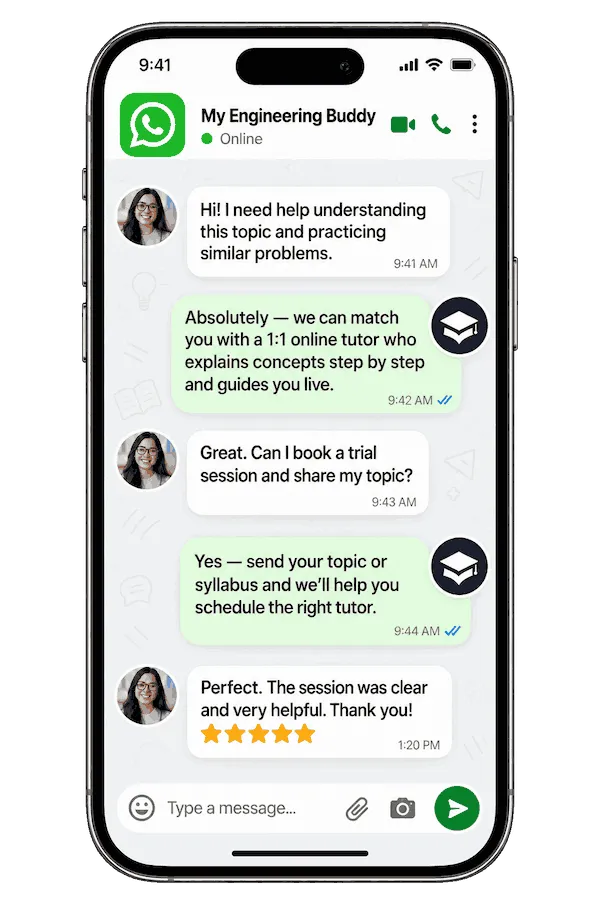
Unlike platforms where you fill out a form and wait, MEB responds in under a minute, 24/7. Tutor match takes under an hour. The $1 trial means you test before you commit. Everything runs over WhatsApp — no logins, no intake forms.
MEB tutors covering OWASP also support adjacent security and development subjects — from software testing tutoring and DevOps help to Docker tutoring — giving students a joined-up view of secure development practice.
Source: My Engineering Buddy, 2008–2025.
Study Plans (Pick One That Matches Your Goal)
The tutor builds the specific sequence after the first diagnostic session. Three common structures: a catch-up plan (1–3 weeks) for students with a submission or resit deadline and clear gaps to close in specific Top 10 categories; an exam or certification prep plan (4–8 weeks) with a structured walk through ASVS or Top 10 aligned to your exam syllabus; or ongoing weekly support aligned to your semester schedule, covering each new vulnerability class as your course introduces it.
Pricing Guide
OWASP tutoring starts at $20/hr for Top 10 conceptual sessions and standard project guidance. Specialist tutors with penetration testing or DevSecOps backgrounds — relevant for ASVS Level 3 or certification prep — run up to $70/hr. Rate factors include your course level, how niche the topic is (OWASP SAMM integration is rarer than Top 10), and how urgent your timeline is.
For students targeting roles at companies with formal application security programmes, or preparing for GWAPT or BSCP certification, tutors with professional AppSec backgrounds are available at higher rates — share your specific goal and MEB will match the tier to your target.
Availability tightens at semester end and during peak hiring seasons for graduate software engineering roles. Start with the $1 trial — 30 minutes, no registration, no commitment. WhatsApp MEB for a quick quote.
Students consistently tell us that the first session reframes the problem entirely — they came in thinking OWASP was a checklist to memorise and left treating it as a reasoning framework. That shift usually happens somewhere around broken access control, when the tutor shows the first IDOR exploit on a real URL pattern.
FAQ
Is OWASP hard to learn?
OWASP is conceptually accessible but technically demanding in application. Most students can read the Top 10 definitions in an afternoon. Applying them to real code — writing correct controls, running ZAP scans, mapping ASVS requirements — takes structured practice with feedback, not more reading.
How many sessions will I need?
For Top 10 conceptual understanding, 5–8 sessions covers most students. For ASVS-aligned project work or certification prep spanning multiple domains, 15–25 sessions is more realistic. The tutor sets a specific plan after the first diagnostic session based on your starting point and deadline.
Can you help with OWASP homework and assignments?
Yes — MEB tutoring is guided learning. You understand the vulnerability class, write the controls or analysis, then submit the work yourself. See our Academic Integrity policy and Why MEB page for full details on what we help with and what we don’t. No work is submitted on your behalf.
Will the tutor match my exact syllabus or exam board?
Yes. Share your course outline, certification target, or exam syllabus when you contact MEB. Tutors are matched to your specific framework — university module, CompTIA Security+, CEH, GWEB, or an internal company training programme — not a generic OWASP overview.
What happens in the first session?
The tutor runs a short diagnostic — they ask you to explain one or two Top 10 categories or walk through a code snippet — to locate your real gaps. From that point, the session becomes active work, not an intake form. You leave with a clear plan for the next 3–5 sessions.
Is online OWASP tutoring as effective as in-person?
For security and development subjects, online is often better — the tutor can share your exact codebase on screen, annotate live with a digital pen-pad, and run tools like OWASP ZAP alongside the session. In-person rarely offers that level of technical integration in real time.
What is the difference between OWASP Top 10 and OWASP ASVS?
The Top 10 is a ranked list of the most common critical risks — primarily a risk awareness document. ASVS (Application Security Verification Standard) is a detailed control framework for verifying security requirements in software at three levels of rigour. Many courses and certifications test both; they serve different purposes.
Can I get OWASP help at midnight or on weekends?
Yes. MEB operates 24/7 across all major time zones. Tutors are available for US evening, UK early morning, Gulf midday, and Australian sessions. WhatsApp MEB at any hour — typical response time is under one minute.
What if my project uses a specific framework — Django, Spring Boot, Node.js?
OWASP controls are framework-agnostic in principle but implemented differently in each stack. MEB tutors can cover OWASP applied to Django project help, Spring Boot tutoring, or Node.js tutoring — so the guidance is always specific to your actual codebase.
Does OWASP ZAP require coding knowledge to use effectively?
Basic passive scanning in ZAP requires minimal coding. Effective use — custom scan policies, authenticated scanning, scripting active rules — requires familiarity with HTTP, session handling, and basic scripting. A tutor walks you through each layer at the right pace for your background and course requirements.
How do I get started with OWASP tutoring at MEB?
Three steps: WhatsApp MEB with your subject, current level, and deadline. You get matched with a verified OWASP tutor — usually within the hour. Then start your $1 trial — 30 minutes of live tutoring or one project question explained in full, no registration required.
Trust & Quality at My Engineering Buddy
Every MEB tutor goes through subject-specific screening before their first session — not a platform-wide skills test, but a review of their application security knowledge, hands-on tool experience, and ability to teach under the formats MEB uses. Tutors complete a live demo evaluation and are assessed against ongoing session feedback. Rated 4.8/5 across 40,000+ verified reviews on Google. Degrees and professional experience are verified; tutors covering OWASP typically hold qualifications or roles in software engineering, information security, or DevSecOps.
MEB tutoring is guided learning — you understand the work, then submit it yourself. For full details on what we help with and what we don’t, read our Academic Integrity policy and Why MEB.
MEB has served 52,000+ students across the US, UK, Canada, Australia, the Gulf, and Europe since 2008 — across 2,800+ subjects including Software Engineering, software quality assurance help, and software architecture tutoring. Tutoring methodology details are available at our tutoring methodology page.
Our experience across thousands of sessions shows that students who fail application security modules rarely lack intelligence — they lack a mental model for thinking like an attacker. That model takes about three sessions to build when it’s taught well. We’ve been building it since 2008.
Explore Related Subjects
Students studying OWASP often also need support in:
- Nmap
- Acceptance Testing
- Integration Testing
- Software Development Life Cycle (SDLC)
- Reverse Engineering
- Parrot OS
- Infrastructure as Code
Next Steps
When you contact MEB, share your exam board or certification target, the specific OWASP topic giving you the most trouble, and how many weeks you have before your deadline or assessment.
Also share your availability and time zone — sessions are matched to US, UK, Gulf, Canada, and Australian schedules.
MEB matches you with a verified OWASP tutor — usually within 24 hours, often within the hour.
Before your first session, have ready:
- Your course outline, certification syllabus, or specific exam topic list
- A recent project brief, homework question, or past exam question you got wrong
- Your submission or exam date — the tutor builds the plan from there
The first session starts with a diagnostic so every minute counts. Visit www.myengineeringbuddy.com for more on how MEB works.
WhatsApp to get started or email [email protected].
Reviewed by Subject Expert
This page has been carefully reviewed and validated by our subject expert to ensure accuracy and relevance.




