




~1 min
Average Reply Time
~1 hour
To Be Matched With A Tutor
30 Min Trial
75% Find Their Tutor On The 1st Trial
$20-35+/hr
Premium Yet Affordable Learning
Most students who struggle with Plant Taxonomy don’t lack effort — they’re missing a clear map of how the classification systems connect.
Plant Taxonomy Tutor Online
Plant Taxonomy is the science of describing, naming, and classifying plants into hierarchical groups using morphological, molecular, and phylogenetic criteria, equipping students to identify species and interpret evolutionary relationships within botanical systems.
If you’re searching for a Plant Taxonomy tutor near me, MEB connects you with a verified specialist — online, live, and matched to your exact course. Whether you’re working through botany tutoring at undergraduate level or tackling graduate-level systematics, MEB gives you structured 1:1 support built around your syllabus and timeline. You won’t just follow along — you’ll be able to explain your reasoning.
- 1:1 online sessions tailored to your specific course or university syllabus
- Expert-verified tutors with degree-level botanical and systematic biology knowledge
- Flexible time zones — US, UK, Canada, Australia, and the Gulf covered
- Structured learning plan built after a first-session diagnostic
- Ethical academic guidance — you understand the material, then submit it yourself
52,000+ students across the US, UK, Canada, Australia, and the Gulf have used MEB since 2008 — including students in Botany subjects like Plant Taxonomy, plant anatomy, and plant evolution.
Source: My Engineering Buddy, 2008–2025.
How Much Does a Plant Taxonomy Tutor Cost?
Most Plant Taxonomy sessions run $20–$40/hr depending on level and topic depth. Graduate-level or highly specialised systematics work can reach $100/hr. New students can start with the $1 trial — 30 minutes of live tutoring or one full homework question explained.
| Level / Need | Typical Rate | What’s Included |
|---|---|---|
| Standard (most undergrad levels) | $20–$35/hr | 1:1 sessions, homework guidance |
| Advanced / Graduate Systematics | $35–$70/hr | Expert tutor, phylogenetic depth |
| $1 Trial | $1 flat | 30 min live session or 1 homework question |
Tutor availability tightens considerably at the end of semester when assignment and exam deadlines cluster. Book early if your deadline is within six weeks.
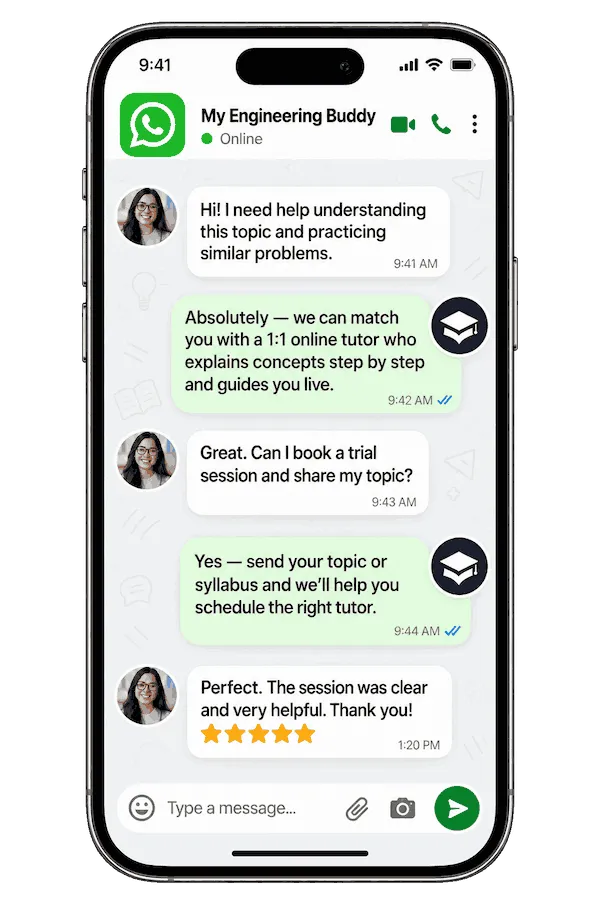
WhatsApp MEB for a quick quote — average response time under 1 minute.
Who This Plant Taxonomy Tutoring Is For
Plant Taxonomy draws students from botany, ecology, evolutionary biology, pharmacognosy, and conservation programmes. The content looks manageable at first — until nomenclature rules, cladistic trees, and the differences between phenetic and phylogenetic systems start to pile up.
- Undergraduates working through angiosperm families, nomenclature codes, or plant identification practicals
- Graduate students tackling phylogenetic systematics, molecular classification, or dissertation chapters on plant diversity
- Students retaking after a failed first attempt — particularly those who lost marks on taxonomic keys or APG classification questions
- Students with a university conditional offer depending on a passing grade in a botany or biological sciences unit
- Students 4–6 weeks from an exam with significant gaps in cladistics, nomenclature, or family identification still to close
- Parents supporting a student whose confidence has dropped alongside their grades in first-year botany modules
Students come from universities including UC Davis, the University of Florida, Wageningen University, the University of Melbourne, Imperial College London, and King Abdullah University of Science and Technology — among many others.
At MEB, we’ve found that students who struggle with Plant Taxonomy often have the same underlying gap: they’ve memorised family names without understanding the morphological logic that groups them. Once that logic clicks — usually in one or two sessions — the whole classification structure becomes navigable.
1:1 Tutoring vs Self-Study vs AI vs YouTube vs Online Courses
Self-study works if you’re disciplined, but Plant Taxonomy requires corrective feedback on your keying and identification technique — something no textbook can provide. AI tools explain nomenclature rules fast but can’t watch you work through a dichotomous key and catch where you go wrong. YouTube covers broad overviews of major plant families well and stops there. Online courses give structure but move at a fixed pace regardless of where you’re stuck. 1:1 tutoring with MEB is live, calibrated to your specific course and exam board, and corrects errors in the moment — whether that’s a misapplied APG family placement or a cladogram you’ve drawn incorrectly.
Outcomes: What You’ll Be Able To Do in Plant Taxonomy
After working with an online Plant Taxonomy tutor through MEB, you’ll be able to apply the APG IV classification system accurately to unfamiliar angiosperm families. You’ll analyze morphological characters and construct dichotomous keys for practical identification. You’ll explain the distinction between phenetic and cladistic approaches in a written exam answer without confusing the two. You’ll present phylogenetic hypotheses using correctly structured cladograms, and you’ll interpret molecular systematics data as supporting evidence for taxonomic decisions — skills that are directly examined in botany and plant biology programmes at universities across the US, UK, and Australia.
If your module includes a plant identification practical or herbarium assignment, get plant pathology help alongside taxonomy support — many programmes assess both together.
Supporting a student through Plant Taxonomy? MEB works directly with parents to set up sessions, track progress, and keep coursework on schedule. WhatsApp MEB — average response time is under a minute, 24/7.
Based on feedback from 40,000+ sessions collected by MEB from 2022 to 2025, 58% of students improved by one full grade after approximately 20 hours of 1:1 tutoring in subjects like Plant Taxonomy. A further 23% achieved at least a half-grade improvement.
Source: MEB session feedback data, 2022–2025.
What We Cover in Plant Taxonomy (Syllabus / Topics)

Classification Systems and Nomenclature
- Binomial nomenclature and the International Code of Nomenclature for algae, fungi, and plants (ICN)
- Phenetic versus cladistic classification approaches
- APG IV system — angiosperm families and their reassignments
- Taxonomic ranks: kingdom, division, class, order, family, genus, species
- Type specimens, herbarium records, and taxonomic authority
- Synonymy, homonymy, and priority rules in plant naming
Core texts for this track include Plant Systematics by Michael Simpson and Flowering Plant Families of the World by Heywood et al.
Morphological and Phylogenetic Methods
- Vegetative and reproductive characters used in identification
- Dichotomous keys — construction, use, and common errors
- Cladistic analysis: character matrices, parsimony, and cladogram interpretation
- Molecular systematics: DNA barcoding, rbcL and matK markers
- Homology vs analogy in plant character comparison
- Bootstrapping and Bayesian inference in plant phylogenetics
Standard references include Plant Systematics: A Phylogenetic Approach by Judd et al. and Molecular Systematics of Plants II by Soltis and Soltis.
Major Plant Groups and Applied Identification
- Bryophytes, pteridophytes, gymnosperms, and angiosperms — distinguishing features
- Key angiosperm families: Fabaceae, Asteraceae, Poaceae, Solanaceae, Rosaceae
- Field identification techniques and herbarium preparation standards
- Ethnobotanical and ecological significance of selected families
- Conservation taxonomy — endangered species listing and taxonomic uncertainty
- Practical plant identification for ethnobotany and pharmacognosy applications
Useful references include Flora of North America (volumes relevant to your region) and Cronquist’s An Integrated System of Classification of Flowering Plants.
Students consistently tell us that the jump from memorising family names to actually using a dichotomous key under exam conditions is where they lose marks. That’s not a knowledge gap — it’s a practice gap. Regular, timed keying exercises with tutor correction close it faster than any other method.
What a Typical Plant Taxonomy Session Looks Like
The tutor opens by checking where you got to last time — usually a specific family or keying exercise, such as distinguishing Asteraceae from Apiaceae using vegetative characters. From there, you and the tutor work through a specimen description or cladogram construction together on screen. The tutor uses a digital pen-pad to annotate diagrams live — marking up character states, correcting cladogram topology, or walking through an ICN nomenclature rule. You then replicate the process or explain your reasoning aloud while the tutor listens for the exact point where the logic breaks. The session closes with a specific practice task — key out three new specimens using a provided flora, or write a short diagnosis paragraph for one genus — with the next topic noted so session two has no wasted setup time.
Need support beyond plant classification? Students in plant biology programmes often pair taxonomy sessions with cytology tutoring and plant anatomy help — both closely assessed alongside taxonomy in most botany degrees.
How MEB Tutors Help You with Plant Taxonomy (The Learning Loop)
Diagnose: In the first session, the tutor identifies your specific gaps — whether that’s confusion between APG IV and older Cronquist families, errors in cladogram construction, or difficulty applying nomenclature priority rules correctly. Not every student starts at the same point.
Explain: The tutor works through live problems using a digital pen-pad — drawing cladograms step by step, annotating dichotomous key pathways, or showing exactly how a floral formula maps to a family diagnosis. You watch it built from scratch, not handed a finished answer.
Practice: You attempt the next problem while the tutor watches. Keying out an unknown specimen, writing a formal plant description, or constructing a character matrix — whichever skill your assessment demands most.
Feedback: The tutor goes through your attempt step by step. Where marks would be lost in an exam, you find out why — and what the correct reasoning looks like. This is the part most self-study methods skip entirely.
Plan: At the end of each session, the tutor maps the next topic and sets a specific task. If you’re eight weeks from a final exam, the sequence is built to hit every assessed family group and method before that date.
Sessions run over Google Meet with a digital pen-pad or iPad and Apple Pencil for real-time diagram work. Before your first session, have your course syllabus or past paper ready, along with any keying exercise or assignment where you lost marks. The first session doubles as your diagnostic — start with the $1 trial and 30 minutes is enough to identify exactly what to fix.
Whether you need help with APG IV family placement, dichotomous key technique, or phylogenetic cladogram construction, MEB matches you with a tutor who has worked through exactly these problems — in Plant Taxonomy specifically, not just general biology.
Source: My Engineering Buddy, 2008–2025.
Try your first session for $1 — 30 minutes of live 1:1 tutoring or one homework question explained in full. No registration. No commitment. WhatsApp MEB now and get matched within the hour.
Tutor Match Criteria (How We Pick Your Tutor)
Match quality is the difference between a session that moves you forward and one that wastes an hour. MEB matches on four criteria.
Subject depth: The tutor must have degree-level or higher training in plant systematics, botany, or evolutionary biology — and familiarity with the specific classification framework your course uses (APG IV, Cronquist, or equivalent).
Tools: Every tutor uses Google Meet with a digital pen-pad or iPad and Apple Pencil — essential for live cladogram annotation and key construction.
Time zone: Matched to your region — US, UK, Gulf, Canada, or Australia. No scheduling lag across 12 time zones.
Goals: Whether you need exam score improvement, help with a practical identification assessment, assignment guidance, or research support for a dissertation chapter on plant diversity, the tutor is matched to that specific goal.
Unlike platforms where you fill out a form and wait, MEB responds in under a minute, 24/7. Tutor match takes under an hour. The $1 trial means you test before you commit. Everything runs over WhatsApp — no logins, no intake forms.
Study Plans (Pick One That Matches Your Goal)
The tutor builds a specific sequence after the diagnostic, but most students fall into one of three patterns. Catch-up (1–3 weeks): concentrated work on the most heavily examined topics — APG IV placement, key construction, cladistic methods — for students close to a deadline with clear gaps. Exam prep (4–8 weeks): structured revision across all assessed topics, timed practice with past exam questions, and weekly progress checks. Weekly support: ongoing sessions aligned to your semester schedule, tracking coursework deadlines and assignment submissions throughout the term.
Pricing Guide
Standard Plant Taxonomy tutoring runs $20–$40/hr for most undergraduate levels. Graduate-level phylogenetics or research-focused work is priced at $40–$100/hr depending on tutor background and topic complexity. Rate factors include your level, the depth of systematics involved, your timeline, and tutor availability.
Availability tightens during end-of-semester exam windows. If your deadline is in the next four to six weeks, book early.
For students targeting competitive graduate programmes in plant biology, conservation, or botanical research, tutors with active research backgrounds in plant systematics are available at higher rates — share your specific goal and MEB will match the tier to your ambition.
Start with the $1 trial — 30 minutes, no registration, no commitment. WhatsApp MEB for a quick quote.
FAQ
Is Plant Taxonomy hard?
It’s not conceptually impossible, but it demands precision. Students find the volume of Latin nomenclature, the shifting classification systems (APG IV vs older systems), and the practical keying skills all hitting at once. With structured 1:1 support, most students resolve their main gaps within 8–12 hours of tutoring.
How many sessions are needed?
Students with 4–6 weeks before an exam typically need 10–15 hours of focused 1:1 work. Those with ongoing academic guidance needs usually book weekly sessions through the semester. The tutor gives a clearer estimate after the first diagnostic session.
Can you help with practice exercises?
Yes. MEB tutoring is guided learning — the tutor explains the method and works through the reasoning with you, then you complete and submit the work yourself. See our Academic Integrity policy and Why MEB page for full details on what we help with and what we don’t.
Will the tutor match my exact syllabus or exam board?
Yes. Share your course name, institution, and the specific topics or exam components you’re assessed on before your first session. The tutor prepares around your exact syllabus — APG IV-based programmes, Cronquist-based courses, or university-specific frameworks.
What happens in the first session?
The tutor runs a short diagnostic — asking you to work through a keying problem or describe a taxonomic concept — to identify exactly where understanding breaks down. From that, they build a session plan. No time is wasted on material you already know.
Is online tutoring as effective as in-person?
For Plant Taxonomy, yes. The digital pen-pad replicates whiteboard work for cladogram construction, key annotation, and morphological diagrams. Most students report that online sessions with real-time annotation are more focused than face-to-face sessions with a printed handout.
What’s the difference between APG IV and older classification systems, and do I need to know both?
APG IV is the current molecular-based standard used in most modern botany courses. Older systems like Cronquist or Takhtajan appear in older textbooks and some herbarium records. Whether you need both depends on your course — your tutor clarifies this in session one and focuses on what your examiners actually test.
Can you help with plant identification practicals and herbarium assignments?
Yes. Tutors help you work through dichotomous keys, interpret floral formulas, write formal plant descriptions, and prepare herbarium specimen labels that meet standard taxonomic conventions. Share the specific brief or marking criteria and the tutor prepares around it.
Can I get Plant Taxonomy help at short notice — including late at night?
Yes. MEB operates 24/7 across time zones. WhatsApp response time averages under one minute. If you have a practical submission due tomorrow or a cladogram question at midnight, message MEB and a tutor will be identified quickly.
What if I don’t get on with my assigned tutor?
Tell MEB over WhatsApp after the trial session. A different tutor is matched immediately — no explanations needed, no delays. The $1 trial exists precisely so you can evaluate fit before committing to ongoing sessions.
How do I get started?
Three steps: WhatsApp MEB with your subject and timeline. MEB matches you with a Plant Taxonomy tutor — usually within the hour. Start the $1 trial — 30 minutes of live tutoring or one assignment question fully explained. No registration, no commitment.
Trust & Quality at My Engineering Buddy
Every MEB tutor goes through subject-specific screening before working with students. That includes a live demo session evaluation, review of academic credentials or professional background, and ongoing performance checks based on student session feedback. Tutors covering Plant Taxonomy hold degrees in botany, plant biology, evolutionary biology, or related life sciences — and are matched only to students whose course level and classification framework they can cover in depth. Rated 4.8/5 across 40,000+ verified reviews on Google.
MEB tutoring is guided learning — you understand the work, then submit it yourself. For full details on what we help with and what we don’t, read our Academic Integrity policy and Why MEB.
MEB has been serving students in the US, UK, Canada, Australia, Gulf, and Europe since 2008 — across 2,800+ subjects. In Botany and related fields, that includes students needing phytochemistry tutoring, paleobotany help, and dendrology tutoring alongside Plant Taxonomy. Learn more about how MEB structures sessions at our tutoring methodology page.
MEB has operated since 2008 with one fixed approach: match the student to a tutor who knows their exact subject, then get out of the way and let the learning happen. No platform algorithms. No random assignment. Human matching, every time.
Source: My Engineering Buddy, 2008–2025.
Explore Related Subjects
Students studying Plant Taxonomy often also need support in:
Next Steps
Before your first session, have ready: your exam board and syllabus (or course outline), a recent past paper attempt or keying exercise you struggled with, and your exam or coursework deadline date. The tutor handles the rest.
- Share your course name, hardest topic, and current timeline over WhatsApp
- Share your time zone and availability
- MEB matches you with a verified Plant Taxonomy tutor — usually within 24 hours
The first session starts with a diagnostic so every minute of your time is used well. Visit www.myengineeringbuddy.com for more on how MEB works.
WhatsApp to get started or email [email protected].
Reviewed by Subject Expert
This page has been carefully reviewed and validated by our subject expert to ensure accuracy and relevance.




