




~1 min
Average Reply Time
~1 hour
To Be Matched With A Tutor
30 Min Trial
75% Find Their Tutor On The 1st Trial
$20-35+/hr
Premium Yet Affordable Learning
Most students who struggle with Plant Anatomy don’t have a knowledge gap — they have a visual gap. Cell walls, vascular bundles, and meristematic zones look identical until a tutor shows you exactly what to look for.
Plant Anatomy Tutor Online
Plant Anatomy is the branch of botany studying the internal structure of plant organs — roots, stems, leaves, and flowers — at cellular and tissue levels, equipping students to interpret histological slides, identify tissue systems, and understand structural-functional relationships in vascular plants.
MEB offers 1:1 online tutoring and academic guidance in 2,800+ advanced subjects, including Plant Anatomy. If you’ve searched for a Plant Anatomy tutor near me and found mostly generic science tutors, MEB is different — every tutor is matched to your exact course, syllabus, and institution. Whether you’re working through cross-sections of dicot stems or preparing a practical lab report, a dedicated botany tutor from MEB will work through it with you live, step by step. You understand it. Then you submit it yourself.
- 1:1 online sessions tailored to your university or college syllabus
- Expert-verified tutors with plant science and botanical research backgrounds
- Flexible time zones — US, UK, Canada, Australia, Gulf
- Structured learning plan built after a diagnostic session
- Ethical academic guidance — you understand before you submit
52,000+ students across the US, UK, Canada, Australia, and the Gulf have used MEB since 2008 — including students in Botany subjects like Plant Anatomy, Plant Taxonomy, and Cytology.
Source: My Engineering Buddy, 2008–2025.
How Much Does a Plant Anatomy Tutor Cost?
Most Plant Anatomy tutoring sessions at MEB run $20–$40/hr. Graduate-level or specialist histology support can reach $70–$100/hr depending on tutor background. Not sure if it’s worth it? Start with the $1 trial — 30 minutes of live 1:1 tutoring or one homework question fully explained.
| Level / Need | Typical Rate | What’s Included |
|---|---|---|
| Standard (most undergrad levels) | $20–$35/hr | 1:1 sessions, homework guidance |
| Advanced / Graduate / Specialist | $35–$100/hr | Expert tutor, histology depth, research support |
| $1 Trial | $1 flat | 30 min live session or 1 homework question explained |
Tutor availability tightens during end-of-semester exam periods — if your submission or practical assessment is within four weeks, book early.
WhatsApp MEB for a quick quote — average response time under 1 minute.
Who This Plant Anatomy Tutoring Is For
Plant Anatomy tutoring at MEB draws students from first-year biology degrees through to PhD-level plant science research. The common thread: the content is more visual and detail-heavy than students expect, and generic biology tutors rarely have the specialist depth.
- Undergraduate students in biology, botany, or plant science programmes struggling with tissue systems or vascular anatomy
- Students retaking after a failed first attempt — particularly where lab practicals or slide interpretation pulled down the grade
- Students with a conditional university offer depending on their biology or botany grade this semester
- Graduate students needing support with anatomical methods in plant biology dissertations or research projects
- Students at universities including University of Florida, UC Davis, University of Exeter, Wageningen University, and the University of Queensland — where plant science programmes run rigorous anatomy modules
- Anyone working through homework on apical meristems, secondary growth, or epidermis structure who needs the explanation, not just the answer
Supporting a student through Plant Anatomy? MEB works directly with parents to set up sessions, track progress, and keep coursework on schedule. WhatsApp MEB — average response time is under a minute, 24/7.
1:1 Tutoring vs Self-Study vs AI vs YouTube vs Online Courses
Self-study works if you can read a micrograph and immediately know which tissue layer you’re looking at — most students can’t, yet. AI tools explain concepts quickly but can’t look at your actual slide image and tell you what you’re misreading. YouTube is useful for overviews of xylem vs phloem, but it stops the moment your question becomes specific to your lab. Online courses move at a fixed pace and won’t slow down for secondary thickening in monocots if that’s your exact gap. 1:1 tutoring with MEB is live, calibrated to your Plant Anatomy syllabus, and corrects your specific misunderstanding in the session — not after you’ve already submitted.
Outcomes: What You’ll Be Able To Do in Plant Anatomy
After working with a Plant Anatomy tutor at MEB, you’ll be able to interpret cross-sectional micrographs of root, stem, and leaf tissue with confidence, correctly identifying collenchyma, sclerenchyma, and parenchyma under exam conditions. You’ll apply your understanding of primary and secondary growth to explain how woody dicots form annual rings. You’ll analyze vascular bundle arrangements to distinguish monocot from dicot stems — a question that trips up most first-year students. You’ll write accurate descriptions of epidermal specialisations such as trichomes and stomatal complexes, and present your practical findings in lab reports that meet the standard your course expects.
“Based on feedback from 40,000+ sessions collected by MEB from 2022 to 2025, 58% of students improved by one full grade after approximately 20 hours of 1:1 tutoring in subjects like Plant Anatomy. A further 23% achieved at least a half-grade improvement.”
Source: MEB session feedback data, 2022–2025.
Students consistently tell us that Plant Anatomy clicked only when someone walked them through an actual slide image in real time — not a textbook diagram. That moment of recognition, where they can finally name what they’re seeing, changes how they approach every subsequent topic in the course.
What We Cover in Plant Anatomy (Syllabus / Topics)

Track 1: Cell Types, Tissue Systems, and Meristems
- Plant cell wall structure: primary, secondary, and middle lamella
- Simple tissues: parenchyma, collenchyma, sclerenchyma — structure and function
- Complex tissues: xylem and phloem organisation and cell types
- Apical meristems: shoot apical meristem (SAM) and root apical meristem (RAM)
- Lateral meristems: vascular cambium and cork cambium
- Intercalary and wound meristems
- Protoderm, ground meristem, and procambium — primary meristematic regions
Core texts for this track include Evert’s Esau’s Plant Anatomy (3rd ed.) and Mauseth’s Plant Anatomy — both used widely across US and UK botany programmes.
Track 2: Organ Anatomy — Root, Stem, and Leaf
- Root anatomy: epidermis, cortex, endodermis (Casparian strip), pericycle, and stele
- Monocot vs dicot root cross-sections — distinguishing features under the microscope
- Primary stem anatomy: epidermis, cortex, vascular bundles, pith
- Secondary growth in dicot stems: formation of wood and bark
- Leaf anatomy: mesophyll organisation, bundle sheaths, C3 vs C4 leaf structure
- Stomatal types: anomocytic, paracytic, diacytic, and anisocytic
- Epidermal specialisations: cuticle, trichomes, hydathodes
Recommended references: Dickison’s Integrative Plant Anatomy and Beck’s An Introduction to Plant Structure and Development cover these topics with detailed micrographs.
Track 3: Reproductive Anatomy and Applied Histological Methods
- Floral organ anatomy: sepal, petal, stamen, and carpel internal structure
- Anther wall layers: epidermis, endothecium, tapetum, and pollen sac
- Ovule types: orthotropous, anatropous, and campylotropous
- Seed anatomy: seed coat, endosperm, embryo development
- Histological staining: safranin-fast green, toluidine blue — what each reveals
- Microtomy: hand-sectioning vs rotary microtome for slide preparation
Raven, Evert, and Eichhorn’s Biology of Plants provides accessible coverage of reproductive anatomy alongside developmental context.
What a Typical Plant Anatomy Session Looks Like
The tutor opens by checking your last topic — usually wherever you left off on vascular tissue organisation or a specific organ cross-section. From there, you and the tutor work through the current material on screen: the tutor uses a digital pen-pad to annotate a micrograph or draw a labelled diagram of a dicot stem cross-section in real time, pointing out exactly where students commonly confuse the endodermis with the cortex. You replicate the labelling or walk through the reasoning aloud, and the tutor corrects your logic before it becomes a habit. The session closes with a specific practice task — usually two or three unlabelled slide images to annotate independently before the next session — and the next topic is flagged so you arrive prepared.
How MEB Tutors Help You with Plant Anatomy (The Learning Loop)
Diagnose: In the first session, your tutor identifies exactly where the gaps are — whether it’s distinguishing tissue types under the microscope, understanding secondary growth sequences, or structuring lab report descriptions correctly. This isn’t a quiz. It’s a conversation that maps your specific course to your specific weak points.
Explain: The tutor works through problems live, using a digital pen-pad or iPad with Apple Pencil to draw annotated cross-sections, trace developmental sequences, and mark up your actual slide images or past homework. You see the reasoning built step by step.
Practice: You attempt the next question or diagram while the tutor watches. Not after the session. During it. This is where most self-study breaks down — no one catches the error in real time.
Feedback: The tutor explains exactly why a mark was lost or a label was wrong — not just what the correct answer is. Knowing that you confused procambium with ground meristem in your written description is different from knowing the right term. The tutor explains the distinction so it sticks.
Plan: After each session, your tutor notes the next topic in sequence, sets a focused practice task, and adjusts the pace based on your upcoming deadline. No guessing what to study next.
Sessions run on Google Meet. Your tutor uses a digital pen-pad or iPad and Apple Pencil for annotating slides and drawing diagrams in real time. Before your first session, share your course syllabus or module guide, any past papers or homework you’ve struggled with, and your exam or submission date. The first session is your diagnostic — every minute after that is targeted. Start with the $1 trial — 30 minutes of live tutoring that also serves as your diagnostic.
A common pattern our tutors observe is that students who struggle with Plant Anatomy lab practicals are often trying to memorise labels rather than understand what each tissue actually does. Once the function is clear, the structure makes sense — and slide interpretation becomes much faster.
Tutor Match Criteria (How We Pick Your Tutor)
Not every botany tutor is the right fit for Plant Anatomy at your level. Here is how MEB matches you.
Subject depth: Your tutor holds a degree or postgraduate qualification in plant science, botany, or a closely related biological discipline, with demonstrated experience in anatomical coursework or research. We match by specific module content, not just broad subject area.
Tools: Every Plant Anatomy tutor works on Google Meet with a digital pen-pad or iPad and Apple Pencil — essential for annotating slide images and drawing labelled cross-sections in real time. Get plant pathology tutoring through the same platform if your course includes disease anatomy modules.
Time zone: Tutors are matched to your region — US, UK, Gulf, Canada, or Australia — so scheduling doesn’t require a 6am compromise.
Goals: Whether you need exam-grade accuracy on tissue identification, stronger written descriptions for a lab report, or conceptual depth for a research module, the tutor is briefed on your specific aim before session one.
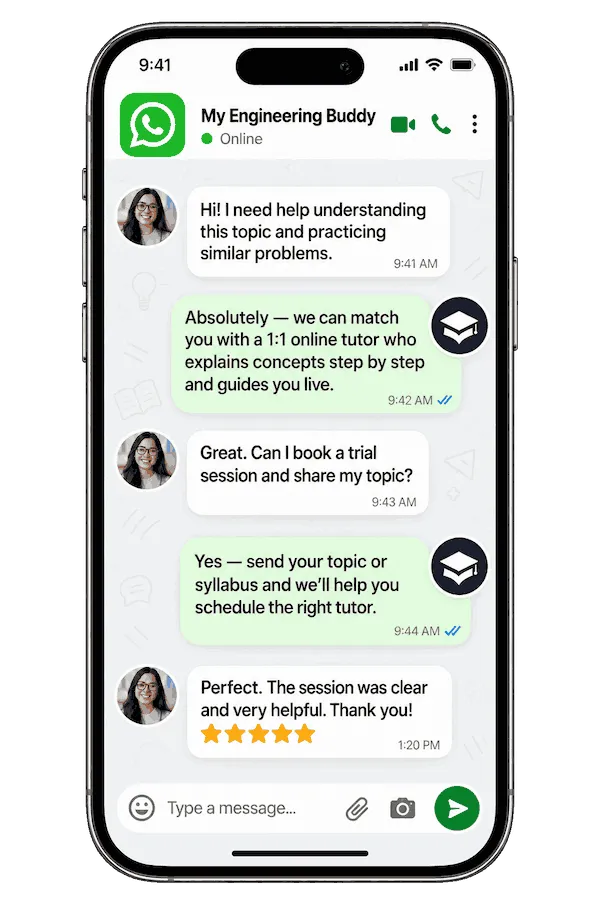
Unlike platforms where you fill out a form and wait, MEB responds in under a minute, 24/7. Tutor match takes under an hour. The $1 trial means you test before you commit. Everything runs over WhatsApp — no logins, no intake forms.
Study Plans (Pick One That Matches Your Goal)
Your Plant Anatomy tutor builds the exact session sequence after the first diagnostic, but here are the common patterns. Catch-up (1–3 weeks): for students behind on tissue systems or organ anatomy with an exam or practical within weeks — fast-track to the highest-yield topics first. Exam prep (4–8 weeks): structured revision working through all three tissue system categories, slide interpretation practice, and past paper questions systematically. Weekly support: ongoing sessions aligned to your lecture schedule, with academic guidance built in throughout the semester.
Pricing Guide
Plant Anatomy tutoring starts at $20/hr for standard undergraduate modules. Graduate-level support, specialist histology, or dissertation-linked anatomical analysis runs higher — up to $100/hr depending on tutor background and topic complexity. Rate factors include your course level, the depth of specialist knowledge required, your timeline, and tutor availability at short notice.
For students targeting admission to competitive postgraduate plant science programmes at institutions like Wageningen, UC Davis, or Kew-affiliated research courses, tutors with active plant biology research backgrounds are available at higher rates — share your goal and MEB will match the right tier.
Spots fill quickly during end-of-semester assessment periods. Start with the $1 trial — 30 minutes, no registration, no commitment. WhatsApp MEB for a quick quote.
MEB has been matching students with expert tutors since 2008. Rated 4.8/5 across 40,000+ reviews. The first session starts at $1 — and the tutor is already briefed on your syllabus before you log in.
Source: My Engineering Buddy, 2008–2025.
Try your first session for $1 — 30 minutes of live 1:1 tutoring or one homework question explained in full. No registration. No commitment. WhatsApp MEB now and get matched within the hour.
FAQ
Is Plant Anatomy hard?
It is harder than most students expect. The content is highly visual — success depends on recognising tissue types in micrographs under exam pressure, not just recalling definitions. Students who practice slide interpretation regularly with guided feedback tend to perform significantly better than those who revise from diagrams alone.
How many sessions are needed?
Most students see a measurable difference in slide interpretation accuracy within 4–6 sessions. Closing a full semester’s gaps before an exam typically takes 10–15 sessions over four to six weeks, depending on starting level. Your tutor will be specific about this after the diagnostic.
Can you help with practice exercises?
Yes — MEB tutoring is guided learning. Your tutor walks you through the reasoning behind each homework question on tissue identification, organ diagrams, or written lab descriptions, and you produce and submit your own work. See our Academic Integrity policy and Why MEB page for full details on what we help with and what we don’t.
Will the tutor match my exact syllabus or exam board?
Yes. Share your course syllabus, module guide, or university department name when you message MEB. Tutors are matched to your specific content — not to a generic botany curriculum. This matters most in Plant Anatomy, where different programmes weight slide practicals and written anatomy differently.
What happens in the first session?
The tutor runs a diagnostic — asking you to describe or label a cross-section, explain a tissue function, or walk through a past homework answer. This identifies the exact gap quickly. The session then moves into targeted explanation. You leave with a clear picture of what to focus on next.
Is online tutoring as effective as in-person?
For Plant Anatomy, yes — and in one way it’s better. Your tutor can annotate actual digital slide images in real time on screen, which is harder to do cleanly on paper. Google Meet plus a digital pen-pad replicates the whiteboard experience while adding the ability to zoom in on specific tissue regions during the session.
Can you help with understanding histological staining techniques?
Yes. Staining interpretation — knowing what safranin highlights versus toluidine blue, and why certain cell walls stain differently — is a specific skill MEB tutors cover. If your module includes lab practicals or slide preparation, tell MEB when you message so the tutor is matched accordingly.
I struggle to tell monocot and dicot anatomy apart under a microscope. Can a tutor help with that?
That is one of the most common Plant Anatomy sticking points, and it is exactly what 1:1 sessions are designed for. Your tutor works through real cross-section images with you, identifies the specific features you’re misreading, and builds a reliable recognition strategy — not just a list of differences to memorise.
Can I get Plant Anatomy help at midnight or over the weekend?
Yes. MEB operates 24/7. Send a WhatsApp message any time — average response is under one minute. Sessions are booked around your schedule, including evenings, weekends, and short-notice requests before a morning practical or submission deadline.
What if I don’t like my assigned tutor?
Tell MEB via WhatsApp. A replacement tutor is arranged, usually within the same day. The $1 trial is specifically designed so you can assess fit before committing to a full session block. If it is not the right match, MEB fixes it — no friction, no forms.
How do I get started?
Three steps: WhatsApp MEB, get matched with a Plant Anatomy tutor (usually within the hour), then start your $1 trial — 30 minutes of live tutoring or one homework question fully explained. Share your syllabus and deadline when you message and the tutor arrives prepared.
Trust & Quality at My Engineering Buddy
MEB tutors in Plant Anatomy hold degrees and postgraduate qualifications in plant science, botany, and related biological disciplines. Every tutor goes through a subject-specific screening process that includes a live demo evaluation and ongoing student feedback review. Generic biology credentials are not enough — tutors must demonstrate familiarity with histological methods, tissue system content, and the practical assessment formats used in university-level plant science programmes. Rated 4.8/5 across 40,000+ verified reviews on Google, MEB has been running since 2008. Find plant evolution tutoring and other specialist botany support through the same vetted network.
MEB tutoring is guided learning — you understand the work, then submit it yourself. For full details on what we help with and what we don’t, read our Academic Integrity policy and Why MEB.
MEB serves students in the US, UK, Canada, Australia, the Gulf, and across Europe in 2,800+ subjects since 2008. Botany subjects — including Plant Anatomy, phytochemistry tutoring, and ethnobotany help — are among the most requested in our life sciences catalogue. The tutoring methodology that underpins every session is documented at our tutoring methodology page.
At MEB, every Plant Anatomy tutor is matched by subject depth, not just broad biology background. The British Geological Survey and similar institutions employ graduates who understood structural science at the cellular level — that precision starts in courses like this one.
Source: British Geological Survey.
At MEB, we’ve found that the students who improve fastest in Plant Anatomy are the ones who come to the second session having genuinely attempted the practice slides from the first. Effort between sessions compounds. The tutor can only accelerate what the student is already doing.
Explore Related Subjects
Students studying Plant Anatomy often also need support in:
Next Steps
When you message MEB, share your exam board or university module name, the topic or lab component you’re finding hardest, and how many weeks you have before your assessment or submission. Include your time zone and preferred session times. MEB matches you with a verified Plant Anatomy tutor — usually within 24 hours, often within the hour.
Before your first session, have ready:
- Your course syllabus or module guide
- A recent homework question or past paper section you struggled with
- Your exam date or submission deadline
The tutor handles the rest. The first session begins with a diagnostic so every minute is used on what actually matters for your grade.
Visit www.myengineeringbuddy.com for more on how MEB works.
WhatsApp to get started or email [email protected].
Reviewed by Subject Expert
This page has been carefully reviewed and validated by our subject expert to ensure accuracy and relevance.




