~1 min
Average Reply Time
~1 hour
To Be Matched With A Tutor
30 Min Trial
75% Find Their Tutor On The 1st Trial
$20-35+/hr
Premium Yet Affordable Learning
Most students can name aspirin’s source plant. Few can explain how its secondary metabolites are extracted, standardized, and tested for bioactivity — and that’s where exam marks are lost.
Pharmacognosy Tutor Online
Pharmacognosy is the study of natural product medicines — plant, fungal, and animal-derived compounds — covering their identification, phytochemical composition, extraction, standardization, and biological activity. It equips pharmacy and biomedical students with the skills to evaluate crude drugs and medicinal plant preparations at undergraduate through doctoral level.
Finding a Pharmacognosy tutor near me who actually knows the difference between a volatile oil and a fixed oil — or why TLC Rf values vary between extraction solvents — is harder than it should be. MEB connects you with a verified Pharmacognosy tutor online who has worked through exactly those problems, at exactly your course level. Sessions are 1:1, scheduled around your time zone, and built around your syllabus from the first session.
- 1:1 online sessions tailored to your pharmacy or biomedical sciences course
- Expert verified tutors with hands-on pharmacognosy and phytochemistry knowledge
- Flexible time zones — US, UK, Canada, Australia, Gulf, and Europe covered
- Structured learning plan built after a diagnostic session
- Ethical academic guidance — you understand the material before you submit
52,000+ students across the US, UK, Canada, Australia, and the Gulf have used MEB since 2008 — across 2,800+ subjects, from AP Calculus to A Level Music Technology to Data Science.
Source: My Engineering Buddy, 2008–2025.
How Much Does a Pharmacognosy Tutor Cost?
Most Pharmacognosy tutoring sessions run $20–$40/hr. Graduate-level work — covering topics like HPLC method validation, structure-activity relationships, or advanced biosynthetic pathways — can reach $70–$100/hr depending on tutor specialization. A $1 trial gets you 30 minutes of live 1:1 tutoring or one full homework question explained in detail.
| Level / Need | Typical Rate | What’s Included |
|---|---|---|
| Undergraduate (most levels) | $20–$40/hr | 1:1 sessions, homework guidance, syllabus alignment |
| Graduate / Specialist | $40–$100/hr | Expert tutor, advanced phytochemistry, research depth |
| $1 Trial | $1 flat | 30 min live session or one full homework question |
Tutor availability tightens around pharmacy board exam windows and end-of-semester assessment periods. Book early if your deadline is within four weeks.
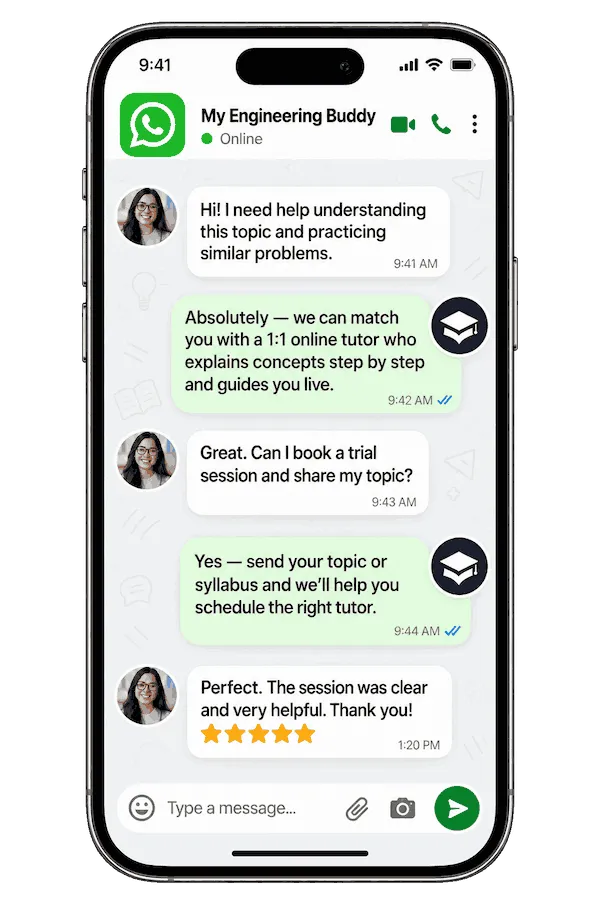
WhatsApp MEB for a quick quote — average response time under 1 minute.
Who This Pharmacognosy Tutoring Is For
This service is built for pharmacy, biomedical sciences, and natural products students who are stuck — not because they lack effort, but because pharmacognosy covers an unusually wide range of disciplines and most courses assume prior knowledge in organic chemistry, botany, and analytical techniques simultaneously.
- Undergraduate pharmacy students working through crude drug analysis, plant taxonomy, or phytochemical screening for the first time
- Graduate students whose thesis or coursework involves secondary metabolite characterization, HPLC fingerprinting, or ethnobotanical validation
- Students retaking a pharmacognosy module after a failed first attempt who need a clear, structured plan before the resit
- Students at the University of Michigan, University of Toronto, King’s College London, University of Sydney, or similar pharmacy schools needing tutor support aligned to their specific course structure
- Researchers and postgraduate students designing natural product extraction studies who need a conceptual sounding board
- Students with phytochemistry tutoring needs that overlap with pharmacognosy coursework
1:1 Tutoring vs Self-Study vs AI Tools
Self-study with a textbook works — right up until you cannot tell whether your thin-layer chromatography interpretation is wrong or your solvent system is wrong, and there is no one to ask. AI tools can define alkaloids and explain the Krebs cycle quickly, but they cannot look at your actual TLC plate photograph, diagnose why your Rf values do not match the reference standard, and adapt the explanation to the exact extraction protocol your lab uses. In pharmacognosy specifically, real-time annotation of chromatogram results and biosynthetic pathway diagrams matters far more than a text-based explanation. MEB tutors work live on screen with a digital pen-pad, covering your exact syllabus and correcting the precise reasoning gap — not a generic version of the problem.
Outcomes: What You’ll Be Able To Do in Pharmacognosy
After targeted 1:1 Pharmacognosy tutoring, you will be able to apply macroscopic and microscopic identification methods to authenticate crude plant drugs with confidence. You will analyze secondary metabolite classes — alkaloids, terpenoids, flavonoids, glycosides — and explain their biosynthetic origins from primary metabolic intermediates. You will solve phytochemical screening problems, present extraction yield data in a format your assessor expects, and write up standardization procedures that meet pharmacopoeial criteria. You will apply your knowledge of pharmacological activity to link chemical structure to therapeutic use in the context of your course assignments.
Supporting a student through Pharmacognosy? MEB works directly with parents to set up sessions, track progress, and keep coursework on schedule. WhatsApp MEB — average response time is under a minute, 24/7.
Based on feedback from 40,000+ sessions collected by MEB from 2022 to 2025, 58% of students improved by one full grade after approximately 20 hours of 1:1 tutoring in a single subject. A further 23% achieved at least a half-grade improvement.
Source: MEB session feedback data, 2022–2025.
What We Cover in Pharmacognosy (Syllabus / Topics)
< >
>
Crude Drug Identification and Quality Control
- Macroscopic and microscopic evaluation of plant-derived drugs
- Organoleptic characters: odour, taste, texture, colour
- Ash value determination: total, acid-insoluble, water-soluble
- Moisture content, swelling index, and foaming index
- Crude drug adulteration types and detection methods
- Pharmacopoeial standards — British Pharmacopoeia and USP monographs
- Foreign organic matter and loss on drying calculations
Key texts: Pharmacognosy by Evans (Trease & Evans, 17th ed.) and the British Pharmacopoeia are the standard references for this track.
Phytochemistry and Secondary Metabolites
- Biosynthetic pathways: shikimate, mevalonate, acetate-malonate routes
- Alkaloids: classification, extraction, identification reactions (Mayer’s, Dragendorff’s)
- Terpenoids and essential oils: steam distillation, GC analysis
- Flavonoids, tannins, and phenolic compounds: extraction and characterization
- Glycosides: cardiac, anthraquinone, saponin — hydrolysis and bioactivity
- Chromatographic techniques: TLC, column chromatography, HPLC fingerprinting
- Structure-activity relationships for naturally occurring compounds
Core texts: Natural Products Chemistry by Dewick and Phytochemical Methods by Harborne are widely used at this level. For additional ethnobotany tutoring on medicinal plant use, MEB covers that separately.
Pharmacobotany and Medicinal Plant Studies
- Plant taxonomy relevant to pharmacy: families Solanaceae, Apiaceae, Fabaceae, Asteraceae
- Morphological features of medicinally important plants
- Collection, drying, and storage of crude drugs
- Ethnopharmacological validation of traditional plant medicines
- Cultivation and post-harvest handling affecting phytochemical yield
- Conservation and sustainability of medicinal plant resources
Texts: Medicinal Natural Products by Dewick (3rd ed.) and Pharmacognosy and Pharmacobiotechnology by Robbers, Speedie, and Tyler cover this material at undergraduate level.
At MEB, we’ve found that pharmacognosy students often lose marks not on content knowledge but on applying the right identification test to the right compound class under exam conditions. Tutors focus on drilling that decision logic early — before the student ever faces it in a timed setting.
What a Typical Pharmacognosy Session Looks Like
The tutor opens by checking the previous session’s topic — usually something like ash value calculation or TLC interpretation — to see whether the reasoning has stuck. From there, the student and tutor work through two or three active problems on screen: annotating a biosynthetic pathway diagram for a terpenoid, walking through the logic of a glycoside hydrolysis question, or correcting an error in a phytochemical screening flowchart. The tutor writes directly on the shared screen using a digital pen-pad, and the student is asked to replicate or explain each step. By the end of the session, there is one concrete practice task to complete before next time, and the next topic — often moving from secondary metabolite identification toward extraction yield calculations — is already mapped out.
How MEB Tutors Help You with Pharmacognosy (The Learning Loop)
Diagnose: In the first session, the tutor asks you to attempt a representative question — typically crude drug identification or a phytochemical extraction calculation. Where you hesitate or go wrong tells them exactly which concept is shaky and which is missing entirely.
Explain: The tutor then works through the problem live, annotating biosynthetic pathways or chromatogram layouts on a digital pen-pad in real time. Not a slide. Not a pre-recorded video. A worked solution built in front of you.
Practice: You attempt the next question yourself while the tutor watches. Silence is useful data — if you pause on a specific step, the tutor knows where the gap still is.
Feedback: Every error gets a targeted correction: here is what you did, here is why it costs marks, here is the correct reasoning path. No vague encouragement. Specific, step-by-step.
Plan: At the end of each session, the tutor sets the next topic in sequence — moving from, say, alkaloid extraction to glycoside bioactivity — with an estimated time to close each gap before your assessment date.
Sessions run over Google Meet with a digital pen-pad or iPad and Apple Pencil. Before your first session, share your course outline or syllabus and one recent homework or past paper question you found difficult. The first session covers that question and runs the diagnostic. Start with the $1 trial — 30 minutes of live tutoring that also serves as your first diagnostic.
Try your first session for $1 — 30 minutes of live 1:1 tutoring or one homework question explained in full. No registration. No commitment. WhatsApp MEB now and get matched within the hour.
Tutor Match Criteria (How We Pick Your Tutor)
Not every tutor who knows organic chemistry knows pharmacognosy. MEB matches on specifics.
Subject depth: Tutors are vetted for working knowledge of pharmacopoeial standards, phytochemical analysis, and crude drug quality control — not just general biology or chemistry backgrounds. The match is made to your exact course level and topic list.
Tools: Every session uses Google Meet with a digital pen-pad or iPad and Apple Pencil for live annotation of pathways, TLC diagrams, and extraction flowcharts. Nothing is delivered as a pre-made slide deck.
Time zone: MEB tutors cover New York, Los Angeles, Chicago, London, Dubai, Toronto, Sydney, Melbourne, and all major European time zones — evenings and weekends included.
Learning style: The tutor calibrates their pace and explanation approach based on what the diagnostic session shows — not a pre-session questionnaire.
Communication: Clear English, adapted to the student’s level. Graduate-level students get graduate-level discussion. First-year undergraduates get first-principles explanations.
Goals: Whether the priority is passing a resit, closing gaps before a final exam, completing a lab report on secondary metabolite extraction, or building research-level knowledge of HPLC fingerprinting — the tutor is matched to that specific goal.
Unlike platforms where you fill out a form and wait, MEB responds in under a minute, 24/7. Tutor match takes under an hour. The $1 trial means you test before you commit. Everything runs over WhatsApp — no logins, no intake forms.
Study Plans (Pick One That Matches Your Goal)
The tutor builds your specific sequence after the diagnostic, but the shape of the plan depends on where you are starting from. A catch-up plan covers one or two core topic areas — crude drug identification, phytochemical screening — in one to three weeks. An exam prep plan runs four to eight weeks, working through the full syllabus in assessed order. Weekly ongoing support runs alongside your semester, keeping coursework and lab reports on track as new topics appear. All three options begin with the same diagnostic first session.
Pricing Guide
Pharmacognosy tutoring starts at $20/hr for standard undergraduate content. Rate factors include course level, topic depth — a session on HPLC method validation costs more than one on macroscopic drug identification — tutor availability, and how quickly you need to be matched. Availability tightens significantly in the four weeks before pharmacy school assessment periods.
For students targeting competitive pharmacy postgraduate programmes, research positions, or roles in the natural products industry, tutors with professional analytical chemistry or drug development backgrounds are available at higher rates — share your specific goal and MEB will match the tier to your ambition.
Start with the $1 trial — 30 minutes, no registration, no commitment. WhatsApp MEB for a quick quote.
MEB has been running 1:1 online sessions since 2008. The model is simple: one student, one expert tutor, every session built around the exact problem in front of you — not a pre-recorded module or a generic study pack.
Source: My Engineering Buddy, 2008–2025.
FAQ
Is Pharmacognosy hard?
It spans organic chemistry, plant biology, and analytical techniques simultaneously. That breadth is where most students get stuck. Each individual topic is manageable — the difficulty is connecting them. A tutor who knows the subject stops you building incorrect connections early, before they compound.
How many sessions are needed?
Most students working toward a specific exam or resit need eight to fifteen sessions depending on how many topic areas need attention. Students with one specific gap — say, biosynthetic pathways or TLC interpretation — can close it in three to five focused sessions.
Can you help with practice exercises?
Yes. The tutor explains the underlying concept and works through a similar example with you. You then complete your own work. MEB tutoring is guided learning — you understand the work, then submit it yourself. For full details on what we help with and what we don’t, read our Academic Integrity policy and Why MEB.
Will the tutor match my exact syllabus or exam board?
Yes. Share your course outline or university module descriptor before the first session. The tutor reviews it and maps sessions to your specific assessed content — British Pharmacopoeia standards, USP monographs, or your institution’s own curriculum, depending on your programme.
What happens in the first session?
The tutor reviews a question or topic you have already attempted, identifies where the reasoning breaks down, and covers that gap in full. By the end you have a worked example you understand and a clear plan for the sessions that follow.
Is online tutoring as effective as in-person?
For pharmacognosy theory, analysis, and problem-solving, yes. Live annotation on screen with a digital pen-pad replicates the whiteboard experience. Students across the US, UK, Canada, and Australia consistently report the same quality of explanation as face-to-face teaching.
Can I get Pharmacognosy help at midnight or on weekends?
Yes. MEB operates 24/7 across all time zones. WhatsApp a request at midnight, and you will typically have a tutor matched and a session confirmed within the hour. Demand is highest in the two weeks before assessment periods, so early booking is worth it.
What if I don’t like my assigned tutor?
Request a different match. MEB does not lock you in after the trial. If the first tutor’s style or explanation approach is not working, message MEB and a replacement is arranged — usually the same day, no questions asked.
Do you offer help with plant-drug identification practicals and lab-based coursework?
Yes. Tutors can work through microscopy interpretation, ash value calculations, extraction yield write-ups, and phytochemical screening flowcharts. The focus is always on explanation and reasoning — the student produces and submits their own work.
How do I get started?
Three steps: WhatsApp MEB with your subject, level, and exam date. You get matched with a verified pharmacognosy tutor — usually within an hour. Your first session is the $1 trial: 30 minutes of live tutoring or one full homework question explained from start to finish. No registration required.
Trust & Quality at My Engineering Buddy
Every MEB tutor goes through subject-specific screening: a live demo evaluation, degree and qualification verification, and ongoing performance review based on student feedback after each session. Tutors covering pharmacognosy hold pharmacy, natural products chemistry, or biomedical sciences degrees at graduate level or above, and are selected based on their working knowledge of specific sub-areas — not just a general life sciences background. Rated 4.8/5 across 40,000+ verified reviews on Google.
MEB tutoring is guided learning — you understand the work, then submit it yourself. For full details on what we help with and what we don’t, read our Academic Integrity policy and Why MEB.
MEB has served 52,000+ students across the US, UK, Canada, Australia, the Gulf, and Europe in 2,800+ subjects since 2008. Students needing support in related areas can access plant pathology tutoring, plant taxonomy help, and cytology tutoring through the same platform. The tutor matching and session structure is consistent across all subjects — one student, one expert, every session.
Students consistently tell us that the biggest shift in pharmacognosy comes when they stop memorising compound classes and start understanding why each identification test works chemically. That shift usually happens in the third or fourth session — and it changes how the student approaches every question after it.
MEB’s tutoring methodology is built on diagnostic-first sessions, live worked examples, and structured feedback — the same approach across every subject, from first-year pharmacy to doctoral research. Read more at our tutoring methodology page.
Source: My Engineering Buddy.
Explore Related Subjects
Students studying Pharmacognosy often also need support in:
Next Steps
Getting started takes less than five minutes.
- Share your exam board or course outline, the topic you are most stuck on, and your exam or submission date
- Share your time zone and availability — evenings and weekends are fully covered
- MEB matches you with a verified pharmacognosy tutor, usually within 24 hours
Before your first session, have ready: your exam board and syllabus or course outline, a recent past paper attempt or homework question you struggled with, and your exam or deadline date. The tutor handles the rest.
Visit www.myengineeringbuddy.com for more on how MEB sessions are structured and what to expect from your first session.
WhatsApp to get started or email [email protected].
Reviewed by Subject Expert
This page has been carefully reviewed and validated by our subject expert to ensure accuracy and relevance.