




~1 min
Average Reply Time
~1 hour
To Be Matched With A Tutor
30 Min Trial
75% Find Their Tutor On The 1st Trial
$20-35+/hr
Premium Yet Affordable Learning
Most students hit a wall identifying Carboniferous plant fossils — not because they’re not capable, but because nobody ever showed them the diagnostic keys.
Paleobotany Tutor Online
Paleobotany is the scientific study of fossil plants, algae, and fungi through geologic time. Typically studied at undergraduate and postgraduate level, it equips students to reconstruct ancient ecosystems, interpret plant evolution, and apply fossil evidence to stratigraphy and climate reconstruction.
MEB offers 1:1 online Paleobotany tutoring and academic guidance across 2,800+ advanced subjects. If you’ve searched for a Paleobotany tutor near me and found no one locally who actually knows the subject, MEB connects you with verified tutors who do — usually within the hour. Sessions are built around your course, not a generic syllabus.
- 1:1 online sessions tailored to your university course or research module
- Expert verified tutors with subject-specific knowledge in fossil plant identification, stratigraphy, and plant evolution
- Flexible time zones — US, UK, Canada, Australia, Gulf
- Structured learning plan built after a diagnostic session
- Ethical academic guidance — you understand the material before you submit
52,000+ students across the US, UK, Canada, Australia, and the Gulf have used MEB since 2008 — across 2,800+ subjects, from AP Calculus to A Level Music Technology to Data Science.
Source: My Engineering Buddy, 2008–2025.
How Much Does a Paleobotany Tutor Cost?
Most Paleobotany tutoring sessions run $20–$40/hr. Postgraduate and research-level work, including dissertation support or specialist fossil group analysis, reaches up to $100/hr. A $1 trial gets you 30 minutes of live tutoring or one full homework question explained — no registration needed.
| Level / Need | Typical Rate | What’s Included |
|---|---|---|
| Undergraduate (most levels) | $20–$40/hr | 1:1 sessions, homework guidance, fossil ID support |
| Postgraduate / Research | $40–$100/hr | Expert tutor, dissertation support, specialist fossil groups |
| $1 Trial | $1 flat | 30 min live session or one homework question explained in full |
Tutor availability tightens around end-of-semester dissertation deadlines and fieldwork report submission windows. Book early if your deadline is within four weeks.
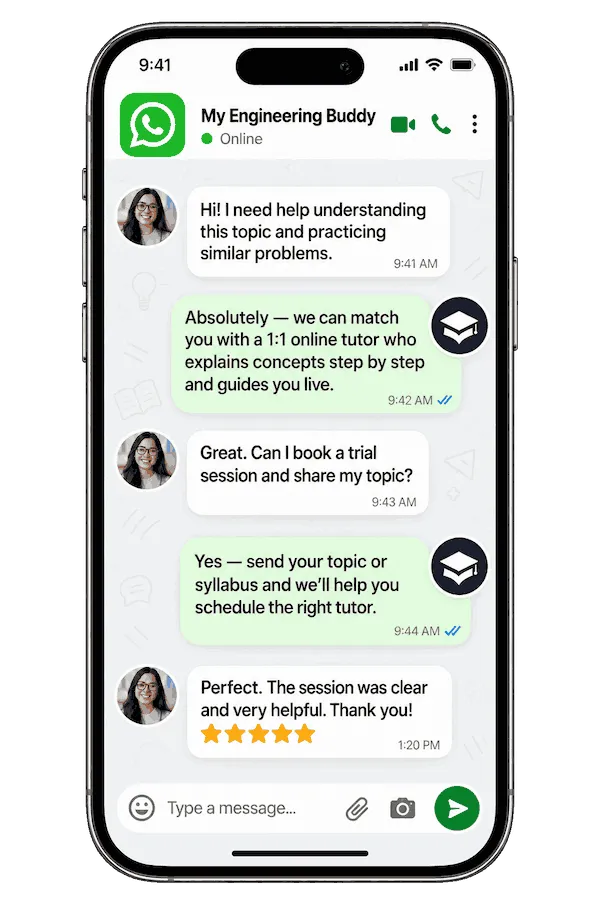
WhatsApp MEB for a quick quote — average response time under 1 minute.
Who This Paleobotany Tutoring Is For
Paleobotany tutoring at MEB is built for students who need more than a textbook and a lecture recording. Whether you’re working through Pennsylvanian coal swamp flora for the first time or writing a masters dissertation on Cretaceous angiosperm diversification, the support is calibrated to where you actually are.
- Undergraduate students taking paleobotany as a core or elective module in geology, biology, or earth sciences programmes at universities including Yale, Cambridge, ETH Zürich, the University of Edinburgh, and the University of Toronto
- Masters and PhD students needing structured support with fossil plant taxonomy, phylogenetic analysis, or paleoecological reconstruction
- Students who failed or underperformed in a paleobotany assessment and are retaking the module or resitting an exam
- Students whose dissertation proposal has been sent back for revision and who need expert guidance on the plant fossil evidence section
- Researchers transitioning into paleobotany from adjacent fields such as plant evolution tutoring or stratigraphy
- Students struggling to connect lecture content to lab practicals — fossil identification under a microscope, slide preparation, or thin section interpretation
1:1 Tutoring vs Self-Study vs AI Tools
Self-study works if you’re disciplined and the material is well-structured — but paleobotany is full of edge cases in fossil identification where you can reinforce a wrong assumption for weeks without realising it. AI tools give fast explanations of broad concepts like the evolution of vascular plants or the Carboniferous coal measures, but they can’t look at your thin section micrograph, tell you why your identification of a Lepidodendron specimen is off, and walk you through the diagnostic features in real time. That requires a tutor who has done it before. MEB sessions run over Google Meet with a digital pen-pad, giving you the live annotated feedback loop that self-study and AI simply cannot replicate for a subject this visually and analytically demanding.
Outcomes: What You’ll Be Able To Do in Paleobotany
After working with an MEB Paleobotany tutor, students report real gains in the practical and analytical skills that assessments actually test. You’ll be able to analyze fossil plant morphology and assign specimens to the correct taxonomic group using established identification keys. You’ll apply stratigraphic principles to interpret plant-bearing rock sequences and explain what a given flora tells us about paleoclimate. You’ll solve phylogenetic placement problems for early land plants using cladistic methods covered in your course. You’ll write lab reports and dissertation chapters that correctly integrate macrofossil, microfossil, and geochemical evidence. You’ll present paleoecological reconstructions of ancient environments — from Devonian rhyniophytes to Eocene rainforest assemblages — with the precision your examiners expect.
Based on feedback from 40,000+ sessions collected by MEB from 2022 to 2025, 58% of students improved by one full grade after approximately 20 hours of 1:1 tutoring in a single subject. A further 23% achieved at least a half-grade improvement.
Source: MEB session feedback data, 2022–2025.
Try your first session for $1 — 30 minutes of live 1:1 tutoring or one homework question explained in full. No registration. No commitment. WhatsApp MEB now and get matched within the hour.
What We Cover in Paleobotany (Syllabus / Topics)

Track 1: Fossil Plant Identification and Morphology
- Gross morphology of leaves, stems, roots, and reproductive structures in fossil plants
- Diagnostic features for major plant groups: lycopsids, sphenopsids, ferns, seed ferns, cordaitaleans, conifers, angiosperms
- Cuticle analysis and epidermal features as identification tools
- Compression, impression, permineralisation, and coalball preservation types
- Thin section preparation and interpretation under transmitted light microscopy
- Use of reference collections and identification keys for common Carboniferous and Cretaceous floras
- Lab practical write-up structure and fossil description conventions
Core texts for this track include Stewart and Rothwell’s Paleobotany and the Evolution of Plants and Taylor, Taylor, and Krings’ Paleobotany: The Biology and Evolution of Fossil Plants (2nd ed.).
Track 2: Plant Evolution and Phylogenetics
- Origins of land plants from charophycean algae — fossil and molecular evidence
- Devonian diversification: rhyniophytes, zosterophylls, trimerophytes
- Evolution of the leaf (microphyll vs megaphyll debate)
- Seed plant origins and Carboniferous seed fern radiation
- Rise of angiosperms: Cretaceous diversification and Darwin’s “abominable mystery”
- Cladistic methods applied to plant fossil data — character selection and matrix construction
- Interpreting phylogenetic trees in the context of the fossil record
Recommended reading includes Kenrick and Crane’s The Origin and Early Diversification of Land Plants and Willis and McElwain’s The Evolution of Plant Physiology.
Track 3: Paleoecology, Stratigraphy, and Palaeoclimate
- Plant fossils as stratigraphic markers — biostratigraphy and zone fossils
- Reconstructing ancient biomes: coal swamps, Mesozoic forests, Eocene tropics
- Palynology basics — spore and pollen morphology, dispersal, and assemblage interpretation
- Stomatal index and leaf margin analysis as palaeoclimate proxies
- Linking plant fossil assemblages to sea level change and climate events
- Writing paleoecological reconstruction sections in dissertations and reports
Key texts include Beerling’s The Emerald Planet and Wing and Boucher’s papers on Paleocene-Eocene floral change, available through your university library.
What a Typical Paleobotany Session Looks Like
The tutor opens by checking where you got to on last session’s topic — say, distinguishing Lepidodendron from Sigillaria using stem surface patterns. If that’s solid, you move on. If there are still gaps, you spend five minutes closing them before going further. From there, tutor and student work through the current problem together on screen: the tutor annotates a fossil image or diagram using a digital pen-pad, walks through the diagnostic reasoning step by step, then asks you to apply the same process to a new specimen. You explain your thinking out loud. The tutor picks up exactly where the reasoning breaks down — not just that the answer is wrong, but why. The session closes with a specific task: two fossil descriptions to complete, one stratigraphy question to attempt, or a section of your lab report to draft before the next meeting.
How MEB Tutors Help You with Paleobotany (The Learning Loop)
Diagnose: In the first session, the tutor identifies exactly where your understanding breaks down — whether that’s fossil identification, stratigraphic interpretation, phylogenetic reasoning, or dissertation structure. This isn’t guesswork; it’s a structured diagnostic that takes 20–30 minutes and shapes every session that follows.
Explain: The tutor works through problems live, annotating fossil images, diagrams, and specimen descriptions on a digital pen-pad shared over Google Meet. You see the reasoning built step by step, not just the finished answer.
Practice: You attempt the next problem with the tutor present. This is the stage most students skip when studying alone — and it’s where the real learning happens. Mistakes made here get caught immediately.
Feedback: The tutor goes through your attempt line by line. You find out not just what was wrong but which part of your reasoning produced the error — and how an examiner or dissertation supervisor would read it.
Plan: At the end of each session, the tutor sets the next topic, the task to complete before you meet again, and a realistic timeline to your deadline. Nothing is left vague.
Sessions run over Google Meet. The tutor uses a digital pen-pad or iPad with Apple Pencil to annotate specimens, diagrams, and your own draft work in real time. Before your first session, share your course outline or module handbook, any recent lab reports or assignments that were marked down, and your exam or submission date. The first session covers diagnosis and the first substantive topic in the same hour. Start with the $1 trial — 30 minutes of live tutoring that also serves as your first diagnostic.
At MEB, we’ve found that students who attempt a problem before asking for help — even if the attempt is wrong — make faster progress than those who wait for an explanation first. The mistake is the data. Bring it to the session.
Tutor Match Criteria (How We Pick Your Tutor)
Not every tutor with a biology or geology degree can teach paleobotany well. MEB matches on specifics.
Subject depth: Tutors are matched to your exact course level — undergraduate fossil identification practicals, masters paleoecology coursework, or PhD dissertation chapters on plant phylogenetics. We don’t assign a general biology tutor to a paleobotany module.
Tools: All sessions use Google Meet with digital pen-pad or iPad and Apple Pencil annotation. Tutors working with students on microscopy or image analysis can share and mark up specimen photographs directly on screen.
Time zone: Tutors are available across New York, Los Angeles, Chicago, London, Dubai, Toronto, Sydney, and Melbourne time zones — evenings and weekends included.
Learning style: The first session diagnostic establishes how you process new information — whether you need worked examples first or prefer to attempt problems before receiving explanation. The tutor adapts from session two onward.
Communication: Clear English, matched to your level. A first-year undergraduate and a PhD candidate need different explanations of the same concept.
Goals: Whether you need to pass a practical exam, strengthen your dissertation’s fossil evidence section, or build conceptual depth across the whole module, the tutor is matched to that specific objective.
Unlike platforms where you fill out a form and wait, MEB responds in under a minute, 24/7. Tutor match takes under an hour. The $1 trial means you test before you commit. Everything runs over WhatsApp — no logins, no intake forms.
Study Plans (Pick One That Matches Your Goal)
After the first diagnostic session, your tutor builds a specific sequence. The three most common patterns: a catch-up plan for students 1–3 weeks from a submission with clear gaps to close; a structured revision plan over 4–8 weeks for students preparing for a practical exam or viva; and ongoing weekly support aligned to semester deadlines for students who want consistent progress through a full paleobotany module. The tutor adjusts the plan as you go — nothing is fixed if circumstances change.
Pricing Guide
Undergraduate paleobotany tutoring starts at $20/hr and runs to $40/hr for most course levels. Specialist postgraduate support — dissertation chapters, paleoecological reconstruction, fossil phylogenetics at research depth — reaches up to $100/hr. Rate depends on the level of the material, how quickly you need to progress, and tutor availability.
For students targeting research programmes at institutions with strong paleobotany faculties, tutors with active research backgrounds in fossil plant systematics or Mesozoic paleoecology are available at higher rates — share your specific goal and MEB will match the right tutor to your work.
Availability tightens around dissertation submission windows, typically April–May and November–December. Book early if you’re within six weeks of a deadline. Start with the $1 trial — 30 minutes, no registration, no commitment. WhatsApp MEB for a quick quote.
MEB tutors cover subjects from foundational plant biology to highly specialised research-level paleobotany — including plant taxonomy tutoring, cytology help, and plant anatomy tutoring for students at every level.
Source: My Engineering Buddy, 2008–2025.
FAQ
Is Paleobotany hard?
It’s demanding. The subject requires you to hold geology, biology, and evolutionary theory together simultaneously. Fossil identification is learned through practice — it doesn’t come from reading alone. Most students find the practical component the steepest part of the learning curve, and that’s exactly where a tutor adds the most value.
How many sessions are needed?
Students with a single gap to close — one fossil group, one stratigraphy concept — typically need 3–5 sessions. Students working through a full module or dissertation chapter over a semester typically book weekly sessions for 8–12 weeks. The first diagnostic clarifies the number quickly.
Can you help with practice exercises?
Yes. MEB tutors explain concepts, walk through fossil identification problems, and help you understand what your lab report or essay needs to argue — and why. You do the writing and the analysis yourself.
MEB tutoring is guided learning — you understand the work, then submit it yourself. For full details on what we help with and what we don’t, read our Academic Integrity policy and Why MEB.
Will the tutor match my exact syllabus or exam board?
Yes. Share your course outline, module handbook, or reading list when you contact MEB and the tutor is matched to your specific content — not a generic paleobotany overview. This applies whether your module is assessed by practical exam, essay, dissertation, or coursework portfolio.
What happens in the first session?
The tutor runs a 20–30 minute diagnostic to identify where your understanding breaks down — fossil identification accuracy, stratigraphic reasoning, phylogenetic method, or written analysis. The remaining time covers the first substantive topic. You leave with a clear task and a plan for subsequent sessions.
Is online tutoring as effective as in-person?
For paleobotany, yes — and in some ways more so. Fossil images, microscope photographs, and diagrams are shared and annotated directly on screen. The tutor’s pen-pad annotation is often clearer than a physical whiteboard. Students in the US, UK, and Australia consistently report comparable outcomes to in-person sessions.
Can I get Paleobotany help at midnight or on weekends?
Yes. MEB operates 24/7 across all major time zones. Tutors are available evenings, weekends, and public holidays. If your dissertation deadline falls on a Monday morning, Sunday night support is available. WhatsApp MEB with your time zone and preferred slot.
What if I don’t get on with my assigned tutor?
Say so and MEB will match you with a different tutor — same day if needed. The $1 trial exists precisely so you can test the match before committing to a full session block. No awkward conversations. Just WhatsApp MEB and request a change.
Do you offer help for students studying paleobotany in the Gulf or Australia?
Yes. MEB has students in the UAE, Saudi Arabia, Qatar, Australia, and New Zealand studying paleobotany through geology and earth sciences programmes. Tutors are matched across those time zones. Sessions run identically regardless of where you are — Google Meet, digital pen-pad, same tutor quality.
How do I get started?
Three steps: WhatsApp MEB with your subject, level, and deadline — you’ll be matched with a verified tutor within the hour. Then take the $1 trial — 30 minutes of live tutoring or one homework question fully explained. If it works, book your next session. That’s it.
Trust & Quality at My Engineering Buddy
Every MEB tutor goes through subject-specific screening — a live demo evaluation, review of their academic and professional background, and ongoing feedback monitoring after sessions begin. Paleobotany tutors hold postgraduate degrees in geology, botany, earth sciences, or evolutionary biology, with demonstrable experience in fossil plant work at course or research level. Rated 4.8/5 across 40,000+ verified reviews on Google.
MEB tutoring is guided learning — you understand the work, then submit it yourself. For full details on what we help with and what we don’t, read our Academic Integrity policy and Why MEB.
MEB has been running since 2008, serving 52,000+ students across the US, UK, Canada, Australia, the Gulf, and Europe in 2,800+ subjects. If you need plant pathology tutoring, ethnobotany help, or phytochemistry academic guidance, the same quality of tutor matching applies. See our tutoring methodology for details on how sessions are structured and how progress is tracked.
Students consistently tell us that the moment things click in paleobotany is when they stop memorising fossil names and start reading the plant as a system — growth habit, preservation environment, taxonomic position, and ecological context together. That shift usually happens in a single session with the right tutor.
Explore Related Subjects
Students studying Paleobotany often also need support in:
Next Steps
Getting started takes about two minutes.
- Share your exam board or course outline, your hardest component, and your current deadline
- Share your availability and time zone
- MEB matches you with a verified Paleobotany tutor — usually within 24 hours, often faster
Before your first session, have ready: your module handbook or course outline, a recent lab report or assignment that was marked down, and your exam or submission date. The tutor handles the rest.
Visit www.myengineeringbuddy.com for more on how the MEB process works, what to expect from your first session, and how tutors are matched.
WhatsApp to get started or email [email protected].
Reviewed by Subject Expert
This page has been carefully reviewed and validated by our subject expert to ensure accuracy and relevance.




