~1 min
Average Reply Time
~1 hour
To Be Matched With A Tutor
30 Min Trial
75% Find Their Tutor On The 1st Trial
$20-35+/hr
Premium Yet Affordable Learning
Fungi destroyed 30% of a student’s crop disease dataset two weeks before submission. Their Plant Pathology tutor found the gap in four hours.
Plant Pathology Tutor Online
Plant Pathology is the scientific study of plant diseases caused by pathogens — fungi, bacteria, viruses, nematodes, and abiotic factors — equipping students to diagnose, manage, and prevent crop and ecosystem losses.
MEB provides 1:1 online tutoring and academic guidance in 2,800+ advanced subjects, including Plant Pathology. If you’ve searched for a Plant Pathology tutor near me and found generic platforms with long wait times, MEB is different — you’re matched with a verified subject specialist, usually within the hour. Our Botany tutoring network spans the full plant science spectrum, and Plant Pathology is one of our most requested specialisms.
- 1:1 online sessions tailored to your course syllabus or university module
- Expert-verified tutors with subject-specific knowledge in plant disease science
- Flexible time zones — US, UK, Canada, Australia, Gulf
- Structured learning plan built after a diagnostic session
- Ethical academic guidance — you understand before you submit
52,000+ students across the US, UK, Canada, Australia, and the Gulf have used MEB since 2008 — including students in Botany subjects like Plant Pathology, Plant Anatomy, and Phytochemistry.
Source: My Engineering Buddy, 2008–2025.
How Much Does a Plant Pathology Tutor Cost?
Most Plant Pathology tutoring sessions run $20–$40/hr. Graduate-level and specialist topics — disease resistance genetics, molecular diagnostics, or nematology — can reach $60–$100/hr. Not sure of your tier? Start with the $1 trial and MEB will quote you after seeing your syllabus.
| Level / Need | Typical Rate | What’s Included |
|---|---|---|
| Undergraduate (standard) | $20–$35/hr | 1:1 sessions, homework guidance, disease ID practice |
| Advanced / Graduate | $35–$70/hr | Expert tutor, molecular pathology, research support |
| $1 Trial | $1 flat | 30 min live session or one homework question explained in full |
Tutor availability tightens around semester finals and dissertation submission windows. Book early if your deadline is within four weeks.
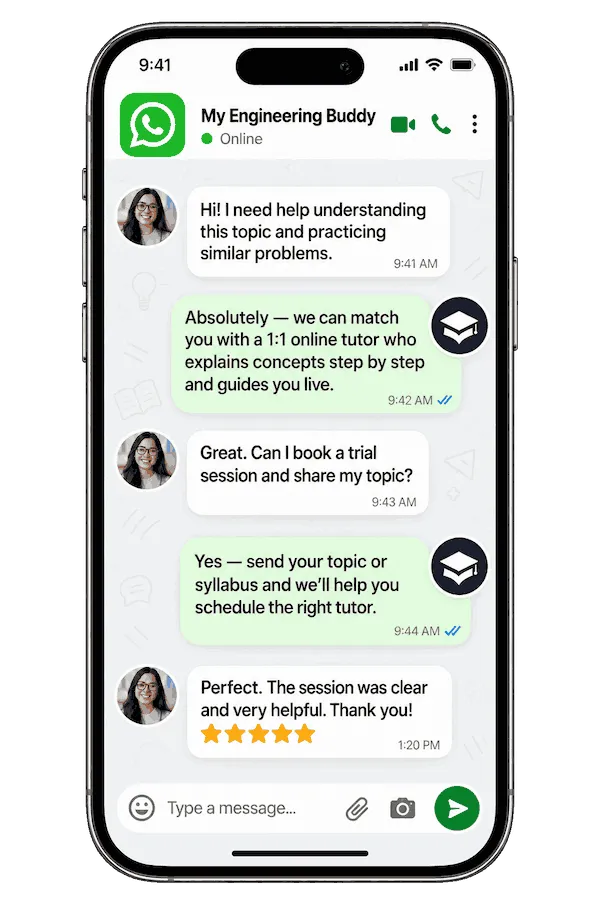
WhatsApp MEB for a quick quote — average response time under 1 minute.
Who This Plant Pathology Tutoring Is For
Plant Pathology draws students from agriculture, biology, environmental science, and food security programmes. The subject rewards precision — and punishes vague answers about disease cycles or host-pathogen interactions.
- Undergraduate students in plant science, agronomy, or horticulture programmes struggling with pathogen classification
- MSc and PhD students needing support with disease resistance mechanisms or molecular diagnostic techniques
- Students retaking after a failed first attempt, particularly those who lost marks on epidemiology models
- Students with a university conditional offer depending on their plant science grade this semester
- Parents watching a student’s confidence drop as they fall behind on disease triangle assignments
- Researchers needing a structured refresher on fungal taxonomy or biocontrol methods before a lab rotation
MEB has worked with students from Cornell University, UC Davis, Wageningen University, the University of Exeter, the University of Queensland, and Purdue University — all of which run strong plant pathology programmes.
1:1 Tutoring vs Self-Study vs AI vs YouTube vs Online Courses
Self-study works if you’re disciplined, but no one tells you when your Fusarium identification logic is wrong. AI tools give fast definitions — they can’t walk through a Koch’s postulates exercise with you step by step. YouTube covers disease cycles at a surface level; it stops when you need to apply the model to a specific host. Online courses are structured but fixed-pace, with no room for your particular confusion about oomycete classification. A 1:1 Plant Pathology tutor from MEB works through your actual coursework, corrects errors as they happen, and moves at your speed — not a pre-recorded script’s.
Outcomes: What You’ll Be Able To Do in Plant Pathology
After working with an MEB Plant Pathology tutor, students can analyze disease triangles to explain why an outbreak occurred under specific environmental conditions. They apply Koch’s postulates correctly to confirm pathogen causality in written assignments and lab reports. They solve questions on fungal life cycles — including asexual and sexual spore stages — that regularly trip up students in exams. They explain the mechanisms behind systemic acquired resistance and write confidently about integrated disease management strategies. They present epidemiological data using standard disease progress curves without the common mistakes that cost marks.
Based on feedback from 40,000+ sessions collected by MEB from 2022 to 2025, 58% of students improved by one full grade after approximately 20 hours of 1:1 tutoring in subjects like Plant Pathology. A further 23% achieved at least a half-grade improvement.
Source: MEB session feedback data, 2022–2025.
At MEB, we’ve found that Plant Pathology students who struggle with fungal taxonomy almost always have the same underlying gap — they’ve memorised names without understanding reproductive structures. One session on ascomycete vs basidiomycete morphology fixes weeks of confusion.
What We Cover in Plant Pathology (Syllabus / Topics)

Track 1: Pathogens and Disease Mechanisms
- Fungal pathogens — taxonomy, spore types, infection cycles
- Bacterial plant diseases — cell wall structure, Gram classification, toxin production
- Plant viruses — transmission vectors, replication, systemic spread
- Nematode pathology — root-knot and cyst nematode life cycles
- Oomycetes — Phytophthora and Pythium species, water mould biology
- Abiotic disease — nutrient deficiency, drought stress, salt toxicity symptoms
- Koch’s postulates — application to novel or confirmed pathogens
Core texts include Agrios’ Plant Pathology (5th ed.) and Schumann & D’Arcy’s Essential Plant Pathology — tutors reference whichever your course uses.
Track 2: Host–Pathogen Interactions and Plant Defence
- The disease triangle — host, pathogen, environment interactions
- Gene-for-gene hypothesis and R-gene resistance
- Systemic acquired resistance (SAR) and induced systemic resistance (ISR)
- Pathogen effectors and PAMP-triggered immunity
- Hypersensitive response and programmed cell death
- Plant signalling pathways — salicylic acid, jasmonic acid, ethylene
Relevant reading: Dangl & Jones (2001) in Nature and Dodds & Rathjen (2010) in Nature Reviews Genetics, depending on course depth.
Track 3: Epidemiology, Diagnostics, and Disease Management
- Disease progress curves — area under the disease progress curve (AUDPC)
- Spatial and temporal spread models in crop systems
- Molecular diagnostics — PCR, ELISA, lateral flow for pathogen ID
- Integrated pest and disease management (IPDM)
- Chemical control — fungicide modes of action, resistance management
- Biological control — Trichoderma, Bacillus-based biocontrol agents
- Quarantine pathogens and international plant health frameworks
Students studying for USDA or EPPO regulatory exams will find this track directly applicable; tutors adjust depth accordingly. The OpenStax Concepts of Biology resource provides a useful foundation for host defence topics before moving to advanced pathology texts.
Students consistently tell us that the AUDPC calculation trips them up not because the maths is hard, but because they don’t understand what the curve is actually measuring. Get that right and the rest of the epidemiology section clicks.
What a Typical Plant Pathology Session Looks Like
The tutor opens by checking the previous session’s topic — usually whichever pathogen group caused confusion, whether that’s Phytophthora infection cycles or the mechanics of PAMP-triggered immunity. From there, the student and tutor work through a specific problem on screen: a disease triangle question, a PCR diagnostic interpretation, or an AUDPC calculation. The tutor uses a digital pen-pad to annotate disease cycle diagrams in real time. The student then replicates the reasoning — explains it back, not just copies it down. By the final ten minutes, the tutor sets a targeted practice task (typically one past question or a short written explanation of a mechanism) and flags the next topic. Nothing is left vague.
How MEB Tutors Help You with Plant Pathology (The Learning Loop)
Diagnose: In the first session, the tutor identifies exactly where the breakdown is — whether that’s pathogen classification, resistance gene theory, or disease management calculations. Generic re-teaching of the full syllabus wastes time. MEB tutors don’t do that.
Explain: The tutor works through a live problem — drawing infection cycles, annotating host resistance pathways, or running through AUDPC step by step — using a digital pen-pad so you see the reasoning built from scratch, not just a finished answer.
Practice: You attempt the next problem with the tutor present. Not after. During. This is where the real learning happens — not in passive note-taking.
Feedback: The tutor marks your attempt step by step, identifies where marks would be lost in an exam context, and explains why — not just what was wrong. Students working on plant anatomy tutoring alongside Plant Pathology often find that feedback on cellular defence structures transfers directly.
Plan: Every session ends with a specific next topic, a practice task, and a clear timeline. If your exam is in three weeks, the tutor knows that and adjusts.
Sessions run over Google Meet. The tutor uses a digital pen-pad or iPad with Apple Pencil for annotations. Before your first session, share your course outline or module guide, a recent assignment or exam question you struggled with, and your deadline date. The first session covers the diagnostic and usually gets through one full topic. Start with the $1 trial — 30 minutes of live tutoring that also serves as your first diagnostic.
Plant pathology covers a wider range of organisms than most biology students expect — fungi, bacteria, viruses, nematodes, and oomycetes each require a distinct diagnostic approach. MEB tutors map your exact syllabus before the second session.
Source: My Engineering Buddy, 2008–2025.
Try your first session for $1 — 30 minutes of live 1:1 tutoring or one homework question explained in full. No registration. No commitment. WhatsApp MEB now and get matched within the hour.
Tutor Match Criteria (How We Pick Your Tutor)
Not every plant biologist is a Plant Pathology specialist. MEB matches on four criteria.
Subject depth: The tutor must have direct knowledge of your specific track — fungal pathology, molecular diagnostics, or epidemiology — not just general plant biology. Students taking agronomy tutoring alongside Plant Pathology are matched with tutors who understand field-level disease management, not just lab-based pathology.
Tools: Google Meet plus digital pen-pad or iPad with Apple Pencil. Every tutor operates this way — no exceptions.
Time zone: Matched to your region. Gulf and Australian students aren’t handed a tutor whose only availability is US Eastern Time.
Goals: Exam pass, conceptual depth, dissertation chapter support, or lab report guidance — the tutor’s approach differs for each. Unlike platforms where you fill out a form and wait, MEB responds in under a minute, 24/7. Tutor match takes under an hour. The $1 trial means you test before you commit. Everything runs over WhatsApp — no logins, no intake forms.
Study Plans (Pick One That Matches Your Goal)
Catch-up (1–3 weeks): for students behind on a specific topic — fungal taxonomy, disease triangle applications, or epidemiology models — with an exam or submission within weeks. Exam prep (4–8 weeks): structured revision covering all examinable pathogen groups, resistance mechanisms, and management strategies in sequence. Weekly support: ongoing sessions aligned to your semester timeline, covering new topics as your course moves forward. The tutor builds the exact sequence after the diagnostic session — nothing is assumed from the first minute.
Pricing Guide
Plant Pathology tutoring starts at $20/hr for standard undergraduate modules. Graduate-level topics — molecular plant-microbe interactions, resistance gene mapping, or biocontrol programme design — typically run $50–$100/hr depending on tutor background and timeline.
Rate factors: course level, topic complexity, how soon your deadline is, and tutor availability. Rates at the higher end apply when you need a tutor with active research experience in the specific pathosystem you’re studying.
For students targeting careers in agricultural research, plant quarantine, or crop protection consultancy, tutors with field and laboratory backgrounds are available at higher rates — share your specific goal and MEB will match the tier to your ambition.
Availability tightens toward the end of each semester. Start with the $1 trial — 30 minutes, no registration, no commitment. WhatsApp MEB for a quick quote.
FAQ
Is Plant Pathology hard?
It depends on your biology background. Students comfortable with cell biology and basic genetics adapt quickly. The challenge is the breadth — fungi, bacteria, viruses, nematodes, and oomycetes each have distinct biology. Most students find epidemiology modelling and resistance gene theory the steepest parts.
How many sessions are needed?
For a specific topic gap before an exam, two to four sessions often close it. For full module support across a semester, weekly sessions over eight to twelve weeks are typical. The tutor gives a clearer estimate after the diagnostic session.
Can you help with practice exercises?
Yes. MEB tutoring is guided learning — you understand the work, then submit it yourself. Tutors explain the reasoning behind disease classification questions, lab report structures, and epidemiology calculations. See our Academic Integrity policy and Why MEB page for full details on what we help with and what we don’t.
Will the tutor match my exact syllabus or exam board?
Yes. Before the first session, you share your course outline or module guide. The tutor reviews it and aligns every session to your actual assessment components — not a generic plant pathology curriculum that may not match your university’s course structure.
What happens in the first session?
The tutor runs a short diagnostic — asking you to explain a concept or work through a problem — to identify exactly where your understanding breaks down. From that point, the session is targeted. You won’t spend an hour re-covering material you already know.
Is online tutoring as effective as in-person?
For Plant Pathology, yes. Disease cycle diagrams, pathogen classification tables, and epidemiology calculations all work well on screen with a digital pen-pad. Students in Australia and the Gulf regularly achieve strong results with MEB tutors based in other time zones.
Can I get Plant Pathology help at short notice — even late at night?
Yes. MEB operates 24/7 via WhatsApp. Message at midnight before a deadline and you’ll typically get a response in under a minute. Tutor matching for urgent requests is usually completed within the hour, depending on availability in your time zone.
What if I don’t connect with my assigned tutor?
Request a different tutor — no questions asked. The $1 trial exists precisely for this. If the first match isn’t right for your learning style or course level, MEB reassigns. The goal is a session that works, not loyalty to a first assignment.
Do you cover fungal disease identification specifically — not just general pathology?
Yes. Fungal pathology is one of the most-requested Plant Pathology specialisms at MEB. Tutors cover ascomycete and basidiomycete taxonomy, spore morphology, and identification keys used in standard university lab practicals, including Agrios-aligned material.
Can MEB tutors help with biocontrol and integrated disease management assignments?
Yes. Tutors with crop protection and agronomy backgrounds cover biological control agents, fungicide resistance management, and IPDM frameworks — including the regulatory contexts used in US and EU agriculture programmes.
How do I get started?
WhatsApp MEB, share your syllabus and deadline, and MEB matches you with a verified Plant Pathology tutor — usually within the hour. Your first session is the $1 trial: 30 minutes live or one homework question explained in full. Three steps: WhatsApp → matched → start trial.
Trust & Quality at My Engineering Buddy
Every MEB tutor goes through subject-specific screening — not a general science interview. For Plant Pathology, that means demonstrating knowledge of pathogen taxonomy, disease cycle mechanics, and resistance theory before a live demo evaluation. Tutors are reviewed after every session based on student feedback. Rated 4.8/5 across 40,000+ verified reviews on Google. Students needing phytochemistry tutoring or plant taxonomy help alongside Plant Pathology are matched with tutors who cover adjacent plant science disciplines.
MEB tutoring is guided learning — you understand the work, then submit it yourself. For full details on what we help with and what we don’t, read our Academic Integrity policy and Why MEB.
MEB has served 52,000+ students across the US, UK, Canada, Australia, Gulf, and Europe since 2008 — across 2,800+ subjects. Botany and plant science are among MEB’s strongest subject areas, including Plant Pathology, plant anatomy, and horticulture tutoring. The MEB tutoring methodology covers how diagnostic-first sessions are structured across all subjects.
A common pattern our tutors observe is that Plant Pathology students preparing for finals have often skipped the foundational disease triangle logic — assuming it’s too simple to revise. It’s the section that costs the most marks. Twenty minutes fixing it changes the entire paper.
Explore Related Subjects
Students studying Plant Pathology often also need support in:
Next Steps
When you WhatsApp MEB, share your exam board or course name, the topic you’re most stuck on, and how many weeks you have before your deadline or submission.
Share your availability and time zone — MEB covers US, UK, Canada, Australia, and the Gulf.
MEB matches you with a verified Plant Pathology tutor — usually within 24 hours, often within the hour for urgent requests.
Before your first session, have ready:
- Your module guide or course syllabus
- A recent homework question or past exam question you struggled with
- Your exam or submission deadline date
The tutor handles everything from there. Visit www.myengineeringbuddy.com for more on how MEB works.
WhatsApp to get started or email [email protected].
Reviewed by Subject Expert
This page has been carefully reviewed and validated by our subject expert to ensure accuracy and relevance.